
Roofers in North Nibley
North Nibley is a Cotswold edge village below Nibley Knoll and its tall monument, reached by a 14.6 road mile drive south-west out of Stroud. Two of its listed houses carry two quite different traditional coverings.
North Nibley at a glance
- Distance
- 14.6 road miles south-west of Stroud
- Council
- Stroud District Council
- Conservation area
- Not on Stroud District Council's list
- Landmarks
- St Martin's and Tyndale Monument, both Grade II*
North Nibley's roofs, from plain tile to stone slate
The village stands on the western edge of the Cotswolds. Its earliest record is from 940 AD, in the Cartularium Saxonicum, under the name hnibban lege. The village sits below Nibley Knoll, where the Tyndale Monument stands. The Battle of Nibley Green, fought on 20 March 1469 or 1470 depending on the calendar used, is described as the last battle in England fought entirely between the private armies of feudal magnates.
For anyone thinking about a roof, the parish records two different coverings in its listed houses, and that is the useful starting point. Nibley House is Grade II* and is a mid-17th-century house with major alterations in 1763. It has ashlar limestone walls, roughcast rear elevations and a plain tile roof. The Chantry is Grade II and is built of coursed rubble marlstone with limestone ashlar dressings, under a stone slate roof.
St Martin's is a fifteenth-century church, thought to stand on the site of an earlier Saxon church, extensively restored in Victorian times and listed Grade II*. The Tyndale Monument is a 111 ft (34 m) tower built in 1866 to designs by S.S. Teulon, also Grade II*.
North Nibley does not appear in Stroud District Council's list of conservation areas. That does not mean a free hand: listed buildings are protected wherever they stand, and some of the village may be covered by other designations. We check each address.

Row of stone cottages with mossy clay tile roofs along a quiet lane 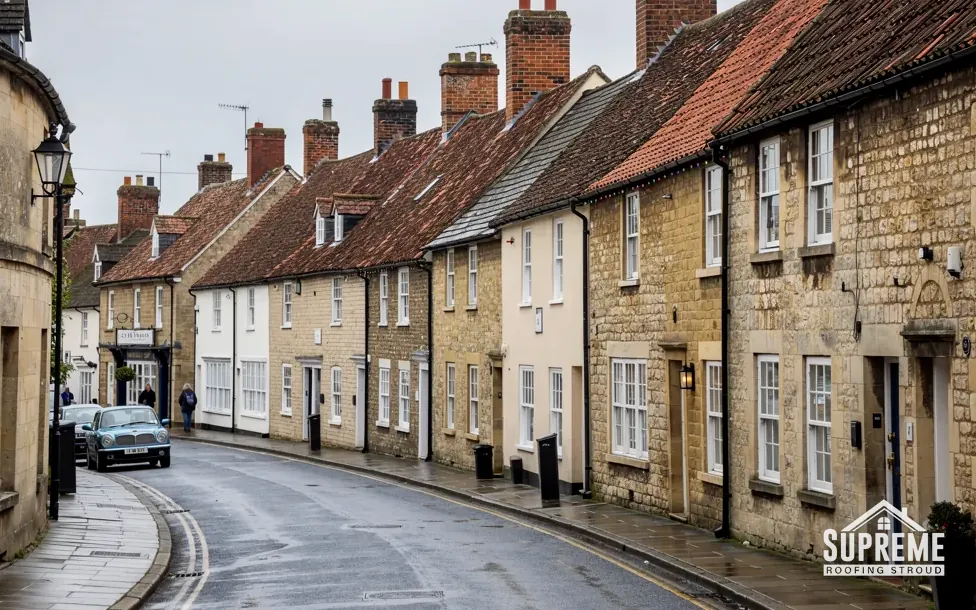
Curving street of stone and rendered terraced houses with tiled roofs
Chapter 01
Nibley House and The Chantry: plain tile beside stone slate
Two listed houses, two different roofs, and why a repair must match the one you have.
Chapter 01In this chapter
The two houses we know most about in North Nibley were built with different coverings. Nibley House has a plain tile roof, and The Chantry has stone slate. Both are listed, and both are good reminders that a new roof must follow the old one. A plain tile is a small clay or concrete unit hung in overlapping rows, usually with a slight curve across its width. A stone slate is a split piece of limestone, far heavier, laid so that the sizes shrink steadily from the bottom edge of the roof up to the top.
In this chapter
The weight difference is the practical point. Cotswold District Council's stone slate guidance gives about 1,000 kg per 10 m² for stone. A concrete plain tile is far lighter, so replacing stone with concrete would be a heavy-to-light swap that changes the roof's appearance, and the reverse swap loads the rafters. Neither is a repair; each is a change that the council and building control need to hear about. English Heritage policy, reproduced in the same guide, regards concrete tiles and reconstituted stone as unsuitable substitutes on historic buildings. New stone slates, it adds, should be matched to the originals closely, down to the type of rock.
Pitch is the other thing that differs. Marley's data sheets give 35° as the minimum for its concrete plain tile, and a traditional Cotswold stone roof is usually between 47° and 55°. A roofer who changes the covering without checking pitch can leave a roof that sheds water badly. Our Cotswold stone roofing page explains how stone is fixed, with wooden pegs hung over battens, and how courses are set out.
Matching the house you have
If your roof is plain tile, we look at the tile's size, colour and camber before suggesting a replacement, and we carry out a trial section if the colour is hard to judge. If it is stone, we count the courses, record the sizes and look for the signs of earlier repair. Stone slate generally costs about £160 to £210 per m² in the UK according to Checkatrade (2026), though that is not specific to the Cotswolds and where the stone comes from changes the price.
Quotes name the covering and the labour, so you can tell which part of the cost is the stone. Before ordering anything, we also check the rafters and battens, because heavy stone needs sound timber under it and a lighter tile does not hide a weak frame. The battens on an older roof are often the part that has given out, even when the covering looks fine from the lane.
A new roof has to follow the old one in material, weight and pitch.
| Covering | Where it appears | Traditional pitch or minimum |
|---|---|---|
| Plain tile | Nibley House (Grade II*) | Marley concrete plain tile: 35° minimum |
| Stone slate | The Chantry (Grade II) | Traditional roofs usually 47° to 55° |
Chapter 02
Nibley Knoll, the monument and working at real height
A 111 ft tower sets the tone for access in a village below a hill.
Chapter 02In this chapter
The Tyndale Monument stands on Nibley Knoll above the village. It is 111 ft (34 m) tall, was built in 1866 and is listed Grade II*. It makes the point that this village sits below a hill, and that height and slope are everyday facts of roof work here.
In this chapter
A roof above its neighbours, or one with the back wall dug into a bank, changes the way a job is laid out. On a bank, the uphill side of a scaffold may be a low platform while the downhill side rises many lifts high. On a steep plot, the base needs levelling with timber or adjustable legs before the first lift goes up. Deliveries may need to be unloaded at the lane end and carried, or lifted by hoist. Stone slate and tile are heavy to move, so the carrying distance is counted in hours of labour and shown as part of the quote, not discovered once the lorry has gone. All of that goes on the quote as access. Scaffolding a typical UK house comes to about £1,125 in MyBuilder's 2026 guide, and a steep plot can push the figure higher.
For a high or awkward roof, the survey comes before any quote. A roof inspection typically runs between £150 and £250 for a standard visit, and £200 to £400 for a drone survey (MyBuilder, 2026). A drone lets us see ridges, chimneys and valleys without putting a ladder against fragile slates, and the pictures go to you with notes. On a hillside village that matters, because uneven ground beside a wall is not always safe for a ladder, and a close view of a stone ridge or a valley can settle in minutes whether a repair is needed or only a watching brief. Our roof inspection and survey page explains what each type of survey shows.
The church at St Martin's
St Martin's, thought to stand on the site of an earlier Saxon church, was extensively restored in Victorian times. So long as services are held there, roof repairs go through the diocese by faculty, and the council's listed building consent is not the route.
- 111 ftheight of the Tyndale Monument, 34 m
- 1866year the Tyndale Monument was built to designs by S.S. Teulon
- 940AD, year of North Nibley's earliest record
For houses and barns near the church, the useful lesson is that an old building can carry the work of several periods. A restored roof may be fixed in ways that differ from the original, so a careful survey tells you which period of work you are looking at before any repair is chosen.

Chapter 03
No conservation area, yet listed houses and a hill setting
Where there is no designation on the council's list, the listing and the landscape still matter.
Chapter 03In this chapter
The council's list of conservation areas does not include North Nibley, and that changes the first question to ask. Inside a conservation area, any visible change goes to the planning officers. Here it is simpler: does the building have a listing, and does the land carry another designation?
A listing protects the entire building, and any alteration to its character needs authorisation first. That covers Nibley House, The Chantry, St Martin's and the Tyndale Monument, and it covers other listed buildings in the parish as well, each with its own entry. Check the National Heritage List for England, or ask the planning team, before assuming your cottage is not listed.
The other designation to check is the Cotswolds National Landscape, which covers just over half of Stroud District. North Nibley lies within it, and the council's own landscape assessment for the parish says as much, though the boundary should still be checked for an outlying address. Inside it, a dormer is not permitted development, and nor is cladding the outside of a house. Class C roof windows have different rules, and our skylights pages set them out.
Like-for-like on a house with no designation
An unlisted house with no designation can usually be re-roofed in the same material without planning permission, since the look of the building is unchanged. Building Regulations may still apply, and that turns on the share of the roof being replaced. For minor work there is nothing to notify. For a larger job we explain the threshold and handle the notification ourselves, so the paperwork never holds up the start date, and we note the steps in the quote so you can follow them. A roof repair to a few tiles or slates is usually outside both, while a full strip is not.
What we put in writing
Following the survey you receive a written quote naming the covering, scaffold, labour and waste, with photographs of your own slopes taken during the visit. Where a consent route applies, the quote says which one and who makes the application. A 10-year workmanship guarantee comes in writing with the finished job.
Myth: If a village is not a conservation area, its roofs are free from rules.
Fact: Listing protects the building wherever it stands, and Building Regulations and other designations still apply.
Map showing North Nibley and the Stroud service radius, with nearby towns we also cover.
Near North Nibley
Roof work we do here
North Nibley roof questions, from Nibley Knoll to the listed houses
My North Nibley house has a stone slate roof like The Chantry. Can I replace it with concrete tiles?
A swap changes weight, pitch and appearance, so it needs approval and a structural check. English Heritage policy calls substitutes inappropriate on historic buildings. Where stone is replaced, new slates are matched closely to the old ones, down to the type of rock.
The council does not list North Nibley as a conservation area. Must I still check before changing my roof?
Yes. Three checks apply: a listing, the Cotswolds National Landscape, which covers the village, and the share of roof being replaced under Building Regulations. Stroud District Council's planning team can answer the first two.
My cottage sits on a bank below the Knoll. How is the roof reached for a survey?
We look at the bank, the lane and the boundary on the first visit and decide between a ladder, a tower and a drone. A drone survey typically costs £200 to £400 (MyBuilder, 2026), and the quote allows for the scaffold and the carrying of materials.
Is a roof in the parish of a Grade II* church treated differently?
The church itself is handled through the diocese when it is in use. A house near it is treated on its own merits, and the question is whether the house is listed. We ask for the listing details first.