

Roofers in Cam
Roofing for Cam, the large Gloucestershire village that adjoins Dursley on the edge of the Cotswolds, from the newest houses on its north-east side to the woollen mill and the Grade I parish church.
Cam at a glance
- Distance
- 11.1 road miles west-south-west of Stroud
- Council
- Stroud District Council
- Listed landmark
- Parish Church of St George, Grade I
- Setting
- Edge of the Cotswolds, adjoining Dursley
A big village where old cloth meets new housing
Cam is large for a village. Wikipedia describes it as a large village on the edge of the Cotswolds that adjoins the town of Dursley, with the Cotswold Way less than a mile away, and the 2021 census count of 8,495 people confirms that it is bigger than many towns we work in. With that many households, Cam cannot be roofed from a single pattern book. Its roofs were laid in different generations and meet different troubles, and a survey has to start from the building in front of us.
Three strands stand out from the record. The first is the old centre, where the medieval Parish Church of St George is Grade I listed and stands south of the village centre, opposite Cam Congregational Church. The second is industry: Cam Mills has manufactured cloth for over 200 years and is the only woollen mill left in an area that once had many. The third is new housing. Construction of the Box Road developments began in 2016, and the strategic site on the village's north-east edge covers 29.1 hectares with 450 new dwellings, 135 of them in the lower-cost housing category.
Those three strands give three kinds of enquiry, and each needs a different first visit. A home on the new estate has a young roof, and the questions are about workmanship, fixings and ventilation. A building near the mill or the church has an old roof, and the questions are about materials and protection. Between them sits everything else, and we look at all of it the same way: up on the roof, with photographs, and a list of what we find before a figure is put against it.

Stone terraced houses with slate roofs and chimneys stepping up a hill 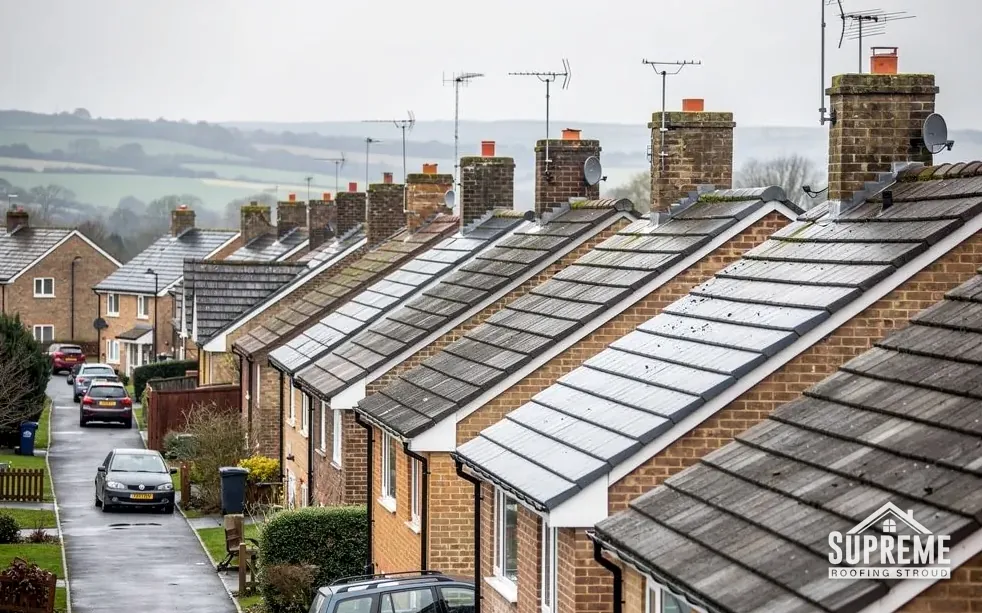
Terraced houses on a hillside street with tiled roofs and brick chimneys
Chapter 01
Young roofs on the Box Road estate
A house built after 2016 can still have a roof problem, and it is usually a small one.
Chapter 01In this chapter
Construction of the Box Road developments began in 2016 on a 29.1 hectare strategic site, with 450 new dwellings, 135 of them in the lower-cost housing category. Several housebuilders worked the site in phases, so we identify the tile on each house at the survey. Our approach to any roof of that age is simple. The covering should be sound, so when something is wrong, the cause is usually a detail, not wear.
In this chapter
The details that matter on a roof under about ten years old are few and easy to check. Ridge and hip tiles should be held down mechanically, because under BS 5534:2014 a bed of mortar is no longer treated as holding them on its own. Dry-fix systems, covered by BS 8612, need their clips and screws to be present and tight. Verge edges and flashings at the junction of a roof and a wall are where wind and water first find a gap. Eaves vents and the loft insulation next to them need to leave an air path, so that a damp loft does not grow mould in its first few winters.
Someone with a newer house will sensibly ask whether a fault belongs with the roofer or with the original builder. The answer turns on warranties and the date of purchase, and we cannot advise on the law. Ask the seller's solicitor or your warranty provider for the paperwork before you decide who to call. We photograph the fault and set out its cause in writing, which gives a builder, an insurer or a warranty provider something concrete to act on.
Extensions and later additions
New homes often get a conservatory, porch or flat-roofed extension within a few years. Those roofs meet the main roof at a junction, and the seam where they meet is a classic leak point. Our flat roofing page explains falls and coverings for small extensions.
What an inspection costs
MyBuilder's 2026 guide puts a roof survey at between £150 and £500, depending on whether it is a standard visual, drone or thermal inspection. A routine check costs a fraction of an investigation after a stain has already spread across a bedroom ceiling, and it gives you a baseline to compare against in future years. Our roof inspections and surveys page sets out what each type looks at and what the report contains.
On a young roof, the fault is almost always in a detail.
- 450new dwellings on the Box Road strategic site
- 135of those dwellings fall in the lower-cost housing category
- 29.1hectares covered by the site on the village's north-east edge
Chapter 02
Cam Mills and the roofs of a cloth village
The last woollen mill in its area still makes cloth, and its neighbours inherited big roofs.
Chapter 02In this chapter
Cam Mills has manufactured cloth for over 200 years. Wikipedia calls it the only woollen mill left in an area that once had many, and says it now makes cloth mainly for tennis balls. That is a good reminder of why the village is the size it is: industry once drew workers in, and houses went up to hold them.
In this chapter
A mill is a roofer's reminder that not every building is a house. The buildings of an industrial site tend to have long, wide roofs, often with several ridges side by side and valleys between them. They carry rainwater from a large area into relatively few outlets, so a blocked gutter or a collapsed downpipe does much more damage than it would on a house. Roof lights set into the slope are another leak point on buildings that need daylight, and so are the edges where one range meets the next. The sealed joints around each light age at their own pace, which is why we check them one by one. The same questions apply to any large old roof: how does the water leave, who can reach the gutters, and what happens when the valley outlet clogs?
Our commercial roofing page explains how we survey larger buildings, including units and workshops, and what the written quote covers. For workshops with a flat or low-pitched roof, the covering, the falls and the upstands at walls are all checked before a price is set.
Roofs near the mill
Houses and outbuildings close to an industrial site share some of its habits. Roofs may be shaded by taller buildings, which holds moisture and encourages moss, and gutters may collect more debris from the surrounding yards and trees. Moss is not an emergency, yet a deep cushion keeps water sitting on the covering and clogs gutters when it drops. Our roof cleaning and moss removal page explains the methods, including why a pressure washer can damage soft tiles.
Planning the work around a working site
Where a roof belongs to a business, access has to be agreed so that work does not stop lorries or staff. We schedule the scaffold and the delivery times with whoever runs the site, and that agreement goes into the quote.


Chapter 03
St George's Church and the Cotswold Way fringe
A Grade I church sets the tone for how the oldest buildings are treated.
Chapter 03In this chapter
The medieval Parish Church of St George is Grade I listed and stands south of the village centre, opposite Cam Congregational Church. Grade I is the top tier of listing in England, kept for buildings of exceptional interest, so work on or beside it follows set procedures. For as long as the building is used for worship, the diocese rather than the council authorises roof work, by faculty. The Congregational Church across the road is a different case, and who authorises work on it depends on its denomination and use, so the church trustees should confirm the route before a roofer is booked.
For a home, begin by finding out whether the building itself is on the list. Listing attaches to individual buildings and not to streets. Stroud District Council says its conservation department is the place to confirm status, and that includes sheds, stables and barns that stand within a listed house's grounds. Cam is not on the council's list of 41 conservation areas, although neighbouring Dursley is, so a Cam house is not in a conservation area just because the town next door is.
The village also sits close to the Cotswold Way, which Wikipedia places less than a mile away. We would not claim that the National Landscape designation applies to a specific road without checking the boundary, and neither should you. Over half of Stroud District lies within the Cotswolds National Landscape, so put your address to the planning team before you plan a dormer or a change of visible material.
Choosing a covering for an older building
On an older house, the fair question is whether to match what is there. For a stone or slate roof, matching means the same material, size and fixing, with a like-for-like quote. Our slate roofing page sets out how slate is mended, re-laid or stripped and renewed, with national guide prices for each.
Leadwork on old stone buildings
Old churches and chapels rely on lead for gutters, valleys and flashings. Lead has a long life when it is fitted correctly, with MyJobQuote citing flashings that can last for over 80 years. It is also one of the first things to go missing from a roof, so the fixings and the condition of the sheet are worth a look whenever scaffold is up for another reason. Lead is sold by code. Light codes suit flashings and soakers, while gutters and valleys that carry more water call for a heavier sheet. A thin sheet laid where a heavy one belongs is a repair waiting to be repeated.

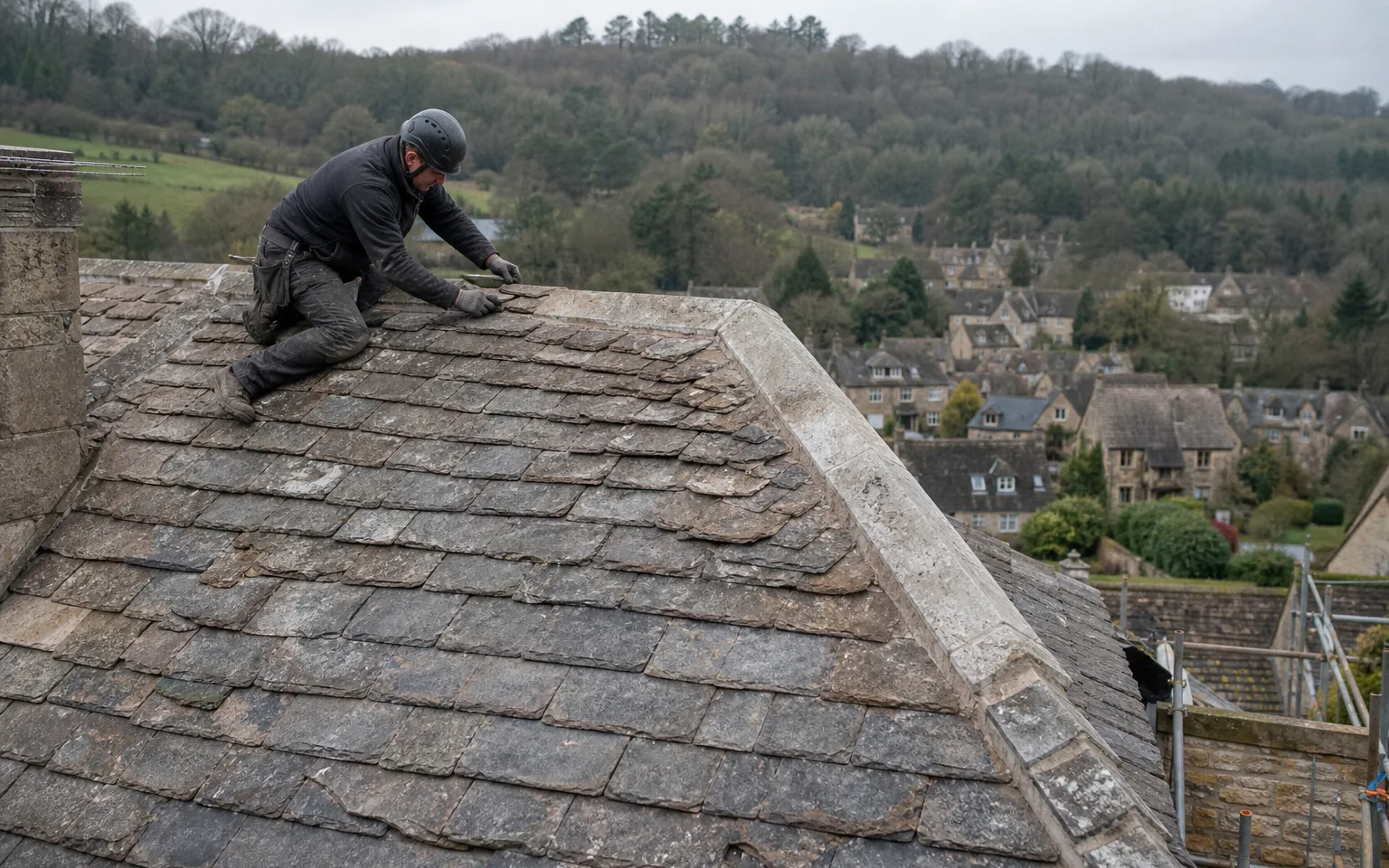
Map showing Cam and the Stroud service radius, with nearby towns we also cover.
Near Cam
Roof work we do here
Woollen mill, Grade I church and new houses
My Cam house was built in the last ten years and has a leak. Who is responsible?
That depends on your warranty and purchase paperwork, which we cannot interpret for you. We can survey the roof, photograph the fault and write down its cause, which is the evidence a builder or warranty provider will ask for.
Is Cam in a conservation area like Dursley?
Cam has no conservation area of its own on Stroud District Council's list of 41, which does include Dursley and Stinchcombe. Their boundaries run close to the parish edge, so an address near them is worth checking, and a Cam property can still be listed in its own right. The council's conservation department can confirm either point.
Can you roof a workshop or unit near the old mill buildings?
Yes. We survey the covering, the falls, the gutters and the upstands, and the written quote covers scaffold, materials, labour and waste. Access is agreed with whoever runs the site before a date is fixed, so deliveries and scaffold do not collide with working hours.
What does a roof survey for a newer house involve?
We go up and photograph the ridge, hips, verges, flashings and eaves, then look at the loft for ventilation and damp. You receive the photographs and a plain list of faults sorted by urgency.