

Roofers in Slimbridge
Roof work in Slimbridge, where a Grade I church, a canal under Patch Bridge and the Ernest Cook Trust's farmland shape how a job is planned and whose permission it needs.
Slimbridge at a glance
- Distance
- 9.8 road miles west of Stroud
- Council
- Stroud District Council
- Listed landmark
- St John the Evangelist, Grade I
- Setting
- Beside the Gloucester and Sharpness Canal
Slimbridge roofs between the canal and the Severn wildfowl reserve
Slimbridge is 9.8 road miles west of Stroud, out on the Severn side of the district, and it is a village where the main questions about a roof are often about who owns the land, not about the slates. The Gloucester and Sharpness Canal runs through the village and passes under Patch Bridge. The parish is also home to the Wildfowl and Wetlands Trust's Slimbridge Reserve, which Sir Peter Scott started.
The village landmark is its parish church, St John the Evangelist, which dates from the early 13th century and holds a Grade I listing, the highest category. For ordinary houses we read the roof itself at the survey and do not assume a covering from the postcode. The record of land ownership is clearer than the record of buildings: in 1945 Ernest Cook bought 1,109 acres in Slimbridge and Gossington from outlying parts of the Berkeley Castle Estate, and the land, now owned by the Ernest Cook Trust, has grown to 2,480 acres.
Slimbridge does not appear on Stroud District Council's list of conservation areas. That keeps one layer of planning out of the picture, though an individual house may still carry a listing, and a rented house still has a landlord. We start every survey by asking both questions, because the answers decide the order in which we do things.
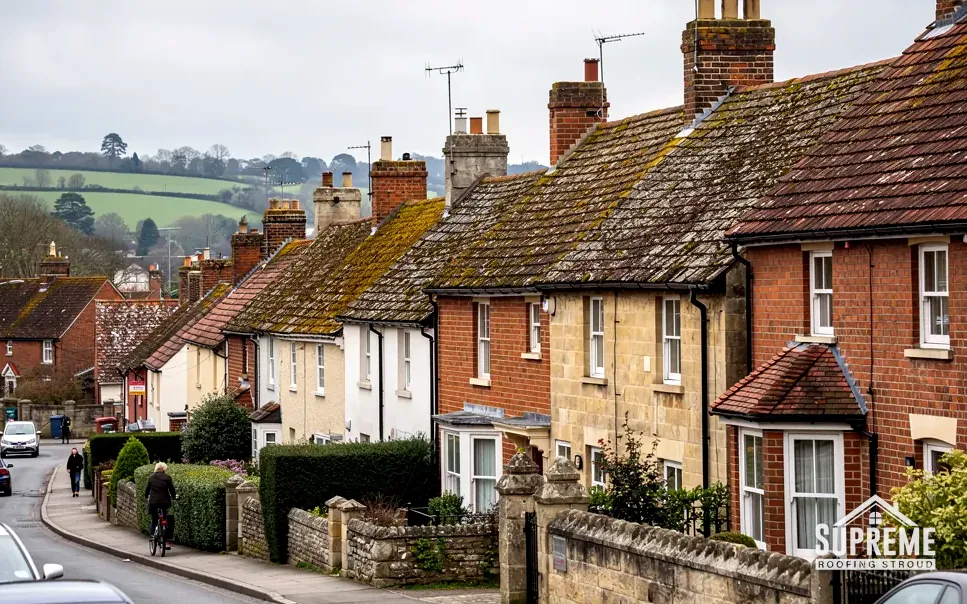
Sloping street of brick and stone terraced houses with mossy tiled roofs 
Victorian terraced houses with slate roofs and chimneys on a hillside

Chapter 01
St John's Grade I listing, and what it means for the houses around it
The highest grade of listing belongs to the church, not to the lane it stands on.
Chapter 01In this chapter
The church was built in the early 13th century, and Grade I is the category kept for buildings of exceptional interest. People living near the church sometimes ask whether that rank spreads to their own roofs. It does not. Listing is building by building. A cottage beside the churchyard is protected only if the list entry names it, and the council's conservation department can tell you from its records in a short call.
In this chapter
If your own house is listed, a different set of rules applies. Whatever the grade, the council treats a listed home as protected by law, and that takes in the roof. Replacing a covering with another material can be a change that needs consent, and even a repair can need it if it alters the character of the building. We are not the decision-makers on this. Our part is to photograph the roof carefully at the survey, record the existing materials, and describe the proposed work so that your application to the council has what it needs.
The church itself follows a separate path. Because it is in use for worship, work to its roof is authorised by a faculty from the diocese, not by listed building consent from the council. The parish and its architect handle that, and it is mentioned only to clear up a confusion. The council does not authorise work to a church in use, and the church sets no rules for the houses around it.
What we check on an older roof near the church
An old roof beside a churchyard often has trees close by. Overhanging branches drop leaves into the gutters and rub the covering in a wind, so we look at what is touching the roof as well as the roof itself.
Where a roof is old, we do two things before we quote. We find the date of the last major work, if the owner knows it, and we look from the loft for light coming through the covering, which shows where laps have opened. Old roofs often fail at the joints and fixings long before the main covering is spent, and a careful repair at those points can add years. Whether a repair will do, or the roof has reached the point of replacement, is something we tell you straight, with the photographs beside it.
Our roof inspections and surveys page describes what the photographed report contains.
A listing belongs to one building, never to the whole lane.
Chapter 02
The canal and Patch Bridge: getting materials to the roof
A waterway through a village means every delivery has a route to plan.
Chapter 02In this chapter
The Gloucester and Sharpness Canal runs through Slimbridge and under Patch Bridge, and a waterway through a village affects the roads around it. Properties close to the towpath or the bridge may be reached by a narrow lane, a single track or a shared drive, and a lorry carrying scaffold, tiles or battens needs a place to turn and a way back out. We cannot tell from a map which lanes will suit, so we look at the route on the day of the survey and say in the quote how we propose to deliver and unload.
That planning is ordinary work for any roofer and it shows in the quote. If the lorry cannot get to the door, materials come off at the nearest suitable spot and travel by hand or barrow, and that carrying time is allowed for in the labour. A drive that is soft or gravelled affects where the scaffold stands, and a hedge or fence close to the wall limits where the scaffold boards can go. None of these is a reason to turn a job down. All of them belong in the written quote before we agree a start date.
Working near water
Canal-side properties often have gardens running down to the bank. Whatever the weather, we tie down loose materials each evening, sheet over any open section of roof, and keep tools away from the scaffold edge. Nothing should end up in the canal.
Gutters and downpipes near a canal bank need to discharge somewhere sensible. If a downpipe empties onto a footpath, it can undermine the path or soak the foot of the wall. We look at where the water goes when it leaves the roof and mention it in the survey notes. Our roof repairs page covers the small jobs, such as refixing slipped pieces after a storm, which are usually the first call from a canal-side home.
A day on a canal-side roof
Before climbing, we walk round the house and look up from each side. A sagging ridge line, a dipped section of eaves or a row of cracked pieces is visible from the ground if you know where to look, and it tells us where to spend the time once we are up there.
A typical repair visit starts with the gutters and the lowest courses, since that is where we can see what the weather has done. Next come the ridge and hips, where we test fittings for movement, look at the flashings around any chimney, and photograph each finding with a note of where it is. At the end we tell you which items are urgent and which can wait for a convenient season.
Visits from further out
Slimbridge is 9.8 road miles from Stroud, and a trip out to the Severn side is routine for us. The survey takes in the roof from the ground and the loft hatch, with photographs of what we find, and the written quote follows. Clear the hatch before we arrive and the visit is quicker. Boxes stacked beneath it are the usual hold-up, and a torch left by the hatch helps too.

Chapter 03
Estate land, tenancies and the reserve next door
In a parish with a large landholding and a wildlife reserve, check the permissions before ordering materials.
Chapter 03In this chapter
Ernest Cook bought 1,109 acres in Slimbridge and Gossington in 1945, from outlying parts of the Berkeley Castle Estate. The estate is now held by the Ernest Cook Trust and has grown to 2,480 acres. Which homes in the village the trust owns or lets is for the trust to say, so we survey the roof you ask us about and leave the landlord's side to them. What matters is that if your home is rented from any landlord, the lease usually decides who is responsible for the roof and who gives permission for work on it.
In this chapter
It pays to find out early, ideally before the survey, since the answer changes who we send the quote to and who signs it off. If the landlord is responsible for the roof, a repair is theirs to arrange, and a contractor needs their instruction and their purchase order. If you are responsible, the landlord may still have to approve anything that alters how the house looks. Either way, a short conversation before the survey saves a delay later. We can provide the written quote and the survey photographs in a form that goes straight to a managing agent, so it is easy for them to approve.
The farmland around the village has barns and outbuildings as well as houses, and many have large roofs. A farm building roof is a different job from a house roof, with longer rafters, a wider span and sometimes sheeting in place of tiles. Where a sheeted roof might contain asbestos cement, we assess the material first. Under HSE guidance, taking out intact asbestos cement carefully is non-licensed work; we explain the method and disposal before the job is agreed.
The reserve and nesting birds
Roofs near open water and fields are favoured by birds, and gaps under eaves or at the ridge can become nest sites.
The Slimbridge Reserve brings a great many birds to the area, and birds and bats that nest or roost in a roof are protected by law. If we find signs of either during a survey, we stop, tell you, and agree how to proceed before any covering is lifted.
Costs on a farm or estate roof
National guides publish typical price ranges for a full re-roof, and our roof replacement page sets out the MyBuilder range and what moves a job within it. A farm roof can fall outside those ranges because of its size and access, which is why we survey it before quoting.
- 1945year Ernest Cook bought land in Slimbridge and Gossington
- 1,109acres bought from outlying parts of the Berkeley Castle Estate
- 2,480acres now held by the Ernest Cook Trust
Map showing Slimbridge and the Stroud service radius, with nearby towns we also cover.
Near Slimbridge
Roof work we do here
Patch Bridge canal and Ernest Cook Trust farmland
Does St John's Grade I listing mean my cottage near the churchyard has restrictions on its roof?
No. Listing applies to one building at a time. Your cottage is covered only if the list entry names it, which the council's conservation department can confirm. We photograph the roof at the survey so the details are to hand if you need to ask.
My Slimbridge home is rented. Who arranges a roof repair?
That depends on your tenancy agreement. We can send the survey photographs and a written quote straight to your landlord or managing agent.
How do you manage deliveries to a lane beside the canal?
We look at the route on the survey day, find the closest spot where a lorry can stop and turn, and write the unloading plan and any hand-carrying into the quote.
What happens if you find nesting birds or bats under the tiles?
We stop work on that section, tell you, and agree the way forward before anything is lifted, because they are protected.