

Roofers in Coaley
Roof repairs, re-roofing and maintenance in Coaley, the village that falls away from the Cotswold edge below Frocester Hill and Coaley Peak towards the River Cam and the Severn Estuary.
Coaley at a glance
- Distance
- 7.7 road miles west-south-west of Stroud
- Council
- Stroud District Council
- Listed landmark
- Parish Church of St Bartholomew, Grade II
- Setting
- Below Coaley Peak, falling to the Severn Vale
Roofs on the slope below Coaley Peak
Coaley is a small village in a big landscape. It drops from the edge of the Cotswold Hills, overlooked by Frocester Hill and Coaley Peak, towards the River Cam and the Severn Estuary. For a roofer, a village on a falling slope is a village of varied ground levels: a house may have a high back garden and a low front one, or the reverse, and the height from ground to eaves changes from one side of the same building to the other.
The Victorian record is short but telling. The 1870-72 Imperial Gazetteer described Coaley as a parish on the Gloucester and Berkeley canal with 777 people in 187 houses, and called its church recent. Those 187 houses were the village of the Victorian period. Some of that housing will have been re-roofed since, some patched, and some still carries what was laid when it was built. Roofs of that vintage have normally met several rounds of repair by now, so the question at survey is which of those repairs still hold.
The Parish Church of St Bartholomew is Grade II listed, according to Historic England's list entry, which dates the listing to 30 June 1961. Coaley was also named Gloucestershire village of the year in 2003 and was runner-up nationally, which tells you that people here look after their homes. We look at each roof as it stands and write down what we see, with photographs from your own survey, before we put a price against it.
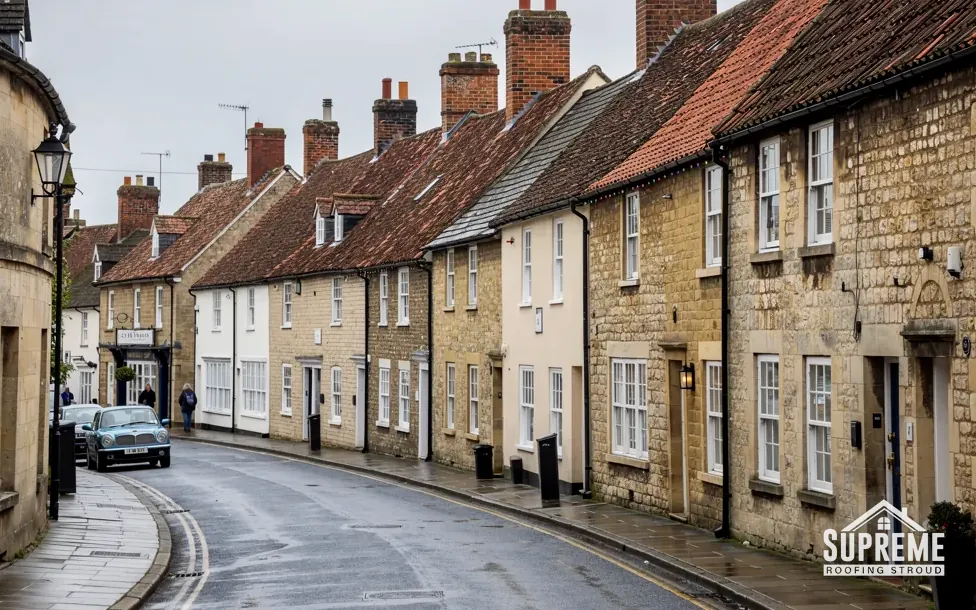
Curving street of stone and rendered terraced houses with tiled roofs 
Detached red brick Edwardian house with mock-Tudor gables and a tiled roof

Chapter 01
Working a house on the Cotswold edge
When the ground falls away, the scaffold and the ladder both need a plan.
Chapter 01In this chapter
Coaley sits below Coaley Peak, with the ground falling away to the Severn Vale, and that is a gift to a walker and a puzzle for a scaffolder. Sloping ground changes three things about a roof job: where the scaffold stands, how materials reach the roof, and how safe it is to work along the eaves.
In this chapter
A scaffold needs level, firm footing. On a sloping plot, the standards at the downhill side may need to be built up on adjustable bases or on sole boards, while the uphill side sits low against the ground. The result is a scaffold with two different personalities on one house. It is also more tubes and more time than the same house on flat ground, and for that reason we allow for access carefully in the quote. On the steepest plots we also check whether a base has to stand in a neighbour's garden, and ask them well before the scaffolders arrive.
Materials follow the same logic. If the lane is narrow or the drive is steep, a delivery lorry may not reach the house, and tiles, battens and sheets are brought up in smaller loads. A hoist on firm ground can help; on soft ground it may not be safe. We decide at the survey, so the plan is ready before the delivery date.
Eaves that sit at two heights
On a house built across a slope, the eaves at the front and back can be at quite different heights above the ground. The lower side is where gutters are hardest to reach and where a failed outlet is easiest to miss, because nobody stands there to see the water pour over. A gutter that overflows onto a downhill wall will stain it and, over a few winters, damp it. When we survey, we look at the gutters from both sides and run through the fall to each outlet. Our guttering, soffits and fascias page explains how the fall is set, and why a short run that drains the wrong way is worth correcting at the same visit as a roof repair.
Ladders and roof ladders
For a small repair, a full scaffold can cost more than the repair itself. Where the ground is firm and the work is short, we say whether a scaffold tower or a ladder hooked over the ridge will do, and where neither is safe we price full scaffold instead. A loose slate near the eaves is often a ladder job, whereas a ridge or valley repair rarely is. You see the figure either way before anything is booked.
A scaffold on sloping ground is a different build from the same house on the flat.
Chapter 02
A canal parish and its Victorian houses
What an 1870 gazetteer entry tells you about the age of the roofs.
Chapter 02In this chapter
The Imperial Gazetteer entry for Coaley is a small snapshot, but it is a useful one. In 1870-72, the parish stood on the Gloucester and Berkeley canal, with 777 people living in 187 houses. That works out as roughly four people to a house, a family-sized village of modest dwellings. It also tells us the village was already established, with a church described as recent, a good century and a half ago.
In this chapter
For anyone with a house here, the age question matters more than the date. A roof laid in the Victorian period has almost certainly had work. The trouble with partial repairs is that they hide each other. A section of new battens beside old, a patch of replacement covering beside the original, and flashing renewed on one side of a chimney but not the other: each repair was sensible at the time, but together they make a roof that is hard to read from the ground.
That is why the survey is done on the roof, with photographs taken of the underside and the junctions, not from the lane. We start with the timber, since slates or tiles can only stay on if the battens and rafters under them are sound. Rot and old woodworm flight holes show up there long before they show on the surface. Then the junctions: chimney, valley, abutment. Then the covering itself. You get the photographs and a written list, and we mark which items are urgent and which can wait.

Repair, patch or replace
The answer comes from the roof, not from a rule. Sound covering with a failed flashing is a repair. Soft battens and slipped covering in several places point towards a strip. We explain which one you have, and if it is the second, we explain why patching it again would only delay the same bill. Our roof repairs page sets out how we make a leak safe first and then plan the lasting fix.

Keeping the village look
A village of the year earns that title in part from how its houses look together. If your roof is visible from the lane, a like-for-like covering keeps it in step with its neighbours. We match the material, the size and the colour as closely as supply allows, and where the first choice has been discontinued, we show you the closest alternative before you commit.
- 777people in the parish in the 1870-72 Imperial Gazetteer
- 187houses recorded in the same entry
- 2003year Coaley was named Gloucestershire village of the year
Chapter 03
St Bartholomew's and the rules for listed roofs
A Grade II listed church in the village shapes what is allowed on older buildings nearby.
Chapter 03In this chapter
Historic England lists the Parish Church of St Bartholomew, Coaley, at Grade II, listed on 30 June 1961. St Bartholomew's falls under the ecclesiastical exemption while services continue. Any roof repair there needs a diocesan faculty, not council consent, and the parish would normally appoint its own architect to prepare it. If you sit on the parochial church council, that is the route your architect will describe, and we are happy to price the roofing part of a specification once it is drawn up.
Private homes follow another route. A listed house needs consent for any work that changes its character, and the council treats every listed building as fully protected, inside and out, whatever its grade. A like-for-like repair on a listed house is not always exempt, so we do not guess. Stroud District Council's conservation team will say what needs consent, and we help you prepare the description of the work.
Coaley does not have its own conservation area. The council's list of 41 conservation areas does not include it, so the extra controls that come with a designated area do not apply on that ground. That does not mean anything goes. A listed building, an outbuilding in the curtilage of one, or a building in a different sort of protected setting can still carry rules, and the Cotswolds National Landscape covers much of the eastern half of the district, so it is worth asking the planning team before you assume. We would rather ask the council one question at the start than redo a roof at the end.
What we put in the quote for protected buildings
Where listing is involved, the quote names the covering, how it is fixed and the lead details, with provision held for any consent condition. If the council attaches a condition, we price it as a variation, in writing, before work continues. Our pitched roofing page covers what a re-roof involves from the first strip to the last ridge.
Myth: A listed church nearby means every old roof in the village needs the same consent.
Fact: The church uses the faculty system, a listed house needs consent from the council, and an unlisted home outside a conservation area usually needs neither for like-for-like work.
Notifiable work
Some re-roofs are big enough to need Building Regulations approval. On those we explain what applies, make the notification and hand over the completion paperwork when we finish, so a future buyer's solicitor finds it in order. Building control for Stroud District is delivered through the Gloucestershire Building Control Partnership, and you can also choose a registered building control approver instead. Either way, the roofer and the inspector need to agree the details before the first tile comes off, not after the last one goes on.

Map showing Coaley and the Stroud service radius, with nearby towns we also cover.
Near Coaley
Roof work we do here
Coaley Peak slopes and St Bartholomew's church
My Coaley house sits on a slope. Does that make a re-roof harder to price?
It changes the access, not the method. Scaffold on falling ground needs adjustable bases and sometimes two heights, and deliveries may arrive in smaller loads. We settle all of that at the survey, and the quote carries it.
Is a house near St Bartholomew's church treated as listed?
Not because of the church. Listing attaches to individual buildings, so a neighbouring house needs consent only when it appears on the list itself. Stroud District Council can confirm a property's status.
Coaley has no conservation area, so can I change my roof covering freely?
Often, but not always. Swapping like for like rarely needs planning permission, yet a listed building, or a new material that changes how the house looks, can. Check with Stroud District Council's planning team before ordering anything unusual.
Can you survey a roof that nobody has been on for years?
Yes. We go up, photograph the covering, timbers and junctions, and give you a written list sorted into urgent and can wait. You get the pictures of your own roof, and the quote follows the findings.