Roofers in Uley
Roof work in Uley starts with the trees. The village lies in a wooded valley below Uley Bury, a drive of 7.4 road miles to the south-west from our base in Stroud. Leaf fall, shade and old trade buildings shape every survey we do there.
Uley at a glance
- Distance
- 7.4 road miles south-west of Stroud
- Council
- Stroud District Council
- Conservation area
- Uley, no. 30 on the council list
- Setting
- Wooded valley below Uley Bury
Uley's roofs under the wooded slope
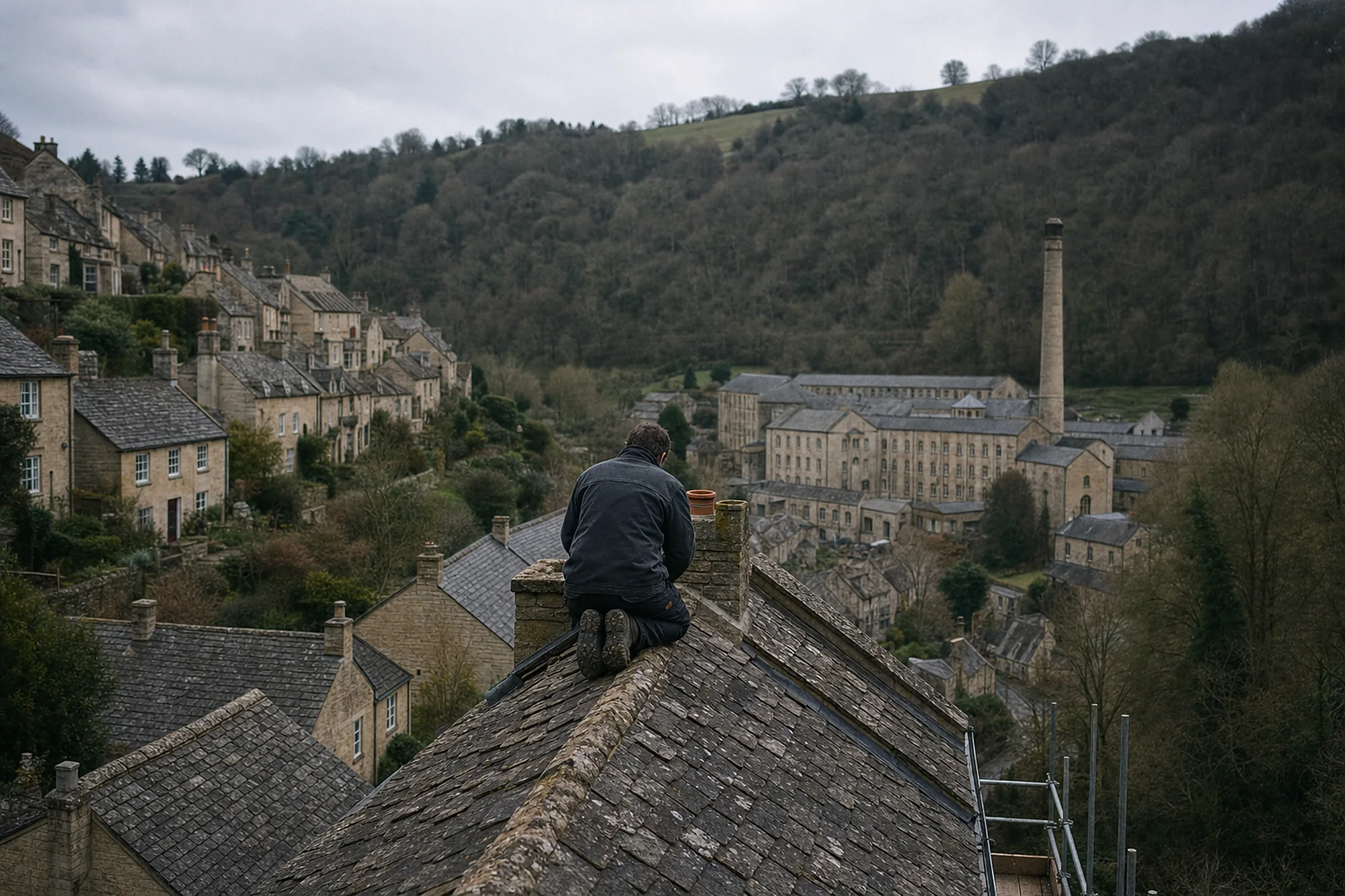
Uley sits in a wooded valley cut into the Cotswold escarpment. The Iron Age hill fort of Uley Bury is just above the village, and Downham Hill lies just to the west. Trees matter more here than they do on an open street. They shade slopes, drop leaves into gutters and keep one face of a roof damp long after the other has dried, so when we survey a roof in the village we look at the canopy as well as the covering.
The village was known for blue cloth during the early Industrial Revolution, and its population was much greater then than it is today. Woollen manufacture had ended in the valley by 1840, and later, when farming declined between the wars as agriculture was mechanised, three council housing estates were built at South Street, Lampern View and Raglan Way. That put a second and very different kind of roof into the village. So there are two broad groups to think about: older buildings from the cloth years and before, and the estate houses that followed the decline.
Two landmarks anchor the village. St Giles' church was designed by Samuel Sanders Teulon and replaced a Norman church, which had itself replaced a Saxon one. The former Price Brewery of 1833 is now Uley Brewery and is listed Grade II.
Uley is a designated conservation area, number 30 on Stroud District Council's list, first designated in August 1988. It has no adopted Conservation Area Statement, so there is no council document to read before you plan work. The practical step is a short conversation with the planning team before anything changes a roof's appearance.
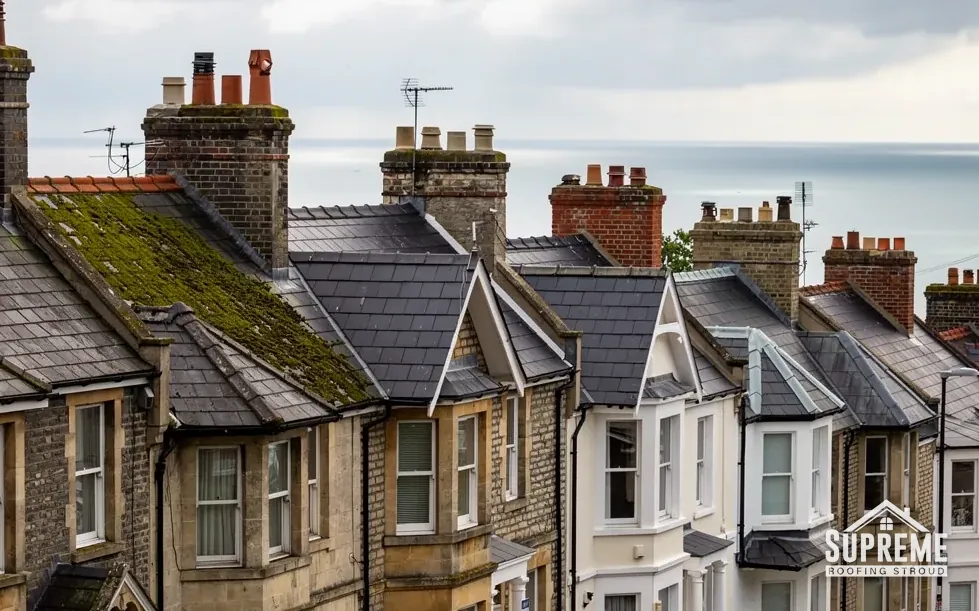
Row of Victorian terraced houses with slate roofs, bay windows and brick chimneys 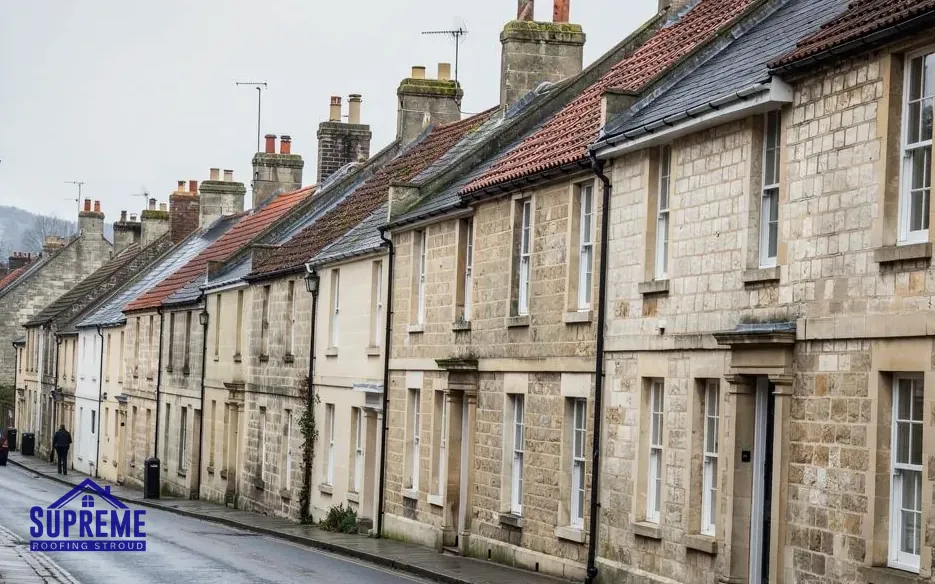
Street of stone terraced houses with slate and clay tile roofs
Chapter 01
The 1833 brewery and the buildings of the cloth years
Listed trade buildings carry bigger roofs and a longer list of permissions than a house.
Chapter 01In this chapter
A brewery built in 1833 was put up to do a job, and the job set the shape of the roof. Buildings made for trade usually have a wider span than a cottage, a longer run of gutter and more places where two roof planes meet. The Price Brewery is the village's best-known example, and the part that is now Uley Brewery is listed Grade II. If you own, manage or rent space in a building that began life as a working building in the cloth years, the same points apply, whether or not it carries a listing.
In this chapter
Listing changes the order of play. The council treats the whole of a listed building as protected, whatever the grade. A roof alteration that would change the character of the building needs authorisation first, and doing it without is a criminal offence. Sheds, stores and walls in the grounds may fall under the same protection, so we ask the council's conservation department about them early. A quote built on a wrong assumption is no use to you, so that question comes before any pricing.
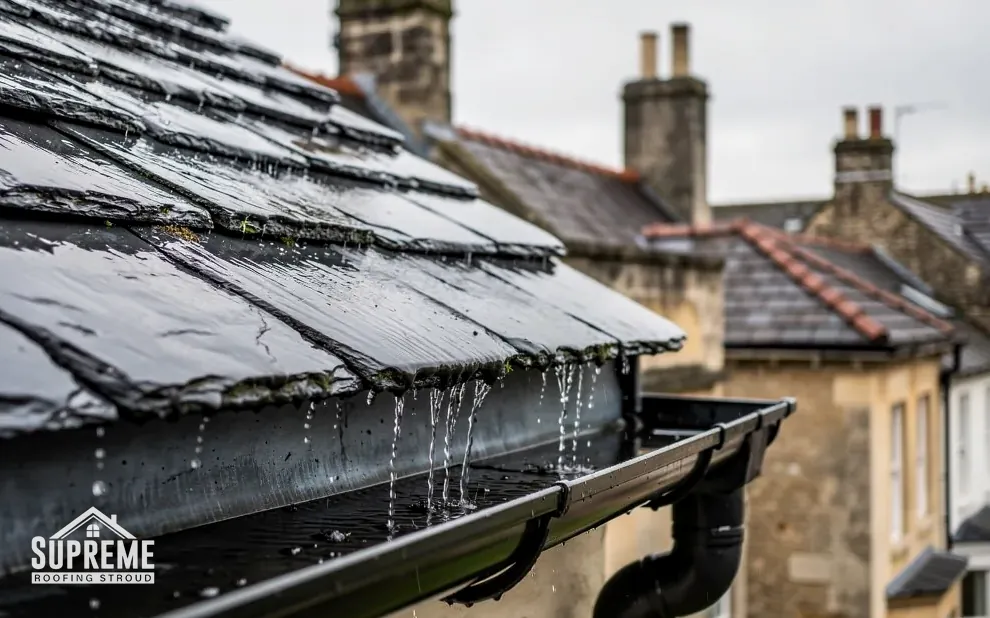
On a big old roof the first question is where the water goes. Valley gutters between ranges, gutters behind a parapet and downpipes set into walls are all places a leak can begin and stay hidden for a season. We photograph the outlets and the gutter lengths from the roof, and quote for any rainwater work. A guttering, soffit and fascia job on a large building is mostly about access and falls, and the gentle fall that makes water run to the outlet varies by system, between about 1:600 and 1:350.
Like for like, in writing
On an older building we replace like with like: the same stone, the same slate, matched for size and colour, with the courses and the line of the ridge kept as they were. Where part of the work involves a modern covering on a later extension, the quote names it, so that each section is priced for what it is.
Planning for a listed roof also means planning time. Consent can take weeks, and a scaffold hired too early costs money while it waits. We would rather hold the start date until the answer is in.
A roof built for trade needs its water route mapped before anything is priced.
Chapter 02
South Street, Lampern View and Raglan Way: roofs that repeat
A farming slump between the wars left Uley with rows of similar houses and one set of questions.
Chapter 02In this chapter
The decline of farming between the wars led to three council housing estates in Uley, at South Street, Lampern View and Raglan Way. Each roof on them is surveyed in its own right, but estate roofs also behave as a type. Houses built together tend to be roofed together, with the same tile, the same underlay and the same fixings from one gable to the next, and they tend to reach the end of their covering at around the same time.
In this chapter
That has a practical use for you. If a neighbour has had a leak at the same point on the same pitch, there is a fair chance your roof has the same weakness. It also has a cost use. Neighbours who need work can share a scaffold, and the saving is reflected in each quote.
Many former council houses are now privately owned, some are let by a landlord or housing association, and some are leasehold flats or maisonettes. Who pays for the roof is a legal question we cannot settle for you, but we can tell you what the roof needs and give the managing party a written quote they can act on.
When a repair becomes a re-roof
Most re-roofing is exempt from Building Regulations approval when the work affects less than 25% of the building envelope and less than 50% of the roof. Stripping a whole pitch passes the second limit. Then Building Regulations approval applies, and the roof may be brought up to Part L insulation standards as well. Choosing a tile that adds 15% or more to the weight brings in approval and a structural check, because the rafters have to carry it. Notifiable jobs are notified by us, not left to you.
The covering is where the money sits. Typical UK full re-roof costs sit between £5,000 and £12,000, with gable-ended houses at £5,000 to £8,000 and hipped ones at £8,000 to £12,000 (MyBuilder, updated August 2026). Concrete tiles are typically cited as lasting 30 to 50 years, though the sources disagree and any lifespan depends on exposure and workmanship. A pitched roofing page sets out how tiles, battens and underlay are priced.
Because Uley is a conservation area, a different tile on a slope the street can see should go to the planning team before we order anything. Same tile, same colour is the simplest route.
Chapter 03
Below Uley Bury: leaf fall, shade and the moss on north slopes
On a wooded valley side, maintenance is the least expensive roof work there is.
Chapter 03In this chapter
Because Uley lies in a wooded valley, a roof here is often working under a canopy. Leaves and seeds settle in gutters and valleys, the outlets slow down, and water backs up under the first course of tiles. A blocked gutter looks minor from the lane, but on a stone or tiled roof it goes to the top of our checklist, since water that runs behind a fascia can rot the board and the rafter ends beneath it.
In this chapter
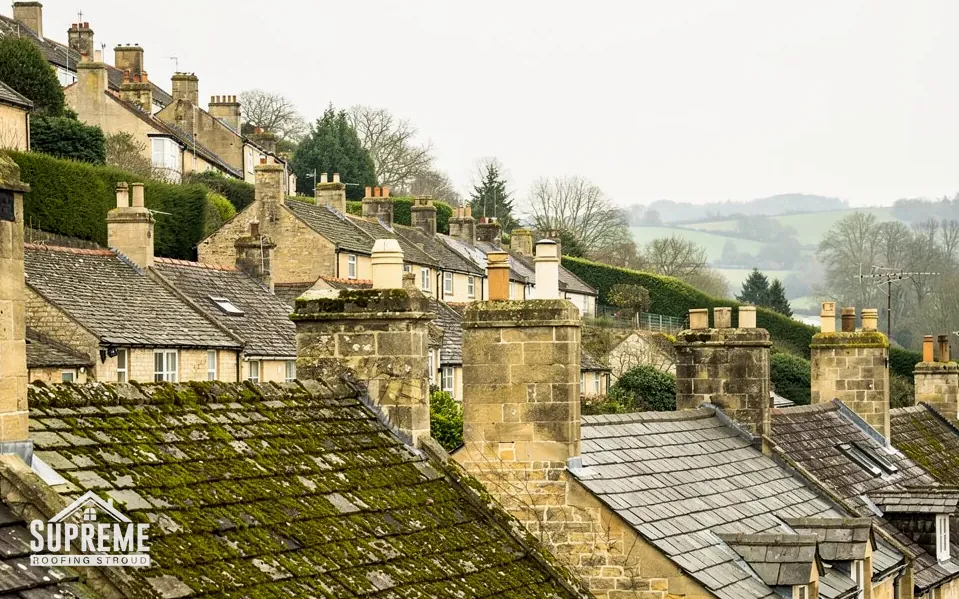
Shade encourages moss. A damp growth of moss keeps water pressed against the covering, and on tiles it can lift courses as it spreads. Old Cotswold District Council guidance reckons that scraping a stone roof each year could double its life. Cleaning every roof the same way is a mistake, though. Scraping by hand is priced at £5 to £10 per m² by MyBuilder, which also cautions that pressure washing may harm delicate tiles. The method has to suit the roof, and we choose it after looking at the covering. Our roof cleaning and moss removal page explains which methods suit which coverings.
Planning around the trees
Branches over a roof change the plan. They limit where a scaffold can stand, they drop debris on an open roof, and they sometimes need cutting back before work can begin. Cutting is for the tree's owner or a tree surgeon, and inside a conservation area the council usually wants notice before trees are worked on. We bring that up at the survey, well ahead of the morning the scaffold arrives.
The slope matters in the same way. Houses sit at different heights along the lanes, and a ridge that seems low from the road can stand much taller above the garden. We note how the materials will be carried in, whether a lorry can stand close enough to deliver, and whether a path crosses the scaffold. All of this is written into the quote as access, not added on the day.
What a maintenance visit covers
A tidy-up visit looks at gutters, outlets, ridge and hip mortar, slipped or cracked tiles, flashings and lead around chimneys, and the condition of the first courses at the eaves. We photograph what we find from the roof, and send you the pictures with a list that ranks urgent work ahead of work that can wait, and a written quote. Lifting a few loose tiles back into place is a small job. Leaving it often turns it into a bigger one.
Map showing Uley and the Stroud service radius, with nearby towns we also cover.
Near Uley
Roof work we do here
Uley roof questions, from brewery to tree line
My Uley roof sits under mature trees. What should I expect to be done?
We start with the gutters, valleys and the first courses at the eaves, where leaves and moss collect. Then we look at how the trees limit scaffold and delivery, and allow for each in the quote. Where branches need cutting back, that is arranged separately with the tree's owner.
Uley has a conservation area but no adopted statement. Who do I ask about changing my roof?
Stroud District Council's planning team. A repair in the same tile is normally uncomplicated. A different material on a slope the street can see should be checked before work begins. We can describe what you want to do in plain terms and send the council photographs of the roof.
I own an ex-council house on one of Uley's council estates. Can I re-roof only my own half of a pair?
Often, though the join with your neighbour's roof needs care at the ridge, the verge and the party wall. We look at that junction on the survey, and the quote says what we would do there, so you are not surprised by it on the day.
A stone outbuilding sits next to a listed building in Uley. Does it need the same consent?
It might. Stroud District Council advises checking the status of structures in the grounds with its conservation department. We would ask that question before pricing, and tell you what the council says.