

Roofers in Wickwar
Roof repairs and replacements in Wickwar, the old market village between Yate and Charfield, surveyed with photographs and quoted in writing.
Wickwar at a glance
- Distance
- 16.6 road miles south-west of Stroud
- Council
- South Gloucestershire Council
- Conservation area
- Wickwar, designated 13 January 1973
- Listed church
- Holy Trinity, Grade II*
Wickwar's roofs: market-town frontage and a church tower
Wickwar sits between Yate and Charfield, at 16.6 road miles from Stroud on a south-west bearing, and planning here is South Gloucestershire's remit. It is an old place by any measure. The Domesday Book of 1086 records it as Wichen, and the de la Warre family developed it in the 13th century, with a market granted in 1285. A market village usually keeps a layout to match: a High Street, houses that stand close to the pavement, and walls that are shared.
Wikipedia says that most of the High Street houses are 18th-century, and that they are fronted, rendered or stuccoed. The Town Hall dates from about 1795. The parish church of Holy Trinity has 12th-century origins, was extensively remodelled in the 14th and 15th centuries, and is listed at Grade II*. The village lies on the Bristol to Birmingham railway line, though its station closed in January 1965.
The detail that matters most to a roofer is the conservation area, designated on 13 January 1973. A rendered High Street front, a shared party wall and a village-centre designation all change the way a roof is repaired. The coverings themselves we leave to the survey: we name no covering until we have been up, and the photographs taken on the day record both the type and its condition.
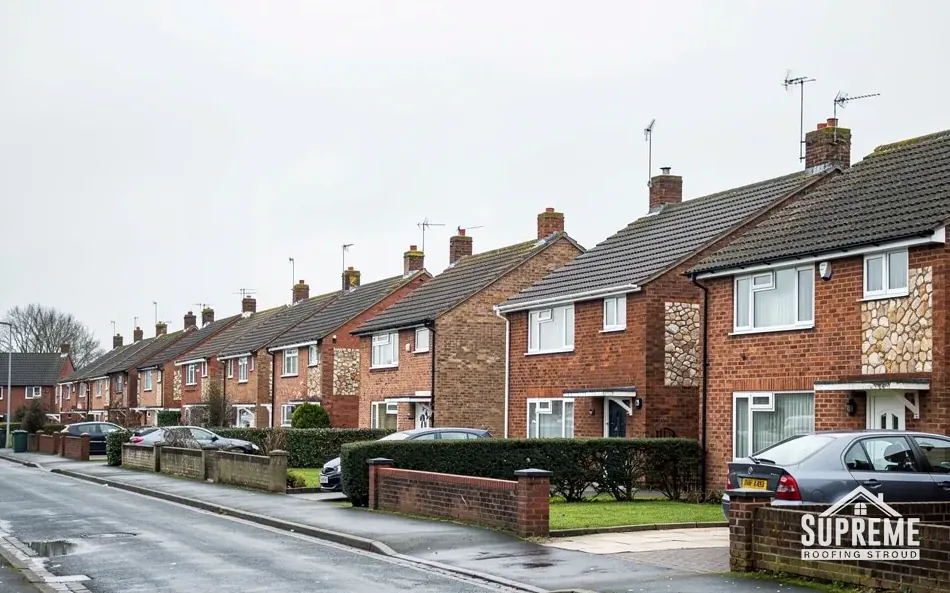
Street of red brick terraced and semi-detached houses with parked cars 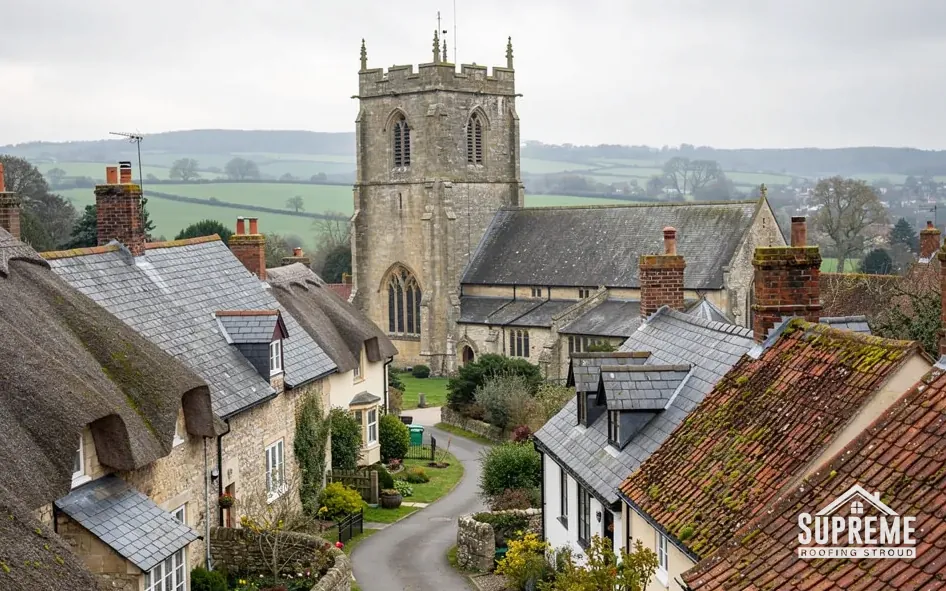
Village of thatched and tiled cottages around a stone church tower
Chapter 01
Rendered High Street fronts and where the roof meets them
Fronted, rendered or stuccoed walls hide water damage until it is advanced.
Chapter 01In this chapter
Render looks sound from the pavement for a long time after the wall behind it has started to suffer. In a village where the High Street houses are 18th-century and fronted, rendered or stuccoed, that has a direct consequence for roof work: the junction of roof and front wall is exactly where water slips behind the finish. A failed flashing, a split joint in a parapet gutter or a blocked downpipe will send water down the face for months, and the first sign is staining, a blister or a hairline crack in the render.
In this chapter
Two terms are worth knowing. A flashing is metal, usually lead, bent into the angle where a roof meets a wall or chimney. The verge runs up the sloping end of a gable, where the covering stops and a barge board, mortar fillet or dry-fix cap finishes the edge. Both are weak points on a terraced street where the houses touch and each roof has several edges. We trace a stain on the render upwards from the stain to the cause, rather than re-rendering over it, because a fresh finish that sits over a live leak will fail again within a season or two.
Repairs at the wall head also call for care about order. If both render and roof need work, the roof is done first so that new render is not damaged by scaffolding and falling debris. We look at the whole line from ridge to eaves before suggesting a sequence, and we tell you when a render repair is a job for a plasterer, not us. Where you want the verge made sound without disturbing a render finish, the options are laid out on our ridge, verge and dry-fix page.
Why verge fixings changed in 2014
Since BS 5534:2014 the fittings along ridge, hip and verge need mechanical fixing, and BS 8612 is the test standard for dry-fix systems. On an old village roof the verge mortar can be the most worn thing up there, and re-bedding with fixings added is the usual cure. MyBuilder puts dry ridge at £40 to £60 per metre, and £500 to £1,000 for a typical job.
A stain on the front of a house tells you where to look on the roof.
Myth: A stain on a rendered front means the render needs replacing.
Fact: A stain usually means water is arriving from above, so the roof junction, gutter or downpipe is checked before the render is touched.
Chapter 02
Wickwar Conservation Area, the 1973 line and Holy Trinity
What a village-centre designation does and does not change when you re‑roof.
Chapter 02In this chapter
The Wickwar Conservation Area was designated on 13 January 1973, according to South Gloucestershire Council's appraisal, with minor amendments in 1991 and an extension in May 1998; the council is the authority. Being inside one does not stop you maintaining a roof. Planning law (section 55(2)(a) of the 1990 Act) excludes work that leaves a building looking materially the same, so putting a matching covering back on generally needs no planning permission. The rule has a limit: if your house is listed, or an Article 4 direction removes the right, the answer changes.
In this chapter
Whether a direction touches a particular Wickwar house is a question for South Gloucestershire's planning team, and we put it to them before any change is priced. That includes a change of material, a new chimney, or a new roof opening.
Dormers are the clearest restriction. A dormer is a roof addition under Class B of the permitted development order, and Class B is not available on land covered by Article 2(3), which includes conservation areas, so a dormer loft conversion in the Wickwar Conservation Area needs a planning application. Roof windows are a different category, and they have their own rules. Our skylights page explains how they work.
Holy Trinity, Grade II*
The parish church of Holy Trinity has 12th-century origins and was extensively remodelled in the 14th and 15th centuries. A church holding services follows the ecclesiastical route instead: the faculty route through the diocese covers roof work, and the council's usual consent does not apply. For a church of that age, a survey from the ground with binoculars or a drone tells you what the covering is doing, and a scaffold survey follows only if the problems justify it.
- 1285year the Wickwar market was set up
- c.1795approximate date of the Town Hall
- 1973year the Wickwar Conservation Area was designated
Planning the order of work
Old buildings are rarely one job. A High Street house in this village may need its ridge refixed, a flashing renewed and a gutter realigned, and the sensible order is set by access: the scaffold goes up once, and every roof-level task is done while it stands. We list those tasks in the report in the order they would be carried out, so that you can see how the scaffold cost is shared across them.

For a house inside the line, we recommend sorting out the planning question before the survey report is final, so that the quote you receive is for work that can go ahead. If a change needs permission, the quote says so and shows the work in two parts, the part you can do now and the part that waits.
Chapter 03
Lead flashings and party walls on a market-town street
On joined houses, the metal at the walls does the work the tiles cannot.
Chapter 03In this chapter
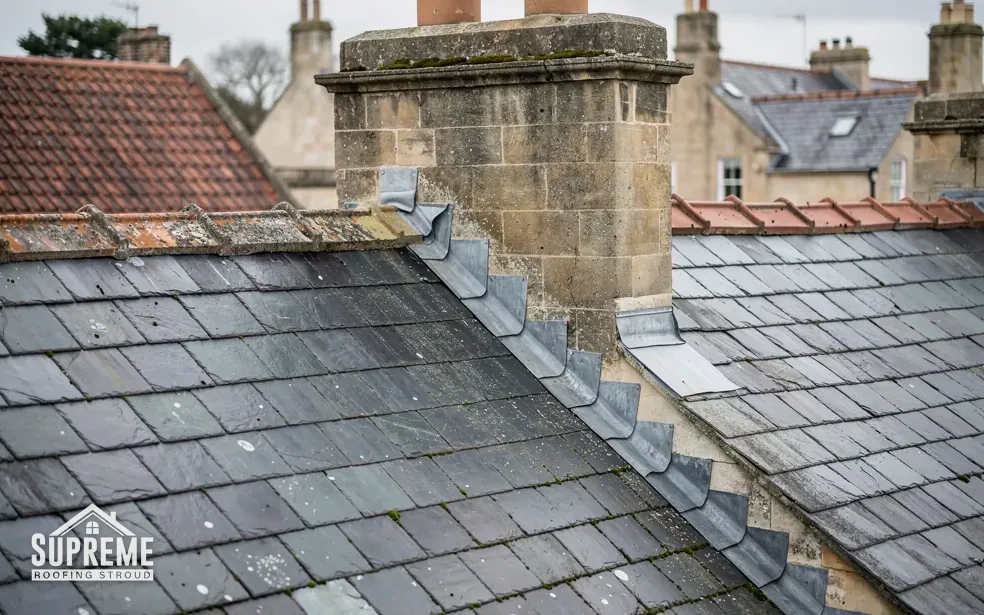
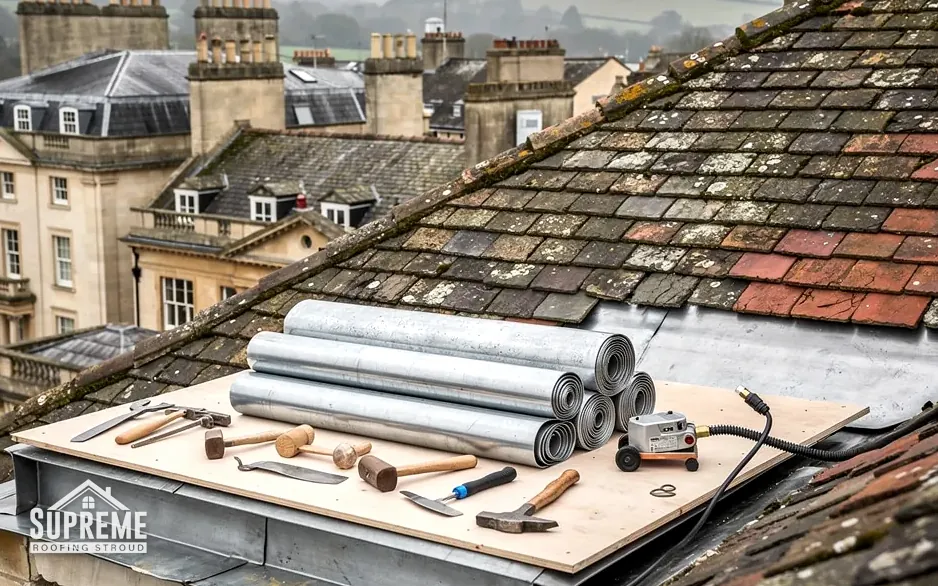
Where houses share a wall, the roofs on either side meet it, and the join is sealed with lead. These are stepped flashings along a rising wall, soakers at a slope's edge, and lead lining where a gutter runs behind a parapet. On a street of 18th-century fronts, much of the roof's watertightness depends on that metal, and it ages differently from the covering around it. Lead is sold by code, and each code is a different thickness: Code 4 is 1.80 mm thick and Code 5 is 2.24 mm.
MyJobQuote says lead flashing can last for over 80 years, and over 100 for higher codes, when it is correctly installed. Failure in practice comes from the detail more than the age: a flashing that is not tucked into a raked-out mortar joint, a lap that is too short, or a sheet that was fixed with no allowance for it to expand and contract. On a shared party wall, a fault on one side shows up in the neighbour's ceiling first, so it pays to speak to the neighbour before the work begins.
Checkatrade puts lead flashing repairs at £50 to £70 per metre and stepped flashing at £80 to £120 per metre in Code 5, excluding VAT. MyJobQuote gives £150 to £250 for a chimney flashing patch and £570 as the average for full replacement. Those figures are national. Once we have been up, our quote covers the length of lead, its code and the access it needs. Our lead roofing page goes through the codes and the typical life of each.
Working beside a neighbour
A party wall means two owners and sometimes two contractors on the same roof edge. We do not take a neighbour's side of the wall on without their agreement. We photograph our own side, note any signs that the shared line is failing, and report what we see, which gives you something to show them. If both sides are done together, the lead can be run as one continuous detail and the scaffold shared, which usually helps both bills.
Checking what the lead is doing
From the ladder we look for lead that has split along a fold, lifted at a lap or slumped down a vertical face, and we press the joints at the wall to see whether the pointing that holds the lead has crumbled. Where a flashing has failed at the edge but the sheet is sound, a local repair can be enough. Where the sheet has crept or cracked widely, relaying it in the right code is the safer route, and the report shows the metre counts for each option.
Matching the street
A terrace reads as one thing from the road, and a mismatched covering or an unusual ridge on one house shows from the other end of the street. Where we replace a covering inside the conservation area, we match the neighbours' pattern as closely as the material allows and show you the sample before ordering. For a general view of the work, see our pitched roofing page.
- Lead flashing repair, per metre£50 to £70
- Stepped flashing, per metre£80 to £120
- Chimney flashing patch£150 to £250
- Full chimney flashing replacement, average£570
Map showing Wickwar and the Stroud service radius, with nearby towns we also cover.
Near Wickwar
Roof work we do here
Wickwar roofs: rendered High Street and Holy Trinity
Wickwar's High Street houses are rendered. Can a roof leak show up as a stain on the front?
Yes. Water that gets behind the render at a flashing, a gutter or a parapet shows as staining, blistering or cracks. We trace it upwards to the roof detail before anyone repairs the render.
Does the Wickwar Conservation Area stop me re-roofing my house?
No. Putting back the same covering in the same way is generally not development at all, so an application is usually not required. A new material, a dormer or a listed house is another matter, so put the address to South Gloucestershire's planning team.
Holy Trinity is listed Grade II*. Who authorises work to a church roof there?
Holy Trinity still holds services, so the Diocese of Gloucester decides on its roof by faculty, in place of the council application a listed house would need.
My Wickwar ridge mortar is crumbling. What does the fix cost in typical terms?
In its 2026 guide MyBuilder gives £40 to £60 per metre for dry ridge, and £500 to £1,000 for a typical job. Our figure follows the survey and is in writing.