

Roofers in Stone
Roof repairs, re-roofing and farm-building work in Stone, the small Berkeley Vale village on the A38 beside the Little Avon, with a Grade II* church and a listed 17th-century mill farmhouse.
Stone at a glance
- Distance
- 17.3 road miles west-south-west of Stroud
- Council
- Stroud District Council
- Listed landmark
- All Saints' Church, Grade II*
- Setting
- Berkeley Vale, on the Little Avon River
Roofs on the A38 and the low ground by the river
Stone lies on the A38 just south-west of where the road crosses the Little Avon River, mostly on the west side of the river, according to Wikipedia. It is a small settlement, with a population of 527 in the Wikidata record, and it sits low. Most homes stand on Silurian mudstone of the Tortworth beds, with alluvium along the river, at heights of about 11 m to 30 m.
Those figures describe a flat, gentle landscape, and they shape the work in two ways. First, roofs here are not perched on hillsides. Ladders reach them easily, scaffold stands on level ground, and delivery vehicles can usually get close. Second, a village on low ground by a river is a village where drainage matters, because the water has to go somewhere. Gutters, downpipes and soakaways are the whole system, and a roof can only be as dry as its outlets are clear.
The housing itself carries some age. Stone was historically part of Berkeley parish, and its housing areas broadly match those of the early 19th century, so the village has kept close to its old footprint. Older buildings, repaired and altered over the years, need a closer look in the loft. All Saints' Church, founded in the 13th century, is listed Grade II*, and Middle Mill Farmhouse, which Wikipedia dates to the early 17th century, is listed Grade II.
Roof coverings differ from house to house in the village, so the survey records what is on yours. We look at each house when we are on site and say what we find.
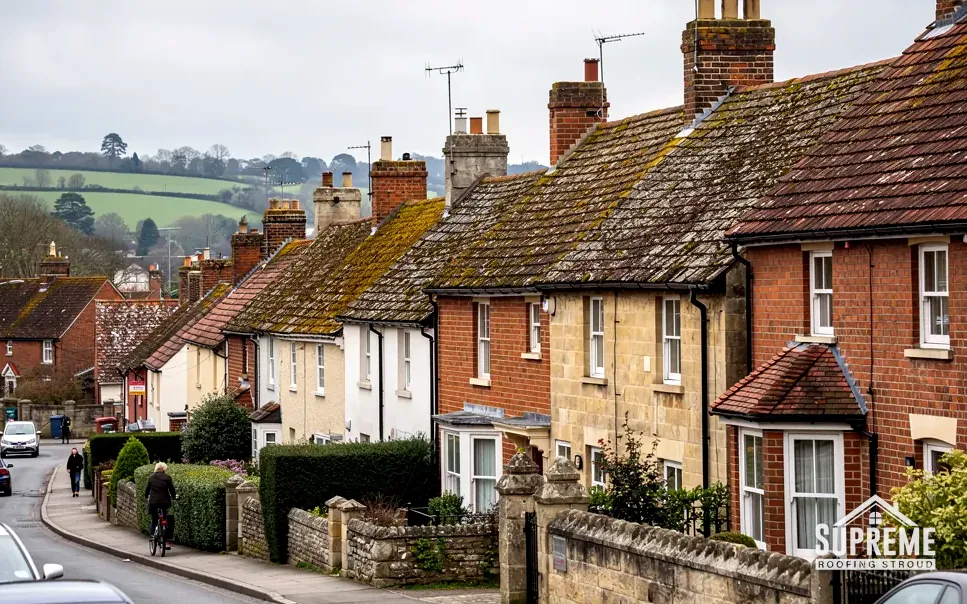
Sloping street of brick and stone terraced houses with mossy tiled roofs 
Victorian terraced houses with slate roofs and chimneys on a hillside
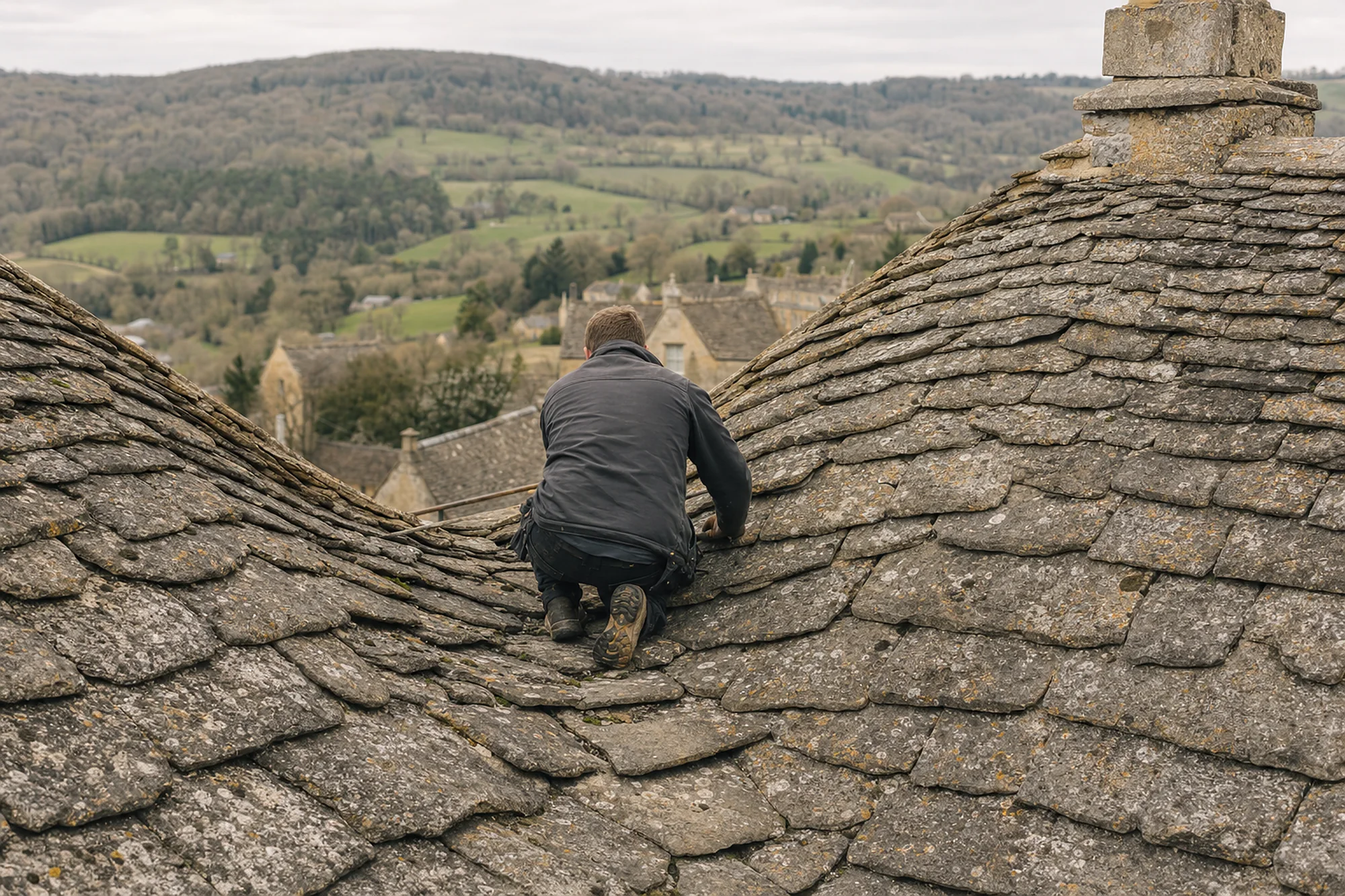
Chapter 01
Low ground, mudstone and alluvium
Level land makes access easy, and the question moves to where the rainwater goes.
Chapter 01In this chapter
The geology of Stone is plain in the record: Silurian mudstone of the Tortworth beds under most homes, and alluvium, the silt laid down by rivers, along the Little Avon, at heights of about 11 m to 30 m. What those figures give a roofer is the shape of the place. It is low, it is near water, and there are no steep streets.
That has real practical benefits. A scaffold on flat ground is quicker to put up and cheaper than one stepped across a slope. A lorry can often park near the house, and materials do not have to be carried far. On a full re-roof, that saves handling time, and the saving shows in the labour and scaffold costs of the written quote. We say that because it is fair to say it: the quote reflects the site, and an easy site usually produces a simpler price.
The difficulty on level ground is usually drainage. On a hillside the slope itself carries rainwater off. On a flat plot, pipes and drains do all of that, and a failed downpipe or silted drain leaves water standing at the foot of the wall. Over time that can damp the masonry and stain the lower courses. When we survey a roof in a low village, our survey traces rainwater from the valley to the gutter, from the gutter to the downpipe and from the downpipe into the drain.
Roof space and timbers
Once in the roof space, we check for pinpricks of light, dark staining on rafters and the underside of the roof boards, and any damp patches around the chimney breast. On a low plot the roof space can hold moisture if ventilation is poor, and BS 5250 describes eaves ventilation as one way of keeping it moving. These checks cost nothing extra on a survey visit, and the photographs go in your report.
Checking the fall
Gutter systems are laid to a gentle fall towards the outlet, and manufacturers recommend somewhere around 1:600 to 1:350, depending on the system. Where a run has dropped at one end, it will hold water, grow weeds and overflow. Our guttering, soffits and fascias page gives national replacement costs from MyBuilder and explains what is checked on site.
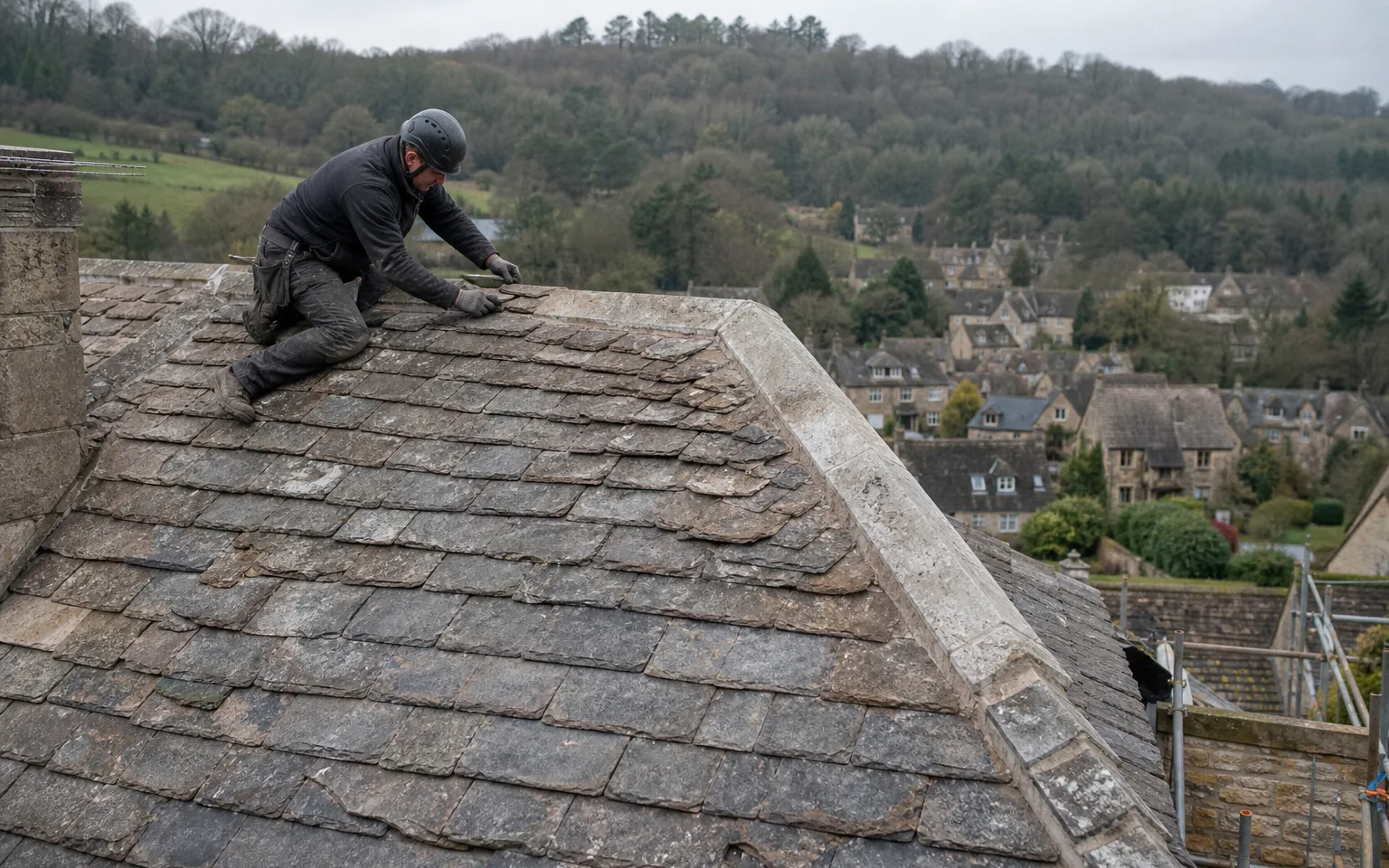
Flat roofs on extensions
Single-storey extensions and garages on level plots often have flat roofs. A flat roof needs a fall to its outlet too: BS 6229 sets a design fall of 1:40 to deliver a finished 1:80 once tolerances are taken out. Our flat roofing page covers coverings, upstands and typical UK costs.
On level ground, the work is easy to reach and the question is where the water goes.
- 527population recorded for Stone in Wikidata
- 11 to 30 mheight range at which most homes stand
- 13thcentury in which All Saints' Church was founded
Chapter 02
Working beside the A38
A main road runs through the village, and the scaffold has to share space with it.
Chapter 02In this chapter
The A38 is the spine of Stone, so many houses sit close to a busy road. That changes the plan for a roof job more than most people expect. Scaffold that stands on or over a public footway needs a permit from the highway authority, and the permit conditions can include lighting, boarding and a protected walkway for pedestrians. We apply as soon as a date is fixed, because the permit is on the critical path and the roof is not.
In this chapter
Delivery matters too. A lorry that stops on the road to unload tiles is a hazard, and parking restrictions may apply. Where a house has a drive or a yard, deliveries can be taken off the road. Where it does not, we arrange timed drops and hand the load up in stages. That handling time is allowed for in advance, and nothing about it is left to emerge when the lorry arrives.
A roof beside a main road also gets dirtier. Traffic films, leaves from roadside trees and road dust all find their way onto roofs and into gutters. Dirt itself is not a structural problem, but it hides the early signs of trouble, such as a slipped tile or a small crack. A surveyor who can see the covering clearly makes better decisions, so a clean-down before inspection sometimes makes sense. MyBuilder's 2026 guide puts roof cleaning at roughly £400 to £750 for a tile roof, and the work can be done with scraping or a soft wash. Our roof cleaning and moss removal page explains the choice.
Noise, dust and neighbours
Stripping a roof makes dust and noise. A house on a main road may not mind a little more of either, but its neighbours might. We tell the adjoining houses what is planned and when, and we cover gardens and cars where we can. Waste goes into a skip, and when the job ends the site is left clear.
Making a leak safe
If a roof fails in bad weather, the first call is to stop the water. Leaks and storm damage take priority on our list, and a temporary cover goes on before the proper repair is planned. Our roof repairs page explains how that works.
Myth: A roof on a main road costs the same to scaffold as one in a quiet cul-de-sac.
Fact: A footway permit, protected walkway and timed deliveries all add to the access cost, which is why the quote allows for access.
Chapter 03
Middle Mill Farmhouse and the older buildings of Stone
A Grade II farmhouse, a Grade II* church and early 19th-century housing share one small parish.
Chapter 03In this chapter
Middle Mill Farmhouse, which Wikipedia dates to the early 17th century, is listed Grade II. All Saints' Church, founded in the 13th century, is listed Grade II*. Both are recorded by Historic England. Stroud District Council tells owners that listing protects the building in full, at Grade II as much as at Grade I, and for structures in the curtilage it says it is always worth checking status with the conservation department.
That last point matters in a farming village. Barns, stables, dairies and sheds beside a listed farmhouse may be caught by the listing, even if they went up later or look modern. If one is, roof work on it needs consent, and starting without is an offence. We make the enquiry before the quote, and it costs you nothing.
Stone has no conservation area of its own. It is not on Stroud District Council's list of 41, so the extra rules that apply inside a designated area do not apply here. That leaves the broader rules: like-for-like repair rarely needs planning permission, and a roof that changes the look of the building may. The sensible step for anything unusual is to ask the council.
Roofs on farm buildings
Farm outbuildings often carry corrugated sheets, and older ones may be asbestos cement. Under HSE guidance, taking intact asbestos cement down carefully is non-licensed work, whereas sheets broken up in the process become notifiable. We inspect the sheets before any plan is made. If the roof is a shed or lean-to rather than a house, the same logic holds: sound timbers, a covering that sheds water, and a fall that leads to a gutter. Our garage roof replacement page explains how asbestos roofs are handled and what the typical national price ranges are.
Church and churchyard
All Saints is a church in use, part of the parish of Stone with Woodford in the Diocese of Gloucester, which means roof work on it goes through the diocese by faculty. It began as a chapel of ease to Berkeley, and its battlemented tower and spire were added around 1400, so the high work there is on medieval masonry, and Historic England has listed it since 30 March 1960. If you are on the parochial church council and need the roofing element priced, we will price it from the architect's specification once it is drawn up.
The early 19th-century housing
Because Stone's housing broadly matches the areas of the early 19th century, some roofs here may be older than they look. On those we look at the timbers first, then the junctions, then the covering, and we tell you in writing which parts are sound.
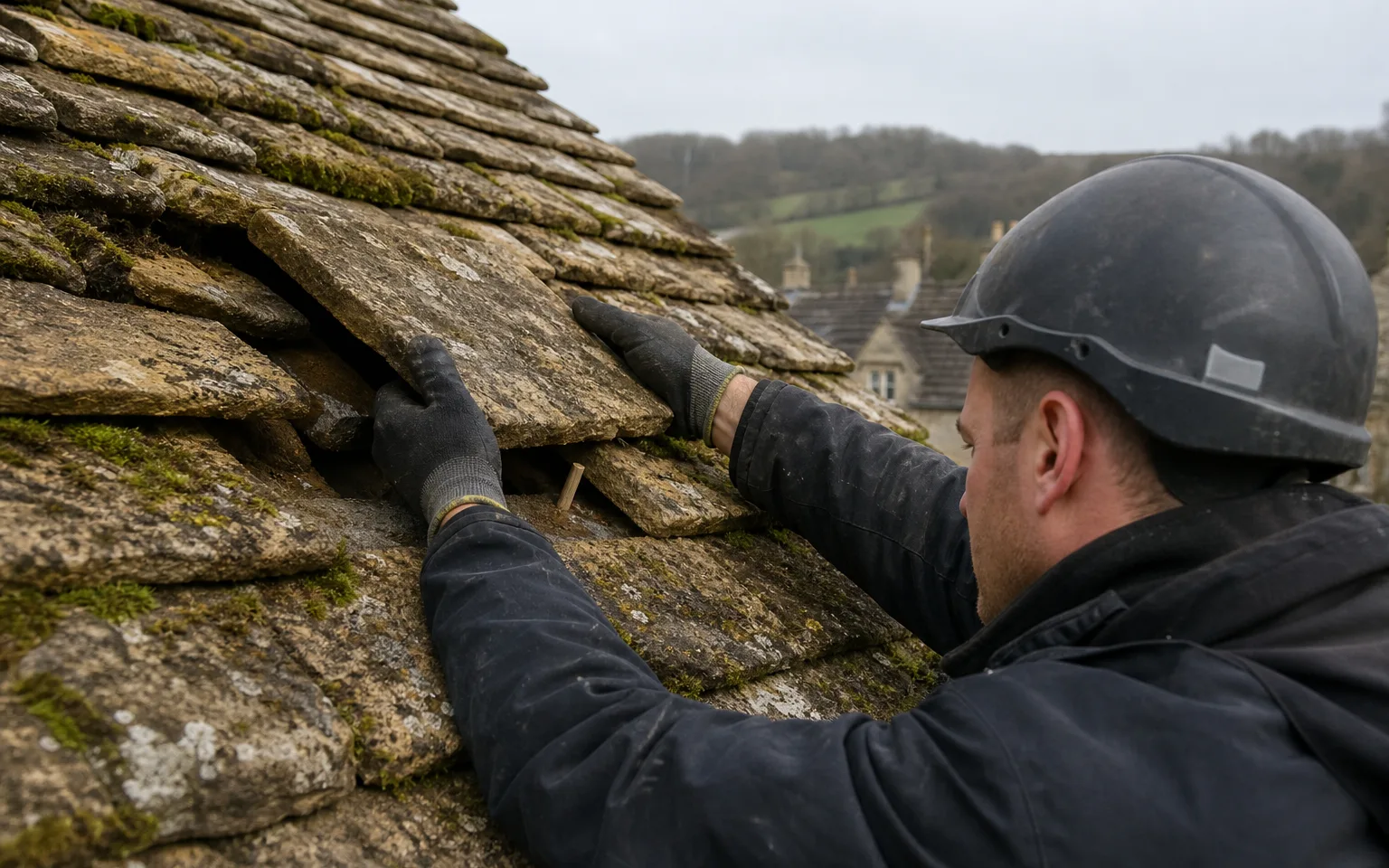
Map showing Stone and the Stroud service radius, with nearby towns we also cover.
Near Stone
Roof work we do here
Middle Mill Farmhouse and the Little Avon meadows
Does low ground by the Little Avon change how my Stone roof should be drained?
It makes drainage the first thing we check. On a flat plot, rainwater has to leave through gutters, pipes and drains, so we follow it from valley to drain and note any run that holds water.
My shed stands near the listed Middle Mill Farmhouse. Can I re-roof it freely?
Not without checking. A shed or barn near a listed house, inside its boundary, can fall under the listing. Put its status to the council's conservation department before any work starts.
Will scaffold beside the A38 need a permit?
If it stands on or over the public footway, yes. We apply for it once a date is agreed, and the permit conditions, such as lighting and a protected walkway, are priced on the quote.
Can you replace an old corrugated farm shed roof that might be asbestos?
Yes. We assess the sheets first. Sheets that are intact can be lowered carefully as non-licensed work. We then write down the method, the disposal route and the replacement covering.