

Roofers in Berkeley
Roof repairs and re-roofing in Berkeley, the old market town on its small hill between the Little Avon and the Severn, where listed churches, Jenner's house and a conservation area all sit within a few streets.
Berkeley at a glance
- Distance
- 13.9 road miles west-south-west of Stroud
- Council
- Stroud District Council
- Conservation area
- Berkeley Conservation Area (no. 5)
- Setting
- Vale of Berkeley, on a small hill by the Little Avon
Berkeley's roofs on the hill above the Little Avon
Berkeley lies in the Vale of Berkeley on a small hill, between the east bank of the River Severn and the M5, on the Little Avon River. That matches the way the town reads from the road: a compact old centre lifted a little above flat, wet farmland. Few towns in this part of the county carry as much recorded history for their size.
The record goes back a long way. Berkeley was first written down in 824 as Berclea, and in medieval times it was a port, a market town and the meeting place of the hundred of Berkeley. St Mary the Virgin church and its separately listed tower are both Grade I. The west gatehouse at Berkeley Castle is Grade I as well. Edward Jenner was born here, and The Chantry, his home for 38 years, is now the Edward Jenner Museum and is Grade II* listed. Berkeley Town Hall dates from 1824.
For a roofer, that list is a map of the rules. Berkeley is one of the 41 conservation areas that Stroud District Council names, number 5 on its list, and a good part of the town's older building stock is listed on top of that. Every Berkeley enquiry opens with two checks, listing status and conservation area boundary. The answers decide what consent is needed, what material must be matched and how the work is described in writing. Everything else follows from there.

Hillside terraces of stone houses with slate roofs and chimneys 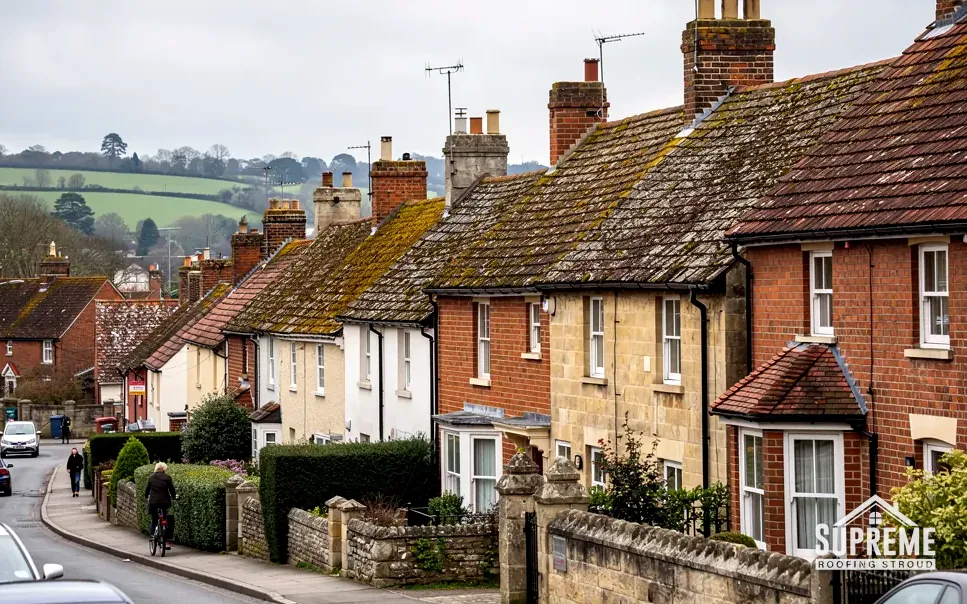
Sloping street of brick and stone terraced houses with mossy tiled roofs

Chapter 01
A hill town above the Vale of Berkeley
Open, low land on every side means roofs are seen from far off, and so are their faults.
Chapter 01In this chapter
Berkeley sits on a small hill in flat country, and from the lanes around it you see its roofs from a long way off. That visibility matters when you choose a covering. A roof that would be tucked out of sight in a valley is part of the skyline here, so a patch in the wrong colour or a flashing in bright new lead will be noticed. We say this plainly at the survey: the repair has to hold, and it also has to look as if it belongs.
In this chapter
The Little Avon and the Severn are close, and low ground near rivers is damp ground. On any building in a wet landscape like this, moisture works in from several sides at once, and a roof survey has to follow each route. Gutters that overflow wet the wall below. Valleys that clog hold water against the timbers. A chimney with failed flashing lets in the wet at the roof line, then the stain appears on the ceiling below. Good roofing here is mostly about getting rainwater away from the building cleanly and quickly. That means open valleys, outlets that are not choked with leaves from garden trees, and downpipes that discharge into a drain and not against a footing. Each of these is quick to check at a survey, and each is cheaper to correct before a wet season than after one.
Access to a hill town often means narrow streets, tight yards and shared walls. Houses that open straight onto the pavement need a permit before scaffold can stand on the public footway, so that application goes in the day a start is fixed. Where lanes are too tight for a lorry, tiles and timber arrive in smaller loads and are handed up in stages.
Gutters and drainage first
Most of the faults we trace in a wet setting begin at the gutter. Gutters are laid to a gentle slope towards the outlet, and manufacturers' guidance runs from about 1:600 to 1:350 depending on the system. Where a run has sagged between brackets, water pools and spills over the front in a downpour. Our guttering, soffits and fascias page covers fixings, spacing and replacement costs in national terms.
Making a leak safe
Water coming through a ceiling is stopped first, under a temporary cover if the weather allows nothing better. Leaks and storm damage come ahead of routine work on our list. We agree the lasting repair after the structure has had a chance to dry. Our roof repairs page explains the order of work.

On a hill town in flat country, a repair is judged from far away as well as from close up.
Chapter 02
Listed churches, a castle gatehouse and Berkeley's conservation area
Berkeley packs several kinds of protection into a small centre, and each one asks something different of a roofer.
Chapter 02In this chapter
St Mary the Virgin and its separate tower are each Grade I. The west gatehouse at Berkeley Castle is Grade I. The Chantry is Grade II* and the Town Hall dates from 1824. Berkeley Conservation Area, number 5 in the district's list, draws a boundary around the older part of the town. It is unusual to find so many protected buildings in so small a place, and it means that guesswork about consent is expensive.
In this chapter
The rule that catches people out is this. Stroud District Council confirms that no grade of listing is a lesser one for legal purposes: the protection covers front, back and interior alike. Anything that changes a listed building's special character needs authorisation first, and going ahead without it is an offence. The parish church follows its own track, since roof repairs on a church in worship use are granted by the diocese. A chapel or church that has stopped holding services reverts to the council's consent process.
A house inside the conservation area but not on the list can usually be repaired like for like without fuss. Changing the covering, rebuilding a visible chimney or adding a dormer is different. Dormers are not permitted development in a conservation area, and Berkeley is not among the five areas where the council has made Article 4 Directions, so ordinary permitted development rights still apply to unlisted houses. Even so, the sensible step before any visible change is to ask the planning team. If you are adding a roof window, our skylights section explains where the rules differ.
Matching what is there
On a protected building, the surveyor and the council will usually want the existing material kept. For stone or slate roofs, that means new or carefully reclaimed stock from the same building, matching in type, colour, texture and thickness. Our Cotswold stone roofing page covers the traditional practice and why one stone is never swapped for another.
What goes into the quote
For a listed or conservation-area job, the written quote covers the covering, the fixings, the lead, the scaffold and any consent or condition. If the council adds a condition, we give you the new figure in writing before anything changes.
| Building status | Who decides |
|---|---|
| Church in use, such as St Mary the Virgin | The diocese, by faculty |
| Listed house, hall or gatehouse not in worship use | Stroud District Council, by listed building consent |
| Unlisted home in the conservation area | Stroud District Council's planning team, if the work changes appearance |
| Unlisted home outside any designation | Usually no planning permission for like-for-like work |
Chapter 03
A market town that began as a port
Buildings that date from different centuries share the same few streets.
Chapter 03In this chapter
Berkeley was a port, a market town and the meeting place of the hundred in medieval times, so its centre grew around trade and gathering. The result is a mix of building types you would not expect to find in a village: a town hall, shop fronts, houses with workrooms and yards, and cottages squeezed between them. Each has its own roof and its own wear.
In this chapter
The Town Hall, from 1824, is a public building of real age, and one like it will have been mended repeatedly, and the layers of mending are usually what cause trouble. Patch after patch of different lead, different mortars and different fixings leave a roof that is hard to understand. We photograph each repair on the survey so you can see which ones are failing and which ones still do their job. We expect old roofs like this to need a full survey before any quote: the covering, the timbers, the junctions with neighbouring walls and the internal gutters, if there are any. Where a roof meets a taller neighbour, a stepped flashing is the weak point, and lead is the material to repair it in. Lead flashings can last for over 80 years when fitted correctly, according to MyJobQuote, but only if the right thickness is chosen for the job and the joints are formed to allow movement.
Shop and house roofs in a market centre often share party walls and chimneys. A repair on one affects the next, and neighbours benefit from sharing scaffold where both roofs need work. We are glad to quote for adjoining properties together if the owners agree, because the scaffold then appears once and serves both. Neighbours who coordinate also tend to agree the party-wall detail once, which avoids two roofers meeting at the same junction with two different ideas about how it should be finished.
Chimneys
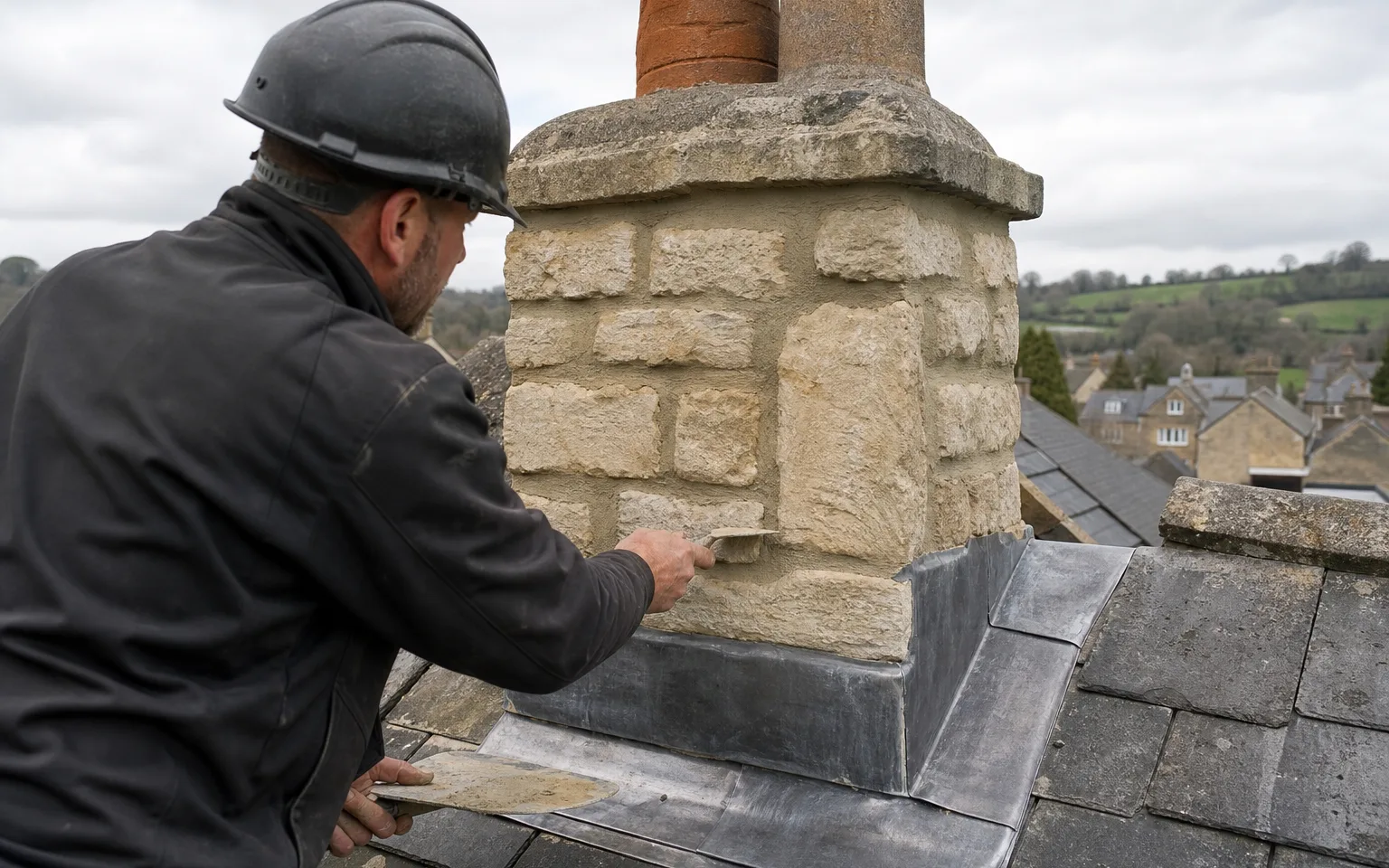
Stacks in a historic centre are often the first thing to need attention. Mortar erodes, pots loosen and flaunching cracks. Our chimney repairs page explains repointing, flashing renewal and full rebuilds, with national price ranges from MyBuilder for each.
- 824year Berkeley was first recorded, as Berclea
- 1824date of Berkeley Town Hall
- 38years Edward Jenner lived at The Chantry
Roofs that lead to the street
Where a roof slope faces the market place, a loose tile is a falling hazard to people below. We make that edge safe first, and the quote covers the pedestrian protection that the site needs. Any gaps that a fall of tile would otherwise leave in the covering are closed before we leave site, so rain does not follow the damage into the building overnight.
Map showing Berkeley and the Stroud service radius, with nearby towns we also cover.
Near Berkeley
Roof work we do here
Jenner's Chantry and Berkeley's hilltop churches
Does the Berkeley conservation area stop me re-covering my roof?
Not for matching repairs, which normally go ahead. Anything that alters the look, such as a different covering or a rebuilt street-facing chimney, should be put to Stroud District Council's planning team before you order anything.
Where can I check if my Berkeley house is on the list?
Ask Stroud District Council's conservation department, which holds the status of every listed building in the district. Listing covers the whole building and applies at every grade.
Can you repair lead flashings on an old stone building without replacing the roof?
Often yes. Lead flashings, soakers and valley linings can be renewed as a repair while the covering stays in place. We survey the joints first and quote for the flashing work, taking photographs of each one as we go.
The lanes around my Berkeley home are narrow. How do you get materials to the roof?
We plan it at the survey. Deliveries may come in smaller loads, scaffold on a public footway needs a licence we apply for, and the extra handling time is allowed for in the quote.