

Roofers in Sharpness
Roof work in Sharpness, the Severn port at the end of the canal: dockside buildings inside a conservation area, a tidal shore and the small cluster at Newtown.
Sharpness at a glance
- Distance
- 15.7 road miles west of Stroud
- Council
- Stroud District Council
- Conservation area
- Sharpness Old Dock (no. 37)
- Setting
- Severn shore at the canal mouth
Sharpness roofs from the Old Dock to the Severn shore
Sharpness lies 15.7 road miles west of Stroud, and it is a place with a different character from the valley towns. It is a port on the River Severn, in the civil parish of Hinton, and Wikipedia calls it one of the most inland ports in Britain. Ships have to deal with a tidal range of about 10 m on a typical spring tide. The village itself is small: about 100 residents live directly beside the port, and the subvillage of Newtown lies about half a mile to the south-east.
The built heritage is industrial. The Old Dock opened in 1827 with the Gloucester and Sharpness Canal, which runs about 16 miles inland from here to Gloucester, and the New Dock opened to the south in 1874. The branch railway followed on 2 August 1875. The Severn Railway Bridge was damaged beyond repair by a barge collision in 1960 and dismantled in 1970, and from 1939 to 1966 the sailing ship Vindicatrix was moored in the Old Dock as a training hulk.
Stroud District Council has designated the Sharpness Old Dock Conservation Area, number 37 on its list. It covers the Old Dock only, not Newtown. That boundary matters more here than it does in most places, because two houses half a mile apart can fall under different rules. We confirm the status of your address with the council before we quote.
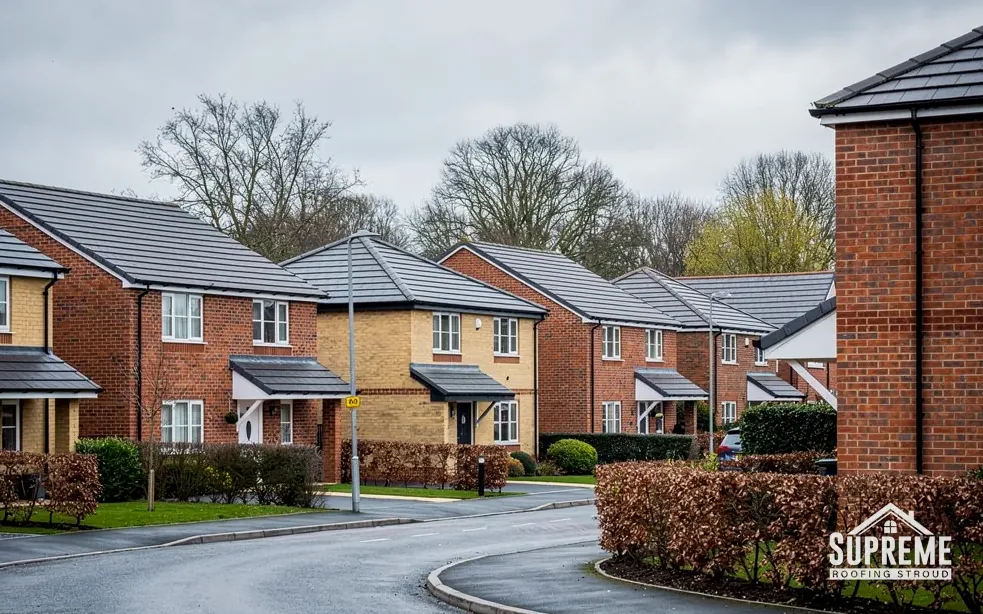
Modern brick housing estate with grey tiled roofs along a curving road 
Hillside of stone terraced houses with mossy stone tile roofs and chimneys

Chapter 01
Roofs inside the Old Dock conservation area
A designated dock from 1827 means repairs begin with the question of what the council expects to see.
Chapter 01In this chapter
The Old Dock opened with the canal in 1827, and the conservation area that now carries its name is the part of Sharpness where roof decisions need the most care. Stroud District Council counts 41 conservation areas across the district, and this is number 37 on its list. What we can describe here is what a conservation area changes, and what it leaves alone.
Re-covering a roof with the same material in the same way is not normally development, so a straight repair with matching material rarely raises a planning question. Conservation areas bring in tighter control of changes to the appearance of a building: replacing slate with another covering, adding rooflights on a visible slope, or removing a chimney. Stroud District has Article 4 Directions in five of its conservation areas, two of them in Stroud itself and the others at Bisley, Wotton-under-Edge and Frampton, and the Old Dock is not among them. Even so, it is worth ringing Stroud's planners before a different material is even considered, because ordering the wrong thing is expensive.
Dockside buildings of the nineteenth century were built to be useful, and their roofs often show it. Wide spans, long gutters running the full length of a range, and gutters set between two roof slopes carry large volumes of water to a few outlets. When one of those outlets blocks, the water finds its own way in. We start every survey of a roof like this with the drainage and photograph each outlet. Our commercial roofing page explains how larger and flatter roofs are surveyed and priced.
Who looks after a dockside roof
Large buildings by a dock often have more than one owner or occupier under the same roof, and a lease may split the repair duty between landlord and tenant. We have no way of knowing the arrangement for your building, so we ask. Their reply settles who approves the quote, who agrees the access, and how the cost is divided. A written survey with photographs of each section helps everyone see which part of the roof is whose problem.
Keeping the character of the dock
Where an old dock building is now a home or a workshop, matching matters. We replace slates, tiles or sheets with the same type, size and colour wherever the roof is visible from the water or the towpath. Where a salvaged covering is on offer and sound, we flag it and quote that choice. If not, we describe the closest new match and show you a sample.
Roof work can be seen from a long way across flat country and water, so a neat finish at the ridge and verges counts as much as the covering itself.
At a dock, the gutters carry more water than the roof was ever drawn for.
- 1827year the Old Dock opened with the Gloucester and Sharpness Canal
- 1874year the New Dock opened to the south
- 37number of the Old Dock on the council's conservation area list
Chapter 02
A tidal shore and a 15.7-mile journey
At the mouth of the canal, working near the water and travelling from Stroud both shape the plan.
Chapter 02In this chapter
Sharpness stands on the Severn shore, where the canal meets the river, and the river here has a tidal range of about 10 m on a typical spring tide. The tide has no direct bearing on a roof, but it does affect a few practical decisions. Access along the shore may be limited at certain times, and a plot close to the water can have soft or damp ground that needs boards under the scaffold. We look at the ground at the survey and put what we find into the access section of the quote.
Near tidal water, we also choose fixings and flashings with corrosion in mind. Exposure varies from plot to plot, so as a matter of method we prefer corrosion-resistant fixings on any roof close to open water, and we say what we use in the quote. Metal that is going to be out in all weathers for decades should be chosen for that life, not for the day it is installed.
The other practical matter is distance. At 15.7 road miles, about 27 minutes by road, Sharpness is a longer trip from Stroud than the valley villages. We plan each visit so that the survey, the photographs and the measuring all happen in one trip. A job that is going to need several days is scheduled in blocks, so the team is on site working and not arriving, unloading and leaving again.
Planning a repair when the weather turns
When a storm lifts part of the covering, a leak is our first call: we make the roof safe, then plan the proper repair. A temporary cover can hold a roof until a proper repair is arranged. Our roof repairs page describes how we handle that, and what gets recorded for any insurance claim.
Days that suit the work
A roof near the water is easy to see from the road, the towpath and the dock, so the finished job is judged by many eyes. We give the ridge line, the verges and the flashings the same attention as the main slopes.
With the open estuary close by, we like to plan a roof job around a run of days on which the weather lets us keep the covering stripped for the shortest possible time. We strip in sections, never more than can be made watertight by evening, and we tell you in advance which part of the house will be open on which day.
What a survey records
Photographs taken at the survey record the roof as it stands, from the ground and the loft, and they go with the written quote. If you are claiming on insurance, the photographs give the insurer a clear record of the condition before work began. We do not give insurance advice, but we are glad to send the pictures to whoever needs them.
Chapter 03
Newtown, the railway and the housing half a mile away
A short distance from the port, a different set of rules and a different kind of building.
Chapter 03In this chapter
About half a mile south-east of the port lies Newtown, the subvillage that grew alongside it. The conservation area covers the Old Dock only, so a house in Newtown does not fall inside it. That simplifies the planning side of a re-roof, though an individual house can still be listed, and Stroud District Council will confirm whether yours is. We check with Stroud District Council before the quote when there is any doubt.
In this chapter
The Sharpness branch railway opened on 2 August 1875. Each Newtown house is surveyed on its own terms, so our approach is to read each roof as it stands: identify the covering and its condition, and compare what is on the roof with the lines drawn on any plans you have.
The Severn Railway Bridge was damaged beyond repair by a barge collision in 1960 and dismantled in 1970. The sailing ship Vindicatrix lay in the Old Dock as a training hulk from 1939 to 1966. Those chapters of the port's history are over, but they remind us that this is an industrial landscape, with large outbuildings and workshops among the houses. Workshop and store roofs are often sheeted. Where such a roof is old, we check whether it could be asbestos cement before anyone disturbs it, and we pause if the sheets are cracked or broken until the method is agreed.
Roofs that were never meant for people
The old working port left a legacy of plain, practical structures: stores, sheds and outbuildings put up for use rather than comfort.
Some buildings in a port area were designed as stores or sheds and later turned into homes or offices. Their roofs may lack the insulation and ventilation a habitable space needs. If you are converting or reusing such a building, the work may need Building Regulations approval, and we explain which parts of the job are covered before we price it. Our flat roofing page describes the options for low-pitch roofs, which are common on workshops and extensions.
Myth: If Sharpness has a conservation area, every house in Sharpness is inside it.
Fact: The designation covers the Old Dock only, so a Newtown address is outside it, and we confirm the status of each address with the council.
Map showing Sharpness and the Stroud service radius, with nearby towns we also cover.
Near Sharpness
Roof work we do here
Old Dock buildings and the Newtown cluster
My building is near the Old Dock. How do I find out whether it is inside the conservation area?
Ask Stroud District Council's planning team, which holds the boundary for conservation area number 37. We check your address with them before the quote if there is any doubt. The area covers the Old Dock only, not Newtown.
Does being near tidal water change the fixings you use on a roof?
We choose corrosion-resistant fixings and flashings for any roof close to open water, and the quote names them, so you can see what is going up on your roof.
Is a roof at Sharpness harder to price because it is so far from Stroud?
The distance is 15.7 road miles, and we plan the survey as a single visit with photographs and measurements together. The written quote then covers scaffold, materials, labour, waste and clearance.
An old shed roof at Newtown may be asbestos cement. What happens first?
We assess the sheets before anyone works on them. Under HSE guidance, lifting intact asbestos cement sheets away carefully is non-licensed work, and the quote spells out how and where it goes.