

Roofers in Twigworth
A village of 380 on Gloucester's northern edge, with a church closed for worship, a Grade II* hall and a large new housing scheme going up beside it, so its roofs span old, empty and brand new.
Twigworth at a glance
- Distance
- 12.6 road miles north of Stroud
- Council
- Tewkesbury Borough Council
- Listed building
- Wallsworth Hall, Grade II*
- Council
- Tewkesbury Borough Council, not Stroud District
Twigworth's roofs: a closed church, a Grade II* hall and a planned green
Twigworth is a small village on the northern edge of Gloucester, in Tewkesbury Borough, and it is named in a record of 1216 as Tuiggewrthe, thought to mean an enclosure belonging to Twicga. The civil parish has 380 people on Wikidata's 2021 figure, so it is one of the smallest places on this part of our map.
Three things stand out about the village. St Matthew's Church was consecrated in 1844, and the Diocese of Gloucester closed it for public worship in 2019. The poet and composer Ivor Gurney is buried in its churchyard. Wallsworth Hall is listed Grade II*. And a large housing development called Twigworth Green is being built by Bloor Homes, Linden Homes and Bovis Homes, a consortium scheme of about 725 homes whose third and final phase of 340 was approved in 2022.
Families have been moving into the first phases for several years. The village therefore puts three situations side by side that a roofer rarely meets together: a building that has stopped being used, a large historic house, and a great many new roofs.
Survey, access and cost differ for each one, so each gets a chapter below. For questions about conservation status or protection, Tewkesbury Borough Council is the place to check.

Flint and brick cottage with a clay tile roof beside a road 
Wooded hillside lined with rows of stone houses and slate roofs

Chapter 01
St Matthew's, closed in 2019: caring for a roof nobody is watching
A building that has stopped being used still has a roof that needs inspecting.
St Matthew's was consecrated in 1844 and the diocese closed it for public worship in 2019. Roof defects in a building that is visited daily are usually found within weeks; in one that has gone quiet, they can run for months. Water that finds its way in through a lifted slate or a split valley lining works slowly on plaster and timber, and by the time a stain is visible it has already done its work.
In this chapter
For that reason the most useful thing for a closed or lightly used building is a regular inspection, with gutters and downpipes cleared and any loose covering secured. MyBuilder (2026) gives £150 to £250 for a standard roof inspection, with a drone survey at £200 to £400. We photograph every slope, every gutter and every junction, and send the set.
Air in an empty building
A building left unheated and unvisited can go damp even when the roof is watertight. Without air moving through the roof space, moisture from stone walls and the ground collects in the timbers. Louvres and vents in the roof void are worth checking, and so is whether bats or birds have settled in the roof space; both are protected, and we would stop and take advice if we found them. A survey notes the ventilation as well as the covering.
Gutters on a closed church
Rainwater goods on a church are often large cast sections, with hopper heads and long downpipes that run down buttresses. When they block, water spills over the wall face and soaks the stone. Clearing them is cheap compared with repairing the damage. We would walk the full length of every gutter, check the joints and the outlets, and flag any run that has pulled away from the wall.
Which permissions apply
The exemption that lets a diocese authorise roof work by faculty reaches only churches still in use for worship. Once a listed church has closed, the council takes over, and its listed building consent is normally what applies. Whether St Matthew's carries a listing is for the council's conservation team to confirm. Anyone responsible for a building like this should ask Tewkesbury Borough Council what protection it carries before accepting a quote.
Making a roof safe first
If a roof is leaking, the first step is to keep further water out: sheeting a section, fixing loose slates, clearing a blocked outlet. A permanent repair follows once the cause is understood and any consent is in hand. Our roof inspections and surveys page lists what a report records, which is a good starting point for a building whose roof has not been looked at in years.
The churchyard and the neighbours
The churchyard holds the grave of Ivor Gurney, and any work beside a burial ground needs care. Scaffold has to be positioned so that it does not disturb graves, and materials must be carried in by a route that respects them. The route is worked out during the survey and written into the access notes that go with the quote.
A closed building still needs its roof read, whether or not anyone is inside.
- 1844year St Matthew's Church was consecrated
- 2019year the Diocese of Gloucester closed it for public worship
- 1216year the name Twigworth was first recorded, as Tuiggewrthe
Chapter 02
Wallsworth Hall and the demands of a Grade II* roof
Few houses reach this grade, and any roof work on one starts with the council.
Wallsworth Hall is listed Grade II*, and Tewkesbury Borough Council is the authority that decides what may be done to it. Listing law is national, and listed building consent is what stands between an owner and any alteration that changes the special interest of the house.
In this chapter
This page does not describe Wallsworth Hall's roofs; any work there would start with a survey of its own. What follows is what large historic houses commonly involve. They tend to be a group of roofs, not one: main ranges, wings, service buildings, chimneys and sometimes a parapet or a lead flat. The lead is the part most likely to need skilled attention. Lead on a hall roof can last a very long time, and MyJobQuote puts correctly fitted flashing at over 80 years, but codes, laps and fixings all matter. Our lead roofing page sets out the codes and where each belongs.
Chimneys and high-level details
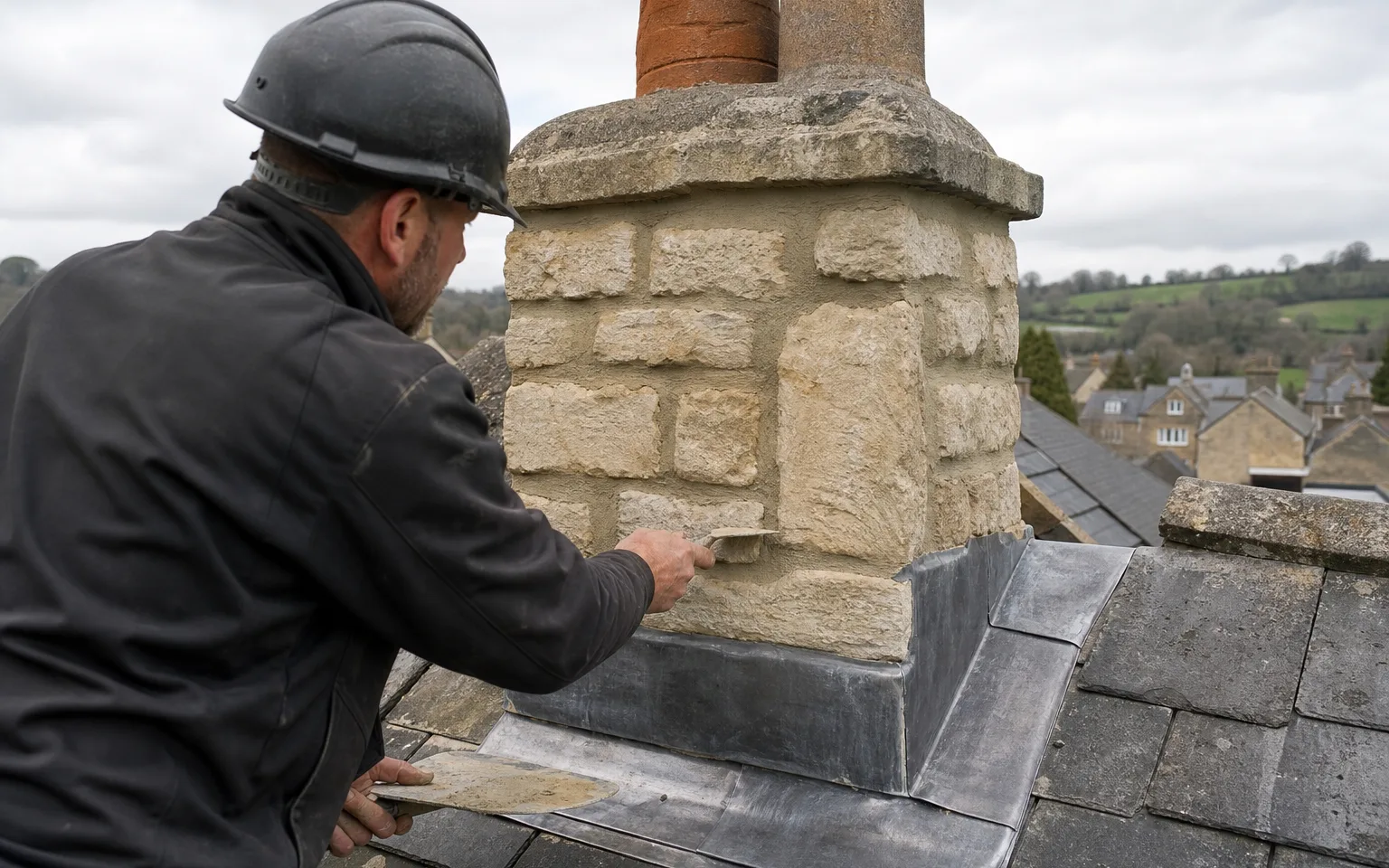
Big houses have tall stacks, and the lead around them is a frequent source of leaks. The stack itself may need repointing, the flaunching may have cracked, and the flashing may have lifted. From the roof we inspect each stack, write up its condition and quote for any repair.
Surveying a large roof safely
A roof of this size is inspected from scaffold, a mobile platform or by drone, and the choice is made at the planning stage. A thermal survey can show where heat is escaping and water is trapped, at £300 to £500 against £150 to £250 for a standard inspection (MyBuilder, 2026). The right method depends on the roof, and we recommend the lowest-cost one that actually answers the question.
Access to the hall roof
A large house usually sits well back from the road, with long drives and mature trees. Scaffold lorries need turning room, and branches overhanging a roof drop leaves into valleys and gutters every autumn. We walk the grounds with the owner, note which trees need cutting back by a tree surgeon, and agree where materials will be stored so lawns and drives are protected.
Like for like, in writing
On a listed roof the goal is to keep as much original fabric as possible. That means re-using sound slates or tiles, matching any new ones to the old and recording each step in photographs. The quote lists what will be kept, what will be replaced and why. A conservation officer may ask for samples, so we allow time for that before the programme is set.
| Survey type | Typical cost | Suits |
|---|---|---|
| Standard inspection | £150 to £250 | A roof with an unknown history |
| Drone survey | £200 to £400 | Large or high roofs |
| Thermal survey | £300 to £500 | Hidden moisture or heat loss |
Chapter 03
Twigworth Green: new roofs on a large new estate
A large development by three builders brings up the question of who looks after a new roof.
Twigworth Green is a consortium development of about 725 homes by Bloor Homes, Linden Homes and Bovis Homes, built in phases, with planning approval for the third and final phase of 340 homes granted in 2022. We note it because a scheme of that scale changes what roof work means for a village of 380.
In this chapter
New homes bring new roofs. A new-build roof is normally covered by its builder's own arrangements for a period after completion, so the first step for any problem is to read the paperwork you were given when you moved in and contact the builder. That is true wherever the house stands, and we would not take on work that cuts across it. When those arrangements end, a young roof still wants the ordinary checks: ridge and hip fixings, verge details, flashings and gutters.
What schools and estates mean for roofs
School buildings and large estates can have flat and low-pitch sections beside pitched ones. Flat roofs are designed to a 1:40 fall to leave 1:80 after tolerances (BS 6229, via IKO, 2021), and ponding is the first sign that a roof is not draining. Our roof replacement page explains how a replacement is planned and priced.
Roof windows and loft rooms on new homes
Owners of new houses often convert the loft, and the roof then needs windows. Rooflights should meet a U-value of 2.2 W/m²K and roof windows 1.4 W/m²K under Part L (2021), and a roof window counts as a fire escape only if it sits within 4.5 metres of the ground. Planning questions on roof windows go to the council.
A small village and a lot of traffic
The parish is small, and it lies 12.6 road miles to the north of Stroud. Deliveries, skips and scaffold lorries all need space, which narrow verges rarely give. Before the work starts we agree where the scaffold, the skip and the materials will stand, and we tell the neighbours.

Where older houses fit
Alongside any new scheme sit the village's older houses, whose roofs we know nothing about without a visit. For those, the quote follows the survey and breaks the job into priced parts: access, stripping, new materials, labour, disposal and finishing.
Map showing Twigworth and the Stroud service radius, with nearby towns we also cover.
Near Twigworth
Roof work we do here
St Matthew's, Wallsworth Hall and the new-build roofs
Who looks after the roof of a church that has closed, like St Matthew's?
The owner, whoever that is now. Who holds St Matthew's now is a matter for the diocese's records. A closed building still needs gutters cleared and the covering checked, and our survey records the state of the roof with photographs so an owner can plan repairs and any consent.
What is special about roof work on a Grade II* house like Wallsworth Hall?
Changes to the special interest of a listed building need consent from Tewkesbury Borough Council. Repairs on a roof like this are planned to keep as much original covering as possible, and the quote says what is kept and what is replaced.
I have bought a new house in Twigworth. Who do I call about a leaking roof?
Start with your builder, because new homes usually come with arrangements that cover defects for a period. Keep the paperwork. If those arrangements have ended, send us photographs of the roof and the leak and we will survey it.
Does a conservation area apply to a house near St Matthew's or Wallsworth Hall?
Tewkesbury Borough Council keeps the definitive list of conservation areas, and its conservation team can say what applies to a particular address, so ask the council before altering how a roof looks.