

Roofers in Tuffley
Roofing for a southern Gloucester suburb where council housing began in 1914 and a listed church tower still marks Stroud Road, with typical costs published before we call.
Tuffley at a glance
- Distance
- 6.8 road miles north of Stroud
- Council
- Gloucester City Council
- Listed landmark
- Church of St Barnabas, Grade II*
- Setting
- Foot of Robinswood Hill, southern Gloucester
Tuffley's roofs, from Northfield Square to Stroud Road
Tuffley is a southern Gloucester suburb at the foot of Robinswood Hill, 6.8 road miles north of Stroud. Its name goes back a long way. The Domesday Book of 1086 records it as Tuffelege, possibly meaning Tuffa's farm. The old parish was abolished on 9 November 1900 and divided between Gloucester, Whaddon and Quedgeley, which is why the suburb now sits under Gloucester City Council.
The housing that matters most for roofs begins with one scheme. The first council housing scheme in the City of Gloucester was devised in 1913 and finished in spring 1914 at Northfield Square, Tuffley, built to what the Gloucester History Festival calls 'Garden Suburb' standards. That is over a century of weather on those roofs, and a century of repairs by successive owners and landlords.
Tuffley also has a listed landmark. The Church of St Barnabas on Stroud Road, whose tower is a local landmark, is listed Grade II*. Tuffley lies outside Gloucester's conservation areas, which sit closer to the city centre and at places such as Hempsted, but for a change of material we still suggest a word with the council's planners first.
Our job on any Tuffley roof is the same: find out what covers it, why it is leaking or ageing, and put the answer in a quote you can read.
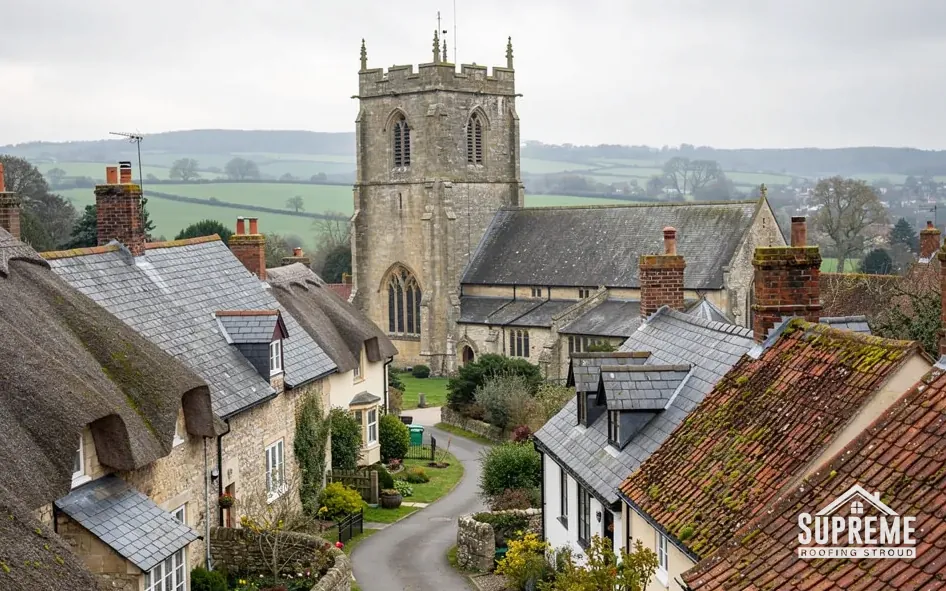
Village of thatched and tiled cottages around a stone church tower 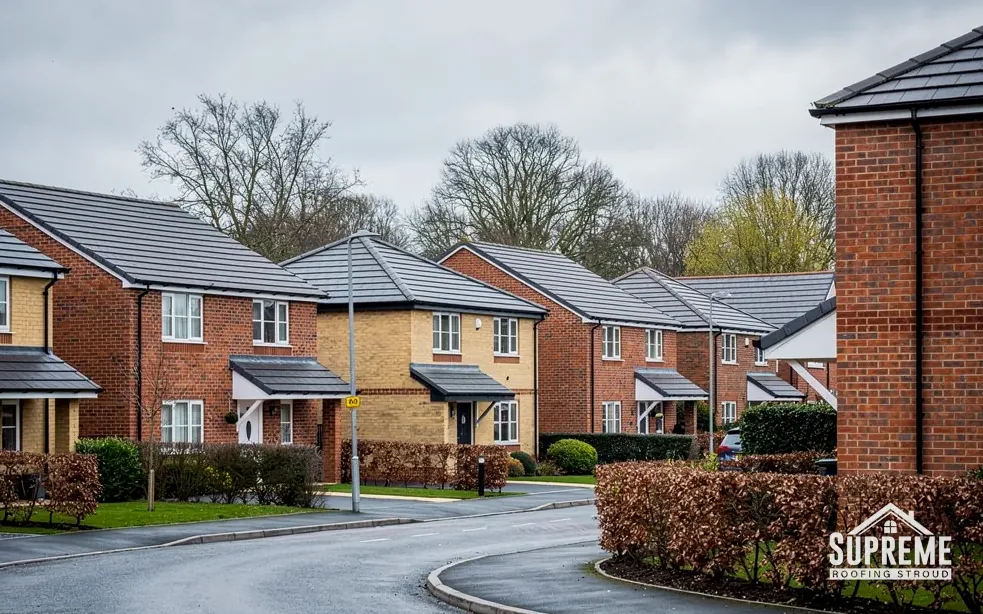
Modern brick housing estate with grey tiled roofs along a curving road
Chapter 01
Northfield Square and the Garden Suburb roofs of 1914
Roofs more than a century old are on their second life, or due a third.
Chapter 01In this chapter
When Gloucester devised its first council housing scheme in 1913 and completed it at Northfield Square in the spring of 1914, the planners were working to Garden Suburb ideals: houses set out in groups, with open space between them. For a roofer the interest is simpler. A group of houses built together has roofs of the same age and the same design, and by now they have all reached the stage where age, not accident, drives the repairs.
In this chapter
Lifespans give a sense of the timescale, with the usual warning that they depend on exposure and workmanship and are never a promise. Natural slate is quoted by MyBuilder at 80 to 100 years or more. Clay tiles are put at 40 to 60 years by MyBuilder and at a minimum of 60 years by the Building Research Establishment (via Marley), while the Building Conservation Directory calls the commonly repeated 'up to 60 years' a poor guide for roofs that have lasted for hundreds of years. A roof from 1914 may therefore be on its original covering, on a second one, or on a mixture, and only an inspection will say which.
On a roof that old we look closely at the parts that are not the covering. Timber battens and rafters can soften where water has crept in. Nails rust through. Lead around chimneys, in valleys and along abutments (the lines where a roof meets a wall) may have been patched with mortar or sealant in the past. Chimneys on older houses often stand tall and are shared by two properties, so repointing and flashing work should be agreed with the neighbour.
Keeping a group of houses looking like one
The appeal of that scheme was its layout, and one house re-roofed in a different material stands out along a row. Before recommending a covering we look at what the adjoining houses carry, and if the original tile is out of production we source the best available match for colour and profile. Houses that were built as a group also tend to be joined: a shared party wall, a shared ridge line or a stack that serves two fireplaces means work on one roof touches the next, so a conversation with the neighbour early on saves argument later. Our roof replacement page covers when a re-roof beats repeated repairs, and how the strip and re-cover are quoted.
If you rent, tell the landlord about any leak promptly and in writing. If you own, dig out the record of earlier work on the roof, because old invoices and photographs help the survey and tell us which parts have already been renewed. Loft insulation matters too: a loft that was boarded out and insulated at some point in the last century may hide damp timbers, so where the occupier agrees we lift a few sections of insulation and look underneath it.
On a century-old roof, most repairs come down to age.
| Covering | Typical life | Source |
|---|---|---|
| Natural slate | 80 to 100 years or more | MyBuilder, 2026 |
| Clay tiles | 40 to 60 years | MyBuilder, 2026 |
| Concrete tiles | 30 to 50 years | MyBuilder, 2026 |
| Lead flashing | Over 80 years if correctly installed | MyJobQuote, 2026 |
Chapter 02
The Grade II* tower of St Barnabas on Stroud Road
A listed landmark shows how permission works for protected buildings, and what it means for neighbours.
Chapter 02In this chapter
The Church of St Barnabas on Stroud Road is listed Grade II* (Historic England list entry 1271790), and its tower is a local landmark. It was built in 1938 and 1939 to a design by N. F. Cachemaille-Day. It is useful to Tuffley homeowners because it shows how protection works in a suburb that has no conservation area.
In this chapter
For a house or a church, listed status means that alterations affecting its character as a building of special architectural or historic interest need authorisation, and carrying out such work unauthorised is an offence under the 1990 listed buildings legislation (section 9). For a church that is in use, the route is different: the ecclesiastical exemption applies, and roof work is authorised by a faculty granted by the diocese. A church that is no longer in use, or a chapel that has been converted, normally needs listed building consent from Gloucester City Council instead.
There are two practical points for homeowners nearby. First, if your own house is listed, even like-for-like re-roofing should be checked with Gloucester City Council before work starts, and a covering of a different material is for the council to decide. Second, if you are not sure whether a garden wall, outbuilding or older boundary structure forms part of a listed property, ask the council's conservation team, and do not assume the answer.
Tall buildings, tall scaffold
A tower roof changes the economics of any repair. The scaffold may cost more than the slates it reaches, and it needs to be designed for the building. We allow for scaffold whether the job is a tower or a bungalow, and on a church or a large public building we agree access with whoever manages it before the date is fixed.
What to bring to a survey
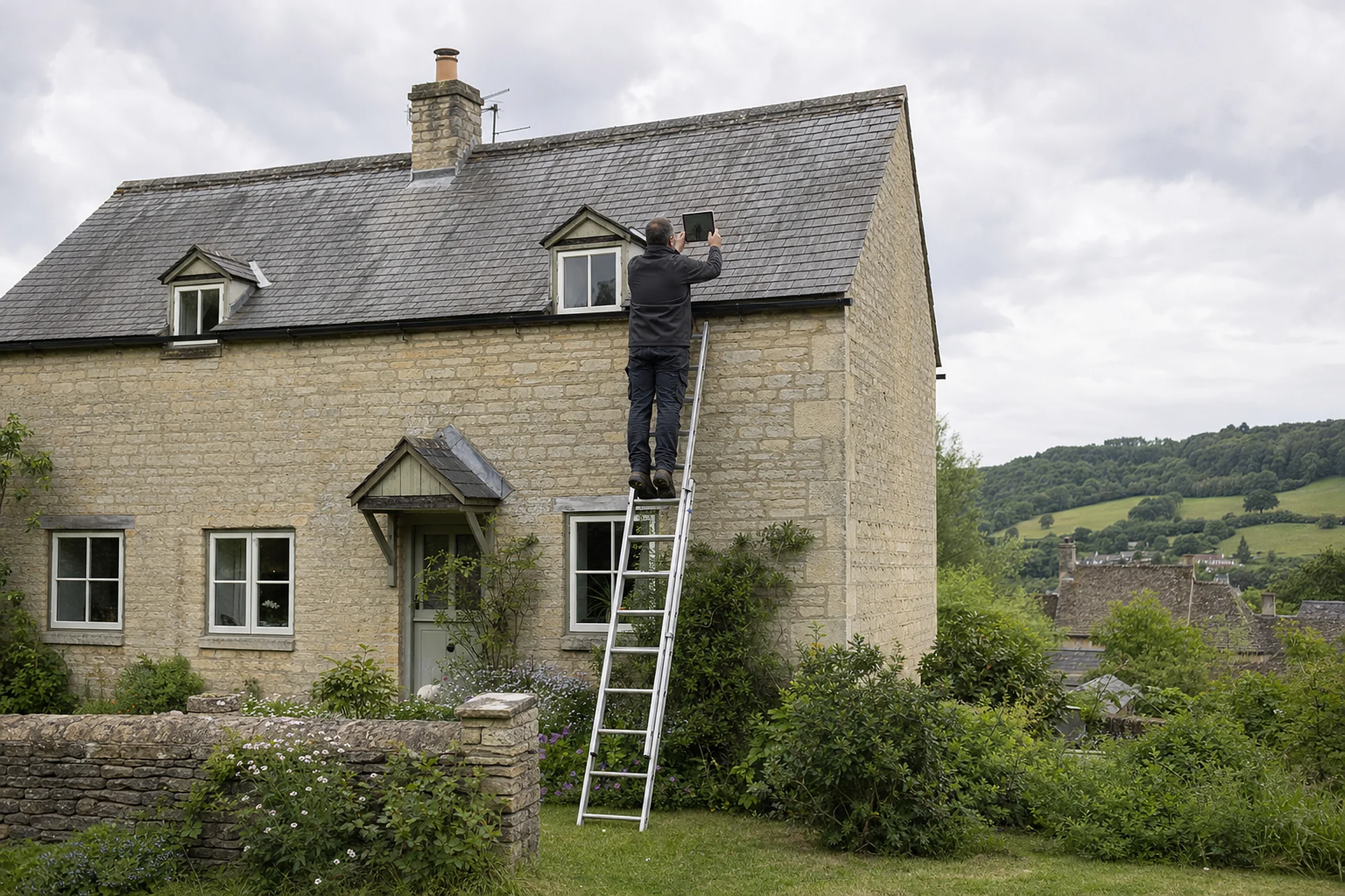
For any listed property, it helps to have the list entry number (the one above is the St Barnabas entry), any earlier consents, and photographs of past work. We can then say whether a repair looks like-for-like. Our guttering, soffits and fascias page covers a related job: leaking gutters and failing fascias often send water into walls and rafters, and old stonework or timber may need repairs of its own.
Chapter 03
Tuffelege to suburb, and who inspects your roof work
The 1900 boundary change put Tuffley under Gloucester, and building control is shared with Stroud.
Chapter 03In this chapter
Tuffley's parish disappeared in 1900, split between Gloucester, Whaddon and Quedgeley, so today the council that matters is Gloucester City Council. For roof work, there is a helpful link back to Stroud. Gloucester City Council and Stroud District Council deliver building control together as the Gloucestershire Building Control Partnership, with applications made through gbcpartners.co.uk. The partnership is run from Ebley Mill in Stroud, and its phone number is 01453 766321.
In this chapter
Re-roofing does not always need an application. Approval is not normally required when the work affects less than 25% of the building envelope and less than 50% of the roof. Past those limits the job needs approval, and the roof may then have to be upgraded to a better thermal standard under Part L, and any extra insulation appears on the quote under its own heading. A new covering that is 15% or more heavier also needs approval. If you choose a private registered building control approver instead of the council, the thresholds are the same.
We tell you which category your job falls into at the survey. Where work is notifiable, we handle the notification.
What a full re-roof tends to cost
A published cost guide tells you the scale of a re-roof before anyone visits. MyBuilder (updated 21 August 2026) puts a full re-roof at between £5,000 and £12,000, with gable roofs at £5,000 to £8,000 and hipped roofs at £8,000 to £12,000. Scaffold alone is about £1,125 in the same guide. These are national ranges, not our prices; the quote for your house follows the survey and is in writing.
From Stroud the survey is a short drive, so inspection and photographs are done in a single visit. Work in a suburb brings considerations of its own: cars parked on a narrow road, a driveway shared with a neighbour, a skip that needs a place to stand. We settle each of these in the access plan at the start, and the scaffold and skip are covered in the quote, so none of them arrives as a surprise on the day. Roofs here are close together, and the neighbours should hear about a start date before the poles go up.
Our roof inspections and surveys page explains what the photographs from the survey cover, including areas you cannot see from the ground.
Tuffley answers to Gloucester, yet the team that inspects its roofs works out of Stroud.
- Gable roof, low end£5,000
- Gable roof, high end£8,000
- Hipped roof, high end£12,000
- Scaffold, about£1,125
Map showing Tuffley and the Stroud service radius, with nearby towns we also cover.
Near Tuffley
Roof work we do here
St Barnabas tower and Northfield Square council houses
My house is near Northfield Square. Might the roof still be the first one?
Possibly. The Northfield Square scheme was finished in spring 1914, so any roof still carrying its first covering is over a century old. We confirm from the loft and from close photographs, and we look at battens, nails and lead as closely as at the tiles or slates themselves.
Does Tuffley have a conservation area, and does it affect my re-roof?
No. Gloucester's conservation areas lie elsewhere in the city, so the suburb is not covered by one. A listed house is different, and any change of covering there should be agreed with Gloucester City Council first. A like-for-like re-roof on an unlisted house seldom needs planning permission.
Who inspects roof work in Tuffley, Gloucester or Stroud?
Building control for Gloucester City is run jointly with Stroud District as the Gloucestershire Building Control Partnership, at gbcpartners.co.uk. Where the work is notifiable, we deal with that for you.
Can I get a gutter repaired without a full re-roof?
Often, yes. If the roof covering is sound, a leaking joint, a sagging run or a rotten fascia can be put right alone. We check the roof edge from a ladder first, photograph what we find and quote for the gutter work.