
Roofers in Hempsted
Hempsted stands on a hill above the Severn floodplain, with red clay ridge tiles and a fish-scale slate schoolhouse among its older roofs. We are 9.8 road miles away in Stroud.
Hempsted at a glance
- Distance
- 9.8 road miles north-north-west of Stroud
- Council
- Gloucester City Council
- Conservation area
- Hempsted, designated 28 November 1990
- Listed church
- St Swithun, Grade II*
Hempsted's roofs: clay tile, fish-scale slate and painted brick
Hempsted sits on a flat-topped hill of lower lias clay capped by gravel, with the River Severn flowing in a broad loop to the north, west and south. That description comes from Gloucester City Council's conservation area appraisal, and it explains the village's character: a small settlement raised above the floodplain, with the river on three sides.
The same appraisal is our best source on the buildings. It says locally made brick is the predominant material in the conservation area, and notes that the brick is mostly painted white or rendered. Several of the older buildings have roofs of red clay tile with decorated ridge tiles. The former National School of 1851 at No. 28 St Swithun's Road has a roof of shaped Welsh slates laid in a fish-scale pattern. The lias clay was also quarried for brickmaking in the late nineteenth century.
History runs deeper than the brick. The manor was given to Llanthony Priory in 1141 and held by it until the Dissolution. The Church of St Swithun is listed Grade II*. And the Hempsted Conservation Area was designated by Gloucester City Council on 28 November 1990, which means any work here sits in a protected setting.
In practical terms this is a village where matching what is there is the working rule, not a slogan. A decorated clay ridge is a feature to be kept. A fish-scale slate pattern is a feature to be matched slate by slate. The conservation team at Gloucester City Council is the first place to ask when a job goes beyond repair. We report what is on your roof in photographs, then quote the matching work.

Detached red brick Edwardian house with mock-Tudor gables and a tiled roof 
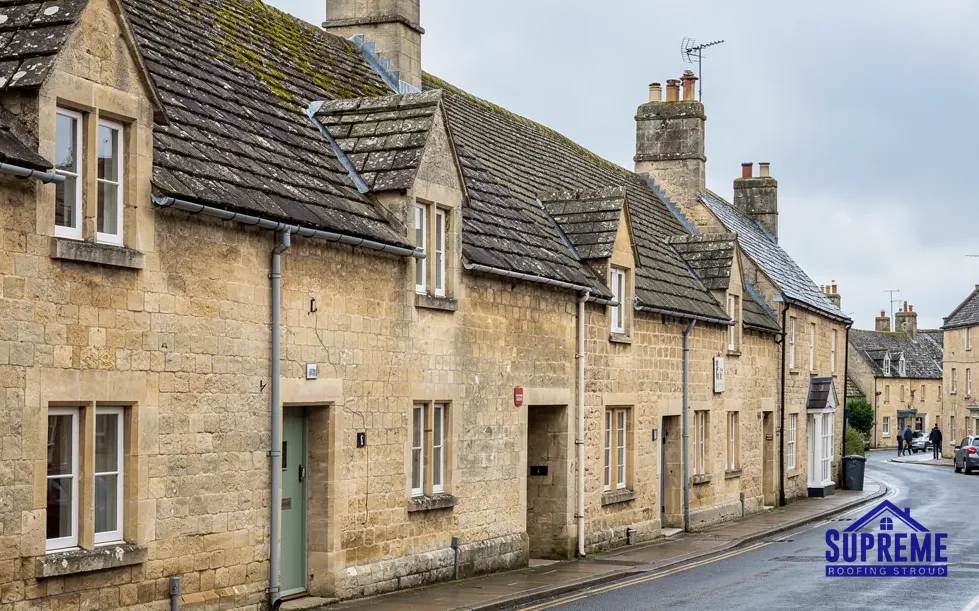
Stone terraced houses with slate roofs and chimneys stepping up a hill
Chapter 01
Red clay tiles and the decorated ridge
Several older Hempsted buildings carry clay tile with ornamental ridge tiles. Keeping them means careful repair, not a quick swap.
Chapter 01In this chapter
Gloucester City Council's appraisal singles out the red clay tile roofs with decorated ridge tiles. A decorated ridge is a row of shaped clay pieces, each with a crest or a pattern, set along the top of the roof. It is part of the look of a building, and where one cracks the instinct is to replace the whole run with plain tiles. In a conservation area that is the wrong move, both visually and in planning terms.
The practical work begins at the ridge. Ridge tiles were traditionally bedded on mortar. After the 2014 revision of BS 5534, a new repair adds mechanical fixings to the bedding. For a decorative ridge, the fixing method has to be agreed rather than assumed, because the shape of the tile may not suit a standard clip or a dry-fix system. Our pitched roofing page covers how ridge, hip and verge work is carried out and priced.
Clay tile lifespans are given as ranges that disagree. MyBuilder says 40 to 60 years. Marley cites a BRE minimum life expectancy of 60 years, and the Building Conservation Directory argues that roofs hundreds of years old show the 60-year figure to be an unreliable guide. For a Hempsted roof, that spread is a reason to judge on condition. We inspect each tile for frost damage, delamination and nibs that have broken, and count how many need replacing before deciding whether to re-lay the slope or repair it piece by piece.
Matching is the real challenge. Clay differs in colour and texture with its source and firing, and new tiles will look different next to weathered ones. We source matching tiles where possible and, on a visible slope, we sometimes re-lay the sound tiles on the front and use the replacements on a rear slope. The written quote lists which approach is proposed, tile by tile where it matters, and the survey photographs show the starting condition.
Chimneys on these buildings add another layer. A brick stack that has been painted or rendered hides its own condition, and the first sign of failure may be a damp patch on a bedroom wall rather than anything visible on the roof. We check the flashing and the flaunching, and if the stack needs repair, the pitched roofing work and the stack work are planned together so the scaffold is only erected once.
The brick below the roof matters as well. Since much of the village brick is painted or rendered, a leaking gutter or a failed flashing shows up on the face as staining or blistered paint. A paint failure can be the first sign of a roof fault, and we trace it upward.
A decorated ridge is a feature to be kept, and a crack in it is a reason to repair it as it was.
Myth: A cracked decorative ridge can be replaced with plain tiles without anyone noticing.
Fact: In a conservation area a change to the look of the ridge is a change to the building's appearance, so matching tiles are the safe course and the planning team is the place to confirm.
Chapter 02
A schoolhouse roof of shaped Welsh slates
The former National School of 1851 shows what fish-scale slating asks: cutting, patience and matching one slate at a time.
Chapter 02In this chapter
The former National School at No. 28 St Swithun's Road, dated 1851, has a roof of shaped Welsh slates laid in a fish-scale pattern, according to the council's appraisal. In fish-scale slating, each slate has a rounded or pointed lower edge, and the slates are laid in staggered courses so the edges form a pattern like overlapping scales. The pattern is decorative and it is also functional, because the overlap sheds water.
That makes repairs different from plain slating. A broken shaped slate cannot be replaced with a rectangular one, and the replacement has to be cut or sourced to the same shape and size. If many have gone, the repair becomes a supply problem before it is a roofing problem, so we check availability early and say in the quote whether the slates are new, reclaimed or cut to match. English Heritage policy, reproduced in Cotswold District Council's 2000 guide for stone slates, says new slates should match in colour, texture, size and thickness, and the same logic applies to Welsh slate.
Welsh slate is also a premium material. MyBuilder's 2026 guide puts a Welsh slate re-roof at £140 to £180 per square metre installed, against £100 to £130 for Spanish slate, and a single replacement slate at £60 to £120. Lifespan figures run from 80 to 100 years or more, and a well-kept roof can pass a century. We do not swap Welsh slate for Spanish to lower the cost; like for like is the principle, and the quote shows the difference if you ask for it.
Fixings need the same attention. Slates are held by nails, and nails rust. When a slate slips, the cause is usually the nail, so we lift adjacent slates to check the fixings and replace them with copper or stainless alternatives where appropriate. The slate roofing hub explains the choices and the costs in full.
A roof like this rewards a proper survey. Fish-scale patterns hide cracked slates until they fall, so we look at the slope from close range, from a ladder or from scaffold, and not from the ground. The roof inspections and surveys page shows what a survey records and what it costs nationally.
Eaves and verges need a mention too. On a school or a cottage with a shaped slate roof, the edge detail is part of the pattern, and a plain new verge or eaves course would break it. We record how the pattern finishes at each edge before any slate is lifted, so it can be rebuilt exactly.
- Spanish slate re-roof£100 to £130 per m²
- Welsh slate re-roof£140 to £180 per m²
- Slate roofs overall£100 to £180 per m²
Chapter 03
A lias clay hill, a priory manor and the 1990 conservation area
Ground, history and designation all bear on the roof work that is open to you here.
Chapter 03In this chapter
The hill beneath Hempsted is lower lias clay capped by gravel, and the appraisal records that the clay was quarried for brickmaking in the late nineteenth century. Clay ground can move as it wets and dries, and walls above it can shift slightly. We cannot say that happens to any particular house, but it shapes how we repair. Rigid mortar fillets at a chimney or along a gable crack easily if the wall moves, while a lead flashing, which flexes, tolerates small movement better. On a Hempsted survey we look at the brick for hairline cracks and at the flashings for signs of tearing.
The village history gives it a second layer. The manor was given to Llanthony Priory in 1141 and held until the Dissolution. Buildings from that long past may be older than the brick that now clothes them, and a house that appears Victorian from the road can have older timbers behind the render. A survey of the roof void tells us what is there.
The conservation area, designated on 28 November 1990, sets the framework. A like-for-like re-cover leaves the outside looking as it did, so in the ordinary way it sits outside planning control. An Article 4 direction can change that, and the city's planning team is the place to check for your address. Changing material, such as clay to concrete or slate to a composite, is a change of appearance and a matter for the council. Roof windows have their own rules, set out on our roof windows in conservation areas page.
The Church of St Swithun, listed Grade II*, is a separate case. As a working Church of England church, it takes its roofing permission from the Diocese of Gloucester in the form of a faculty, and the council plays no part. Anyone who has bought a former church or chapel in the area should treat it differently, because the exemption ends with the use. In both cases the roofing questions are the same: what is the covering, what is the lead doing, and where does the water go?
Whatever the building, the survey comes first. You receive photographs of your own roof with a written quote. If the job turns out to be notifiable under Building Regulations, we set out the route and file the notification, and when the work ends we clear the site and take the waste away.
Map showing Hempsted and the Stroud service radius, with nearby towns we also cover.
Near Hempsted
Roof work we do here
Fish-scale slate schoolhouse and painted brick in Hempsted
Can a cracked decorative clay ridge in Hempsted be repaired rather than replaced?
Often. Sound ridge tiles can be lifted, re-bedded and mechanically fixed, with matching pieces substituted for cracked ones. The fixing method is agreed for the tile's shape, and the conservation area makes plain replacements a poor choice.
What happens if a fish-scale slate breaks and no matching one is available?
Replacement slates are cut or sourced to the same shape and size. We check supply at the survey and state on the quote whether the slates are new, reclaimed or cut to match, before any date is set.
Does re-roofing a painted brick house inside the Hempsted conservation area need consent?
Matching the existing covering rarely calls for permission, whereas a different material becomes a question for Gloucester City Council. Ask its planning team whether an Article 4 direction touches your address.
Does the clay hill matter to my roof?
It can affect walls, and walls affect the junctions on the roof. We check gables, stacks and abutments for cracks and use flashings that tolerate small movement. The photographs from the survey record the starting condition.