

Roofers in Westbury-on-Severn
Repairs, lead and flat roof work in Westbury-on-Severn, where brick houses, old farm buildings and a Grade I tower sit between the river loop and the Forest of Dean hills.
Westbury-on-Severn at a glance
- Distance
- 18.7 road miles west-north-west of Stroud
- Council
- Forest of Dean District Council
- Conservation area
- Westbury on Severn, designated 1989
- Listed church
- St Peter and St Paul, Grade II*
Brick roofs and river-level land in Westbury-on-Severn
The parish of Westbury-on-Severn runs from the River Severn up towards the Forest of Dean hills, and its southern half of the parish sits inside a loop of the river close to river level. The Victoria County History records severe floods there in 1852 and 1899. A parish with that history builds, repairs and drains differently from one on a hilltop, and its roofs are part of that story.
The same history makes a plain statement about the buildings: the predominant building material is brick. Coarse blue Lias stone quarried at Chaxhill in the later nineteenth century went into houses and walls, and some cottages in the east are of Old Red Sandstone. Timber-framed buildings are fewer than you might expect, though there are more of them than is obvious, because rough-cast and other facings hide the frames. Hutts Farm carries the date 1665 on a beam.
Later growth is easy to place. Mid-twentieth-century council houses went up south of Rock Farm, and new bungalows and houses extended Northwood Green, with more council houses there in the late 1950s. From Stroud it is 18.7 road miles to the west-north-west. Westbury's own conservation area was designated by the Forest of Dean district on 29 June 1989.
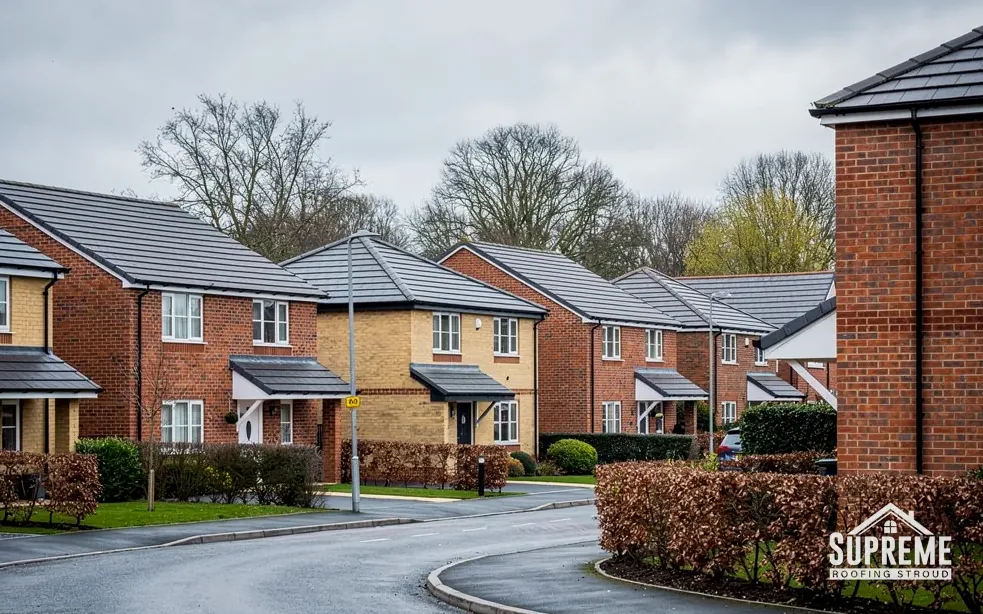
Modern brick housing estate with grey tiled roofs along a curving road 
Hillside of stone terraced houses with mossy stone tile roofs and chimneys
Chapter 01
The Grade I tower and spire, and what stands in its shadow
A listed church and its surroundings set the standard for careful roof work in Westbury.
Chapter 01In this chapter
The parish church takes its name from St Peter and St Paul and is Grade II* listed. Its tower and spire have a separate Grade I listing. The listing grades tell you that this is a church of real standing, and it is surrounded by cottages, farms and houses that also deserve a careful hand, even where they carry no listing of their own.
In this chapter
A tower and spire are specialist work, and we would not pretend otherwise. What we can say is how a roofer thinks about them. Any roof that rises to a point, such as a spire or a tower with a steep cap, has junctions where lead meets masonry, and the lead flashings and soakers there have to move with the structure without cracking. The right sheet is a matter of code and thickness: Code 4 is widely used for general flashing work, while heavier codes suit gutters and valleys. The lead roofing page sets out each code and where it belongs on a roof.
For a church in use, a faculty granted by the diocese covers roof work so no application goes to the council. A house or outbuilding nearby is different. If it is listed, works that alter its character need listed building consent from the council, whatever the grade, indoors or out. If it stands inside the Westbury on Severn Conservation Area, a like-for-like repair is usually straightforward, while swapping materials or adding a feature is something to raise with the Forest of Dean planners before any order is placed.
For churchyard walls, porches and other small roofs close to a listed building, the neighbouring listing is a reason to ask first and price second. A short call to the council costs nothing, and it can save a stop order or a costly rework.
Reading the roofline from the street
You can learn a good deal from the ground. Look along the ridge for dips, which can point to a structural fault. Check the verges for tiles that have shifted and lifted, and look at the chimneys for leaning, loose pointing or cracked flashings. Take a photograph from the same spot each season, and you will see change that is easy to miss day to day. Send us the pictures with the date taken, and we can often tell whether a visit should be a repair, a survey or just a check.
For work on any older building here, the aim is to mend the roof in the material it already has. That is cheaper than it sounds when it prevents a more disruptive repair later.
Lead on a tall, old roof earns its keep at the junctions, where the structure moves.
| Code | Thickness | Typical use |
|---|---|---|
| Code 3 | 1.32 mm | Soakers |
| Code 4 | 1.80 mm | General flashing work |
| Code 5 | 2.24 mm | Flashings, pitched valley gutters |
| Code 6 | 2.65 mm | Larger roofs |
Chapter 02
Brick, blue Lias and rough-cast: reading the walls under the roof
Brick, stone and hidden timber frames all meet the roof at the wall head, and each wants its own repair.
Chapter 02In this chapter
The County History is plain about Westbury: the predominant building material is brick. Where a roof sits on brick, the junction between the wall and the covering is the place to look. Brick parapets, chimney stacks and gable ends all meet the roof with flashings, and those flashings are only as good as the pointing they are fixed into. A lead flashing tucked into a crumbling joint will not stay put, and the repair then starts with the masonry, not the lead.
In this chapter
Blue Lias stone, coarse and quarried at Chaxhill in the later nineteenth century, appears in houses and walls. Old Red Sandstone appears in some of the eastern cottages. Stone walls behave differently from brick: they can hold more moisture, and their joints are often wider and softer. We never push a hard cement mortar into a soft stone wall, because it can trap damp and damage the stone, so pointing around a flashing is done in a mix suited to the wall.
Then there is the timber. Westbury has fewer timber-framed buildings than many villages, but there are more than are obvious, because rough-cast and other facings cover them. Hutts Farm, with 1665 carved on a beam, is a reminder that an unremarkable front can hide a seventeenth-century frame. If your house is one of them, then the roof structure is likely to be old as well, and the plan should respect it. Strengthening is possible, but replacement of old oak with new is a last resort.
Dating the roof matters here too. A cottage whose walls are Old Red Sandstone, a house of brick and a farm building with a seventeenth-century frame under rough-cast will each have been re-roofed at different times, in different coverings, with differing nail and batten conditions. That history shapes what a survey finds, and it is why we photograph both faces of the roof, one seen from inside the loft and one from the ladder.
Repairs that keep the building dry
Many repairs in a brick village are small: a slipped tile, a cracked hip, a stack that needs repointing. MyBuilder's 2026 guide puts a minor roof repair at £100 to £300, and a moderate one at £500 to £1,000, as national ranges that depend on access and extent. After a survey, our quote covers your repairs. Our roof repairs page describes how we handle a leak, from the make-safe to the lasting fix.
Myth: A hard cement mortar is the strongest repair for any old wall.
Fact: Cement can trap moisture in soft stone and brick, so pointing around a flashing is matched to the wall it sits in.

Chapter 03
A parish in a river loop: damp, drainage and the flat roofs of later houses
Low ground and mid-century building shape the problems we meet at Northwood Green and south of Rock Farm.
Chapter 03In this chapter
The southern half of the parish sits within a loop of the Severn, close to river level, and the Victoria County History records severe floods in 1852 and 1899. Roofs do not flood, but low land affects them in other ways. Ground that stays wet is a poor base for scaffold, so we check the bearing under every standard and use sole boards to spread the load. Damp air and wet ground also keep walls and timbers damp, which makes any leak in the roof worse, as the water has nowhere dry to go.
In this chapter
If a house has been flooded at ground level, check the roof as part of the recovery. Water inside a building rarely comes from the roof alone, but the loft is where some damp problems show first. Stains on ceilings, a musty smell or condensation on the underside of the covering all deserve a look. Ventilation matters: under BS 5250, a cold roof needs a flow of air at the eaves, and blocked insulation can cut it off.
Mid-twentieth-century building adds its own layer. Council houses went up south of Rock Farm, and bungalows and houses extended Northwood Green, with more council houses there in the late 1950s. Houses of that era sometimes gain extensions, porches or garages later, and where one of those has a flat roof it deserves its own look. BS 6229 guidance is to design a flat roof to a 1:40 fall so that the finished fall is 1:80, which keeps water moving to the outlet instead of lying in pools.
Gutters and downpipes carry the water away from low ground, so they matter more here than on a slope. Outlets are checked for blockage, joints for leaks and falls for ponding, because a gutter that spills against a wall at river level soaks the foundations as well as the brickwork.
Choosing a flat roof covering
MyBuilder's 2026 flat roof guide gives national ranges per square metre: bitumen felt £70 to £100, EPDM £90 to £130 and GRP £95 to £150. EPDM is a synthetic rubber membrane, and GRP is glass-reinforced plastic, laid as a continuous skin with no joints across the deck. The right one depends on the shape of the roof, its access, and how many penetrations it has. Our flat roofing page compares them. Your quote will cover the covering, the insulation, the edge trims and the waste removal, so you can compare like with like.
- Bitumen felt£70 to £100 per m²
- EPDM£90 to £130 per m²
- GRP£95 to £150 per m²
Map showing Westbury-on-Severn and the Stroud service radius, with nearby towns we also cover.
Near Westbury-on-Severn
Roof work we do here
Blue Lias walls and the Grade I tower
Can a brick house in Westbury-on-Severn be repaired without disturbing a hidden timber frame?
Usually, yes. Westbury has more timber-framed buildings than are obvious from the street, because rough-cast and other facings cover them. During the survey the rafters and purlins are checked from within the roof space, and where an old frame is present the repair works with it and keeps the existing timbers wherever they are sound.
My home is close to the church. Does the Grade I listing of the tower affect my roof?
Not directly, since a listing attaches to the building it names. A listed house of your own, or one inside the conservation area, falls under separate rules, and the district council's planners can tell you which apply. We price the repair once you know.
Does living on low ground near the river change how the roof is repaired?
It changes the access more than the roof. We test the ground for the scaffold, board it where it is soft, and look hard at damp in the loft. A leak over a damp wall is harder to trace, so the survey records both the covering and the ceiling below.
Is a flat extension at a 1950s or 1960s house worth patching or replacing?
It depends on the deck, the falls and how far the damp has gone. A local patch can last when the deck is sound. If water lies in pools or the deck has softened, replacement is usually better value, and we show both options with their separate costs.