
Roofers in Newnham on Severn
Ridge, verge and re-roofing work in Newnham on Severn, the old river port on its bluff above the Severn, where plaster hides timber frames and a conservation area covers the centre.
Newnham on Severn at a glance
- Distance
- 21.6 road miles west-north-west of Stroud
- Council
- Forest of Dean District Council
- Conservation area
- Newnham Conservation Area
- Church
- St Peter, Grade II listed
The roofs of the Severn bluff at Newnham
Newnham stands on a bluff rising from the right bank of the Severn, above flood level, at the point where a ford and a ferry once crossed the river. A cliff-edge promontory called the Nab projects into the water at the southern end. Newnham was called a borough from 1187 and was long the only Gloucestershire borough west of the Severn, which is a lot of civic history for a town of its size.
The port's role declined rapidly after the Gloucester and Sharpness Canal opened in 1827, and the buildings left behind reflect that history: houses and premises built for a trading town, now serving a quieter one. The Victoria County History notes that most of the town's sixteenth and seventeenth-century timber framing is hidden behind rough-cast or plaster, and shows mainly at the rear elevations and in outbuildings. What shows from the street can be much newer than what stands behind it.
Later housing is easier to place. Council houses were built near the station in the 1930s, and 20 more went up on the Littledean road in the 1950s and 1960s. The drive from Stroud is 21.6 road miles, heading west-north-west. Newnham Conservation Area covers the centre of the town, and the Grade II church of St Peter stands on the higher ground where it was built in 1366.
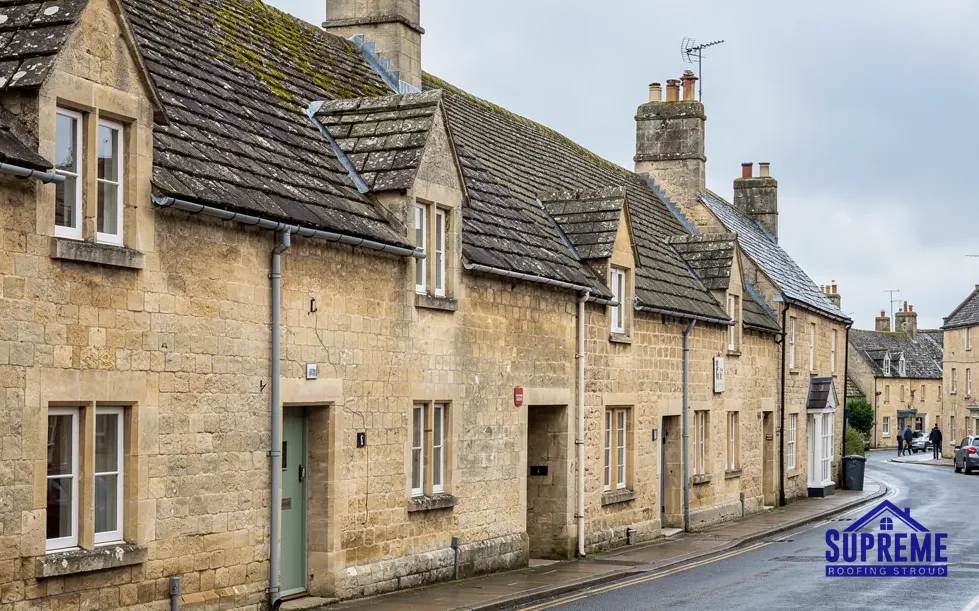
Terrace of stone cottages with dormer windows and stone tile roofs 
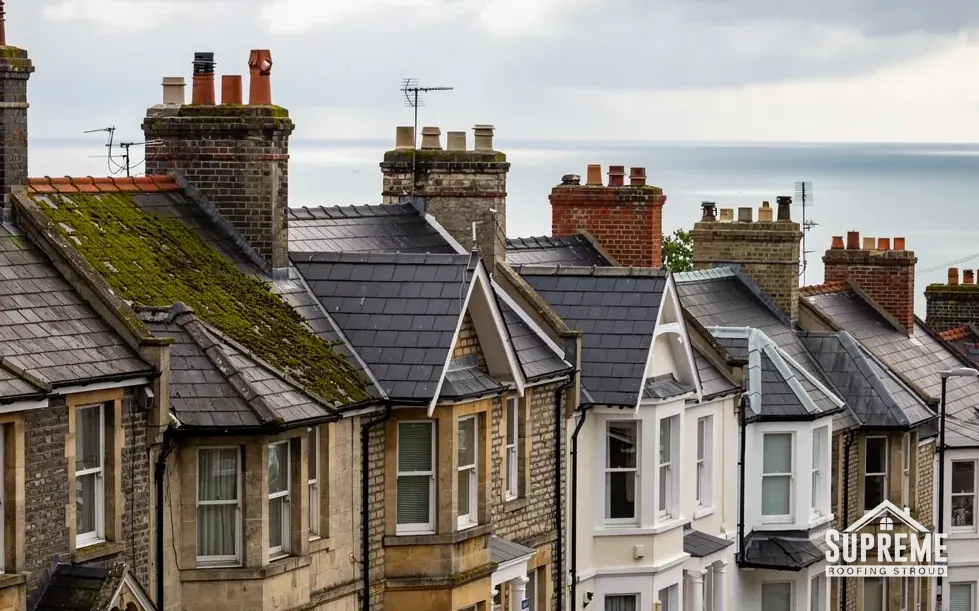
Hillside terraces of stone houses with slate roofs and chimneys

Chapter 01
A borough since 1187: the main street and its commercial roofs
A trading town has shops, inns and workshops, and their roofs need a firm plan.
Chapter 01In this chapter
Newnham was called a borough from 1187, and a town with that standing builds for trade. A port needs premises as well as houses, and a building that combines a shop or workshop with rooms above is a common pattern in such towns. Where a building like that is split between owners or tenants, a single roof may answer to several people.
In this chapter
Roofs on mixed-use buildings have particular demands. A shop that has a flat-roofed extension at the back, a pitched roof over the upper floor and a shared chimney stack has three different roofs to look after, and each fails in its own way. The flat roof leaks at the upstand, the pitched roof at its valleys and the stack at its flashings. Commercial owners also need the work to happen without losing trading days, so deliveries, scaffold and the noisy stages are timed around opening hours. Our commercial roofing page describes how we plan work around a business.
The Newnham Conservation Area applies to the centre, and the council that decides planning matters is Forest of Dean District Council. A like-for-like repair rarely changes the outside of the building, but a new covering, a new rooflight or a change to a street frontage might. Put the question to the council before you place an order, and keep the quote in the same material as the roof it replaces.
Landlords, tenants and shared roofs
Where a roof is shared, responsibility is rarely obvious. A lease may put the roof on the freeholder, or it may pass the cost to the occupiers through a service charge. Before commissioning a survey, establish who holds the repairing obligation, since that person signs off the quote. We can send the survey photographs to more than one party so that everybody sees the same evidence, which makes agreement easier.
It is also worth knowing who will let us onto the roof. A flat roof behind a shop may be reached through a first-floor flat, and a lane at the back may be shared with a neighbour. Those facts are easy to establish in advance and expensive to discover on the day.
A shop roof, a flat roof and a shared stack are three jobs that happen to sit on one building.
Chapter 02
Timber frames behind plaster and rough-cast
At Newnham the oldest structure is often at the back, and the roof above it deserves a gentle hand.
Chapter 02In this chapter
The County History is specific about Newnham's early timber framing: most of it is hidden behind rough-cast or plaster, visible mainly at rear elevations and in outbuildings. That tells a roofer where to look. The front of a house in the old part of town may say little about the roof frame inside it, whereas a back wall or a lean-to can show jointing, pegging and timber sizes that belong to the sixteenth or seventeenth century.
In this chapter
This matters because an old timber frame reacts to the roof above it. Rafters and purlins that have carried a covering for centuries have settled into their shape, and a heavier covering can force movement. Building control gets involved once a covering is around 15 per cent heavier or more, with a structural check on the roof frame, which makes a switch from a light covering to a heavy one a decision with consequences. We start by finding out what the roof carries today, and we keep the weight close to that unless a structural reason says otherwise.
Fixings are the other consideration. Ridge and verge tiles on older houses were bedded in mortar, and BS 5534:2014 no longer accepts mortar alone as the thing holding them down. A mechanical fixing is added, or the ridge is replaced with a dry-fix system tested to BS 8612. A dry ridge removes the mortar joint that cracks and drops, and MyBuilder's 2026 guide puts dry ridge at about £40 to £60 per metre as a national figure. Our ridge, verge and dry-fix page explains what is replaced and what stays.
The bluff itself shapes the visit. Newnham stands above the river on higher ground, so access varies from street to street. Some frontages meet the pavement directly, while rear gardens may fall away or be reached only through an alley. We note this at survey, agree where materials will be stored, and allow for the scaffold in the quote.
Working from the back
Because the old fabric shows at the rear, the survey starts there. Outbuildings and rear extensions tell us about the age of the main structure and about how past repairs were done. Photographs of those rear slopes go into the report beside the front elevation, so you see what we see. If plaster or rough-cast meets the roof edge, the junction needs particular care, as a gap there lets water behind the render and into the frame.
Where work disturbs old timber, we stop and look before going further. Cutting into a frame is a last resort.
- Dry ridge per metre£40 to £60
- Typical dry ridge job£500 to £1,000
- Re-bedding ridge tiles£300 to £600
Chapter 03
From the station estate to the Littledean road: replacing the roofs of the 1930s and later
Council houses built between the wars, and again in the 1950s and 1960s, are now reaching their next roof.
Chapter 03In this chapter
The station estate and the Littledean road houses are the two groups of public housing in the record. Houses of those decades have carried a covering for a long time, and some are on a second. At that stage the question is whether to repair or to replace.
In this chapter
A repair makes sense when the problems are local and the structure is sound: a few slipped tiles, a failed section of ridge, a stack flashing that has lifted. Replacement makes sense when the covering is failing across the whole slope, the battens have softened, or the underlay has split. MyBuilder's 2026 guide gives national typical figures for a full re-roof of £5,000 to £12,000, with a gable roof at £5,000 to £8,000 and a hipped roof at £8,000 to £12,000. Your own figure depends on size, access and covering, and it comes after the survey as a written quote. Our roof replacement page explains the stages from scaffold to clear-up.
The houses by the station and the later ones on the Littledean road were put up by the council in different decades, so the two groups should not be assumed alike. We ask when a house was built, look at the roof structure from the loft, and note any earlier repairs. A patch of newer tiles in an older roof, or a section of replaced battens, shows where past leaks were fixed and where the next one is likely to appear.
What a strip reveals
When an old covering comes off, the timbers underneath are on show for the first time in decades. Rafters are checked for rot and woodworm, battens are replaced, and any weakness in the wall plate is dealt with before the new covering goes on. Insulation can be improved while the roof is open. Insulation fitted in the roof or loft of a home carries zero VAT until 31 March 2027, whereas the covering and labour around it are charged at the standard rate, and your quote lays this out.
Notification is part of the process. A re-roof touching under 25 per cent of the building envelope and under 50 per cent of the roof usually falls outside Building Regulations approval. Past those limits approval applies, and Part L can ask for better insulation. We tell you where your roof sits against them and handle the paperwork when it applies.
Matching along a road
Where a pair or a terrace was built together, a new roof on one house will be seen next to the old covering on its neighbour. We look at the colour and profile alongside, and discuss the match before ordering tiles. The finished roof is cleared of debris, and the old covering and rubbish are taken away at the end.
Map showing Newnham on Severn and the Stroud service radius, with nearby towns we also cover.
Near Newnham on Severn
Roof work we do here
Plastered timber frames on the Newnham bluff
Newnham's old timber frames are hidden behind plaster. Does that change a roof repair?
It changes where we look. Early framing shows mainly at the rear and in outbuildings, so the survey starts there. If the roof above an old frame needs re-covering, we keep the weight close to what it carries now and avoid cutting into timbers that are sound.
Is the centre of Newnham a conservation area, and does that stop me re-roofing?
Newnham has a conservation area, and it does not stop a re-roof. A like-for-like covering does not usually change the outside of the building. A new material or roof feature should go to Forest of Dean District Council's planners before you commit.
Who pays for the roof on a shop with a flat above it in Newnham?
That depends on the lease or the title, not on us. Find out whether the freeholder or the occupiers hold the repairing obligation, and we will send the survey photographs and the written quote to every party who needs to agree.
Do 1930s council houses near the station need the same roof work as the 1950s houses on the Littledean road?
Not necessarily. Different decades were framed and covered in different ways. We look at rafters, battens and underlay on survey, and the quote reflects what your own house needs rather than what the next one down the road had done.