
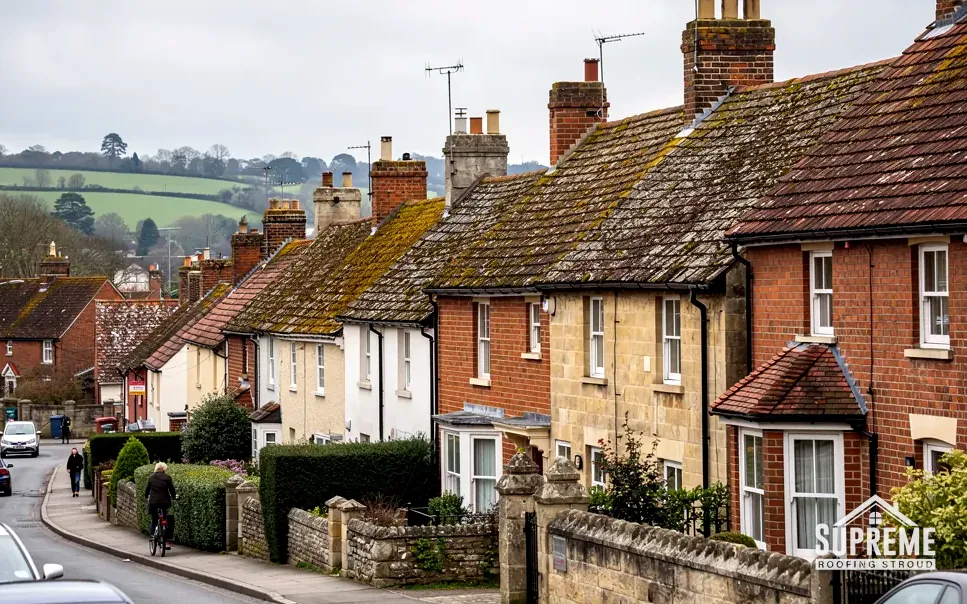
Roofers in Twyning
Twyning climbs a slope above the River Avon near Tewkesbury, with Tudor black-and-white houses, a Grade II* church in its older part, Churchend, and a name said to mean between the rivers.
Twyning at a glance
- Distance
- 27.1 road miles north of Stroud
- Council
- Tewkesbury Borough Council
- Setting
- Slope above the River Avon near Tewkesbury
- Listed landmark
- Church of St Mary Magdalene, Churchend, Grade II*
Twyning's roofs, on the slope above the Avon
Twyning lies on the River Avon near Tewkesbury, on a slope above the river. That position means the village largely avoids the regular local flooding, although riverside properties such as the Fleet Inn were affected in 2007. The parish is first mentioned around 1016 as Tuinaeum, a name said to mean between the rivers, and a roofer working here is always aware of water in the landscape even when the village itself sits above it.
The older part of the village is called Churchend, and it is where the Church of St Mary Magdalene stands, listed Grade II*. A ferry crossing operated from medieval times until 1963, and was briefly reinstated in 1996. Wikipedia notes that a number of original black-and-white Tudor houses still stand in the village, which is the single most useful fact for anyone planning a roof here. A black-and-white house is a timber-framed house, and its roof has to be treated as part of the frame.
With a population of 1,835 at the 2021 census, Twyning is larger than the hamlets around it, and it has had time to gather houses of many kinds beyond the Tudor core. Churchend lies inside the Twyning Conservation Area, which takes in the church and churchyard and listed houses such as Glebe Cottage and The Rookery, and Tewkesbury Borough Council is the authority to ask about it.
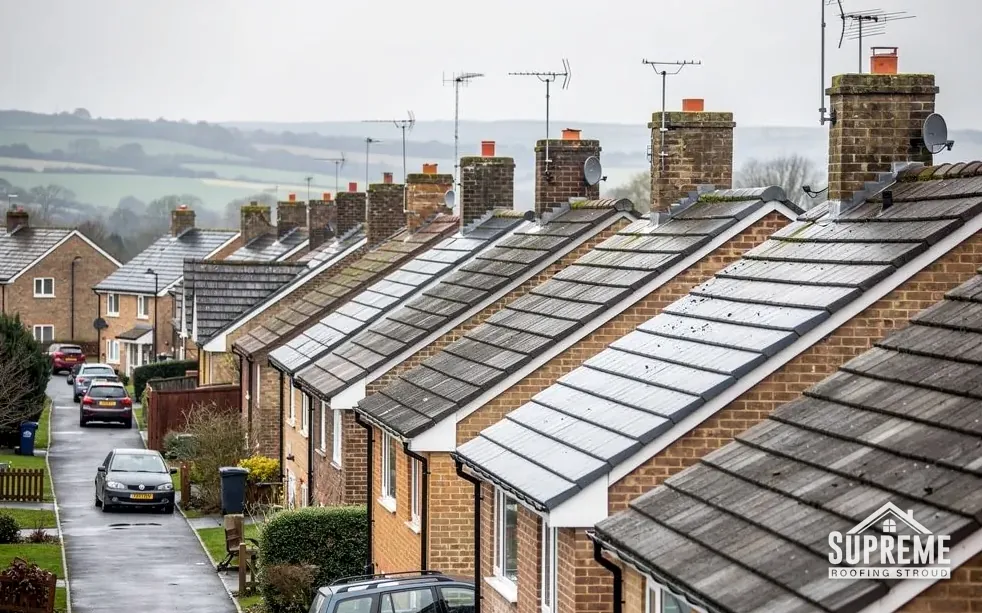
Terraced houses on a hillside street with tiled roofs and brick chimneys 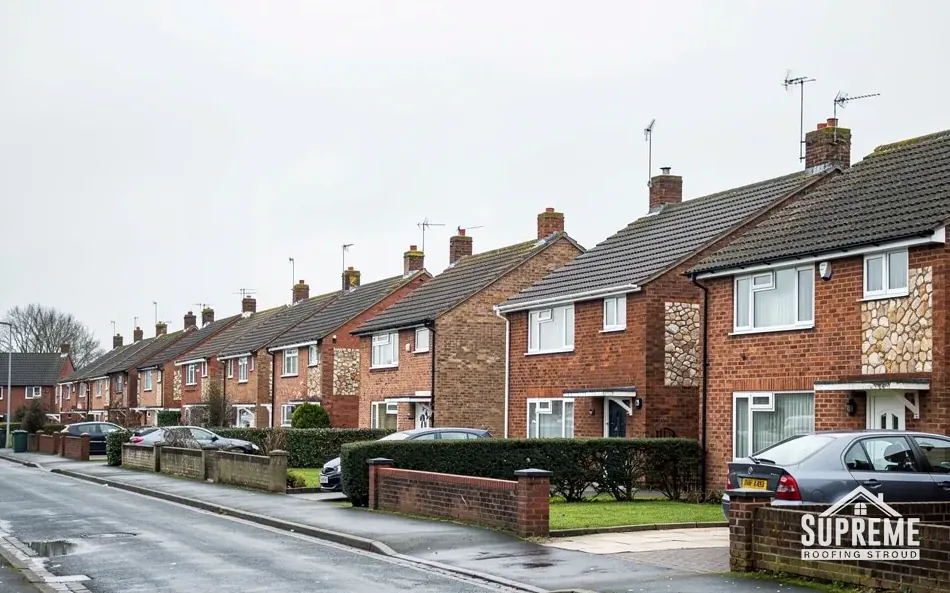
Street of red brick terraced and semi-detached houses with parked cars

Chapter 01
A slope above the Avon: rain, runoff and the Fleet Inn lesson
A village above the flood line still has to deal with water coming off a hill.
Chapter 01In this chapter
A house on a slope above a river has a different relationship with water than one on the flat. The river may not reach it, but rain runs downhill, and a roof at the top of a slope delivers a large amount of water to the plots below. Twyning's position means the village mostly avoids the regular local flooding, yet the Fleet Inn and other riverside properties were affected in 2007. For anyone with a roof near the bottom of the slope, the practical lesson is to keep every part of the rainwater system working.
That begins with the gutters and the downpipes. When a joint lets go, the gutter does more than wet the wall; it sends a stream down the face of the building to the foot of the wall, where the ground already carries water from above. Joints are the usual weak point, and their seals harden and open with age. Replacing a sealed union is a minor task, while a leaking joint ignored for years can mean a damp wall, softened fascia and rot in the rafter feet. The roof repairs page sets out the typical cost of the smaller jobs.
Roof slopes follow the same logic. A leak that shows low on a hillside house may start higher up, where a flashing or ridge has failed, and the stain on the ceiling is only where the water finally came through. Nobody can promise how a given slope behaves in a given storm. What we do is trace a stain back to its source before quoting for a repair, so that you are not paying to patch the place where the water shows instead of the place where it gets in.
Check the discharge, not just the roof
On a sloping site we follow the downpipe to wherever it ends. A pipe that discharges onto a path that falls toward the house simply moves the problem. If a pipe needs to go elsewhere, we say what is needed and who should do it. Drainage below ground is not roofing, but it decides whether the roof works.
Moss and leaf litter are the other seasonal chore for a roof on a hill with trees around it. Debris that gathers in a valley or behind a chimney holds water against the covering and speeds up wear. A gentle clean, by scraping and soft brushing, is typically priced by the square metre, and MyBuilder puts manual scraping at £5 to £10 per m². Pressure washing can harm delicate tiles, so we choose the method to suit the covering.
What we leave to others
We make no statement about flood risk for any individual property. Where a house has a history of water, the owner knows better than any survey, and the conversation about the roof starts there.
Even above the flood line, a hill sends its rain to the plots below.
Myth: A house above the flood line has no water worries to plan for.
Fact: Rain runs down a slope into the plots below, so a roof near the bottom still needs sound gutters, clear outlets and a sensible place for the water to go.
Chapter 02
Black-and-white houses and the roofs that cover them
A Tudor frame wants a covering laid to follow it, and a conservatory roof beside it is a separate job.
Chapter 02In this chapter
The original black-and-white Tudor houses that Wikipedia records in Twyning are timber-framed. The black is the oak frame and the white the infill between the timbers. A roof on such a house is carried by rafters and purlins that rest on the frame, and over the centuries the frame has settled, twisted and sometimes sagged. Nothing is level or square, and any new covering must be set out to the building as it really is, not as a drawing says it should be.
For the roofer, that means a survey that begins in the loft. We look at the rafter feet, the wall plate and the tie between them; at any old repairs, bolted plates or sistered timbers; and at the state of the infill below the eaves, where a leak shows first as a stain. Only then do we talk about the covering. If the structure is sound, the choice is between repair, partial re-covering and a full strip, and the quote can cover each option.
Weight and structure
A covering that weighs about 15 per cent more than the existing one needs Building Regulations approval and a structural check. A frame of this age may or may not accept the extra, so changing from lightweight to heavy materials is a decision for after the structural check, not before it.
Timber you can see
The visible black timbers of a Tudor house are part of its look, and they are also part of its roof support. Where a wall plate meets the rafters at the eaves, rot can start from a blocked gutter or a slipped tile long before the stain reaches the plaster. Replacing a length of oak is skilled carpentry, and where it is needed we describe the extent in the survey and refer to a carpenter with the right skills. The roofing part of the job is then sequenced around the structural repair, so tiles are not laid over timber that is about to be opened up again.
Conservatories and extensions
Many old houses have a later conservatory or extension. A polycarbonate conservatory roof typically lasts around 10 to 15 years, and swapping it for a solid roof is treated as a material alteration, which brings in a Building Regulations application. The frame may also need reinforcement, which MyBuilder puts at £500 to £2,000. Our conservatory roof replacement page explains the options and typical ranges.
Chapter 03
Churchend, the old ferry and the village lanes
The oldest part of Twyning grew around a church and a river crossing, and its lanes show it.
Chapter 03In this chapter
Churchend is the older part of Twyning and the site of the Church of St Mary Magdalene, listed Grade II*. A ferry crossing operated from medieval times until 1963, and a briefly reinstated service ran again in 1996. A village that grew around a church and a crossing tends to have narrow lanes, buildings close to the road and few places for a lorry to stop. That is the first thing we look at in this part of Twyning.
In this chapter
When a scaffold has to go up on a narrow lane, the timing and the setting out matter. A lorry that cannot get to the frontage leaves every pole and board to be carried by hand, and that labour appears in the pricing. On a lane with a bend, we agree where the vehicle waits and whether a neighbour needs warning. Where the road has to be restricted, the council must be asked, so we build the lead time into the programme and allow for it in the price.
Working in the old village
The oldest part of a village often has the least parking and the most overhead wires, boundary walls and shared access. Before any date is fixed we walk the approach with you, note the width of the lane, and check where a skip can stand. A skip on the road may need permission, and we plan it. Where a neighbour's drive is the only workable route for materials, we agree it in advance, and the agreement is written down with the quote so there are no surprises on the day.
The church
St Mary Magdalene is still a place of worship, which brings it under the ecclesiastical exemption: roof work there is approved by the diocese through a faculty, so the council is not the body to ask. Anyone sitting on the parish's church council should start there.

Skylights in old houses
Fitting a roof window to an old house raises questions of status, structure and thermal performance. Our skylights page links to the planning detail so this page does not need to, and a survey tells you whether the roof structure suits one.
A written 10-year workmanship guarantee comes with the finished job, and the site is left clear.
A village built around a crossing has lanes that were made for ferrymen.
- 1016approximate year Tuinaeum is first mentioned
- 1963year the medieval ferry crossing ended
- 2007year riverside properties were affected by flooding
Map showing Twyning and the Stroud service radius, with nearby towns we also cover.
Near Twyning
Roof work we do here
Black-and-white frames, Churchend and Glebe Cottage
My Twyning cottage is black-and-white and timber-framed. What does the loft check involve?
We look at the rafter feet, the wall plate and the ties, any old repairs and bolted timbers, and the infill below the eaves where stains first show. Only after that do we discuss a covering, and each option is quoted for.
I live low on the slope near the river. Should I worry about my gutters?
Gutters matter most where the ground is already wet. A split joint can send water down a wall to the foot of the building, so we check unions, outlets and where the downpipe ends. A sealed union is a small job, and a rotted fascia is not.
I have a polycarbonate conservatory roof on an old Twyning house. Can it be replaced with a solid one?
Yes, though it is a bigger change than it looks: a solid roof means a Building Regulations application. The frame may also need strengthening. We survey the frame first, then give the options and prices.
Is my house in Churchend covered by a conservation area?
Quite possibly. The Twyning Conservation Area covers Churchend around St Mary Magdalene, and Tewkesbury Borough Council can confirm whether your address falls inside its boundary. Tell us if your house is listed so the work is described to match.