
Roofers in Tewkesbury
Tewkesbury grew where the Severn meets the Avon, and its roofs run from the lead of a Norman abbey to Tudor timber frames on the High Street and the housing laid out beside the M5.
Tewkesbury at a glance
- Distance
- 22.5 road miles north of Stroud
- Council
- Tewkesbury Borough Council
- Conservation area
- Tewkesbury, designated 6 October 1987
- Listed buildings in it
- 359, per HeritageCheck
Tewkesbury's roofs, between the Severn and the Avon
Tewkesbury stands at the confluence of the River Severn and the River Avon. Large areas of the surrounding land are prone to flooding, and severe floods hit the region in July 2007. That setting has shaped the town since the Middle Ages, and it shapes what people ask of a roof: sound gutters, clear downpipes and a covering that keeps the water out when the ground around is already wet.
The Norman Abbey was consecrated in 1121. At the Dissolution the townspeople bought it by paying for the lead on its roof, and it became their parish church. Elsewhere in the centre, the Old Baptist Chapel is a timber-framed medieval hall house of the 1480s, and a black-and-white Tudor building in the High Street dates from about 1510. The Battle of Tewkesbury, one of the decisive battles of the Wars of the Roses, was fought on 4 May 1471.
The modern town has two more layers. In 1965 the borough was enlarged to include the Mitton housing estate, and the M5, opened in February 1971, divides the urban area in two. That makes Tewkesbury an unusual mix for a roofer: an abbey, a medieval centre with hundreds of listed buildings, and housing from the post-war and motorway era, all under one council, Tewkesbury Borough Council.

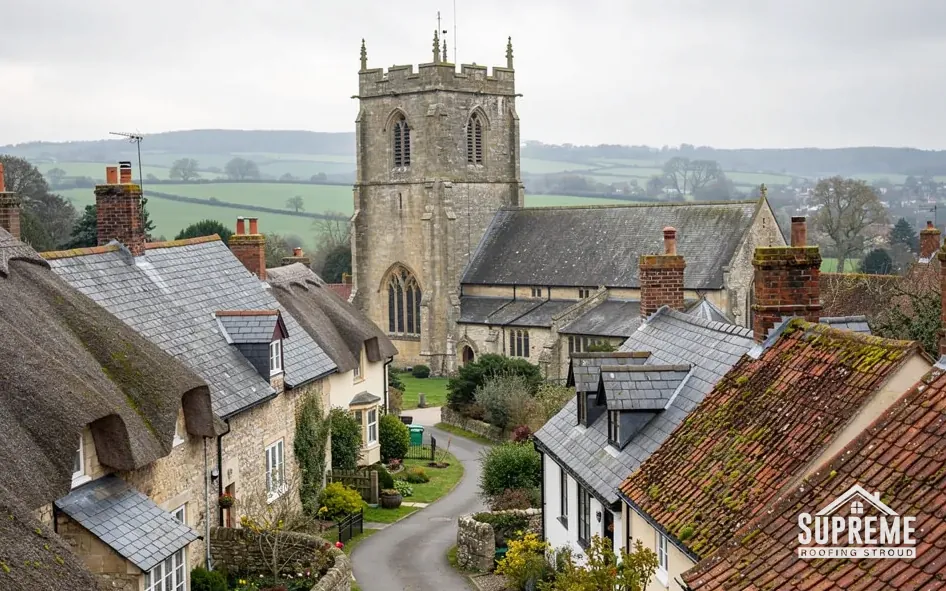
Street of stone terraced houses with slate and clay tile roofs 
Row of stone cottages with mossy clay tile roofs along a quiet lane
Chapter 01
The abbey, the lead on its roof and the metal on yours
A town that bought its abbey by paying for the roof lead has a long relationship with the metal.
Chapter 01In this chapter
At the Dissolution the townspeople of Tewkesbury bought the abbey by paying for the lead on its roof, and it became their parish church. The story is a reminder of what lead was worth, and why it has stayed on roofs for centuries. Sheet lead is long-lived and workable. MyJobQuote (updated September 2026) says a well-fitted lead flashing can outlast 80 years, and the heavier codes pass 100.
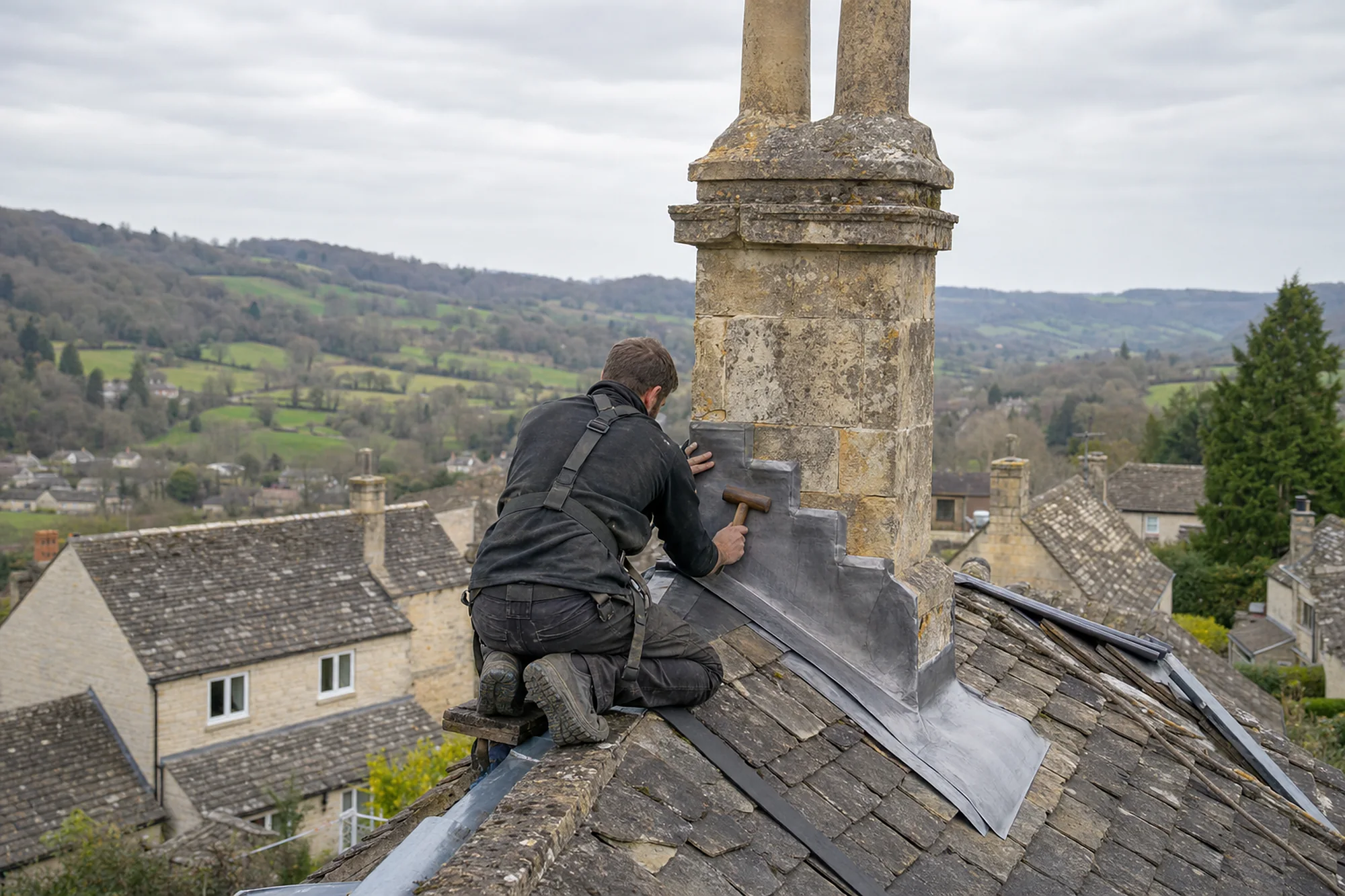
On a house, lead works out of sight. It is the strip turned up a chimney, the small soakers under tiles where a roof butts a wall, and the hidden gutter running behind a parapet. Lead comes in codes, numbered by thickness: Code 4, at 1.80 mm, is the common pick for everyday flashing, and Code 5 at 2.24 mm is common for vertical and pitched work. A thicker code costs more and suits a more exposed or more demanding position.
What lead work costs
National cost guides give a feel for the money. Checkatrade shows lead flashing repairs at £50 to £70 per metre and stepped flashing, the staircase pattern up a gable wall, at £80 to £120 per metre in Code 5, excluding VAT. Those are typical UK ranges, not our prices; the figure for your roof comes in the written quote after the survey, lead included.
Repair or replace a lead detail
Lead rarely fails all at once. It splits at a fold that has been flexed by sun and frost, lifts where a clip has corroded, or is simply stolen. A short split can often be patched or burned and dressed back; a long run that has creeped down a slope is better renewed. The survey records the length, the code if it can be read and the state of the fixings, then prices both options so you can see what a patch saves against a renewal that should outlast it.
The abbey and church roofs
The abbey is a church in use, which means the roof is dealt with through a faculty from the diocese, because of the ecclesiastical exemption. A chapel that has become a home has lost that cover and normally goes to the council for listed building consent. Anyone responsible for a church or chapel here should find out which applies before approaching a roofer for a price. Our lead roofing page explains the codes, the typical lives and the methods in more detail.
Tewkesbury bought its abbey by paying for the lead on the roof.
- Flashing repair, from£50 per m
- Flashing repair, to£70 per m
- Stepped flashing, from£80 per m
- Stepped flashing, to£120 per m
Chapter 02
Tudor frames and a conservation area of 359 listings
A medieval centre means most roof decisions start with a question about status.
Chapter 02In this chapter
The Tewkesbury Conservation Area was designated on 6 October 1987, according to the national planning dataset. The heritage index HeritageCheck gives its extent as 303.5 hectares and counts 359 listed buildings within it: 7 at Grade I, 42 at Grade II* and 310 at Grade II. The council's own list is the place to check the status of your property.
In this chapter
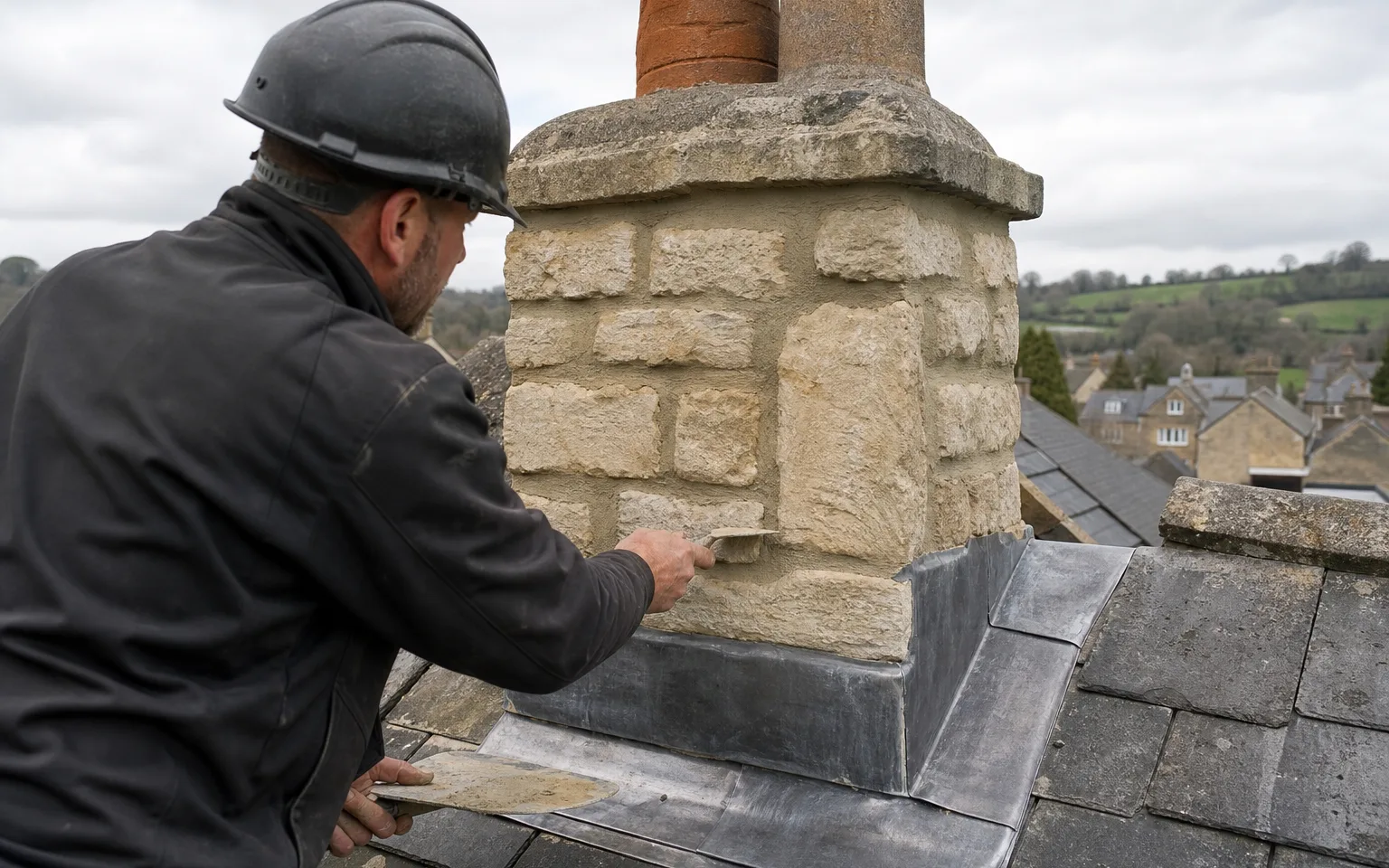
The centre is full of timber-framed buildings. The Old Baptist Chapel is a medieval hall house from the 1480s; a Tudor building in the High Street dates from about 1510. On a timber-framed house, the roof carries its load into a frame that has moved over five centuries, and the tiling has to follow the sag of the frame, not fight it. Battens are set to the real line of the rafters, not to a theoretical one, and the lead at abutments is cut to a wall that is not quite plumb.
A framed building also changes how scaffold is planned. A tower or a scaffold tied to a fifteenth-century wall must be fixed with care, so ties go through existing openings or on to the sound masonry and not through old plaster. We check this at the survey and note the arrangement on the quote.
Listed status and consent
A listed house cannot have its character altered without consent from the council, and breaching that is an offence. Deciding where repair ends and alteration begins is the council's call, not ours. Matching the existing material is the safe route, and the quote is built on that principle. The covering that is there goes back, unless the council agrees to something else. Spray foam deserves a warning here: RICS states it is "not considered reversible" and unlikely to win consent on a listed building.
Check the designation first
An address in the centre can be harder to categorise than it looks. A shopfront on the High Street may have flats above, with a roof that belongs to a different owner from the ground floor. Leases, freeholds and shared walls all affect who can sign off a quote. We ask early who owns the roof and who pays for it, because the answer decides who we write the quote to.
Before we quote on a house in the centre, we ask whether it is listed, whether it lies within the conservation area and whether anything restricts changes to it. For roof windows in such an area, our skylights page links to the planning detail. A quick call to the council saves a revised quote later.
On a medieval High Street, the first question is always what status the building holds.
- 359listed buildings inside the Tewkesbury Conservation Area
- 303.5hectares covered by the conservation area
- 42of the listings at Grade II*, alongside 7 Grade I and 310 Grade II
Chapter 03
Mitton, the M5 and a town split by water and motorway
Post-war housing and commercial units sit on the same ground as the floodplain.
Chapter 03In this chapter
The borough was enlarged in 1965 to include the Mitton housing estate, and the M5, opened in February 1971, divides the urban area in two. Housing from those decades is a different roofing job from the medieval centre. Interlocking concrete tiles, flat-roofed extensions and garages, and fascia boards in timber or plastic are all common wherever houses were built in volume.
Flat roofs are a good example. According to MyBuilder, a flat roof typically lasts between 15 and 30 years, so a garage or extension roof from the building boom has often had two or three coverings by now. A replacement is typically £70 to £100 per m² in bitumen felt, £90 to £130 in EPDM and £95 to £150 in GRP, per the same guide. EPDM is a synthetic rubber sheet laid in one piece; GRP is glass-reinforced plastic, often called fibreglass. Falls matter: BS 6229 designs a flat roof for a 1:40 fall to leave a finished fall no flatter than 1:80.
Bungalows and two-storey houses from those decades are often alike along a road, so a repair that works on one usually works on the next, and neighbours can share a scaffold if both need work. A matching tile along the road keeps the street looking consistent, and we try to find the nearest colour and profile when the original has gone out of production.
Wet ground and drainage
The town sits in a landscape where the ground can be saturated, and the floods of July 2007 are a matter of record. Some streets sit higher than others, and the survey looks at yours. What the setting does justify is a close look at roof drainage on every job: clear gutters, outlets that are free, and a downpipe that discharges somewhere useful. Our commercial roofing page covers larger buildings such as warehouses and units where drainage is the first design question.
The commercial side deserves a sentence of its own. A unit with a long flat or low-pitched roof has its own routine: outlets cleared, laps and upstands inspected, and the membrane walked for blisters and splits. We note each of these on the survey and price repairs by section, so a landlord or tenant can decide what is urgent and what can wait for a budget.
Planning a scaffold on a busy town street
A scaffold that stands on the public footway needs a licence, and on a town street the timing matters. Once a start date is fixed we apply for the permit, and the quote takes its cost into account.

Map showing Tewkesbury and the Stroud service radius, with nearby towns we also cover.
Near Tewkesbury
Roof work we do here
Abbey lead and High Street Tudor frames
My Tewkesbury house is timber-framed. Will a new roof covering sit properly on an old frame?
It can, if the battens are set to the real line of the rafters rather than a perfect one. After five centuries the frame has moved, so the covering follows the building instead of forcing it, and the survey checks the timbers first.
Is my Tewkesbury street inside the 1987 conservation area?
Tewkesbury Borough Council holds the boundary map. The area was designated on 6 October 1987. Send us your postcode or the council's answer and the quote will say what work is described, so the council can check it.
Does the abbey roof tell me anything about lead on my own roof?
That shows how durable lead is, with correctly installed flashing lasting more than 80 years. Your own lead is likely to be Code 4 or Code 5 flashing, and a survey can tell you its condition and whether a repair or a replacement is the sensible choice.
Which council handles building control for a re-roof in Tewkesbury?
Cheltenham and Tewkesbury Building Control, formed in 2010, covers Tewkesbury Borough; a registered building control approver is the private alternative. A like-for-like re-roof below the 25 and 50 per cent thresholds does not normally need an application.