
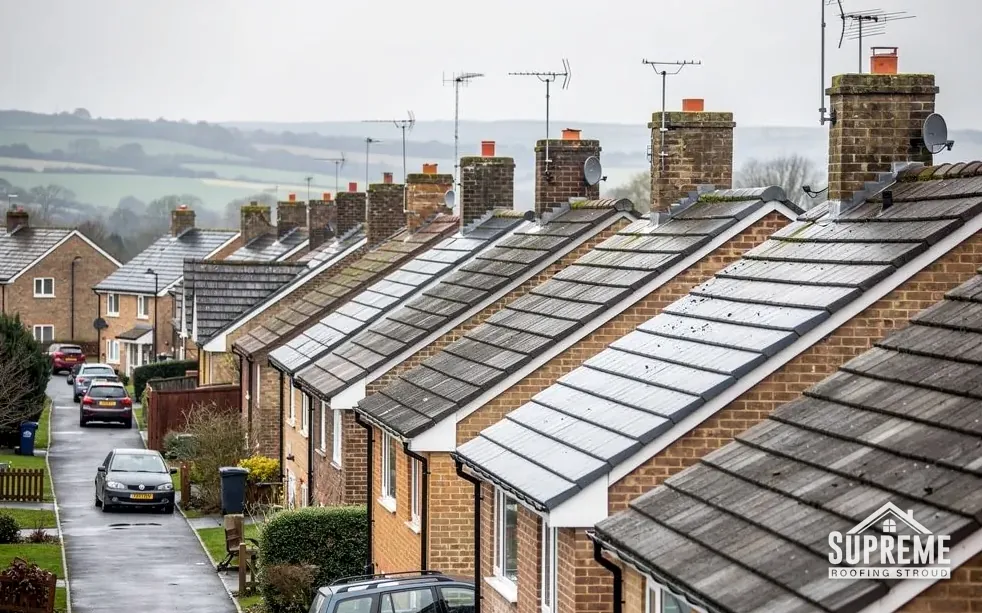
Roofers in Gotherington
Roof work in Gotherington, the village across the Dean brook from Bishop's Cleeve, where Cotswold stone tiles cover brick and stone walls, twenty buildings are Grade II listed and a 1950s building boom added brick and reconstituted stone.
Gotherington at a glance
- Distance
- 22 road miles north-north-east of Stroud
- Council
- Tewkesbury Borough Council
- Listed buildings
- Twenty Grade II
- Setting
- Cotswold edge, across the Dean brook from Bishop's Cleeve
Gotherington's roofs, from Godrinton to the 1950s
Gotherington is on record by 1086 as Godrinton, and the Victoria County History reckons it was probably the second largest village in the ancient parish of Bishop's Cleeve. The Dean brook divides the two. Nine centuries later the village still reads in layers, and its roofs show every one of them.
The oldest cottages are timber-framed, with thatched or stone-tiled roofs. Later houses, dating from the 1700s and 1800s, are built of brick or stone, and the history records Cotswold stone roofs on many of them. For a roofer that single phrase carries a great deal. Stone tiles are heavy, graded by size and hung on pegs, and they behave nothing like a concrete tile from a pallet.
Two farmhouses mark the span. White's Farm is a timber-framed house of the early or mid-seventeenth century, and Brickhouse Farm is a large brick house of about 1700. The village school opened in 1881, and a railway station opened in 1906 and closed in 1955. There are twenty Grade II listed buildings in the village, and no Anglican church of its own. Whenever we survey a house here, we begin by working out which layer of the village it belongs to, because that settles the materials, the rules and the method.

Stone village houses with slate and tile roofs above green fields 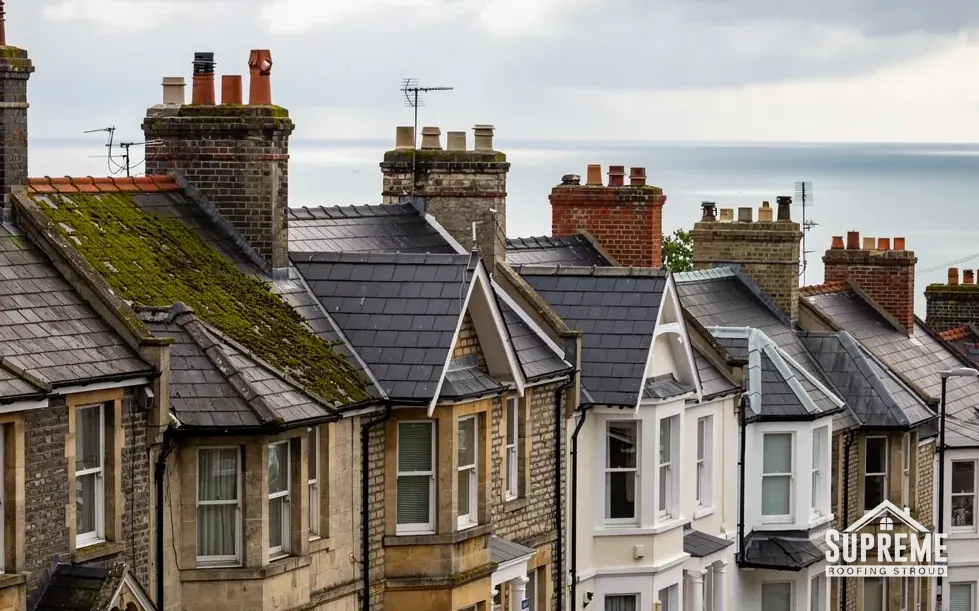
Row of Victorian terraced houses with slate roofs, bay windows and brick chimneys

Chapter 01
Cotswold stone on the village's eighteenth- and nineteenth-century houses
Gotherington's stone roofs reward patient hands and punish shortcuts.
Chapter 01In this chapter
When the county history turns to Gotherington's later houses, it names the roof: Cotswold stone. That is a covering a roofer may well meet on a brick or stone house of those centuries here, and it deserves understanding before anyone talks price.
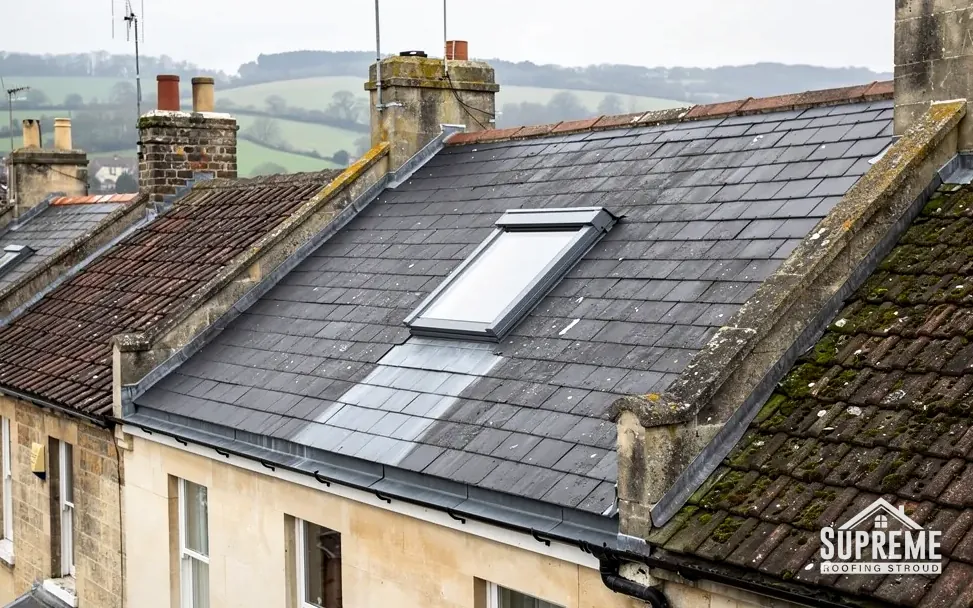
Cotswold stone slates are oolitic limestone. The two traditional sources are Forest Marble, split by hand, and Stonesfield Slate, split by frost. Cotswold District Council's technical guide describes the simple pitched roof of this tradition as usually set at 47 to 55 degrees. Courses diminish as they rise, so the longest pieces, normally about 600 mm and sometimes 750 mm, sit along the eaves while ever shorter ones carry on up toward the ridge. The ridge itself was traditionally dressed stone.
The stone is seldom what fails. Each slate hangs from a peg through a hole near its head, and when the peg rots or the slate cracks across the hole, the slate slides down. Water then reaches the batten beneath, and the first symptom indoors is often a stain close to the wall plate. We look for slides, for moss packed into joints and for crumbling mortar at hips and ridge. The council guide adds that a scraped roof outlives a neglected one by a wide margin, and that a century is an easy target when upkeep is regular. Our Cotswold stone roofing hub explains what a stone repair involves.
Valleys in stone
At the junction of two stone slopes the older method was a swept valley, made with specially cut slates so the stone curves around the angle. The council guide says close-mitred or open lead valleys cost less to form, yet look poorer than the traditional detail and are best avoided. On a house that already has a swept valley, we keep it. On one that has been patched in lead, we show you both options and quote for each, so the decision is yours.
Telling stone from imitation
Owners are often unsure whether the roof over their head is natural stone, a cast imitation or a concrete tile. A snapshot taken at the gate is normally enough for a first identification. Natural stone varies in thickness and size from one slate to the next, while a cast tile repeats the same pattern across the whole slope. That distinction decides the repair, and it decides what appears on the quote.

Thatch and stone under one ownership
Because older cottages here may be thatched or stone-tiled, an extended house can carry both. Where the two coverings meet, rain collects, and a chimney close to thatch raises its own fire questions. Thatching is a separate trade. We will flash and make good the stone side of the join and say clearly where our scope stops.
On a stone roof the peg goes first, and the slate pays for it.
Chapter 02
Twenty Grade II buildings and the rules that follow
Listing covers the entire house, and the council decides what counts as like for like.
Chapter 02In this chapter
Gotherington contains twenty Grade II listed buildings, a high count for a village this small. For a roofer, that number means a conversation with the planning authority often comes before any scaffold goes up.
Listing protects the whole house, roof included. Anything that would alter its special character needs consent from Tewkesbury Borough Council before it starts. A repair in the same stone, with the same pegs, is the sort of work a conservation officer expects to see. Replacing stone with concrete tile is another matter, and so is any new opening in a historic slope. The English Heritage policy quoted in the Cotswold guide asks for new stone slates wherever possible, says reclaimed ones belong only on the building they came off, and adds that limestone and sandstone slates are not interchangeable.
We cannot tell you whether your own house is one of the twenty. The council can, from the listing record. If you are not sure, find out before you collect quotes. We survey either way, and the quote marks where consent is needed.
Consent before scaffold
If you decide to go ahead on a listed house, the sequence matters. The survey comes first, then talks with the council's conservation staff over the proposal, then the quote with any consent conditions marked, and only then a start date. Skipping a step risks an offence under the listed building legislation, which is not worth any saving in time. We keep the photographs from the survey so your application to the council has evidence to support it.
What stone costs
One national cost guide puts stone slate roofing at roughly £160 to £210 per m², and says the figure shifts with where the slate was quarried, whether it is salvaged or fresh, and where the house stands. It is not a Cotswold figure and it is not a Supreme price. The written quote we send after the survey is the figure to rely on.
Getting slates to a farmhouse
A listed farmhouse set back from the road, such as the timber-framed White's Farm or the brick Brickhouse Farm, may need stone carried a long way from where a lorry can stop. We settle that at the survey: how the stone gets up, where the old material goes and who agrees access. The chimney repairs hub covers stacks, flashings and pots, usually the first parts of an old roof to ask for attention.
- Typical low£160 per m²
- Typical high£210 per m²
Chapter 03
The 1950s growth and the village after the railway
House numbers rose by about half in little over a decade, in brick and reconstituted stone.
Chapter 03In this chapter
The county history records that house numbers in Gotherington rose by about half in the 1950s and early 1960s, chiefly private houses of brick or reconstituted stone. The railway station, which had opened in 1906, closed in 1955. The village was losing its trains just as it filled up with new homes.
Those houses have a different roof character from the stone cottages. Reconstituted stone is cast concrete made to imitate the natural kind, laid in regular courses on battens and felt. The units are uniform and the lap is fixed, so repairs call for matching units rather than hand-sorted slates. Treating it like natural stone leads to wrong answers; so does treating it like an ordinary concrete tile, because the colour and surface texture have to be matched too.
On houses of this age the usual weak points are predictable. Ridge and hip mortar has weathered, and since BS 5534:2014 these tiles are mechanically fixed instead of trusting mortar alone. The felt below the battens may have gone brittle. Fascias and soffits from the period may be timber that needs renewing, and an old garage may carry sheets of asbestos cement. HSE guidance treats the gentle removal of sound sheets as non-licensed work, and heavy breakage as notifiable work. We inspect the sheets before we quote and describe the method, disposal and new covering in writing.
One street, one tile
Where a 1950s row shares the same stone-effect tile and one owner changes to a plain concrete one, the odd one out is obvious from the corner of the street. Matching the tile also keeps the weight roughly the same, and the written quote sets the new covering's weight beside the old.
Gutters, soffits and the 1950s eaves
Timber boards and cast-iron or asbestos cement gutters were common on houses of that date, and many have been replaced with plastic since. Plastic gutters need support at regular spacing and a gentle fall toward the downpipe. We look at the bracket fixings and joints and note them on the quote, since a gutter that holds water leaves green streaks on the wall beneath it.
Roofs from the school years
The village school dates from 1881, and a building of that age may carry slate, clay or stone with lead at the abutments, so it is surveyed on its own terms. Moss builds up on shaded slopes, and our roof cleaning and moss removal hub explains how to remove it without scarring the surface. Between jobs, a look along the gutters after leaf-fall costs nothing and heads off the damp patches that begin at the eaves.

Map showing Gotherington and the Stroud service radius, with nearby towns we also cover.
Near Gotherington
Roof work we do here
Twenty Grade II buildings and Cotswold stone tiles
My Gotherington house has Cotswold stone slates. Must the whole roof come off?
Rarely. We count slipped and cracked slates from the loft and from a ladder, rehang the sound ones and replace only what has failed. A full strip is quoted only when battens, pegs or stone are past repair.
How can I find out whether my house is among Gotherington's twenty Grade II buildings?
Ask Tewkesbury Borough Council to check the listing record. Do it before you collect quotes, because listed status means consent is needed before the roof's character is changed. We survey either way and the written quote flags where consent applies.
Does a 1950s reconstituted stone roof get repaired like a real stone one?
No. It is cast concrete in regular sizes, so a repair uses matching units on a fixed lap, not hand-sorted slates on pegs. The survey identifies the product, and the quote gives its name.
Can you work on a cottage where thatch meets stone tile?
We take care of the stone side and the junction, flashing and making good so rain leaves the join cleanly. Thatching is its own craft, and we say plainly where our scope finishes.