

Roofers in Bishop's Cleeve
Roof work in Bishop's Cleeve, the town at the foot of Cleeve Hill, from a stone-tiled tithe barn and timber-framed cottages in Church Street to a brick estate built for factory workers and the newest streets on its edges.
Bishop's Cleeve at a glance
- Distance
- 20.1 road miles north-north-east of Stroud
- Council
- Tewkesbury Borough Council
- Setting
- Foot of Cleeve Hill, on the Lower Lias vale
- Listed
- St Michael & All Angels Church, Grade I
Bishop's Cleeve's roofs, under the highest hill in the Cotswolds
Bishop's Cleeve lies at the foot of Cleeve Hill, the highest point in the Cotswolds. The name goes back to the eighth century, when it was recorded as Clife, and the Bishop's part comes from the estate held here by the bishops of Worcester. A place with that much history carries several kinds of roof at once, and few of them are alike.
The oldest we can point to is the fifteenth-century tithe barn opposite the rectory. It is built of stone with a stone tiled roof, and the parish council bought it around 1952 to serve as a village hall. Church Street holds houses of the sixteenth and seventeenth centuries that the county history describes as timber-framed, under roofs of thatch or stone tiles. St Michael and All Angels Church, which is Grade I listed and has parts more than nine hundred years old, anchors the older core.
Then the scale changes. A watch and instrument factory opened here in 1939, and a brick estate of about 500 houses went up on the south side for its workers. More recently, 450 houses were begun at Homelands Farm in 2010, followed by 550 dwellings in the north-west after a 2013 appeal. A roofer in Bishop's Cleeve may spend Monday on a stone roof and Tuesday on a street of brick houses with concrete tiles. Both jobs deserve a proper look.
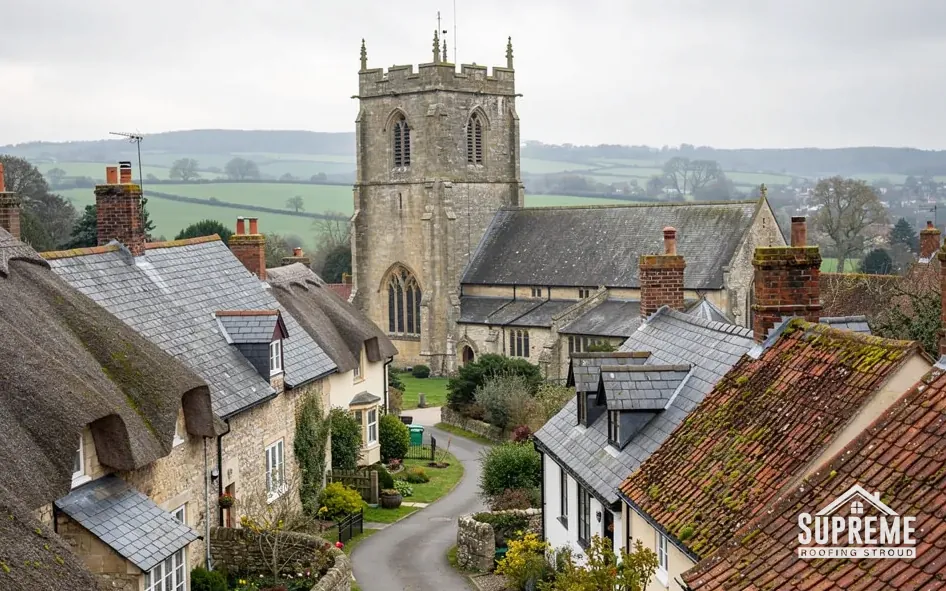
Village of thatched and tiled cottages around a stone church tower 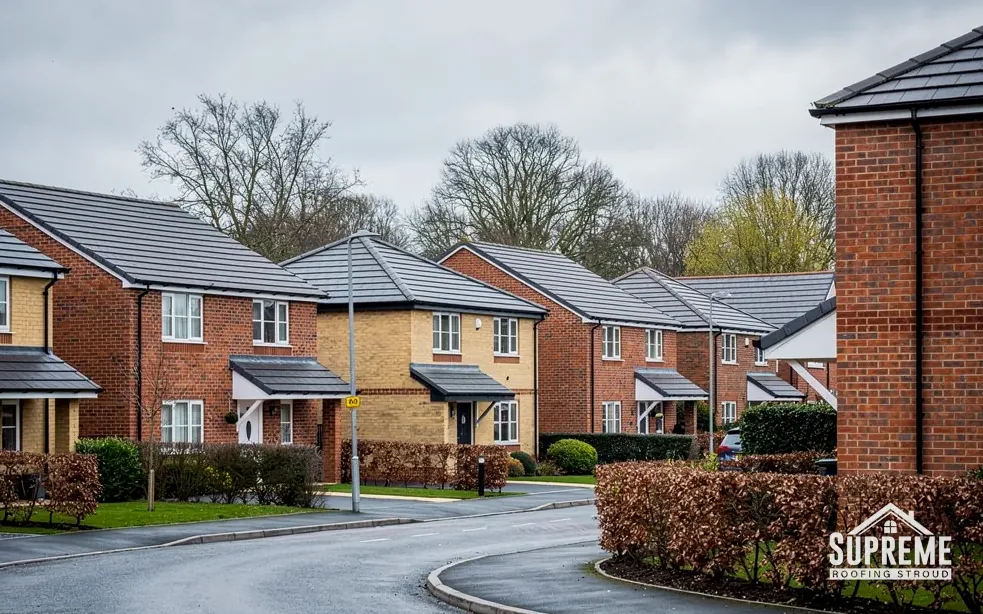
Modern brick housing estate with grey tiled roofs along a curving road

Chapter 01
The tithe barn, Church Street and the stone-tiled roof
Heavy stone and thatch call for people who know how to handle them.
Chapter 01In this chapter
When the county history lists the village's oldest buildings, it keeps returning to the same coverings. The tithe barn has a stone tiled roof. The Church Street houses of the sixteenth and seventeenth centuries are timber-framed with thatch or stone tiles. A stone tiled roof is a very different thing to repair from a tiled one, because every slate is a different size.
In this chapter
Cotswold District Council's technical guide to stone roofing explains the logic. The quarried stone gives plenty of small pieces and few large ones, so the biggest slates, normally about 600 mm long and sometimes up to 750 mm, go at the eaves, and the courses shrink as they climb to the ridge, where the smallest are a quarter of that length or less. Each slate is hung from a wooden peg, typically split oak, pushed through a hole drilled close to its top edge. A roofer who tries to lay modern tile gauges over that pattern ends up with something that looks wrong and sheds water badly.
Stone roofs are also heavy: the same guide puts them at about 1000 kg per 10 sq m. Swap a lighter covering for stone, or take stone off for something lighter, and the timbers carry a different load; a covering that is 15% heavier or more brings Building Regulations approval and a structural check. That is why we match like for like, and say so in the quote.
What goes wrong first
On an old stone roof the weak points are rarely the stone. Oak pegs rot, and a slate that has lost its peg slips down until the one below catches it. We look for rows that have dropped out of line, for moss packed into the joints and for lime mortar that has washed from the ridge. The same guide says a stone roof can easily reach a century with regular upkeep, which is why most jobs are rehanging and patching, not renewal. Our Cotswold stone roofing page explains how we repair and re-lay stone.
The Grade I church
St Michael and All Angels is the village's most senior listed building. While it is in use for worship, it falls under the ecclesiastical exemption, so authority for roof work comes as a faculty from the diocese. Nothing is done to its roof without that route. For the many houses around it, the sensible habit is to look up at the church roof now and then: if its lead and gutters are being kept clear, the same attention does well on your own.
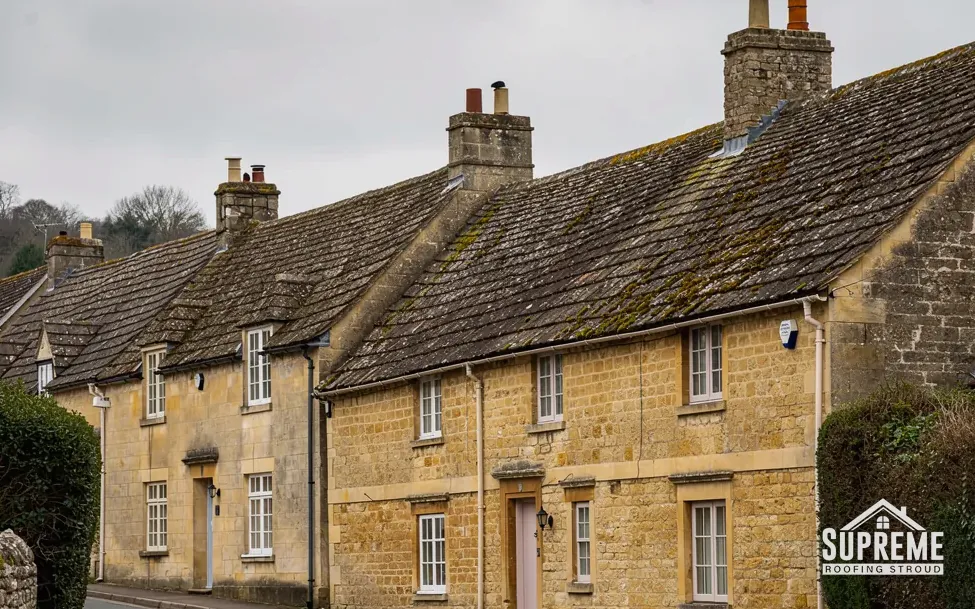
Thatch beside tile
Thatch is a separate trade, and we are straightforward about where a job sits. Where a Church Street house has thatch on one range and stone tile on another, the junction between them takes a careful flashing, and fire safety around chimneys needs a proper survey before any work near the thatch.
A stone roof is mended slate by slate, with the old courses left as they are.
Chapter 02
The Smiths factory and the Cleeve estate
A brick estate built in one go is repaired in the same way, house after house.
Chapter 02In this chapter
In 1939, S. Smith & Sons opened a watch and instrument factory in Bishop's Cleeve. By 1964 it employed about 3,750 people, and the Cleeve estate, around 500 brick houses on the south side of the village, was built to house them. That is a large number of homes from one period, and it shapes the work in a way a mix of old cottages never would.
Roofs built together tend to fail together. A run of houses with the same tile, the same ridge detail and the same underlay will show the same signs at around the same age: slipped tiles at the verge, cracked ridge mortar, and the felt beneath the battens turning brittle. When we are asked about one house on an estate like this, we ask how the neighbours' roofs look, because they often tell us what to expect before the ladder goes up.
Many roofs from that period have been altered since. Extensions, loft rooms and replaced windows add junctions that the original designers never planned. A flat-roofed extension on a brick estate house has often been re-covered more than once, and the flashing where it meets a pitched slope does a great deal of work. Our roof replacement page sets out how a full strip and re-roof is planned and priced.
Pavement and parking
Estate roads built for workers' cars are rarely generous. Where houses front the pavement or share a parking court, scaffold may need a licence and lorries may have to wait for a gap. Deliveries and skips are fitted into the programme, and the way in is described in writing alongside the price.
Lofts on the Cleeve estate
Plenty of owners on a brick estate like this have turned the loft into a room. That brings in the means-of-escape rules, which allow a roof window to count only within 4.5 m of the ground, and, for a loft room over two storeys, a protected stair. A roofer who is also asked to fit windows should raise those points at the survey, not after the scaffold is up.
Neighbours and shared work
When several owners on a row decide to re-roof, a shared scaffold brings the cost per house down, and tiles bought in one order keep the row uniform. We can survey several houses in a single visit and quote each separately. The scaffold is divided between the owners who want it, and nobody is bound into work they have not agreed.
- 1939year the Smiths watch and instrument factory opened
- 3,750people employed there by 1964, about
- 500brick houses built on the south side for its workers, about
Chapter 03
Homelands Farm and the north-west streets
Newer roofs fail at the joins, and the work needs to be priced before it is needed.
Chapter 03In this chapter
Development of 450 houses at Homelands Farm began in 2010. After a 2013 appeal, a further 550 dwellings followed in the north-west. These are modern streets, a short way from the stone barn and the Grade I church, and the roofs on them have little in common with the older village except the sky above them.
In this chapter
Modern roofs are lighter and thinner than older ones, with concrete interlocking tiles, a breathable underlay and a dry-fix system along the ridge and verges. The covering lasts. The weak points are details: the flashing along a gable wall, the valley gutters that collect water from two slopes, and the lead or sealant around a roof window. Roofs this young are well inside the lifespans the manufacturers quote, so when a leak does appear, a repair is almost always the answer, and the right repair is a small one made accurately. Our ridge, verge and dry-fix page describes how those dry systems are made and refixed.
Tewkesbury Borough and building control
Planning in Bishop's Cleeve is dealt with by Tewkesbury Borough Council, and building control by Cheltenham and Tewkesbury Building Control. Bishop's Cleeve has its own conservation area, so if you are unsure whether your street falls inside it, ask the planning team at Tewkesbury before work starts. A straightforward like-for-like re-cover seldom raises a planning question, yet a listed house is another matter, and any change to the roof's shape or openings should be raised with the council early.
Gutters under a big sky
With the long slope of Cleeve Hill above, the village is overlooked by open land, and leaves and seeds blow into gutters across the newer streets. Guttering on a new-build house is usually uPVC with clipped joints, and a joint that has parted at a corner drips onto the wall below. Clearing and refixing is quick work, and our dry-fix approach on verges avoids the mortar cracks that appear on older bedded edges.
Myth: A roof on a new estate cannot need work for decades.
Fact: The covering may last, but valleys, flashings and ridge fixings are made by hand and are the parts that need checking first.
Surveys before a problem
On a newer house, a roof inspection is worth considering before the building is sold or when a warranty is nearing its end. It is a photographic record of valleys, flashings and ridge, and it gives the owner a written list of what needs attention and what does not. Typical UK prices for a standard roof survey cost £150 to £250 (MyBuilder, 2026), and ours is confirmed in writing after the visit.

Map showing Bishop's Cleeve and the Stroud service radius, with nearby towns we also cover.
Near Bishop's Cleeve
Roof work we do here
Church Street thatch to Homelands Farm in Bishop's Cleeve
My Church Street cottage has a stone tiled roof. Can the old slates be reused?
Usually many can. We check each slate and peg, rehang the sound ones in their existing courses and replace only those that have split or perished. The quote shows the number of slates reused and the number replaced.
Is the Cleeve estate roof likely to need a full re-roof or just repairs?
It depends on the house, not the estate. We survey the tiles, battens, felt and ridge and tell you plainly whether a repair will do. If a re-roof is needed, the scaffold, strip, materials and waste are all covered by the quote.
I live in a Homelands Farm house. What should be checked on a roof this young?
Valleys, flashings against gable walls, the ridge and verge fixings, and any roof window. These are the joins that move or crack first, and each can be photographed and repaired without touching the rest of the roof.
Who do I ask about work to a listed house in Bishop's Cleeve?
Tewkesbury Borough Council. A listed house has full legal protection, and changes that touch its character need consent before work. For a listed church in use, the route is a faculty from the diocese instead.