

Roofers in Gretton
Roof work in Gretton, a small village at the foot of the western scarp of the Cotswolds, where a conservation area, a Grade II* farmhouse, a listed Victorian church and the listed tower of an older church set the terms for any roof work.
Gretton at a glance
- Distance
- 25.6 road miles north-north-east of Stroud
- Council
- Tewkesbury Borough Council
- Conservation area
- Gretton, designated 1975
- Listed
- Gretton Farmhouse, Grade II*
Gretton's roofs, beneath the scarp
Gretton lies at the foot of the western scarp of the Cotswolds, where the ground begins to climb behind the village. The name is first recorded in 1175 and is said to mean a settlement on gravelly soil. The civil parish is far younger: it was created in 1994 from part of Winchcombe parish. The village is small, which makes the buildings that carry formal protection easy to count and hard to overlook.
Three of them are listed. Gretton Farmhouse is Grade II*, one grade above Grade II. Christ Church, built in 1868 with money from Emma Dent of Sudeley, is Grade II, and the fifteenth- or sixteenth-century tower of the old church it replaced has a separate Grade II entry of its own. Alongside them Gretton has a conservation area, designated in 1975.
The covering on any one house is identified at the survey. For that reason the survey carries more weight here than in a village with a documented stone or slate tradition. We establish what each roof is made of, how heavy it is and how the battens and timbers are holding up, and the quote is built from what we find on that house, not from an assumption about the village.

Hillside of stone terraced houses with mossy stone tile roofs and chimneys 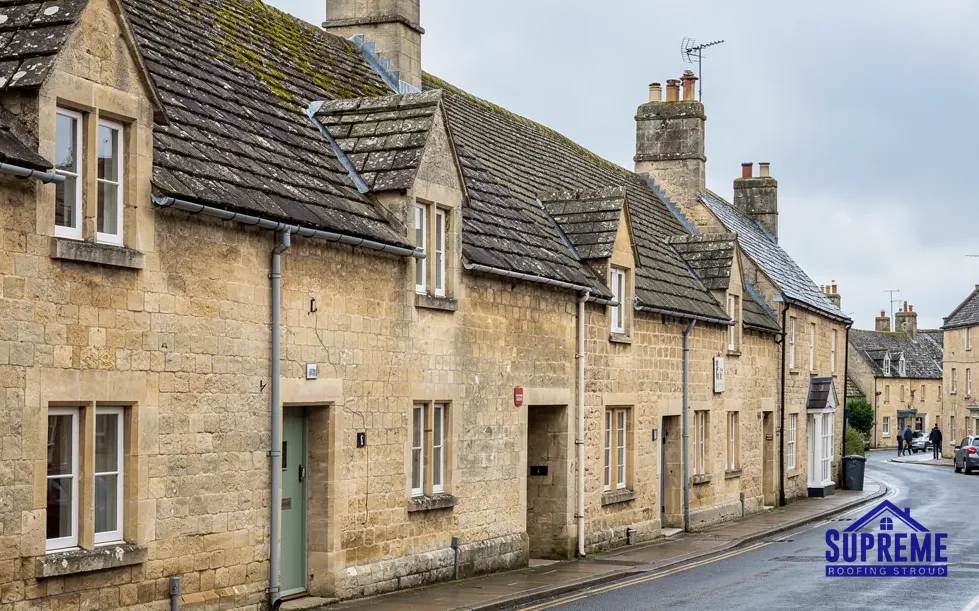
Terrace of stone cottages with dormer windows and stone tile roofs

Chapter 01
A conservation area at the foot of the scarp
Designation in 1975 means roof decisions here begin with a call to the council.
Gretton Conservation Area was designated in 1975. The idea behind any conservation area is to protect a place's character, and the rules that follow are the same wherever one sits. A like-for-like re-cover that leaves a building's outward appearance unaltered is not normally development in law. Changing the material, adding an opening to the slope or enlarging the roof is another question, and so is any work on a listed building.
In this chapter
Planning decisions here sit with Tewkesbury Borough Council. Whether any extra restriction applies to roofs in this conservation area is a question for the planning team, and we would put it to them before work starts. The better route is to take the question to the council's planners ahead of signing any quote: describe the covering, say what you intend to change and ask whether permission or consent is involved. If you are planning a loft conversion with a dormer, remember that dormers are not permitted development in a conservation area or in the Cotswolds National Landscape.
The ground behind the village
The scarp rises behind Gretton, and the soil is said to be gravelly. What that means for wind or rain is judged on the day, from the roof itself. The practical point is narrower. A house on rising ground can be reached at different heights front and back, and a scaffold on a slope has to be built to fit, with bases, boards and ties planned at the survey. Scaffolding is allowed for in the price, never hidden.
Finding out what you have
Before any price is given, we need to know what covers the roof. Send two or three photographs, one from the road and one along the ridge if you can see it, and we will say what we believe it to be. The survey then confirms the covering, the lap, the size of the battens and the state of the timbers beneath. The roof inspections and surveys hub sets out what is photographed and what the written report contains.

What the survey looks at under the covering
The covering is the visible part, but the timbers carry the roof. We check rafters for sagging between purlins, battens for softness at the nail line and the wall plate for damp, and we look for daylight where the ridge meets the gable. Underlay that has split or sagged is noted, because on an older house it may be missing altogether. Each finding is photographed and numbered, and the numbers match the quote, which ties it to a photograph.
Keeping a record
Inside a conservation area, a dated photographic record of the roof as it stands is useful long after the job ends. If a later owner or the council asks what was there before, you have the answer. Our survey photographs form that record, and a copy goes to you with the quote.
Ask the planning team first; the call costs nothing and a wrong guess can cost a great deal.
Chapter 02
Gretton Farmhouse and the work a Grade II* roof allows
A higher grade of listing, and the roof is part of what it protects.
Chapter 02In this chapter
Gretton Farmhouse is listed Grade II*, a step above the Grade II that applies to most listed houses. Stroud District Council states that no listed building, whatever its grade, is any less protected than another, and the same principle holds in Tewkesbury Borough. Roof, walls, chimneys and the structure behind are all covered.
In this chapter
The practical result is that works affecting the character of the house need listed building consent, and doing them without it is a criminal offence under section 9 of the 1990 listed buildings legislation. A sound approach to a roof like this is repair, not replacement, using the materials already there. Reusable covering is rehung where it can be. Where new material is unavoidable, it should match the old in type, colour, texture and thickness.
Lead is the detail that most often wants attention on a house of this standing. Chimney flashings, valley gutters and box gutters are all made from sheet, and the code, which is its thickness, matters. For ordinary flashing most roofers now reach for Code 4, keeping the heavier codes for gutters and wider areas. MyJobQuote puts the life of correctly installed lead flashing at over 80 years, and over 100 for higher codes, so it repays being done well the first time. For the codes and their usual jobs, see the lead roofing hub.
How the quote reads on a listed roof
Where consent is involved, the quote says which work depends on it. Scaffold, stripping, repair, new material and making good all belong to the job, which helps you tell routine maintenance from work that needs the council's agreement.
Surveying a higher-grade roof
A survey here includes the loft space, not only the slope. In a farmhouse the roof structure may itself be part of what is protected, so timbers, joints and visible marks are photographed before anything is disturbed. If the frame shows movement, we recommend a structural engineer's view over guesswork.
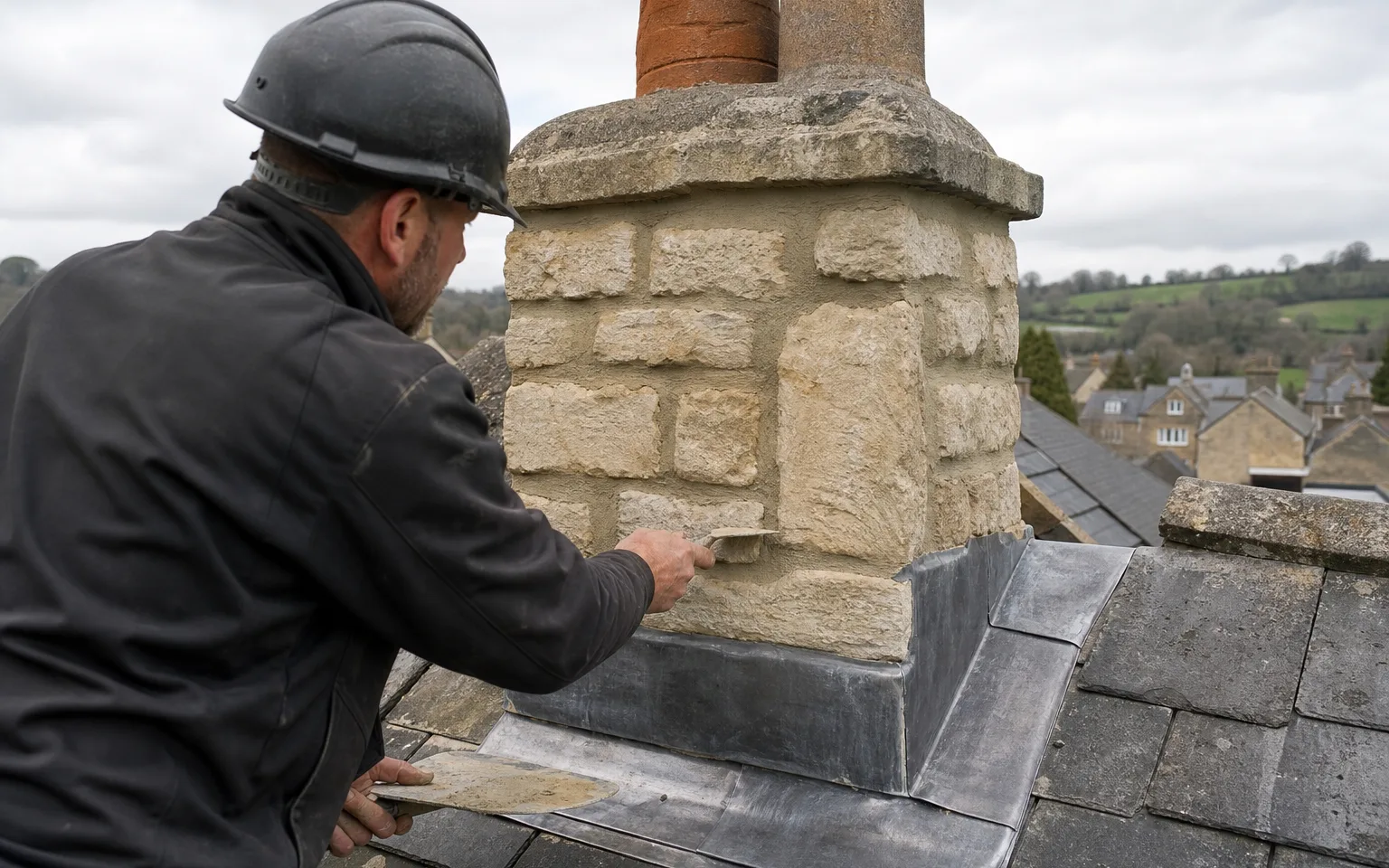
Chimneys on an old farmhouse
Farmhouse stacks are often large, and the flashings around them are where water most often finds a way in. We examine the pointing, the lead, and the flaunching, which is the mortar bed that sets the pots, and quote for each repair.
- Flashing repair, per m£50 to £70
- Stepped flashing, per m£80 to £120
- Chimney patch£150 to £250
Chapter 03
Christ Church, the old tower and the village halt
A church and a tower with separate listings, and a railway stop that has gone.
Chapter 03In this chapter
Christ Church and the old church tower are both Grade II, and the national dataset records them as separate entries. The tower is what survives of the earlier church: when Christ Church was dedicated in 1868, the old nave was demolished and the tower left standing. For roof work that distinction is more than a technicality, because the two are separate structures with separate coverings, and each may need its own handling.
In this chapter
For as long as Christ Church serves a congregation, the ecclesiastical exemption covers it, and a faculty through the diocese is the route for roof work, in place of the council's consent. Were it to stop being used for worship, ordinary listed building consent would normally apply. The old tower no longer serves a congregation, so its consent route is one to confirm with the diocese and Tewkesbury Borough Council before work is planned. In both cases the parish and its advisers move first. Afterwards we survey the roof, gutters and parapets, photograph every valley and flashing, and write a quote covering scaffold, repair and making good. A tower normally needs a purpose-built scaffold, and its cost is often the largest single part, so we explain it before work is agreed.
Towers gather leaves and debris in their gutters, and blocked outlets are a frequent cause of damp in the walls below. Clearing the outlets and checking the lead is ordinary maintenance that a parish can plan for, rather than waiting for a stain to appear inside.
Gretton Halt and the line beside it
Gretton Halt closed in 1960, and the Gloucestershire Warwickshire Railway passes the site today. For us it is a landmark rather than a roofing matter, but it is a reminder that old railway land, embankments and cuttings can sit close to houses, and that a delivery route or scaffold position near them is worked out in advance and set down in the quote.
Gutters and the walls below
On any older house, a gutter that overflows stains and dampens the masonry beneath it. Cast-iron and aluminium gutters last longer than plastic, but all of them need their joints sealed and their falls checked. We test the gutters with water at the survey when conditions allow, and report the brackets and joints we find loose.
A short list for owners
Three things help any roofer here. Know whether your house stands in the conservation area. Know whether it, or any structure in its grounds, is listed. And keep earlier invoices or photographs of the roof. From there we handle the survey, the photographs and the written quote, with routine work kept distinct from anything that needs the council's agreement.
- 1175year the name Gretton is first recorded
- 1975year the conservation area was designated
- 1960year Gretton Halt closed
Map showing Gretton and the Stroud service radius, with nearby towns we also cover.
Near Gretton
Roof work we do here
Gretton Farmhouse, the church tower and 1975 conservation area
I own a house in the Gretton Conservation Area. Must I get permission before re-roofing?
Often not for a straight like-for-like job, but the council is the body to confirm it. Describe the covering and anything you plan to alter, then put that to Tewkesbury's planners before you accept a quote. A change of material, a bigger roof or a new opening is a separate question, and it is better answered before scaffold goes up than after.
I have a barn beside Gretton Farmhouse. Is its roof protected too?
A barn or wall standing in the garden of a listed house can sometimes share its protection, depending on its age and use. The council's conservation staff can confirm the status of any outbuilding or wall, and we would want that answer before touching the roof.
Will you survey the old church tower at Gretton?
Yes, once the owner has settled the authorisation route. We survey the tower and Christ Church as two jobs, with notes kept apart for each, photograph gutters, flashings and parapets, and quote for each, with the tower scaffold allowed for.
How can you quote for a Gretton roof before you know what it is made of?
The survey tells us. We identify the covering from photographs, then confirm the lap, battens and timbers on site. The written quote lists the actual covering and the work it needs.