

Roofers in Winchcombe
Winchcombe lies in a Cotswold combe, with timber-framed and limestone buildings along its High Street, a Grade I church of St Peter, and a conservation area designated back in 1971.
Winchcombe at a glance
- Distance
- 20.9 road miles north-east of Stroud
- Council
- Tewkesbury Borough Council
- Conservation area
- Winchcombe, designated 19 March 1971
- Listed landmark
- Church of St Peter, Grade I
Winchcombe's roofs, from the High Street to Sudeley
Winchcombe's name is said to mean corner combe, and the town sits in a Cotswold valley below Cleeve Hill. In Anglo-Saxon times it was a major Mercian community favoured by King Coenwulf, and in the eleventh century it was briefly the county town of Winchcombeshire. A roofer reads that history in the buildings it left, and plenty of them are still lived in.
Timber-framed and Cotswold limestone buildings line the High Street, some dating back to the fifteenth century. The parish church of St Peter, noted for its grotesques, is listed Grade I. Sudeley Castle and its Church of St Mary, beside the town, are both Grade I as well. Michael Cardew revived a derelict pottery at Winchcombe and its seventeenth-century slipware tradition, and Ray Finch bought the pottery in 1939.
The council, Tewkesbury Borough Council, named the Winchcombe Conservation Area on 19 March 1971. A designation that old has had decades to shape local expectations, and it means roofs here are judged against their neighbours, so the material, scale and colour of a covering all matter. Where a house is listed as well, the rules are tighter again, and the survey starts there.

Hillside terraces of stone houses with slate roofs and chimneys 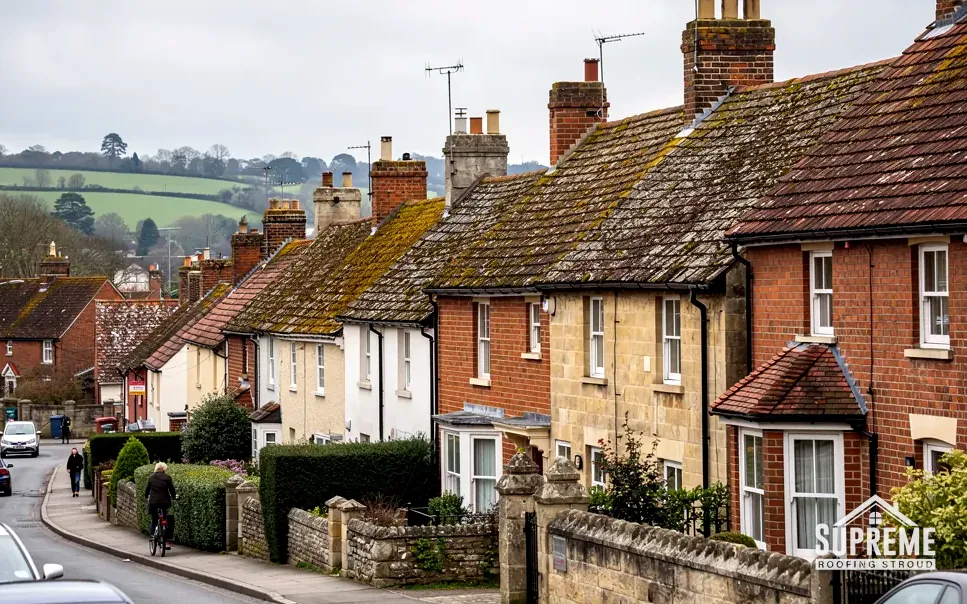
Sloping street of brick and stone terraced houses with mossy tiled roofs
Chapter 01
Cotswold limestone walls and the stone roofs above them
If your Winchcombe roof is stone, almost everything about repair is set by how it was made.
Chapter 01In this chapter
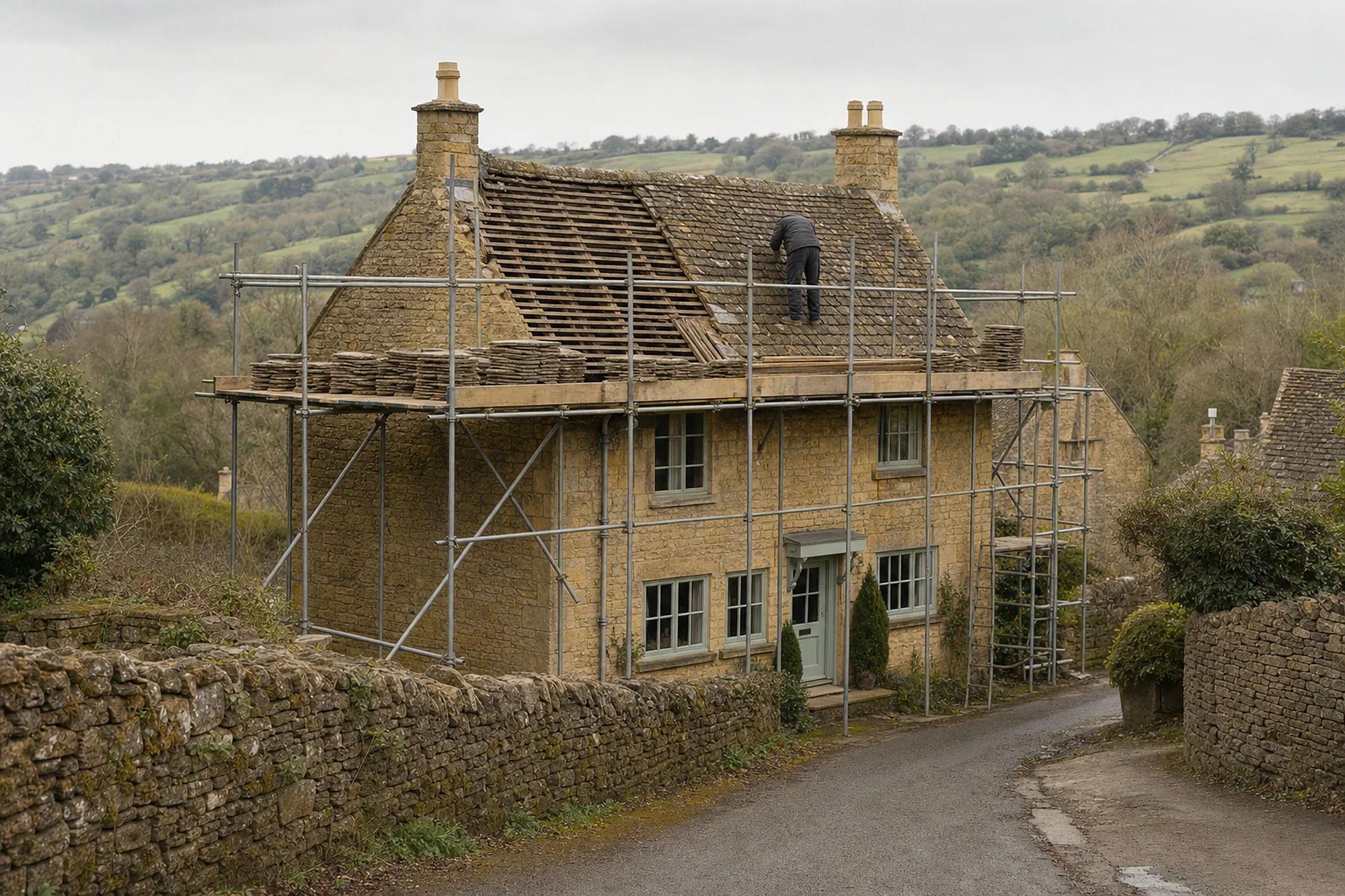
The High Street's Cotswold limestone buildings are a reminder of what many people in this part of the world expect to see on top: stone slates, split from oolitic limestone and hung on the roof in courses that shrink towards the ridge. Not every limestone building has a stone roof, and a survey is the only way to know what yours has. But if it does, the details below shape every decision.
Stone slates are graded by size. The biggest, normally about 600 mm long and sometimes up to 750 mm, form a doubled bottom course known as cussoms, with followers above them. The smallest, the short cocks, measure barely 15 cm and sit at the top of the slope. These diminishing courses are what give a Cotswold roof its look, and any repair that ignores them shows. They are fixed with one or two wooden pegs hung over a batten, and the ridge is traditionally a dressed stone section.
Weight, pitch and life
Cotswold District Council's technical guide of 2000 puts a stone slate covering at about 1000 kg for every 10 square metres, which is heavy. A traditional roof is a straight pitch of about 47 to 55 degrees. With regular care, such a roof can easily last 100 years and potentially far more. Replacing stone with a lighter covering changes the loading, and the reverse can overload a frame, so Building Regulations approval and a structural check may apply.
Reading a stone roof from the street
A stone slate roof has a texture a machine-made one lacks. The slates are thick, edges vary, the colour shifts from honey to grey across a single slope, and moss and lichen settle in the gaps. From the pavement you can see whether courses are straight, whether any have slipped and whether the ridge line has dipped. Take a photograph, zoom in and send it; it saves a first visit in many cases. Where slates have perished, the usual remedy is to lift and relay the sound ones and replace the failed with matching new or sourced stone. That is a slow job by hand, which is why it is priced by area and by the hour, and why quotes break it down.
What it costs
Checkatrade puts stone slate at about £160 to £210 per m², with the final figure moving with the stone's origin, new or salvaged, and with the location. That is a national guide and not a Cotswold-specific figure. The English Heritage policy printed in that same guide asks for new slates in preference to second-hand ones, and rules artificial look-alikes out for historic buildings. Our Cotswold stone roofing page explains repair, re-laying and sourcing in detail.
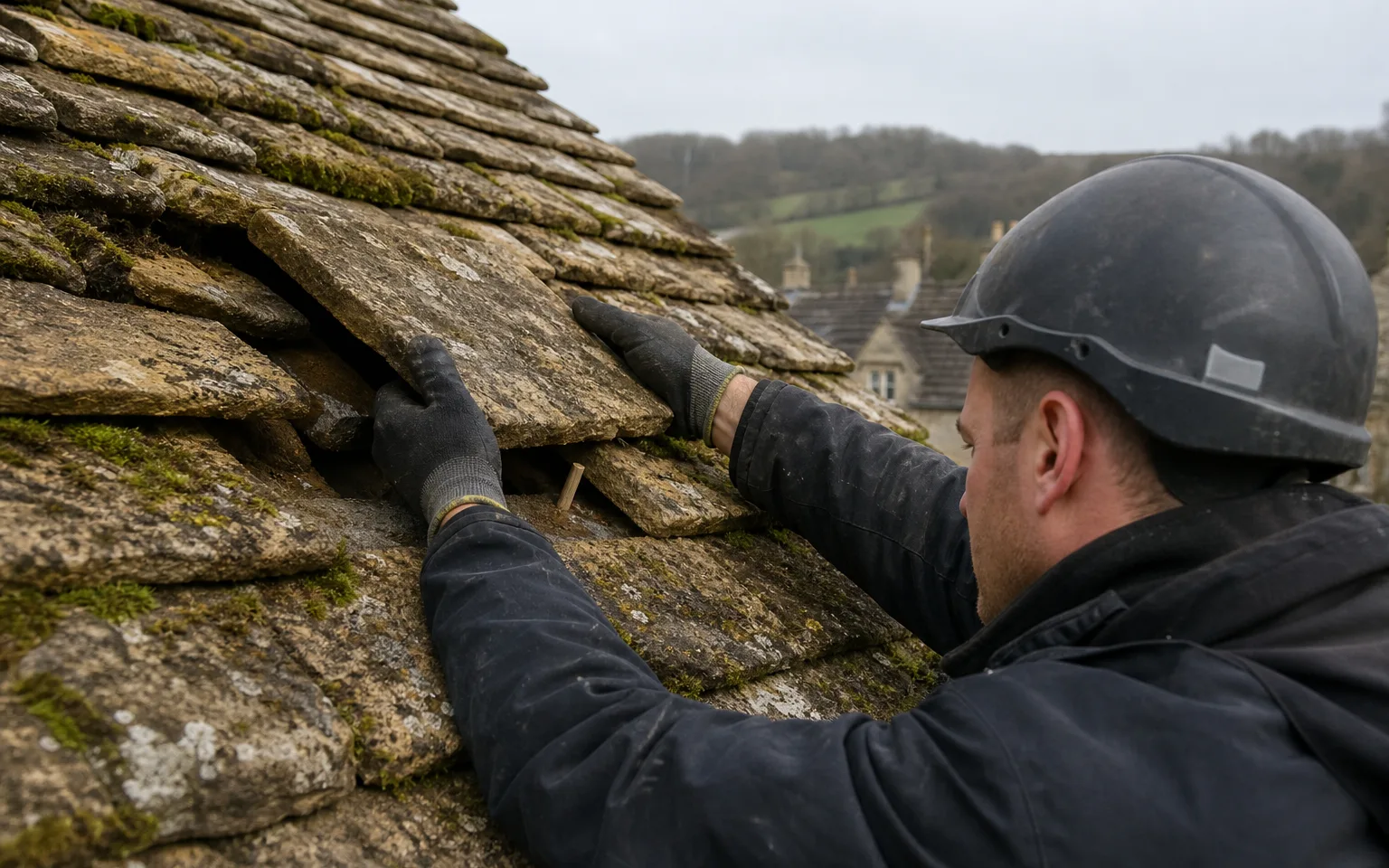
On a Cotswold roof the courses shrink towards the ridge, and a repair that ignores that shows.
- Natural slate re-roof, low£100 per m²
- Stone slate, low£160 per m²
- Stone slate, high£210 per m²

Chapter 02
Fifteenth-century timber frames beside the limestone
The High Street mixes two structures that need different care, often under a shared roof line.
Chapter 02In this chapter
The High Street holds timber-framed buildings next to stone ones, some dating back to the fifteenth century. Where the two meet, a roof has to cope with a join between structures that move differently. A timber frame flexes with the seasons and with age, while a stone wall stays put. The line between them is a weak point, and it is usually covered with lead.
In this chapter
Lead flashings at a stone-to-frame abutment are cut in brief lengths so they can move. Lead sheet is specified by code: Code 4 (1.80 mm thick) is the everyday grade, and Code 5 (2.24 mm) steps up for heavier duty. MyJobQuote says fitted well, lead flashing can outlast 80 years. When it fails, the usual causes are splits at folds, creep down a slope and a loosened fixing.
Party walls and shared valleys
A street of old buildings has party walls and valleys where one roof drains into the next. A repair to one roof can alter how water reaches the neighbour's. We look at both sides of a shared valley and tell you if a neighbour should know. Neighbours sharing a scaffold can split the cost, which is often the largest single cost in a terrace job.
Scaffold on a main street
A scaffold on the High Street stands on the public footway and needs a licence. The permit takes time, and the access plan, including pedestrian routes, goes into the quote. Our roof inspections and surveys page explains how a survey looks at a roof that is hard to reach.
Myth: A timber-framed building and a stone one beside it can share the same repair method.
Fact: The frame moves and the stone does not, so lead at the join is cut in brief lengths that can slide, then inspected on every visit.
Why lead is cut short at a join
A long sheet of lead moves when it warms and cools, and if it is fixed along its whole length it buckles and splits. Short lengths with overlaps give each piece room to slide. Joints are formed with rolls or welts, not with sealant, and clips hold the lower edge. A flashing done this way can outlast the covering on either side. Done badly, with mastic smeared along a crack, it fails in a year or two and hides the cause.
Chimneys
Old stacks are a feature of the roofline. Repointing typically averages about £750, with a range of £500 to £2,000, according to MyBuilder, with a complete stack rebuild priced at £2,000 to £10,000 or more. Our chimney repairs page covers the choices.

Chapter 03
A corner combe below Cleeve Hill, and 1971's conservation area
Winchcombe's valley setting and its early conservation area both shape what a roof can be.
Chapter 03In this chapter
Winchcombe stands in a Cotswold combe below Cleeve Hill, and the shape of the valley shapes the roofs. Houses step up the sides, gardens fall away behind and a roof may be looked down on from the slope behind as much as seen from the street. The visible slope therefore counts, since people on the hillside look straight down on it.
Tewkesbury Borough Council set up the conservation area on 19 March 1971 and remains the body to ask about it. A repair that copies what exists tends to be simple. If you want a different material, a new feature or a roof window, put that to the planning team before ordering. For the planning detail on roof windows, our skylights page links to the right guidance, and this page does not repeat it.
Grade I neighbours
The church of St Peter, Sudeley Castle and the Church of St Mary are all listed Grade I. Churches in use are authorised by a faculty. For a house or other building, a listed status means works that affect character need listed building consent, and a conversation with the council's conservation team comes before a quote.
Insulation and old roofs
An old stone roof often has little insulation and a lot of draught. When a roof is stripped and relaid, there is a chance to improve it. Under Approved Document L, a renovation covering more than 50% of the surface brings the whole roof element to a U-value of 0.16 W/(m²·K), subject to feasibility, and a lesser standard can apply where headroom is tight. Spray foam is a poor fit for a historic roof: RICS says it is not considered reversible. Ventilation for a cold roof follows BS 5250.
When a roof is opened up
Stripping a historic roof is a moment when the building is at its most exposed, and the plan for covering it overnight is part of the quote. Sections are opened a few at a time, so the rest of the roof stays watertight, and the loft is protected beneath. Old timbers are looked at when they come into view, and any repair is photographed before it is closed up. You see the roof in a state that would otherwise stay hidden for another century.
Pottery and craft
The pottery tradition shows that craft is part of Winchcombe's story. We bring a craftsperson's patience to a stone roof: match, fix and finish, then clear up.
In Winchcombe the status of the building decides the plan before the price does.
Map showing Winchcombe and the Stroud service radius, with nearby towns we also cover.
Near Winchcombe
Roof work we do here
Sudeley, St Peter's and the 1971 conservation area
I think my Winchcombe roof is stone slate. How can I tell, and does it change the survey?
Stone slates are thick, uneven in size and graded from large at the base to tiny at the top. A photograph from the street usually shows the diminishing courses. If it is stone, we check the pegs, the ridge and the condition of the slates, and price like for like.
Where a timber-framed building meets a stone one on the High Street, what fails first?
The join, usually. The frame moves and the stone does not, so the lead flashing between them splits at a fold or creeps down the slope. Replacement lead goes in as brief lengths that can slide, and it gets another look whenever we pass.
Is my house in the Winchcombe Conservation Area, designated in 1971?
Tewkesbury Borough Council holds the boundary and the answer. Ask it, and let us know if your house is also listed, so the written description of the work matches its status.
Can I insulate my stone roof when it is stripped?
Often yes, and a re-lay is the time to do it. Renovating more than half the surface can bring the whole roof under the Part L upgrade rules, where feasible. Spray foam is not suitable on a historic roof, and cold-roof ventilation has to be kept.