

Roofers in Bredon
Bredon's roofs sit on limestone quarried from the hill above, beside a Grade I barn and a church with a tall octagonal spire, on the Avon bank at the southern edge of Worcestershire.
Bredon at a glance
- Distance
- 24.6 road miles north-north-east of Stroud
- Council
- Wychavon District Council
- Conservation area
- Bredon (Wychavon)
- Listed buildings
- 43, two at Grade I
Bredon's roofs, between the Avon bank and Bredon Hill
Bredon lies on the banks of the River Avon on the lower slopes of Bredon Hill, at the southern edge of Worcestershire. The northern third of the parish falls inside the Cotswolds National Landscape, the current name for the area still known in law as an Area of Outstanding Natural Beauty. The parish had 2,705 people at the 2021 census, and it sits three miles north-west of Tewkesbury on the B4080.
The stone is the first thing to know. Almost all of Bredon's historic buildings are at least partly built of Cotswold limestone quarried on Bredon Hill, with timber framing used as a secondary material until the mid-17th century. Bredon has 43 listed buildings. St Giles' Church and Bredon Barn are Grade I, the Old Rectory is Grade II*, and the rest are Grade II. The barn, a late-14th-century threshing barn and a Grade I listing, was badly damaged by a fire in 1980 and has been restored by the National Trust.
So the village is dense with protection, and a roofer here has to think about walls, consents and the level of the ground as much as about the covering itself. Bredon has its own conservation area, and Wychavon District Council is the local authority. Stroud to Bredon is 24.6 road miles, on a north-north-east bearing, well inside our range. Your survey comes with pictures of the roof and loft, followed by a written quote for the whole job. A 10-year workmanship guarantee goes in writing with the finished job.
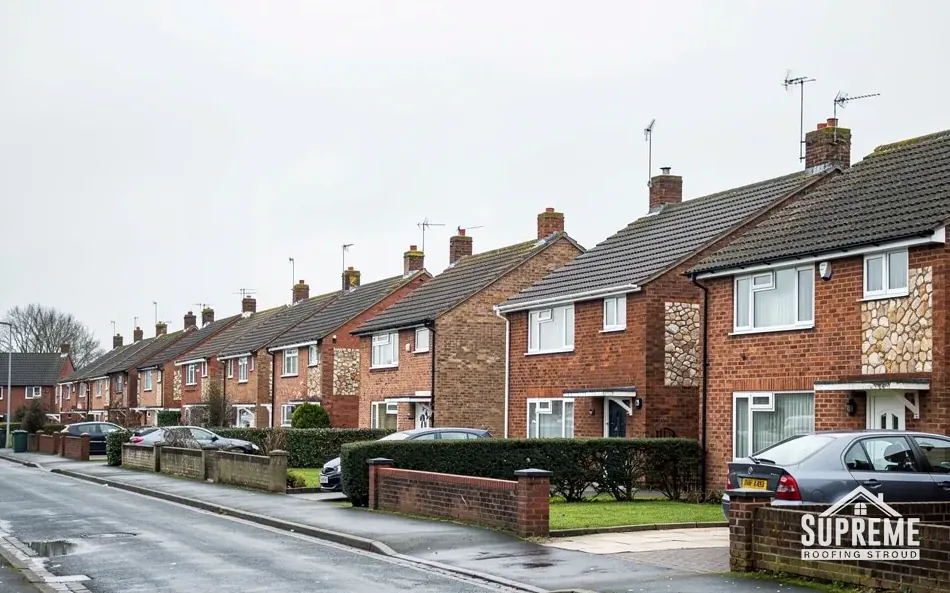
Street of red brick terraced and semi-detached houses with parked cars 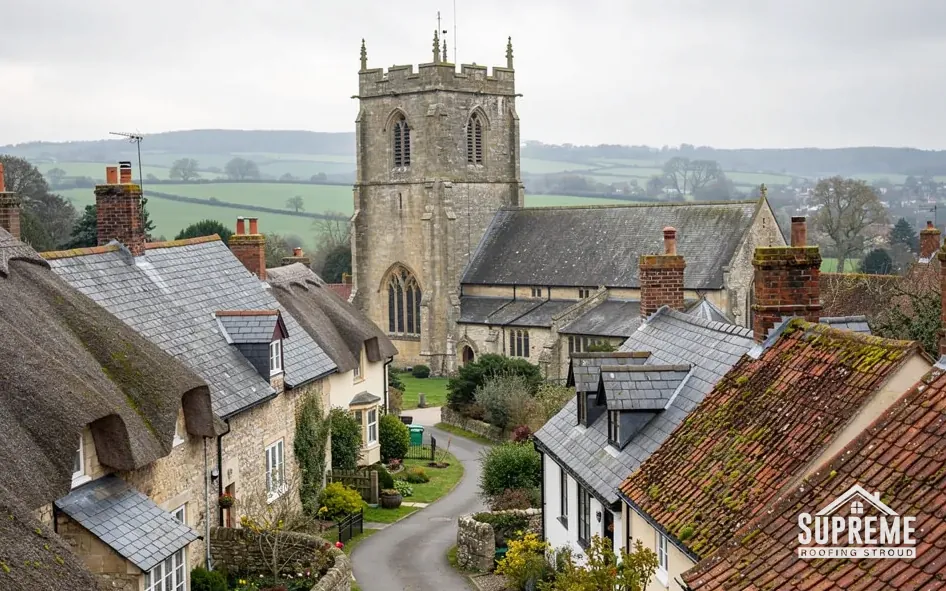
Village of thatched and tiled cottages around a stone church tower
Chapter 01
Hill limestone: the walls that hold up Bredon's roofs
In a village built of local stone, the junction between wall and roof decides how long a repair lasts.
Chapter 01In this chapter
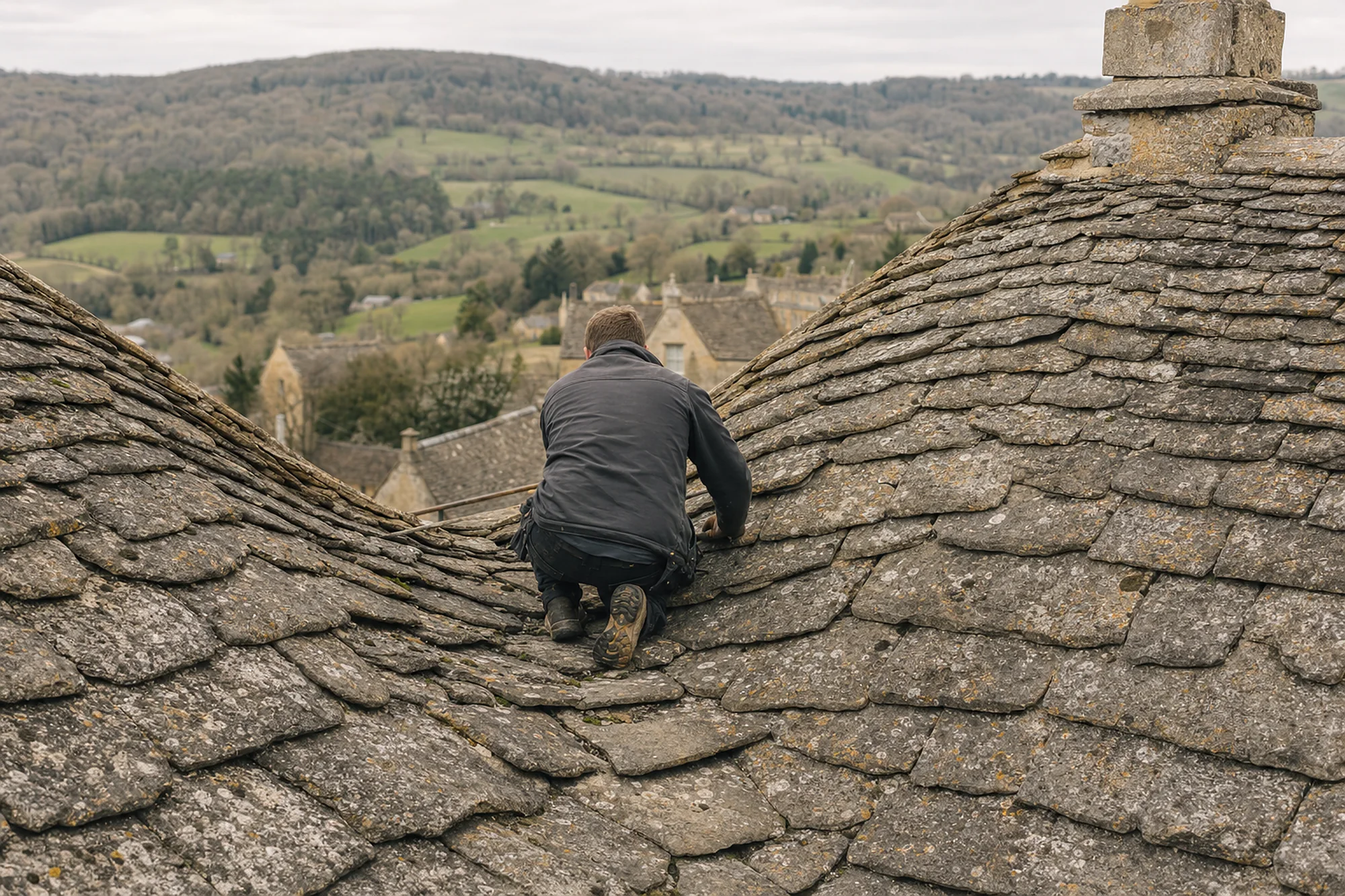
A stone-walled building and a roof meet at several awkward places, and in Bredon those places are older than most of the country's housing. Chimney stacks rise through the ridge, gables finish in a verge, and one roof slope often runs against another building's wall. Each of those junctions depends on a strip of lead or a line of pointing, and each is where a leak will usually start.
In this chapter
Lead flashing is chased into the stone joint above the roof, then dressed down over the covering. If the mortar has softened, the flashing loses its grip, and rain runs behind it. A repair therefore has two parts: re-pointing the joint and renewing or re-dressing the lead. National cost guides from MyBuilder put chimney repointing at about £750 on average and a flashing repair at £250 to £1,200, depending on the stack and the access. Those are national ranges, not Bredon prices, and only a visit sets the number for your own chimney.
Timber framing was the secondary material here until the mid-17th century, so some older houses combine stone with a frame. Where we meet that, we check how the roof load comes down, because a frame and a stone wall move differently. If a lighter covering replaces a heavy one, or the reverse, the change in weight matters: a covering that adds 15% or more brings Building Regulations approval and a structural check.
The National Landscape and the village
The northern third of the parish lies in the Cotswolds National Landscape, which counts as protected land for planning purposes. Dormer windows are not permitted development there, and new wall cladding to a house is not covered by those rights either. Like-for-like roof repairs are different and are not normally development at all. The Landscape's board does not grant planning permission, so for any change of look we point you to Wychavon District Council's planning team. Our Cotswold stone roofing page explains how stone slate roofs are repaired.
A leak at a stone gable usually starts in the joint.
- Chimney repointing, average£750
- Repointing range£500 to £2,000
- Flashing repair£250 to £1,200
- Stack rebuild£2,000 to £10,000+
Chapter 02
Bredon Barn and the problem of very large roofs
A late-14th-century barn shows what a big timber roof carries, and what a fire can do to it.
Chapter 02In this chapter
Bredon Barn is a late-14th-century threshing barn, about 40 m by 12 m, and it is listed Grade I. A fire in 1980 did serious damage, and the National Trust has restored it. Its enormous steep-pitched roof is covered in Cotswold limestone tiles, over limestone rubble walls divided into nine bays by oak posts. We are not suggesting that the barn needs a roofer from outside; it is in the care of an owner with its own specialists. What it does show is the scale that old farm buildings can reach, and how such a roof is made and kept.
In this chapter
A barn of those dimensions has a footprint of hundreds of square metres before any slope is counted. The roof is a large timber structure: trusses, purlins and rafters, holding up a covering that is heavy and exposed. The cost of work on a roof of that size is dominated by three things: access, the weight of material to be lifted, and the labour per square metre. For stone slate, Checkatrade's national guide gives about £160 to £210 per m², which depends on the quarry and on new against reclaimed supply; it is not a Bredon figure.
Smaller outbuildings in the village share the problems at a lower cost: open timber, damp, birds and a covering that has had many repairs. When a farm building has been converted to a home, a workshop or a garage, the roof loses its role as a simple shelter and takes on the standards of a house roof. Insulation, ventilation and the way the covering is fixed all come into the survey, with BS 5250 ventilation rules applied to a cold roof, and a thermal upgrade under Part L if more than half the roof is renewed.
After a fire
The barn's 1980 fire is a reminder of what we look for on any old timber roof: charred or cracked members, loose joints and covering that has been disturbed by heat. A building that has had a fire gets a close check of the timbers from the loft, with the damage photographed and shown to you.
- About 40 m by 12 msize of Bredon Barn, a late-14th-century threshing barn
- 1980year a fire badly damaged the barn
- 43listed buildings in the village
Weight, cost and the order of the work
Before any big roof is stripped we weigh the choices rather than rush them. A patch repair on a sound frame is cheap by comparison. A full re-cover is a larger sum but removes the unknowns. National guides from MyBuilder (2026) put labour for a full re-roof at £50 to £130 per m² and scaffold at about £1,125 on an ordinary house, and a large roof scales both up. We show you both options so you can decide whether to repair now and renew later, or do the whole roof once.
On a large roof the order of work matters. We plan the scaffold first, then the strip, then the repair of the timbers, then the new covering, and the quote covers each stage. Our roof replacement page walks through a complete strip and relay, step by step.
Chapter 03
St Giles' spire and the lanes below Bredon Hill
A tall octagonal spire and a hillside village make access the first question on any survey.
Chapter 03In this chapter
St Giles' Church is Grade I, with a 12th-century nave and north porch and a tall octagonal spire of about 1300 to 1350. In the village it is the landmark, and close up it is a lesson in height: a spire concentrates the exposure and the access problem in one place, and it means that anything from slipped coverings to loose lead can fall a long way.
In this chapter
For a church in use, repairs are handled by a faculty rather than listed building consent, and the faculty is granted through the diocese. For houses, farm buildings and the other listed buildings in the village, consent comes from the council. We say which route applies before we price, because getting it wrong costs weeks. The Old Rectory, graded II*, is one of the buildings where that question will arise, and the rest of the 43 listed buildings are Grade II.
The parish climbs from about 10 m on the Avon valley floor to around 250 m on the upper slopes of Bredon Hill, so a plot can sit well above or below its lane. A lorry can only deliver within sight of the roof if the lane is wide enough, and the skip may have to stand on the road, which needs a permit. We walk the route from the lane to the ridge and write the scaffold plan into the quote.
Roofs near the water
The village sits on the banks of the Avon, so many roofs are near open ground, trees and water. That brings leaves, moss and bird nests into gutters, valleys and flat sections. Clearing and checking outlets is the lowest-cost maintenance there is, and it is the job we recommend doing before a wet season. Moss removal by hand scraping costs about £5 to £10 per m² nationally (MyBuilder, 2026), and pressure washing can damage delicate tiles.
Choosing a covering for an older roof
If a roof needs replacing, the right covering depends on the building, its age and the walls beneath it. On an older house the new covering should match the old one for type, colour and size, as English Heritage policy, quoted in Cotswold District Council's 2000 guide, puts it, and a limestone slate must never replace a sandstone one, or the reverse. Our roof inspections and surveys page explains what we record before recommending a covering.
Myth: If a roof was fine ten years ago, it will be fine now.
Fact: Gutters, flashings and fixings age on different clocks from the covering, so the survey checks each of them on its own.
Map showing Bredon and the Stroud service radius, with nearby towns we also cover.
Near Bredon
Roof work we do here
Bredon Barn and the limestone of Bredon Hill
My Bredon house has limestone walls. What should I watch at the roof edge?
The lead flashing set into the stone joint, the pointing above it and the chimney stack. If the joint softens, rain runs behind the lead. A proper repair deals with the pointing and the flashing together.
Do the Cotswolds National Landscape rules apply to every part of Bredon?
Only the northern third of the parish lies inside it. Where it applies, dormers are not permitted development. A repair in matching material is not normally development at all, and for anything else we send you to Wychavon District Council's planning team.
How do you handle a roof on a barn conversion of the Bredon Barn type?
We check the timbers from the loft first, then ventilation and insulation. A converted barn roof has to behave like a home's, so we quote for the covering, the insulation and any approvals.
Who signs off roof work on a Grade II listed house in Bredon?
The council gives listed building consent, so the question goes to Wychavon District Council. We help with the survey photographs and a clear description of the work, but the decision is theirs.