
Roofers in Upton-upon-Severn
Upton-upon-Severn is a Worcestershire river town, 26.5 road miles north of Stroud, where flood years and a copper-capped church tower shape the roofing.
Upton-upon-Severn at a glance
- Distance
- 26.5 road miles north of Stroud
- Council
- Malvern Hills District Council
- Landmark
- The Pepperpot, Grade II*
- Setting
- Severn floodplain, western side
Upton's roofs beside the Severn
Upton-upon-Severn faces the River Severn from its western side, and until the later twentieth century its bridge was the only road crossing of the river between Worcester and Tewkesbury. The present bridge dates from 1940. That one fact explains a good deal about the town: it grew as a crossing, with an inn trade to match, and it still carries the look of a place built for travellers.
It is also a floodplain town, and the record is blunt about it. Wikipedia says the town floods often, with serious floods in 1947 and 2000, and in 2007 the water rose higher than in 2000 and cut the town off by road. For a roofer that is the defining local fact. A roof is the one part of a building that stays out of the water, so it is the part that matters most when a house is drying out.
The landmarks are well recorded. The Pepperpot is a tower with a copper-clad cupola, all that survives of the old church of St Peter and St Paul after its nave was demolished in 1937, and its Grade II* listing remains. The replacement parish church was designed by Sir Arthur Blomfield and is also Grade II*. The White Lion Hotel is a sixteenth-century coaching inn with parts dating to 1510.
The 2021 census counted 2,903 people in the parish, up from 2,881 in 2011. Ordinary houses here vary in age and covering, and we survey each one on its own terms. The three chapters below take the flood record, the metalwork of the church tower and the old inn trade in turn.

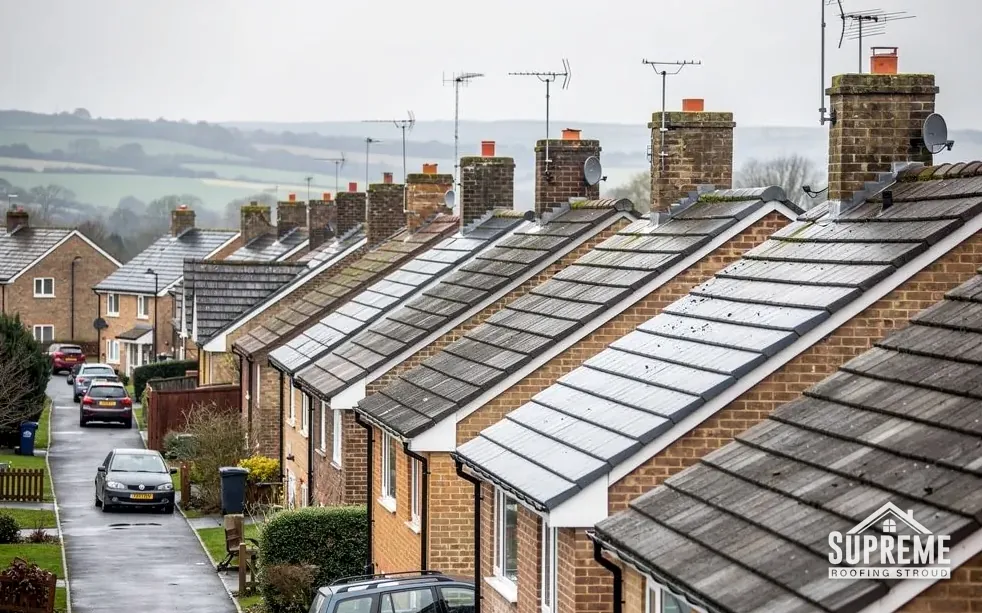
Stone village houses with slate and tile roofs above green fields 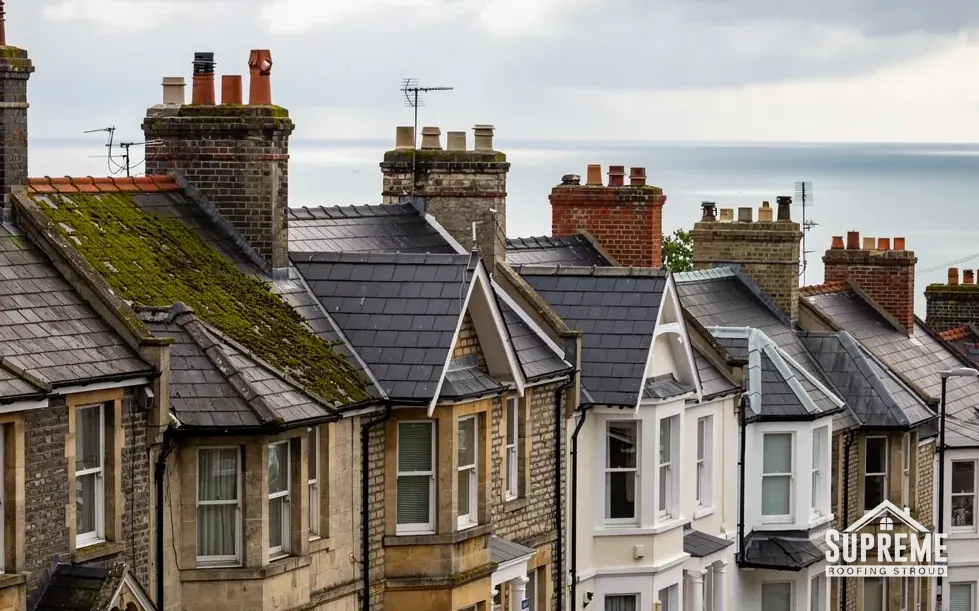
Row of Victorian terraced houses with slate roofs, bay windows and brick chimneys
Chapter 01
Floods in 1947, 2000 and 2007, and the roof overhead
When the Severn comes up, the roof and its drainage are what keep a house workable.
Chapter 01In this chapter
Wikipedia records serious floods at Upton in 1947 and 2000, and in 2007 the water stood higher than in 2000 and the town was cut off by road. Those three dates are enough to show how a flood-prone setting alters the thinking about a roof.
Flood recovery tends to follow a sequence, and the roof sits at the start of it more often than people expect. Drying a building out is slow work. Before the plaster is renewed or the floors relaid, the cause of any new damp has to be separated from the flood itself, and a roof or gutter fault is one of the usual suspects. A survey that clears the roof saves arguments later about where a stain came from.
First, the roof is dry when much else is not. After water has been in a building, the walls and floors can take a long time to dry, and a leaking roof above them makes that slower and harder. A sound roof lets the building dry from the inside out. So in a town like this, a roof check belongs in the list of jobs after a flood, not after the carpets are down. Our roof inspections and surveys page explains what we look at and what you get in writing.
Second, drainage. When the ground is saturated and the river is high, rainwater from the roof has nowhere to go. A downpipe that empties into a soakaway or drain can back up, and a gutter that is blocked or sagging is more likely to overflow against a wall that is already damp. Cleaning the outlets and fixing the brackets is cheap compared with repairing an internal wall. MyBuilder (updated August 2026) gives guttering at £30 to £70 per metre and a roofline total including fascia at about £150 per metre, as UK typical figures.
Third, access. When a town can be cut off by road, as it was in 2007, jobs cannot be booked on the assumption that a lorry will arrive on a given day. We build slack into the programme, each open section is sheeted over when the working day ends, and you hear from us if conditions change. A house is never left exposed just because the schedule says so.
If a leak is the immediate worry, tell us: leaks and storm damage take priority, and the first step is a roof made safe. If the building has been flooded and the order of repairs is unclear, ask us for a roof survey, and put the wider questions to your insurer or surveyor.
After a flood, a sound roof is what lets the walls below dry out.
- 1947year of a serious flood at Upton
- 2000year of the next serious flood
- 2007year levels rose higher than in 2000 and the town was cut off by road
Chapter 02
The Pepperpot, its copper cupola and the Blomfield church
A tower capped in metal and a church built to replace a lost nave show how varied roof work can be in one small town.
Chapter 02In this chapter
The Pepperpot is the tower of the old church of St Peter and St Paul. Its nave was demolished in 1937, and the tower, with its copper-clad cupola, is listed Grade II*. The replacement parish church by Sir Arthur Blomfield is Grade II*, too. The cupola is younger than the tower: in 1769 the old spire was replaced by an octagonal timber cupola with a copper roof and lantern, to the design of Anthony Keck. A lone tower with a metal cap is a useful picture of how roofing metals work.
The cupola raises a point about shape. A small domed or curved roof has no straight lines, and every sheet has to be cut and worked to fit. Even a modest curved bay on a house can need the same patient work. Flat sheets are laid in a pattern, and joints must run with the fall of the water. We tell you at the survey if a roof feature needs a specialist detail, and we say what it adds to the price.
Metal roofing is a different trade from tiling. Copper, lead and zinc are all worked by bending, folding and soldering or welting sheet, and each needs careful detailing at joints because the metal moves as it warms and cools. Copper work on a cupola is specialist, so what the Pepperpot needs is judged from a close inspection and set out in the written quote. For lead, MyJobQuote puts correctly installed flashing at over 80 years, and for zinc, VMZINC, a manufacturer, states more than 100 years, so the metals you may find on a house here have a long record.
The ordinary house version of this is lead flashing around a chimney, a lead-lined valley, or a zinc or lead dressing on a bay roof. Faults at those joints are the usual cause of a stain on a ceiling, and our lead roofing page explains how they are repaired. MyJobQuote's typical UK figure for a chimney flashing patch is £150 to £250.
Roof work on a church in worship goes through the diocese by faculty, under the ecclesiastical exemption. A house or shop in the town with its own listing follows another route, applying to Malvern Hills District Council before its character is altered. The Pepperpot no longer serves a congregation and now houses the town's Heritage Centre, so it follows the ordinary listed route. Upton also has a conservation area, one of 21 that Malvern Hills District Council maps, and we ask the council whether your address falls inside it before proposing a change.
One practical point on towers and tall buildings: access is planned from the ground up. A cupola or a high gable calls for scaffold or a tower with edge protection, and the quote reflects that. We would not price a high roof without having looked at how we reach it.

Chapter 03
The White Lion, the bridge town and old roof structures
A coaching inn with parts from 1510 is a reminder of what sits under an old roof covering.
Chapter 03In this chapter
The White Lion Hotel, a coaching inn with parts from 1510, tells the same story. Upton grew as a place to cross the Severn, and inns grew with it. Its portico carries a lion of its own, and the inn appears in Henry Fielding's novel Tom Jones of 1749. What a building of that age does teach is a rule for the town: the covering is the visible part, and the old structure underneath decides what is possible.
An old roof carries its load through timbers that were cut and fixed long before modern standards. Swapping a light covering for a heavy one can overload those timbers, and under the Planning Portal's guidance Building Regulations approval is needed once the new covering is 15 per cent heavier or more than the existing one. We confirm the threshold with building control on each job. A structural check comes first, and we raise it at the survey.
The opposite change matters as well. A lighter covering on a heavy roof can leave tiles or slates that were chosen to match a street suddenly out of place. Like for like is our default on older buildings: stone stays stone, slate stays slate, tile stays tile.
Roof edges, valleys and abutments on old buildings often reveal several generations of repair. Each junction is photographed, which lets you check the lead, the pointing and the fixings for yourself. The survey sorts the roof into parts that are sound, parts that need a small repair and parts that are spent, and the quote reflects each.
Flat or low-pitched sections, such as a rear extension or a porch, are priced differently from the main pitched roof. MyBuilder gives the typical UK replacement cost for a flat roof at £2,800 to £7,500, averaging about £75 per m², and a minimum finished fall of 1:80 is the usual target, with a design fall of 1:40 to allow for tolerance (BS 6229, via IKO and Rockwool). Ask us about our flat-roofing work if your rear extension is low-pitched.
We give a 10-year workmanship guarantee in writing, take away the waste and leave the site clear.
Map showing Upton-upon-Severn and the Stroud service radius, with nearby towns we also cover.
Near Upton-upon-Severn
Roof work we do here
The Pepperpot tower and Severn flood years
My Upton house was flooded at ground level. Should the roof be checked too?
Yes, ideally early. A leaking roof slows the drying of walls that are already wet, and gutters and downpipes may have been damaged or blocked. A survey records the roof's condition with photographs, so you have a record to show an insurer.
Does the Pepperpot tell me anything about copper roofing on my house?
Only that metal-clad roofs exist here. Any repair to a copper cupola is described and priced after that inspection, not guessed in advance. For lead and zinc, which you are more likely to find on a house, we use the published ranges.
Is my Upton-upon-Severn property in a conservation area?
Upton has a conservation area, one of the 21 that Malvern Hills District Council maps. The council can confirm whether your address lies inside it, and we check with them before suggesting a different covering or a new rooflight.
Can you work when the river is high and the roads are affected?
We plan around conditions and keep the roof covered at the end of each day. If the town is cut off, we move the programme and tell you, rather than leaving a roof open to the weather.