

Roofers in Hanley Swan
Hanley Swan is a Worcestershire village built around a green and a pond, 27.3 road miles north of Stroud by the usual route.
Hanley Swan at a glance
- Distance
- 27.3 road miles north of Stroud
- Council
- Malvern Hills District Council
- Listed
- Our Lady and St Alphonsus, Grade II*
- Village centre
- Green and pond
Hanley Swan's roofs around the green and pond
Hanley Swan lies in the Malvern Hills district, between Malvern and Upton-upon-Severn, with a village green and pond at its centre. It sits about 2 miles from Malvern and 3 from Upton, and it shares a civil parish with Hanley Castle, which counted 1,441 people at the 2021 census.
A green and a pond make a village that faces inward. The houses around them look at each other across open ground, and a roof there is read from a distance and from several sides. Any patch, any mismatched tile, any sagging ridge shows. That is the first practical point about working in a place built round a green.
Two churches are on the list. The Roman Catholic Church of Our Lady and St Alphonsus, designed by Charles Hansom on land given by the Hornyold family and opened in August 1846, is listed Grade II*. The Church of St Gabriel is listed Grade II. And in 2009 the village won the Calor Herefordshire and Worcestershire Village of the Year competition.
Each house here is read fresh at the survey, whether it turns out to be an old cottage, a farmhouse, newer infill or a bungalow. The chapters below follow the three themes the facts suggest: the green and the way roofs are seen together, the church and the rules that touch listed buildings, and the extensions and conservatories added to houses in a village that people care about.
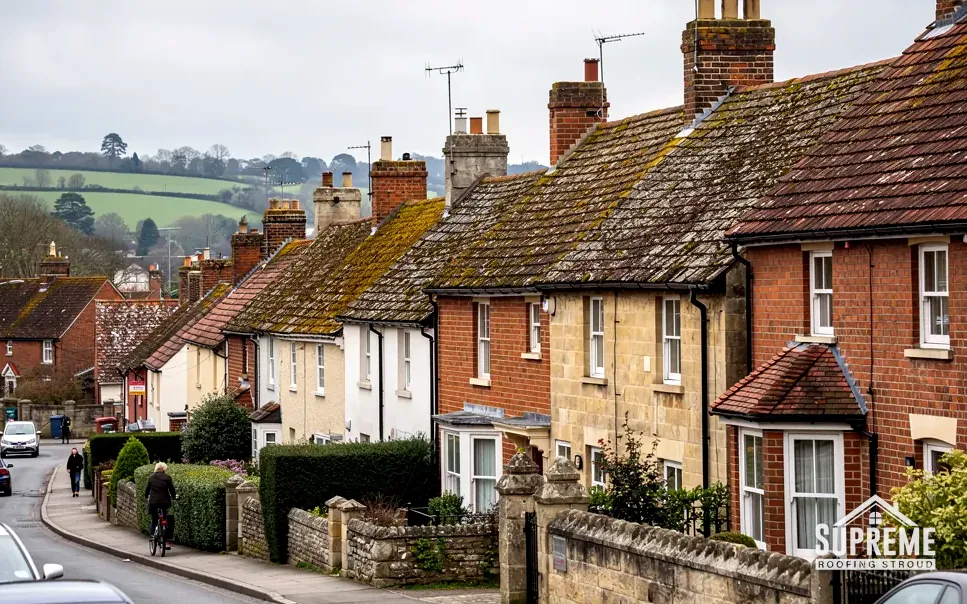
Sloping street of brick and stone terraced houses with mossy tiled roofs 
Victorian terraced houses with slate roofs and chimneys on a hillside

Chapter 01
Reading roofs across a village green and pond
On a green, every roof is on show to every neighbour, so repairs have to look as good as they work.
Chapter 01In this chapter
When houses stand around an open green, a roofline is seen as a group. A new section that is a different colour from its neighbours, a ridge that dips, a chimney that leans: all are visible from across the water. People notice such things in a village, and owners care about them. The practical response is to repair with attention to what sits beside you.
For a repair, that means matching. If a roof is clay tile, the replacement tile is clay of the same type, size and colour range, and if the original is no longer produced we search for the nearest colour and profile, then work it in among weathered tiles so the join softens with age. Slate repairs follow the same idea. A strip of brand-new slate on a weathered slope will stand out for a while, so we mix the replacements across the roof where we can, and the survey tells you what is likely to show.
Chimneys are the other feature that reads against the sky. A stack on an older house can lose pointing, crack at the top or lift its flashing, and all of that is visible from below. MyBuilder (updated August 2026) gives repointing a chimney at an average of about £750 within a £500 to £2,000 range, a flashing repair at £250 to £1,200, and a full stack rebuild at £2,000 to £10,000 or more. Those are national figures. Our chimney repairs page explains how we tell a repoint from a rebuild.
Rainwater is the other point. Wherever a roof sheds a lot of water, the gutters and downpipes must reach a proper outlet and must not discharge against a wall. Plastic gutter systems are usually laid to a slight slope, in a band from roughly 1:600 to 1:350 according to the maker, and a sagging run shows up as a pool at the low point after rain. Our survey photographs include the gutters, so you can see where they hold water and where the joints have opened.
Those details matter more on a house whose roof is read from the green. A stained wall below a broken gutter is as visible as a patched slope. Fixing the gutter and the roof edge together is often the sensible way to do it, since both sit on the same scaffold, and we explain the choice so you can decide.
Finally, a note on scaffold. A house on a green can have one face that is hard to reach, and the way a lorry reaches the plot is worked out before booking. The scaffold is covered in the written quote, and our survey photographs show the roof the way it appears from the green.
Around a green, a repair is judged from across the water.
Chapter 02
Our Lady and St Alphonsus, St Gabriel and the rules on listed roofs
Two listed churches and a village full of questions about what needs consent.
Chapter 02In this chapter
The Roman Catholic Church of Our Lady and St Alphonsus was begun in 1844 on land provided by Thomas Charles Hornyold, designed by Charles Hansom with furnishings by Augustus Pugin, and opened in 1846; it is listed Grade II*. St Gabriel's is graded II. Both entries are on the Historic England list, and the St Gabriel record is list entry 1098814.
For a roofer, the interest is practical. A Grade II* church of the 1840s has a pitched roof, lead dressings, gutters and a stone or brick structure to protect. The rule is clear: the covering, the lead and the gutters are repaired in kind, and any change goes through the proper authority first. A house nearby with its own listing is handled the same way, only the authority differs.
The rules for church roofs differ by denomination, and we do not decide them. Churches of the Church of England in use come under the faculty system, and the 2010 Order retains an exemption for qualifying Roman Catholic church buildings too, with its own approval route. For either, the church's own authorities are the people to ask. For houses and other buildings, the council's route applies: a house on the list must apply to Malvern Hills District Council before work changes its character.
Many owners in a village like this ask about rooflights. A roof window is often an easy addition to a loft, but the planning rules have conditions, and listing and conservation status change them. We do not restate the rules on this page. Our guide to roof window planning sets them out, and the skylights hub covers the choice of window, its fit and its price. For reference, Part L sets 1.4 W/m²K as the limit for a roof window and 2.2 W/m²K for a rooflight.
Hanley Swan is not among the 21 conservation areas that Malvern Hills District Council maps, although neighbouring Hanley Castle is. We still ask the council's planners about your address before we propose a new covering, a dormer or an added rooflight, because listing and planning conditions can apply anywhere.
On a listed or older house, our default is like for like. The covering that is there is the covering that goes back, and repairs are made to the pitch and details the house already has. We record each roof slope with photographs before work and after, and the quote covers the work from scaffold to making good. A 10-year workmanship guarantee comes with the work, in writing.
Chapter 03
A Village of the Year, extensions and conservatory roofs
In a village that won a regional contest, a worn conservatory roof stands out.
Chapter 03In this chapter
In 2009 Hanley Swan won the Calor Herefordshire and Worcestershire Village of the Year competition. The title is worth a line because it reminds us that residents here may take care over the appearance of their houses and gardens, and extensions and conservatories are a big part of that.
Conservatory roofs are among the shortest-lived roofs on a home. HomeBuilding gives polycarbonate roofs a typical life of about 10 years, and The Eco Experts put glass or polycarbonate at about 10 to 15 years, so a conservatory added some time ago may be due attention. A tired polycarbonate sheet clouds, cracks at the fixings and lets water in at the glazing bars. Our conservatory roof replacement page covers the choices.
The decision usually comes down to material. MyBuilder (updated August 2026) lists £2,000 to £5,000 for a polycarbonate replacement, £3,000 to £8,000 for glass and £5,000 to £10,000 for solid, all as UK norms. A solid roof is heavier, and the frames that carried polycarbonate may need strengthening, which MyBuilder puts at £500 to £2,000. Homebuilding & Renovating describes a switch to a solid roof as material alteration work, which brings a building control application, and we talk you through the route.
Condition is easy to judge from inside. Look up on a bright day for brown or green staining, hairline cracks along the sheet edges, and daylight at the ridge or eaves. Check the frame too: rot at the base of a timber frame, or corroded fixings on an aluminium one, can mean the problem is more than the roof sheet. We photograph the frame at the survey and note any movement, since a structural fault found after a new roof is on is a much more expensive discovery than one found before.
If the room is used all year, thermal comfort is part of the decision. A glazed roof gives light but loses heat in winter and gains it in summer, and a solid roof brings a conventional insulated build-up. Part L expects new roof elements in existing homes to meet a U-value of 0.15 W/(m²·K), which a solid roof can be designed to do. We set out the options side by side, with the work involved in each.
Planning is a separate matter. The Planning Portal FAQ warns that planning permission may be required where a change significantly alters how the roof is built or looks. For that reason we raise a solid roof that changes the look of a house with the planning officers at Malvern Hills District Council first.
An extension roof is priced like the main roof: typical ranges are published first, and a written quote follows the survey. At the end of the job we leave the site tidy and carry off the waste.
- Polycarbonate£2,000 to £5,000
- Glass£3,000 to £8,000
- Solid roof£5,000 to £10,000
Map showing Hanley Swan and the Stroud service radius, with nearby towns we also cover.
Near Hanley Swan
Roof work we do here
Pond, green and Hansom's Catholic church at Hanley Swan
The chimney on my Hanley Swan house faces the green and the pointing is crumbling. Does it need repointing or rebuilding?
It depends on how far the damage goes. If the brick is sound and only the mortar has failed, repointing is enough. If the stack is leaning or the courses have loosened, a rebuild is safer. The survey photographs decide it.
Can I add a rooflight to a house near Our Lady and St Alphonsus?
Possibly, but listing, conservation status and planning conditions all matter. Check the address with Malvern Hills District Council, and read our roof window planning guide for the rules before we design anything.
My conservatory roof is cloudy polycarbonate. Should I go solid?
A solid roof lasts longer and keeps the room more even in temperature, but it is heavier and counts as a Building Regulations job. We will price polycarbonate, glass and solid options so you can compare them.
Does winning Village of the Year mean Hanley Swan has special roof rules?
No. The 2009 title carried no planning controls. The rules that apply come from listing, any conservation area and the Building Regulations, and Malvern Hills District Council can confirm them for your address.