
Roofers in Tibberton
A small Forest of Dean parish of 1,406 acres, with a Grade I church founded in the 12th century and a record of rectors that runs unbroken from 1283, which makes it a good place to talk about roofs that are meant to last.
Tibberton at a glance
- Distance
- 14.9 road miles north-north-west of Stroud
- Council
- Forest of Dean District Council
- Listed church
- Holy Trinity, Grade I
- Parish
- 1,406 acres, Forest of Dean district
Tibberton: one Grade I church and a parish of 1,406 acres
Tibberton is a village and civil parish in the Forest of Dean district, covering 1,406 acres, with 576 residents at the 2021 census. It is small and quiet, and its best-known building is the Church of the Holy Trinity, which was founded in the 12th century and is listed Grade I. The parish has an unbroken record of rectors from 1283.
That church is the fixed point for the village's roofing story. A building that has stood since the 12th century has been re-roofed, patched and repaired many times, and each generation of rectors and churchwardens has faced the same questions: what is failing, what can wait, and who pays. The same questions face any owner of an older house in the parish, on a smaller scale.
Beyond the church, the village's houses span many periods and coverings, so a survey in Tibberton starts with the roof itself and nothing assumed. We identify the covering, date the construction as best we can from the structure, and photograph each fault. Planning here is decided by Forest of Dean District Council, whose building control team also covers the district, so it is the body to ask whether a given house carries any designation.
The parish is 14.9 road miles away from Stroud, set to the north-north-west. A survey there can be fitted in without a long trip, and we are often working in neighbouring parishes already.

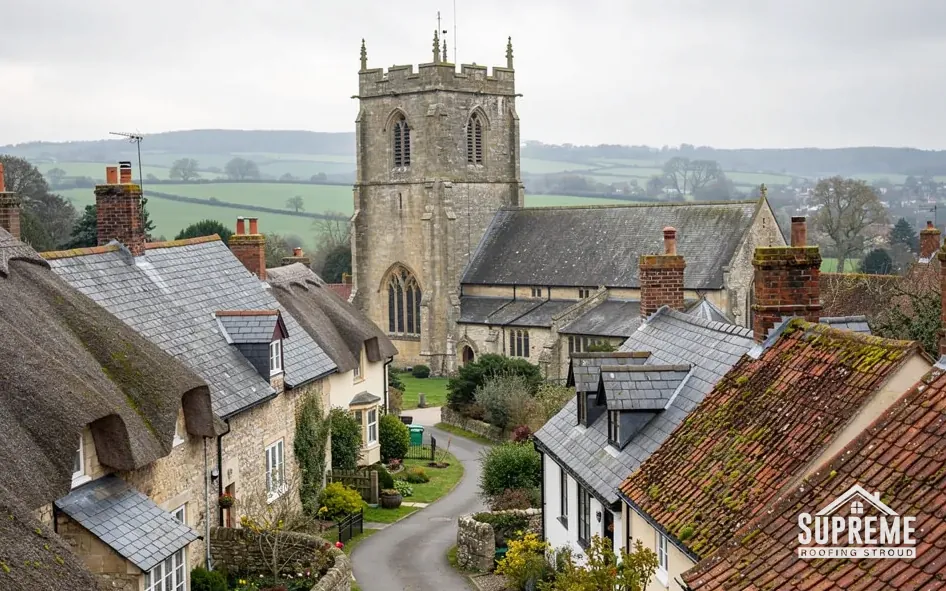
Street of stone terraced houses with slate and clay tile roofs 
Row of stone cottages with mossy clay tile roofs along a quiet lane

Chapter 01
Holy Trinity and what a Grade I roof asks of its keepers
A 12th-century foundation has outlasted many coverings; the aim is that the current one does the same.
Chapter 01In this chapter
Historic England's list entry places the Church of the Holy Trinity in the top grade, which is reserved for buildings of exceptional interest. Roof repair on a building like that is a question of stewardship before it is a question of price. The covering has to keep out the weather, but the decisions around it are made with the long view in mind, and with the church's advisers involved from the start.
Because Holy Trinity is a church in use, its roof sits within the ecclesiastical exemption, and a faculty from the diocese is the route for approval. Our part in that is the evidence. A roofer's report with dated photographs, a record of every gutter and outlet, and a list of defects ranked by urgency gives the people making the application something concrete to put forward. It also gives the parochial church council a basis for budgeting across years, not just for the next emergency.
On a church roof, certain features repay close attention. Lead flashings at the junction of nave and tower take most of the weather. Valley gutters between roofs carry large volumes of water. Parapet and box gutters can fill without anyone seeing them, because they sit behind stone. Lead has a long life when correctly installed, and a flashing can last over 80 years, and over 100 years in heavier codes (MyJobQuote, 2026), but only if it is allowed to move and is not constrained by hard pointing. Our roof inspections and surveys page explains how a written report is laid out.
Church roofs also bring height, and height brings cost. Scaffold for an ordinary house re-roof typically costs about £700 to £1,300 (Checkatrade, 2026), and a tower or nave roof needs a good deal more, designed by a scaffolder for that site. For any large roof, that is worth reading first on a quote.
Anyone can read the list entry for themselves on the Historic England website. It describes what is protected and is a useful thing to have in hand when talking to anyone about the building.
On a Grade I roof, the report matters as much as the repair.
Chapter 02
Rectors since 1283: planning maintenance across generations
A long record of custodians is a reminder that roofs are looked after in cycles, not in crises.
Chapter 02In this chapter
Tibberton's parish has an unbroken record of rectors from 1283. Whatever else changed over those centuries, a roof was always above the church, and someone was always responsible for it. The lesson for a modern homeowner is a practical one: a roof is easier and cheaper to look after if it is checked on a schedule than if it is left until something falls.
In this chapter
Every covering has its own expected life, and published sources give ranges. Natural slate is quoted at 80 to 100 years or more (MyBuilder, 2026). Clay tiles are quoted at 40 to 60 years, and concrete tiles at 30 to 50 years, though published figures vary and depend on exposure and workmanship. Lead flashings can pass 80 years, while a good felt flat roof may last up to 20 years and a poor one fewer than 10. None of those numbers is a promise. They are a guide to when a roof deserves a closer look.
A sensible cycle for a house roof is a check once a year, after the leaves have fallen, for gutters, outlets and loose tiles, plus a fuller inspection every few years or after a severe storm. The cost of that is small. A standard survey typically runs from about £150 to £250 (MyBuilder, 2026), and clearing gutters and fixing a few slipped tiles is far cheaper than repairing the rafters and plaster that a long leak destroys. Our roof repairs page describes how we find a leak's source and what repairs commonly cost.
Gutters are the lowest-cost part of the cycle and among the most useful. A guide figure for new guttering is about £30 to £70 per metre, and for fascia and soffit work £80 to £150 per metre for fascia and £100 to £180 per metre for soffit (MyBuilder, 2026). A sagging run is a sign that either the brackets or the fascia behind them have given way, since a gutter must slope towards its outlet to drain, and manufacturers give figures from about 1:600 to 1:350 depending on the system.
When maintenance is no longer enough
Sooner or later a covering reaches the end of its life, and the question becomes repair or replace. A roof that needs patching in several places each year, with battens that crumble and underlay that tears when touched, is usually past repair. Re-roofing in that case is the economical choice, and our roof replacement page sets out what the work involves.
A full re-roof in the UK typically costs between £5,000 and £12,000, with a gable roof at £5,000 to £8,000 and a hipped roof at £8,000 to £12,000 (MyBuilder, 2026). Those figures include materials, labour, scaffold and disposal, and they are national, so your own quote will follow a survey and cover the work your roof needs.
| Covering | Typical life |
|---|---|
| Natural slate | 80 to 100 years or more |
| Clay tiles | 40 to 60 years |
| Concrete tiles | 30 to 50 years |
| Built-up felt flat roof | 10 to 20 years |
Chapter 03
A parish of 1,406 acres: one house, one survey, one quote
In a small parish each job stands alone, so each one starts with a clean sheet.
Chapter 03In this chapter
With 1,406 acres and 576 residents at the 2021 census, Tibberton is a parish where each roofing job is its own project. There is no standard house to measure against, so each answer is built from the roof in question. It begins with a snapshot taken at the gate and a short conversation about what you have noticed: a stain, a drip, a missing tile, a gutter that overflows.
In this chapter
The visit follows. We look at the covering, the ridge and verges, the abutments, the chimney, the gutters and the roof void, and we photograph each defect. From the survey comes a written quote covering scaffold, stripping, materials, labour, waste and any extras. That makes it possible to set it beside another quote. On an older roof the new covering matches the old one in kind, so a stone roof is repaired in stone and a slate roof in slate.
Does the job need approval?
A repair usually does not. The Planning Portal says an application to building control is not normally required while less than 25 per cent of the building envelope and less than 50 per cent of the roof are touched. Beyond those limits approval is needed, and the insulation may have to be improved. A new covering that adds 15 per cent or more to the weight triggers approval and a structural check as well. The district council runs its own building control team; if your job is notifiable, we take care of the notification.
- 1,406acres covered by the parish
- 576residents at the 2021 census
- 1283year the unbroken record of rectors begins
Planning is a separate question. A re-roof in matching materials is normally not development, though a listed building or a conservation area changes that, and the council can confirm either. Bats and nesting birds have legal protection, and work pauses if we meet either.
The road to the roof also needs thinking about on a rural property. A farm lane or a long drive affects where the scaffold is delivered, where materials are stacked and how the waste skip is positioned, and the survey records the answer, which then goes into the quote. That keeps access from turning into a surprise charge once the van has arrived.
What you get at the end
When the work is finished, the site is left clean and the waste is taken away. The workmanship carries a 10-year guarantee in writing, and the invoice shows the VAT, since roofing work is normally standard-rated.

To start, send photographs through the enquiry form or WhatsApp, or ring 01453 933613.
Map showing Tibberton and the Stroud service radius, with nearby towns we also cover.
Near Tibberton
Roof work we do here
Holy Trinity and the 1,406-acre parish
Holy Trinity is Grade I. Does that affect the houses near it?
Not automatically. The listing protects the building it names; a house next door is touched only if it is listed in its own right or lies within a designated area. The district council holds the record, and checking it is one of our first questions.
How often should the roof of an older house in Tibberton be checked?
A look once a year, after the leaves have fallen, covers gutters, outlets and loose tiles, with a fuller inspection every few years or after a severe storm. A standard survey typically costs £150 to £250 (MyBuilder, 2026).
What does a faculty have to do with my church roof?
For a church in use, roof work is approved by a faculty from the diocese and not by the council. The church and its advisers make the application, and we supply the survey, photographs and written costs behind it.
Will you handle building control if my re-roof needs it?
Yes. We explain whether the work is notifiable and deal with the notification to the council's building control service or to a registered building control approver, so the paperwork does not fall to you.