

Roofers in Staple Hill
A hilltop suburb in Bristol's east, 29.3 road miles south-west of Stroud, Staple Hill has Victorian streets with ornate roof ridges and decorated eaves.
Staple Hill at a glance
- Distance
- 29.3 road miles south-west of Stroud
- Council
- South Gloucestershire Council
- Listed
- Hill House, Rodway, Grade II*
- Setting
- Hilltop suburb, former Kingswood Forest
Staple Hill's decorated ridges and its broad High Street
Staple Hill is a suburb of Bristol in South Gloucestershire. It lies east of Fishponds, south of Downend, west of Mangotsfield and north of Soundwell. The land was once part of the ancient Royal Forest of Kingswood, modern settlement began in the eighteenth century, and the suburb itself developed through the nineteenth.
That Victorian growth gave Staple Hill its character. The architecture is Victorian, with ornate roof ridges and eaves, and the High Street is broad because trams once ran along it. Those two details tell a roofer a good deal. Decorative ridges and eaves were meant to be seen, which means they are made of shaped parts that cannot simply be swapped for a plain modern equivalent without changing how a street looks. And a wide main road with shops along it suggests the other kind of roof work in the suburb: low-pitched or flat roofs over the buildings behind the frontages.
Hill House, just to the east at Rodway in Mangotsfield and built around 1743, is listed Grade II*, a reminder that some buildings need consent before anything is altered. The suburb has no conservation area of its own, so for most houses the usual rule applies: matching the existing roof covering is normally straightforward, and changing its appearance is a question to put to the council.
A survey identifies what you have. The written quote that follows takes in the whole job.

Flint and brick cottage with a clay tile roof beside a road 
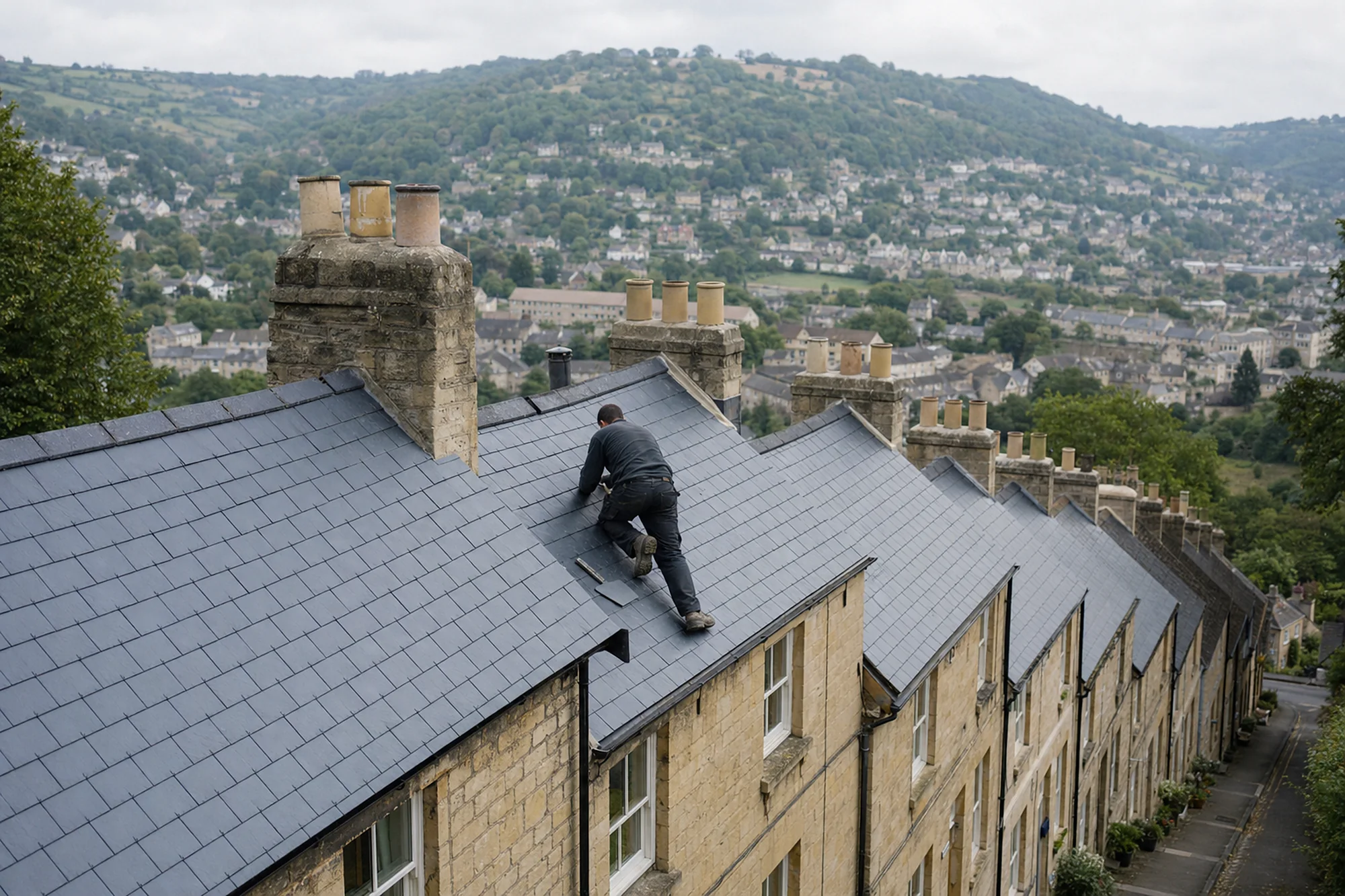
Wooded hillside lined with rows of stone houses and slate roofs
Chapter 01
Ornate ridges and eaves: repairing Staple Hill's Victorian detail
A decorative ridge is cheap to ignore and costly to lose.
Chapter 01In this chapter
Staple Hill's Victorian architecture is known for its ornate roof ridges and eaves, and they sit where a roof takes the most punishment. A ridge line sits at the top of the roof, in the wind and the sun, and a decorative one adds shaped tiles whose joints and ends collect water. Over a century and a half, the mortar that bedded them has shrunk and cracked, and the tiles can shift or drop.
In this chapter
Repair starts with deciding whether the ridge can be saved. Sound tiles are lifted, cleaned and set aside. Cracked ones are matched, not replaced with a plain substitute. If the ornament is clay, a clay replacement of the same profile and colour is the right match. A plain half-round ridge on a decorated terrace looks wrong from the pavement, and it would be noticed by every neighbour.
Fixing matters as much as appearance. BS 5534:2014 means a ridge or hip is no longer left to its mortar bed alone, so we add mechanical fixings to the ridge as well. BS 8612 covers dry-fix systems that use clips and screws, and some of those systems can be dressed to look right on a decorated roof, though a fully ornamental ridge often keeps its bedding with mechanical fixings added. MyBuilder's 2026 figures give £300 to £600 to re-bed or replace ridge tiles and £200 to £400 to repoint a ridge or hip. Our ridge, verge and dry-fix page compares the methods.
Eaves that carry detail
The eaves are the second place where Victorian builders showed off. Decorated eaves usually combine a timber fascia, a soffit under the overhang and a gutter on brackets, with perhaps a moulding or an extra course of tiles to finish the line. Boards kept damp over many winters soften first at the joints, and a gutter that leaks onto it speeds the rot. We probe the timber with a blade, check the gutter fall, and tell you which parts are sound.
Where the detail needs a specialist, such as shaped clay ridge tiles that are no longer made in standard ranges, we source salvage or a close new match and show you samples before ordering. If a ridge tile is cut to fit, the cut edges are sealed. Gutter brackets and ornamental stops are retained where they are sound.
Matching what is there
Where eaves detail has been lost, we measure what survives on neighbouring houses and reproduce it. Photographs of a surviving original are the best brief a joiner can have, and we pass them on with the quote.

On a decorated ridge, the profile is part of what you are repairing.
Myth: A decorative ridge can be replaced with a plain one without anyone noticing.
Fact: On a street of matching Victorian ridges, a plain run stands out from the pavement, so we match the profile and colour.
Chapter 02
The broad High Street and the flat roofs behind its frontage
A road wide enough for trams brings long frontages, rear extensions and low-pitched roofs.
Chapter 02In this chapter
The High Street is broad because trams once ran along it. A road of that width, lined with buildings that were put up to serve it, tends to have long frontages with pitched roofs on the street side and flatter, lower roofs towards the back. Single-storey rear additions, shop extensions and outbuildings are common behind such frontages, and many of them are covered with felt, EPDM or GRP.
In this chapter
Flat roofs are different from pitched ones. They are not truly flat: BS 6229 calls for a design fall of 1:40, so that the finished roof still reaches 1:80 once tolerances and deflection are allowed for. A roof that ponds water has usually lost that fall. The covering matters too. MyBuilder's 2026 flat roof guide lists felt at £70 to £100 per m², EPDM at £90 to £130 and GRP at £95 to £150, and EPDM is commonly quoted at 20 to 30 years or more. Flat roofs generally run between 15 and 30 years, so a roof that is fifteen years old deserves a close look even if it is not yet leaking.
When a flat roof leaks, the cause often lies at an edge or an upstand, not out in the field of the membrane. We check the perimeter trims, the junction where the roof meets the wall, the outlets and any penetrations. A small failure at a detail can be repaired. A membrane that has split in many places is a replacement. Our flat roofing page describes the systems and what each is suited to.
Flats over shops
Upper floors over commercial units have a particular weakness: the roof above is out of sight of the people on the ground floor, and a slow leak can run for months before a ceiling stains. An occasional look from a ladder costs very little beside a ceiling replaced after the fact. MyBuilder's 2026 guide gives £150 to £250 for a standard roof inspection, with drone surveys at £200 to £400, so a check is a modest outlay. We would suggest one before a tenancy changes or a lease is renewed, so that any repair liability is clear from the photographs.
Where a parade has homes above the shops, the roof is shared by several owners or tenants, and the freeholder usually decides who arranges repairs. We ask who is responsible before pricing, and the access arrangements are put in writing with the quote, because scaffold over a pavement needs a licence and some lead time.
Working while the shop stays open
Trading premises need their entrance kept clear. Scaffold is built to leave a safe way in, deliveries are planned for quieter times, and the roof is made watertight at the close of each working day.
- Bitumen felt£70 to £100 per m²
- EPDM£90 to £130 per m²
- PVC single-ply£95 to £140 per m²
- GRP£95 to £150 per m²
Chapter 03
From Kingswood Forest to railway tunnel: dating a Staple Hill roof
Eighteenth-century beginnings and a Victorian boom leave roofs of several ages side by side.
Chapter 03In this chapter
Staple Hill lay within the ancient Royal Forest of Kingswood. Settlement began in the eighteenth century, and the suburb developed in the nineteenth. The Midland Railway opened Staple Hill station in 1888, with a tunnel deep under the hill, and the station closed in 1966. Each of those dates leaves a trace in the housing that came after it, and a roofer who can place a house in its period knows where to look for trouble.
In this chapter
A house from the early settlement is likely to have the oldest timbers and the most patched covering. Houses from the Victorian expansion are the bulk of the suburb, and their roofs have passed the century mark, and plenty are on a second covering or overdue for one. The railway's arrival in 1888 coincided with the late Victorian years, when terraces were being built in numbers. A date alone never tells us the covering, so the survey looks at the roof itself.
Hill House at Rodway, on the suburb's eastern edge, is listed Grade II*, and for any listed building the covering, the ridge and the eaves are part of what is protected. The council's conservation officers decide whether a proposed change needs listed building consent, and we would follow their direction. Hill House is one example, and the Staple Hill war memorial, listed Grade II, is another. Houses around it that are not listed face lighter rules, though matching the existing covering is still the sensible default.
Gutters and drainage on a hilltop
A hilltop suburb sheds its water downhill, and gutters and downpipes carry the load. MyBuilder's 2026 guide gives guttering at £30 to £70 per m, fascia at £80 to £150 and soffit at £100 to £180, and MyBuilder says a uPVC fascia or soffit usually comes due for replacement within 10 to 20 years. On a Victorian terrace with decorated eaves, replacement boards should follow the original profile where they can. The guttering, soffits and fascias page shows which boards and gutters are renewed and which are simply refixed.
A survey before you decide
If you are not sure how old your covering is, send a photograph, or book a survey. The report names what is on the roof and what is holding it there, and sorts the findings into urgent items and ones that can wait a season.
Map showing Staple Hill and the Stroud service radius, with nearby towns we also cover.
Near Staple Hill
Roof work we do here
Ornate Victorian ridges and shopfront flat roofs
Can ornate Victorian ridge tiles be repaired instead of replaced?
Often, yes. Sound tiles are lifted, cleaned and reset, and cracked ones are matched to the original profile and colour. The ridge is mechanically fixed as well, because BS 5534:2014 no longer relies on mortar alone.
Why do the eaves on an older Staple Hill house rot at the joints?
Water from a leaking gutter sits on the fascia and soffit, and timber softens first where boards meet. We probe the wood, check the fall of the gutter and replace only what has failed, copying the original moulding where we can.
What is involved in re-covering a flat roof behind a shopfront?
We check the fall, the edges, the outlets and any upstands, then strip to the deck, repair it and lay the new covering. Access is planned so the entrance stays clear, and the roof is sealed each evening.
Does Hill House's Grade II* listing affect nearby roofs?
Only the listed building itself. Hill House itself needs consent for work that changes its character. Unlisted houses nearby follow the ordinary planning rules. Staple Hill has no conservation area of its own.