

Roofers in Mangotsfield
Roof work in Mangotsfield, from the Grade II* church of St James to the streets around Rodway Hill, surveyed first and quoted in writing before any scaffold goes up.
Mangotsfield at a glance
- Distance
- 26.5 road miles south-south-west of Stroud
- Council
- South Gloucestershire Council
- Parish church
- St James (Grade II*)
- Setting
- Near Rodway Hill, north-east Bristol
Mangotsfield's roofs, from a Domesday name to a Grade II* church
Mangotsfield is a suburb on the north-eastern side of Bristol, set near Rodway Hill, and it is older than its suburban look suggests. Domesday Book (1086) records it as Manegodesfelle. The parish church of St James dates from the 13th century, although it was rebuilt and altered in the 19th century, and it is listed Grade II*. Rodway Hill Manor, in an east and a west wing, and Hill House carry the same Grade II* listing.
For a homeowner the useful point is how mixed the roofscape is likely to be. A suburb with a medieval church, a manor house and a railway station that ran from 1845 to 1966 has been built up over many generations, and every generation roofs differently. We do not guess a covering from the street name. The first visit finds out what is actually on your roof, how it is fixed and what lies beneath it, and the written quote is built from that.
A listed roof and an ordinary house roof are different jobs. When a building is listed, any change to its character needs listed building consent from South Gloucestershire Council before work begins, and even a repair can come under that. A house without a listing is easier: matching the existing material is usually routine. Unsure where your own property stands? We can look up the national list entry with you, then ask the council's conservation team to confirm in writing.
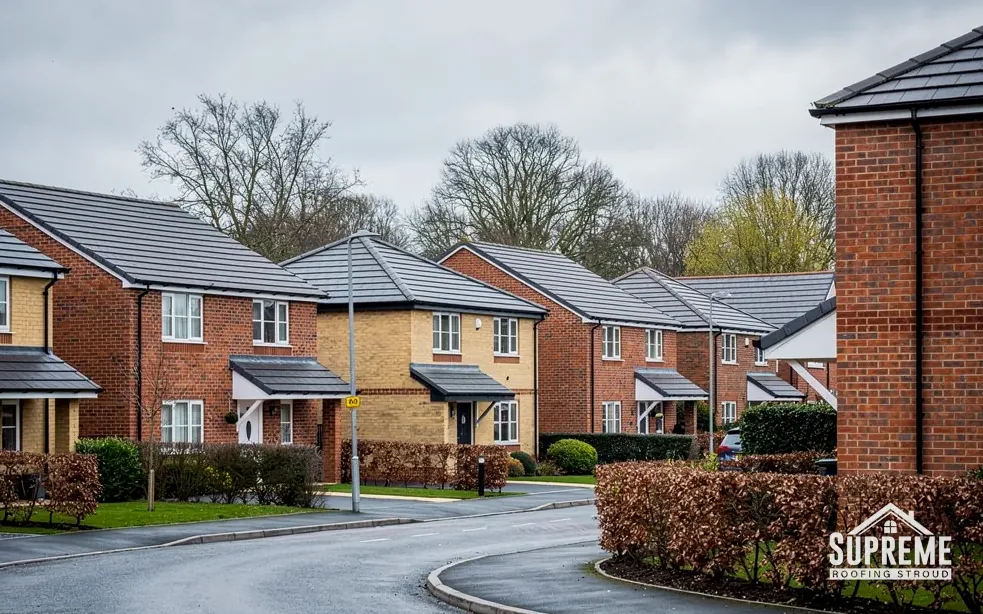
Modern brick housing estate with grey tiled roofs along a curving road 
Hillside of stone terraced houses with mossy stone tile roofs and chimneys

Chapter 01
St James's church, Rodway Hill Manor and the listed roofs
Three Grade II* buildings, and two different routes to permission.
Chapter 01In this chapter
Mangotsfield has an unusual pair of listed neighbours: a parish church and a manor house, both at Grade II*. They look like similar problems, but the paperwork runs down separate tracks, and mixing them up costs weeks.
In this chapter
Because St James's remains in use as the parish church, the ecclesiastical exemption covers it, and Mangotsfield's church roof is a matter for a diocesan faculty rather than for South Gloucestershire's planners. That route involves the church's own advisers and a formal application, so a repair to St James's is led by the parish, and any contractor works to whatever the faculty allows. Were a church to close and pass into other hands, or an old chapel to be turned into a house, that exemption would fall away and the council's listed building consent would take its place.
Rodway Hill Manor and Hill House follow the ordinary listed building route. The listing protects the whole building, inside and out, so the roof is part of what the council considers. Anything that alters the look of the roof, such as a different slate size, a changed ridge or new rooflights, needs consent first. A straight repair in the same material may or may not need it, which is why we ask the conservation team rather than assume.
How we go about a listed roof
The survey is slower. We photograph every slope, junction and chimney, then record each defective area and the existing materials, sizes and fixings. Two junctions get particular attention. A hip runs down the outward corner of a hipped roof. A valley is the inward fold where two slopes drain into one channel. On an old roof these are the spots where earlier repairs pile up, one on top of another.
The quote that follows covers scaffold, strip, materials, labour and clearing the waste. For a listed roof it also lists the consent step, so you can see who is applying and when, and the timetable allows for it. Our roof inspections and surveys page explains what the photographs and report cover, and why a survey often settles the argument about repair versus replacement.
Check who authorises the work before anyone prices the slope.
Chapter 02
The railway years, 1845 to 1966, and the roofs of those decades
A station that served the village for over a century is a useful yardstick for roof age.
Chapter 02In this chapter
Mangotsfield railway station served the village from 1845 to 1966. It is gone, but the dates make a handy yardstick. A house built when the railway first arrived is now well over a century and a half old, and one from the last years of the station is closer to sixty. Those are very different roofs to survey, even when they stand on the same road.
In this chapter
On the older end, we expect a covering that has been patched more than once. Past repairs show as mismatched patches, a ridge line that dips where timber has softened, and mortar renewed in several shades. Take the verge, the sloping edge of the roof beside a gable wall. It is often the most weathered part, because rain reaches it from the side as well as from above. Soakers are another giveaway. These are the small folded sheets of lead or other metal that slot between tiles and a wall or chimney, and a failed one lets water travel into the house, well away from the point where it got in.
On roofs from the later decades, the questions change. The underlay may be a stiff old felt that has turned brittle, or a modern breather membrane. Battens, the thin timber strips that carry the tiles, can be soft after years of damp even when the tiles above them look sound. Fixings matter as well. The number of nails and clips holding the covering down varies with the era of the build, and a roof fixed to an earlier standard may be worth bringing up to date while it is stripped.
Dating a roof is a survey task
Age alone does not condemn a roof. A covering from the railway years can still be sound if the timber beneath it has stayed dry, and a newer one can be failing because of a single blocked gutter. We separate the two by tracing leaks back to their source, looking from the loft side where we can, and checking the ceiling below for stains that point to a slow, long-running fault.
- 1086year Mangotsfield appears in Domesday Book as Manegodesfelle
- 1845year Mangotsfield railway station began serving the village
- 1966year its service to the village ended
Nobody can date a roof honestly from the pavement. What we do is read the tiles or slates, the layer beneath them and the timber under that, then report each finding alongside a photograph of your own roof. On a full replacement the old covering comes off, the garden is swept and the waste leaves with us. Our pitched roofing page sets out how a sloping roof is stripped and relaid.
Where you only need a local fix, the aim is to put back what was there, fixed as well as or better than before, so that the repair does not stand out and does not create a new weak point alongside it. We say which of the two jobs we think you have, and the quote reflects it.
Chapter 03
From urban district to South Gloucestershire: who to ask
Local government changed twice after 1974, and today the council to call is South Gloucestershire.
Chapter 03In this chapter
Mangotsfield Urban District was abolished in 1974, becoming part of Kingswood Borough in Avon, and then of South Gloucestershire in 1996. For a homeowner the effect is simple: planning, listing and conservation questions go to South Gloucestershire Council, and any Building Regulations notification goes through your building control body, whether that is the council or a private registered building control approver.
In this chapter
Swapping a roof covering for the same kind of covering normally falls outside planning control. A much heavier covering, or a large share of the roof being renewed, can bring Building Regulations into play, and the roof may then need extra insulation. We say where your job sits on that scale, and a notifiable job gets its notification from us. No conservation area covers the village centre; the nearest, at Siston, was designated in 1989 and lies about a mile to the east. Boundaries are reviewed from time to time, so we confirm with the council before relying on that.
Distance is the other practical matter. Mangotsfield is 26.5 road miles south-south-west of Stroud, inside our working area, and the journey is planned into the job from the start. We book the survey for a time that suits you, photograph your own roof and send the written quote afterwards. Where a smaller repair would not justify putting up scaffold, we tell you so and describe the alternatives.
Access on a suburban street
Planning a job here also means thinking about the road itself. Parked cars narrow many suburban streets, and a delivery lorry carrying a pack of tiles needs somewhere to stop. We agree a drop point with you in advance, so materials arrive when the scaffold is ready rather than blocking a neighbour's drive.
Suburban plots usually give workable access, with a front drive or a side passage for materials. What we look for is where the skip can stand, whether a neighbour's car or fence is in the way and whether the scaffold has to cross a pavement. We raise each of these at the survey, and any cost attached to them is explained in the quote.
Work on a shared boundary, such as a party wall chimney or a terraced run, is agreed with the neighbour beforehand. A repair that suits one house can affect the next, and a short conversation at the start saves a longer one in the middle of the job. The work carries a 10-year workmanship guarantee in writing, and our chimney repairs page covers the stacks and flashings that sit on those shared lines.
Map showing Mangotsfield and the Stroud service radius, with nearby towns we also cover.
Near Mangotsfield
Roof work we do here
St James's, Rodway Hill and the railway station
Does roof work on St James's church or Rodway Hill Manor need consent?
Yes, but by different routes. A church in use needs a faculty from the diocese, while the manor, as a Grade II* listed building, needs listed building consent from South Gloucestershire Council. We work out the route before pricing so that the timetable we give you is realistic, and we say who is applying for what.
My house is old but not listed. Can I repair the roof in a new material?
Often yes, but we recommend like for like, because mixed coverings on one roof age at different rates and the join between them becomes a weak point. If the building is listed or inside a protected area, a change of material is something to raise with South Gloucestershire Council first.
How old is the covering on a house built when the railway station opened?
Anything from 1845 onward is over 150 years old, so the original covering has usually been replaced at least once. The underlay, the battens and the fixings all get a look, not only the visible covering, and the photographs let you judge for yourself.
Who inspects a re-roof in South Gloucestershire?
A notifiable job is inspected by a building control body, which means either South Gloucestershire's service or a registered building control approver. We explain whether your job is notifiable, and we handle the notification so it does not fall between you and the roofer.