
Roofers in Kingswood, Bristol
Roofing in Kingswood, the large town on the eastern edge of Bristol that grew from a royal forest and a coalfield, with good and fair prices and typical ranges published before anyone climbs a ladder.
Kingswood, Bristol at a glance
- Distance
- 28.9 road miles south-south-west of Stroud
- Council
- South Gloucestershire Council
- Grade I listed
- Whitefield's Tabernacle
- Conservation area
- Whitfield Tabernacle, designated 15 October 1995
Kingswood's roofs, from a royal forest to a Grade I Tabernacle
Kingswood sits on the eastern edge of Bristol, and it is a town of some size: its wards had a combined population of 40,734 at the 2011 census. The name goes back to the King's Wood, a royal hunting forest surrounding Bristol, whose first recorded chief ranger, Ella, died in 920. In the late 17th century the town became industrially prominent through coal mining, and that mix of forest and coalfield is how the area is usually described.
Two buildings anchor the town's heritage. Whitefield's Tabernacle is listed Grade I, and the 1851 Gothic Masters Church beside it is listed Grade II. Around them is the small Whitfield Tabernacle Conservation Area, designated on 15 October 1995. It covers the Tabernacle site, not the whole town, so most Kingswood roofs sit outside it.
A note on names: Stroud District's own list of conservation areas includes a Kingswood, and that is a different place from this one. This page is about Kingswood in South Gloucestershire, where the planning authority is South Gloucestershire Council. The distinction matters when you ask about permissions, because the wrong council will give you the wrong answer, and a wasted week at the start of a job is easily avoided.
For roofing, the main consequence of the town's scale is variety, and variety is why we never quote from a postcode alone. A population of that size lives in houses, flats, shops and workshops of every age, and no single covering or method describes them. Each roof gets its own survey, with photographs, and the price follows what we find on it.

Row of stone cottages with mossy clay tile roofs along a quiet lane 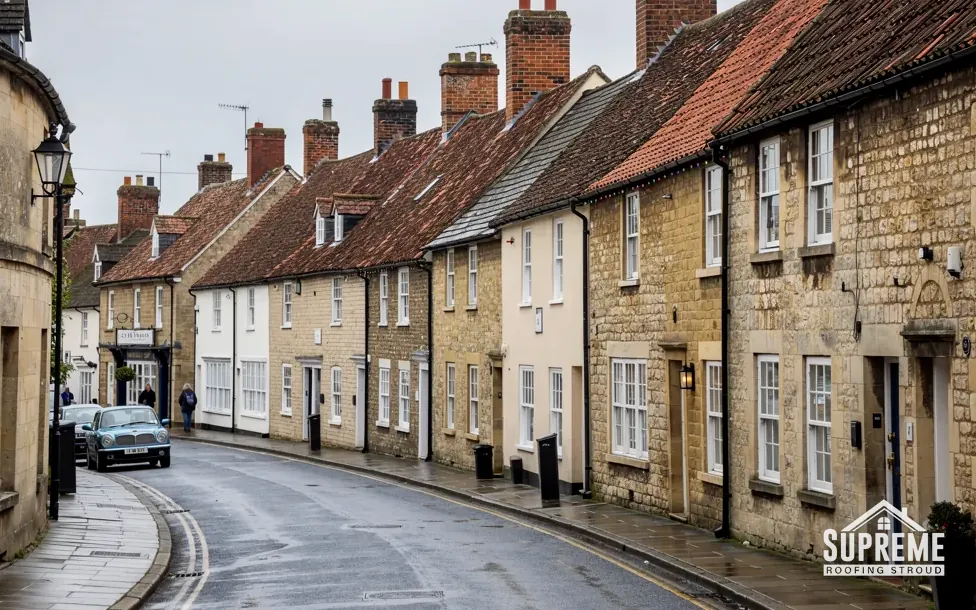
Curving street of stone and rendered terraced houses with tiled roofs

Chapter 01
Whitefield's Tabernacle of 1741, the Masters Church and a small conservation area
A Grade I meeting house, a Grade II Gothic church and the roofs around them.
Chapter 01In this chapter
George Whitefield preached in the open air to Kingswood's coal miners, and Whitefield's Tabernacle was completed in 1741. Its Grade I listing is the highest the system gives. The Masters Church beside it, a Gothic building of 1851, is listed Grade II. Together they form the town's best-known pair of historic buildings, and the conservation area designated in 1995 was drawn around the Tabernacle only.
In this chapter
The first thing to know about a roof near them is whether the building itself is listed, since that settles which rules come into play. A listed building cannot have works that affect its character done without authorisation, and a roof is part of its character. For a church or chapel still used for worship, the route depends on the denomination: Church of England buildings go through a faculty from the diocese, and certain other denominations hold exemptions of their own. Neither of these two is a working place of worship today. The Masters Church site has been approved for conversion to flats, and the Tabernacle, added to Historic England's Heritage at Risk register in 1999, is being restored by the Whitfield Tabernacle Trust, so the council's consent is the route for both. For any building where worship has ended, or one now converted to a home or office, the exemption normally falls away and the council's listed building consent becomes the way in.
For a house or shop in the conservation area, the position is lighter. Putting the same covering back normally leaves a building looking as it did, which is why planning permission is not usually required. A different material, a change to a visible chimney or new roof windows are things we raise with the planning team first, so that the design is settled before the quote is. If the council wants a particular profile or colour, that requirement goes into the specification from the beginning and not after the scaffold is up.
What a survey of an old chapel roof looks for
Chapel and church roofs share a few features: a steep main span, a ridge that runs the whole length, and gutters or parapets at the eaves that are hard to reach. Their roof timbers are large and often hidden, so the survey includes a look from inside the roof space wherever access allows. Water stains on old plaster are the clue we look for first, because they show a long-running leak that a surface inspection might miss.
We do not price work on a place of worship until the right authority has said yes, but we can survey a listed roof, photograph the condition and set out the repairs needed, so that a congregation or a trust has a record to submit. Our roof inspections and surveys page describes what the report contains.
Find out who has to say yes before anyone prices a listed roof.
- 1741year Whitefield's Tabernacle was completed
- 1851year of the Gothic Masters Church beside it
- 1995year the Whitfield Tabernacle Conservation Area was designated, on 15 October
Chapter 02
From the King's Wood to the coal pits: a timeline for Kingswood's roofs
More than a thousand years of history, and how little of it a roof reveals without a survey.
Chapter 02In this chapter
Kingswood's history is long enough that it helps to set it out. The King's Wood was a royal hunting forest, and its first recorded chief ranger, Ella, died in 920. Coal mining made the area industrially prominent in the late 17th century. In 1741 the Tabernacle was finished, and in 1851 the Masters Church followed. The conservation area came much later, in 1995.
In this chapter
Those dates are useful as a frame, and a frame is all they are. A roof is dated by its materials and its timber, not by the history of the street it stands on. Knowing when a street was laid out does not tell you what is on its roofs today, because coverings get replaced. We therefore avoid the lazy shortcut of guessing a house's age from the town's story. What we do instead is look at the roof, the loft and the ceilings below, and report what we find.
In a large town built across several centuries, the useful questions are always the same. How old is the covering? Is there an underlay beneath it, and if so what is its condition? Are the battens sound? Is the ridge fixed mechanically? Are the lead flashings around the chimney intact? A survey answers each of those in turn, with photographs. Roof windows and any flat-roofed additions get the same treatment, because they are often where water first finds a way in. The quote then deals with what is actually there.
Why a survey comes before a quote
Between a minor repair and a full re-roof lies a range of jobs, and from pavement level the right one can be hard to pick. A patch repair might be £150 to £1,500, according to MyBuilder (2026), while a full re-roof is a much larger project. The sensible approach is to find out which end of the range your roof sits at, and a survey is the way to do it. Our roof repairs page sets out the typical ranges with their sources.
Once the survey is done, the written quote covers the scaffolding, the stripping, the materials, the labour, the waste and the making good. You can then compare it against any other quote, and see which parts are for work you could do without if you chose.
| Date | Event |
|---|---|
| 920 | Ella, first recorded chief ranger of the King's Wood, dies |
| Late 17th century | Coal mining makes Kingswood industrially prominent |
| 1741 | Whitefield's Tabernacle is completed |
| 1851 | The Gothic Masters Church is built beside it |
| 15 October 1995 | Whitfield Tabernacle Conservation Area is designated |
Chapter 03
A town of 40,734: shops, homes and workshops across the same wards
Size changes what a roofer is asked to do, from a bay window canopy to a unit roof.
Chapter 03In this chapter
With 40,734 people counted across its wards in 2011, Kingswood is a town in the full sense, and its roofs are not all domestic. Alongside the houses, a place with that many residents has shops, offices, workshops and community buildings. Our commercial roofing page covers the larger and lower-pitched roofs that those buildings tend to need, from flat sections on a parade to a pitched roof over a unit.
In this chapter
Domestic work is just as varied. A terraced house, a semi and a block of flats each have their own roof logic. On a terrace, the roof is a continuous run, and any scaffold or any repair near a party wall involves the neighbour. A block of flats has shared responsibility for the roof, with a freeholder, a management company or a group of leaseholders deciding what is done. We find out who that is at the start, since the quote needs their agreement.
Access is easier in some places than others. Kingswood is 28.9 road miles south-south-west of Stroud, so we plan the journey as part of the job, and we raise the practical questions at the survey: where the scaffold can stand, how materials will be brought to the roof and where the skip can go. Scaffold over a pavement or into the road needs the highway authority's licence, so that application goes in early.
Working in a busy street
On a street with shops and traffic, a scaffold needs more than boards and poles. It needs fans or netting over the footway, clear signs and a plan for the public to pass safely. We agree the working hours with you and with neighbouring businesses so that deliveries to them are not blocked. If a shop needs its frontage clear at certain times, the schedule is built around that, and we say in advance when the noisiest tasks, such as stripping the old covering, will take place. On a larger roof, we also clear the working area each evening, so that the building can open the next day.
The workmanship guarantee runs for 10 years and is given in writing; at handover the site is left clear and the rubbish is gone. If a roof has more than one problem, we tell you about each, and you decide which to do now and which to leave. The pitched roofing page explains the usual stages for a house roof.
Map showing Kingswood, Bristol and the Stroud service radius, with nearby towns we also cover.
Near Kingswood, Bristol
Roof work we do here
Whitefield's Tabernacle and the 1851 Masters Church
Is my Kingswood house in the Whitfield Tabernacle Conservation Area?
Only if it is close to the Tabernacle, because the area was drawn around that site and not the whole town. South Gloucestershire Council can confirm your address. Most Kingswood roofs sit outside it.
How do Whitefield's Tabernacle and the Masters Church differ for roof work?
The Tabernacle is listed Grade I and the Masters Church Grade II. Neither is used for worship now: the Masters Church site has been approved for conversion to flats and the Tabernacle is in the hands of a restoration trust. Roof work on either therefore needs listed building consent from South Gloucestershire Council.
Why do you mention the other Kingswood in Stroud District?
Stroud District's conservation area list includes a Kingswood of its own, which is a different place. For this one, South Gloucestershire Council is the planning authority, so permissions questions go there.
Who agrees the roof work on a block of flats in the town?
Normally the freeholder or a management company, sometimes with the leaseholders. We find out who that is at the survey, because they have to approve the quote and the timetable before the scaffold goes up.