

Roofers in Cadbury Heath
Roofing in Cadbury Heath, the post-war estate suburb on the eastern fringe of Bristol, planned around its crescents and a neighbourhood centre, with a written quote before work starts.
Cadbury Heath at a glance
- Distance
- 28.7 road miles south-south-west of Stroud
- Council
- South Gloucestershire Council
- Parish
- Oldland, eastern fringe of Bristol
- Nickname
- Banjo Island, around Park Crescent
Cadbury Heath's roofs, from the old forest edge to Banjo Island
Cadbury Heath lies in Oldland parish, on the eastern fringe of the Bristol built-up area, and it was historically part of the Kingswood Forest. The forest has long gone from the streets, but the name tells you how recently the land was built over. Most of the area was developed in the immediate post-war period as a low-rise council estate suburb, with a neighbourhood centre of primary school, pub and community hall. The layout around Park Crescent gave the estate its nickname, Banjo Island.
Cadbury Heath is also not one of South Gloucestershire's 30 conservation areas, although neighbouring Warmley and Siston are. The estate pattern itself tells a roofer something useful. An estate built over a short period, to a handful of designs, tends to share roof features across whole streets. A fault found on one house is often present on its neighbours, and the repair that suits one house is often a fair guide to its neighbour.
That is a real advantage for owners on a street like this one, and it costs nothing. If you live in a row of similar houses, a neighbour's recent roof job tells you a good deal about yours. We can compare, and we can tell you whether a repair on one roof is likely to be needed on yours soon. The survey on your own house still comes first, with photographs of your own roof, and the written quote covers every element of the job. The house next door is a guide for us, never a substitute for looking.
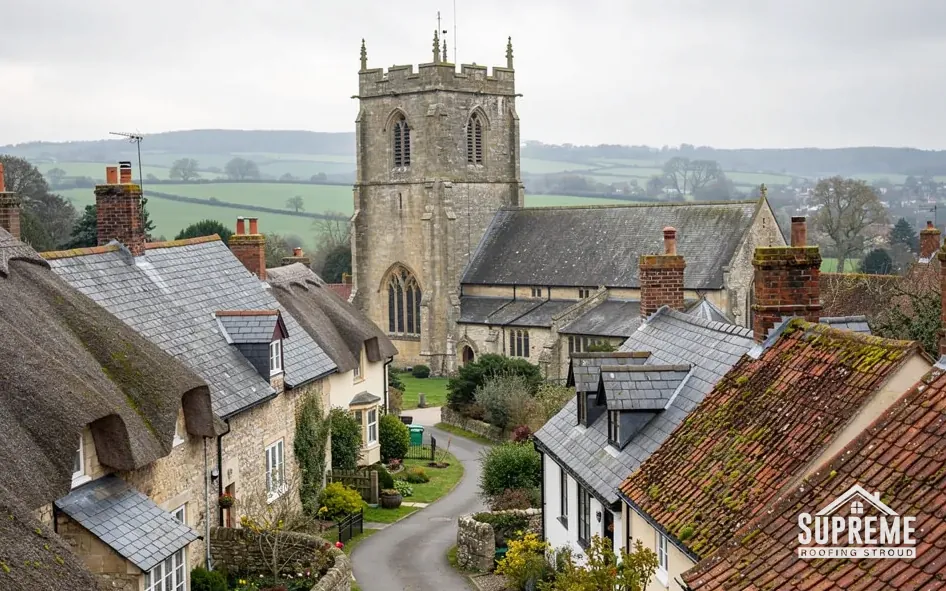
Village of thatched and tiled cottages around a stone church tower 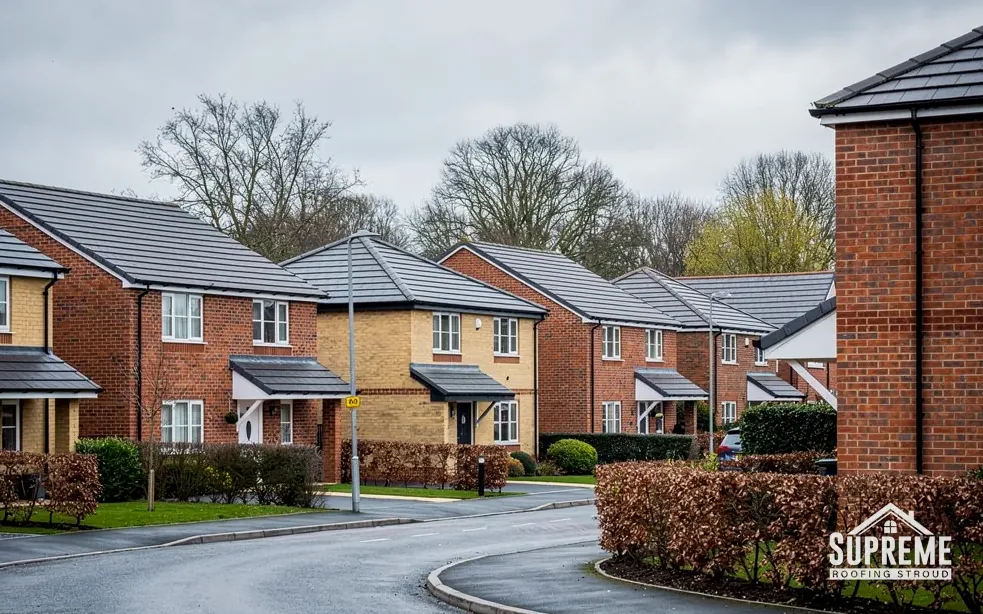
Modern brick housing estate with grey tiled roofs along a curving road
Chapter 01
A post-war council estate: what a uniform street means for the roof
Houses built together age together, and that changes how a repair is planned.
Chapter 01In this chapter
Most of Cadbury Heath was built in the immediate post-war period as a low-rise council estate. The logic of such an estate is simple: a lot of homes built close together, to a limited number of plans, using the same methods. Roofs on those homes are likely to share features too. When one starts to show a particular fault, the others are worth a look.
In this chapter
For a homeowner, the first benefit is information. If a neighbour has had the ridge re-fixed or the verge repointed, you can ask what was found. The second is cost: when several adjoining houses need similar work, shared scaffold is possible, and a single scaffold across two or three houses costs less per house than three separate erections. We are glad to price a joint job, provided each owner receives their own written quote and agrees it separately.
The third point is appearance. On a street where every house has the same roof, a replacement in a different colour or profile is obvious from the far end of the road. If the original covering has gone out of production, our search is for the nearest colour and profile, and samples and photographs reach you before anything is ordered. Previous owners or the landlord may hold records of past roof works, and a quick request for them can save us searching for evidence.
Ridge, verge and the edges of the roof
On an estate roof, the edges deserve most of the attention. Take the ridge, which runs along the apex, and the verge, which finishes the slope beside a gable wall. Both depend on fixings. Under BS 5534:2014 the bedding mortar is not what holds a ridge or hip tile down; clips or screws do that job. Dry-fix systems, which clip the ridge down without relying on mortar, are one way of doing that, and our ridge, verge and dry-fix page explains the choices.
Flat-roofed additions
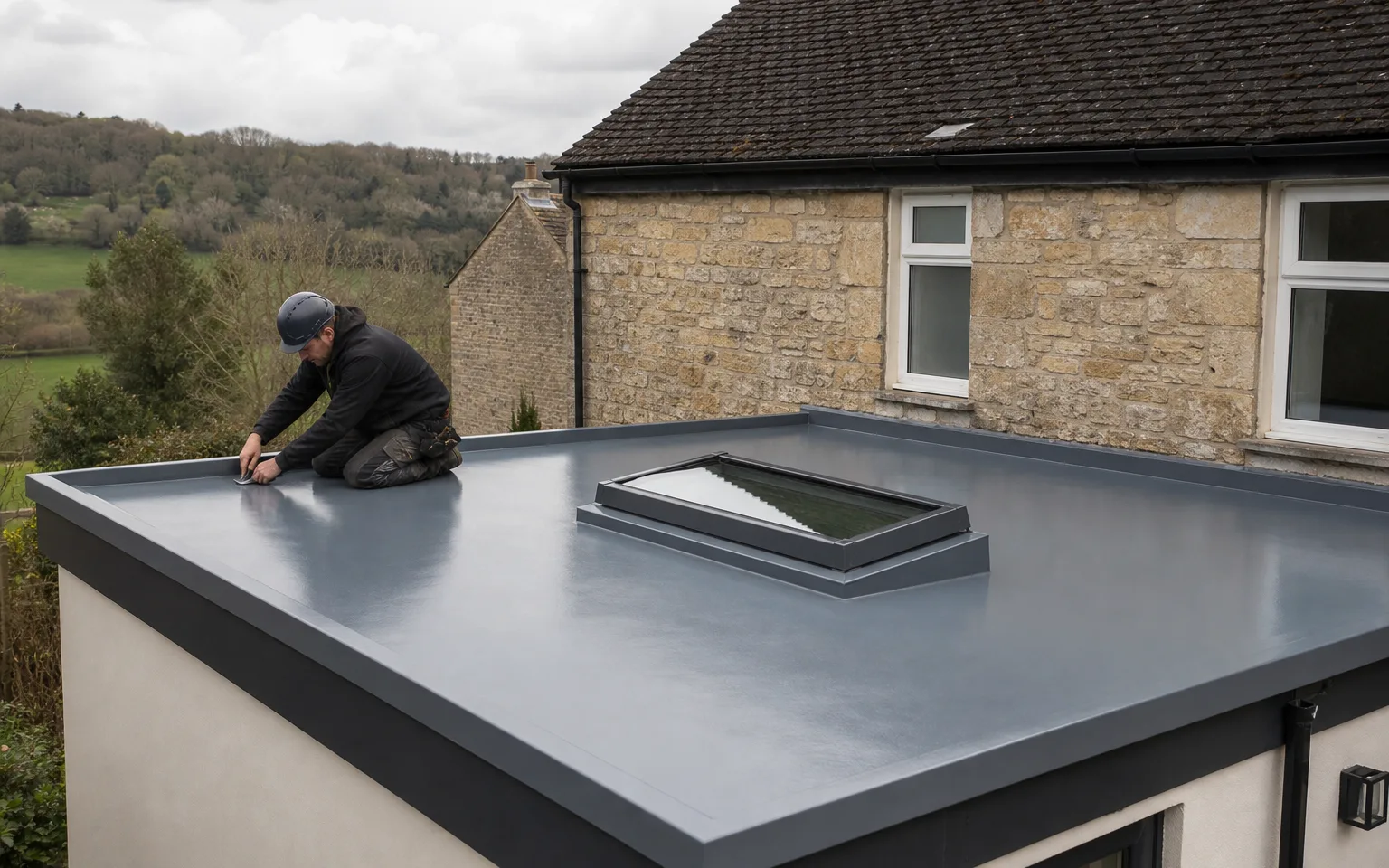
Estates like this often gain small flat-roofed extensions or garages over the years. A flat roof has a shorter life than a pitched one, and its failure shows up inside first, as a stain on the ceiling. We check the falls, which means the slope that carries water to the outlet, and the edge trims, then explain whether a patch will do or the roof needs recovering. The flat roofing page lists typical ranges by material.
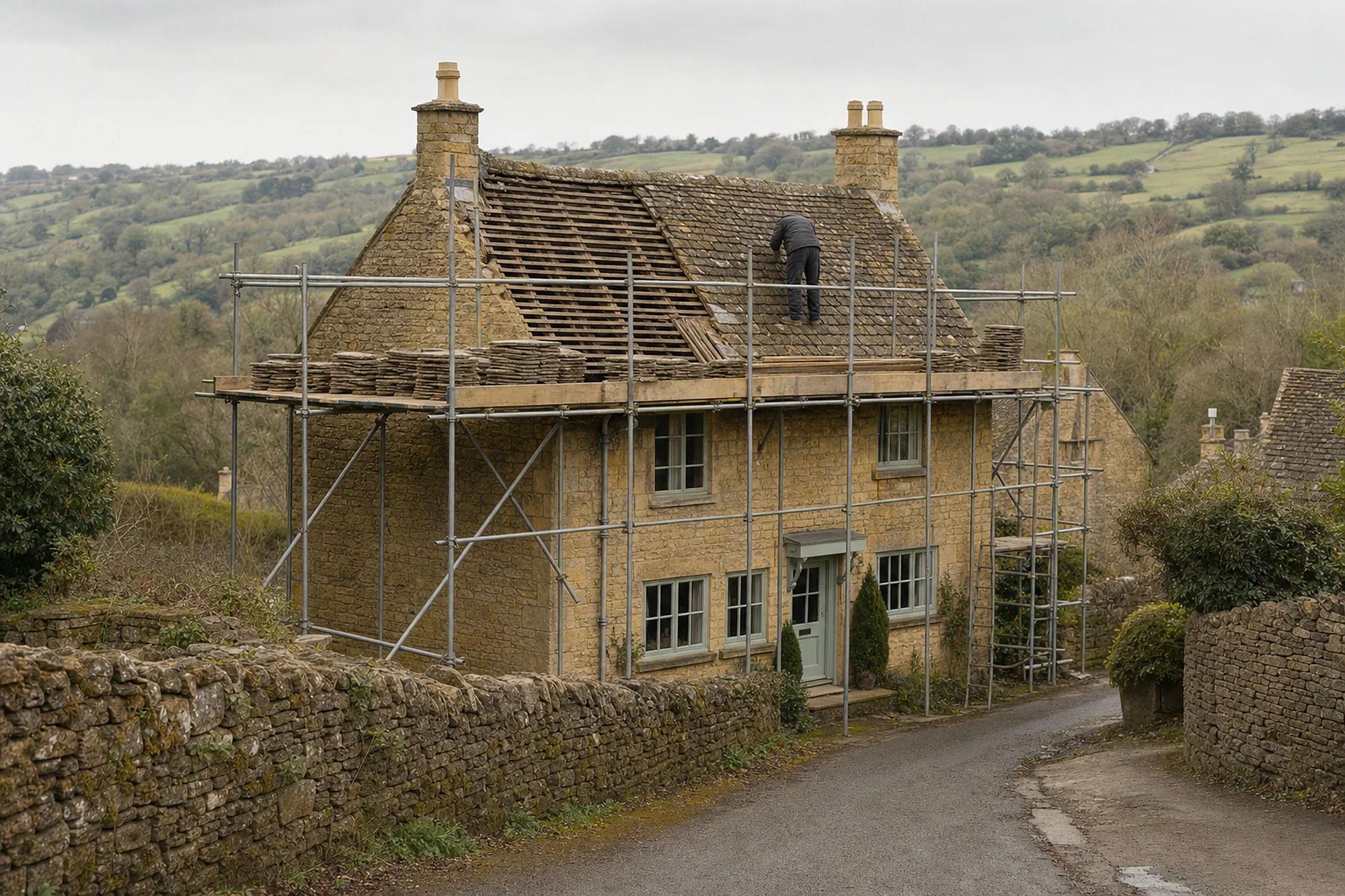
On a street of matching houses, one roof is a clue to the next.
Chapter 02
Banjo Island and the loops around Park Crescent
A street layout with a nickname, and what a looping road does to scaffold and deliveries.
Chapter 02In this chapter
The estate gained the nickname Banjo Island from the street layout around Park Crescent. A banjo shape, in road terms, usually means a loop at the end of a stem, with houses all the way round it. A pattern like that raises practical questions on every job: where a long vehicle can turn, where it can stop and how much of the road a delivery occupies.
In this chapter
Those questions drive a lot of the programme. A tile lorry with a crane arm is a large vehicle, and a crescent has parked cars on both sides at most times of day. The simplest fix is to agree with you, and with a few neighbours, a window in the day when the street is clear and the lorry can unload close to the house. We put the date and the drop point in writing.
Scaffold on a looped road also needs thought. The towers and boards stand on the pavement or the front garden, and on a curving road the footway can be narrow where the road bends. If the scaffold takes up the pavement, a licence from the highway authority is needed and a safe walking route has to be kept. We apply for it early, because the paperwork takes time and the start date depends on it. Where the loop of the road is tight, we also ask the scaffolder to mark the walking route with clear signs on both sides.
Skips, bins and parking
The skip is the next question. On an estate street with limited off-road parking, a skip often has to go on the road, which also needs a permit. Where a drive or a hard standing is available, we use it. Where not, we plan the number of skip changes, so the street is never blocked by a full one. When the crew leaves each evening, the front of the house is swept and the working area tidied, so nobody comes home to a mess. Tools and materials that cannot be locked away are stacked where they cannot be reached from the street.
Myth: A small estate roof repair always needs full scaffold.
Fact: Where a ladder or tower reaches the fault safely, that is what we use, and scaffold appears on the quote only where the job needs it.
For a smaller job, such as a handful of slipped tiles or a leaking flashing, none of this is needed. A ladder and a tower may be all that is required, and we tell you when the job is small enough that scaffold would cost more than the repair. If you suspect the roof is beyond patching, the roof replacement page explains what a full re-roof involves and how the quote is divided. Until then, a repair is usually the sensible first step.
Chapter 03
The primary school, pub and community hall at the neighbourhood centre
Three public buildings around the heart of the estate, with roofs of a different scale.
Chapter 03In this chapter
At the heart of Cadbury Heath is a neighbourhood centre of primary school, pub and community hall. They are not houses, and their roofs are not house-sized. A school hall, a pub and a hall for community events all have bigger roof areas and more demanding use than a home, and commercial or public roofs are a different kind of job.
In this chapter
The first difference is who decides, and it affects the timetable more than the roof does. A school answers to a trust or the local authority, a pub to a landlord or a brewery, and a community hall to trustees or a committee. Each has its own way of approving spend, and each needs the work timed around use: school holidays for the school, quiet days for the pub, and gaps in the booking diary for the hall. We build the programme around those constraints and write down the dates.
The second difference is the roof itself. Larger buildings often have flat or low-pitched sections, built-up parapets and internal gutters. These are the places where leaks begin, and they need a careful survey. We look at the outlets first, since a blocked outlet on a flat section can pond water, and ponding is hard on any covering. Then we check the edges, the upstands where the roof turns up against a wall, and the lead or membrane that seals them.
A survey for a public building
Our survey of a larger building produces a written report with photographs, a list of findings in order of urgency and a price. That lets a committee or a trust decide what to do now and what to plan for the next budget year. An active leak can be made safe at once, because leaks and storm damage get priority. Everything else can be scheduled.
Our flat roofing page covers the membranes and felt systems typically used on low-slope sections, and the typical UK prices we publish for them. Whether you manage a building or own a house nearby, the approach is the same: survey first, write the quote, agree the programme and keep the site clean from the first day to the last.
As for planning, Cadbury Heath is not among South Gloucestershire's conservation areas, so ordinary rules apply unless a building is listed. A change of appearance goes to the council's planning team first, and permission questions are theirs to answer, not ours.
Map showing Cadbury Heath and the Stroud service radius, with nearby towns we also cover.
Near Cadbury Heath
Roof work we do here
Crescents and Banjo Island on the old forest edge
Can neighbours on one Cadbury Heath street share a scaffold?
Yes, where adjoining houses need work at the same time. A single scaffold across two or three houses costs each owner less than separate ones. Each owner still receives their own written quote and agrees it independently.
My house is on a crescent with cars parked all round. How are materials delivered?
We agree a delivery window and drop point with you in advance, ideally with a few neighbours' help to keep the road clear. The skip goes on a drive where possible, and on the road only with the right permit.
Does a conservation area cover any part of Cadbury Heath?
No. South Gloucestershire Council has 30 conservation areas and Cadbury Heath is not one of them, though Warmley next door is. Ordinary planning rules therefore apply unless a building is listed. If a change of look were proposed, the council's planning team would be asked before a figure went into a quote.
My extension has a flat roof and the ceiling is stained. Where do you start?
With the outlet and the falls, because ponding water is the usual culprit. We then check the edge trims and the upstands against the wall, and tell you whether a local repair will do or the roof needs recovering.