
Roofers in Bitton
Roofing in Bitton, the River Boyd village between Bristol and Bath where a Grade I church, a conservation area and a heritage railway each leave their mark on the way roof work is organised.
Bitton at a glance
- Distance
- 27.8 road miles south-south-west of Stroud
- Council
- South Gloucestershire Council
- Conservation area
- Bitton Conservation Area
- Landmark
- Church of St Mary (Grade I)
Bitton's roofs along the Boyd, from a Saxon church to a heritage station
Bitton sits on the River Boyd, in the country between Bristol and Bath, and the river is the first thing to understand about the village. It gave the settlement its line, and the older buildings cluster where the water and the roads meet. The second thing is St Mary's church, which began as a tall Saxon structure and holds the top listing grade, Grade I. Its Lady Chapel was built in 1299 and its tower around 1370.
Around those landmarks the village carries a conservation area of about 87.6 hectares. That is a large designation for a village, and it holds 34 listed buildings. One is Grade I, two are Grade II* and 31 are Grade II. A roof inside that boundary is rarely just a roof: it may be part of a listed building, part of the setting of one, or simply a house whose street the council wants to keep looking as it does.
The heritage Avon Valley Railway runs from Bitton station, with the Bristol and Bath Railway Path alongside, so the village sees visitors as well as residents. For a roofer that means thinking about deliveries, parking and scaffold in places where people walk and cycle. We do not assume what any house is covered with. We climb up, photograph the roof, read what is there and price from the evidence. Planning around the lanes counts here as well: lane widths, parking and the line of the scaffold are worked into the quote rather than discovered halfway through the week.

Detached red brick Edwardian house with mock-Tudor gables and a tiled roof 
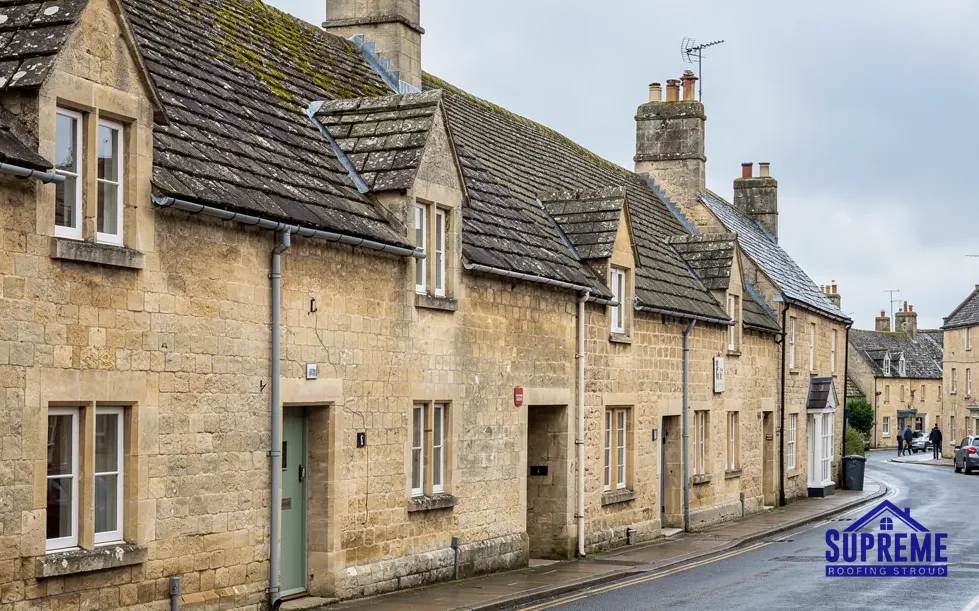
Stone terraced houses with slate roofs and chimneys stepping up a hill

Chapter 01
St Mary's tower, the Lady Chapel and the mahogany hammer-beam roof
Seven centuries of church building, and what that means for anyone working near it.
Chapter 01In this chapter
St Mary's has been added to for most of its life. The Lady Chapel, a chantry chapel dedicated to St Catherine, was built in 1299, and the church tower followed around 1370. In the 1840s the Reverend H. T. Ellacombe installed the hammer-beam roof inside, and it is made of mahogany. A hammer-beam roof is a timber roof in which short horizontal beams jut out from the wall tops instead of one beam spanning the full width, and the trusses above them carry the load. Inside the church it is an unusual piece of carpentry; outside, the roof covering above it has to keep water off timber that nobody would want to see wet.
In this chapter
That is the useful lesson for ordinary roofs too. What matters is what sits beneath the covering. When we survey a house in the village, the visible tiles or slates are only half of the story. We want to know whether the rafters are dry, whether any battens have softened and whether water has been getting past a flashing. A roof can look tired from the lane and still be dry underneath, or look fine and hide a slow leak at one abutment.
As a Grade I building, St Mary's is the village's most protected structure, and the rule for a church in use is the faculty route. The diocese authorises roof work on a church that is in use, and the council's listed building consent is not what governs it. Work on the church itself is for the parish and its advisers to commission, and it is not something we would quote for without that authority in place.
What neighbouring properties should ask
Houses near the church sit in its setting, and a bright new roof in an unsuitable material can change how the whole group reads from the churchyard. If you live close by, ask the council's conservation team before choosing anything other than a match for your existing covering. Putting back what was there is the simplest route, and it is where we begin.
Chimneys and parapets near an old church are often where earlier owners have patched and re-patched. When we find a bead of sealant doing the job of a flashing, we point it out, because sealant is a short-term stopgap and the lasting fix is a properly dressed metal edge. Our lead roofing page describes the sheet metal that is often used for flashings and valley linings, which is where much of a church-side repair is concentrated.
What sits under the covering matters as much as the covering.
- 1299year the Lady Chapel, a chantry chapel dedicated to St Catherine, was built
- c.1370approximate date of the church tower
- 1840sdecade the mahogany hammer-beam roof was installed by Rev H. T. Ellacombe
Chapter 02
Working beside the River Boyd, the railway and the cycle path
A village with a river, a heritage line and a path alongside has its own rhythm of access.
Chapter 02In this chapter
The River Boyd flows through Bitton, and the old village grew in relation to it. Houses near water bring one particular concern for a roofer: the rainwater system. Gutters, downpipes and the drains they feed have to carry the roof's runoff somewhere sensible, and on a plot close to a stream or a low-lying garden the destination matters more than usual. On a survey we trace where each downpipe ends, because a perfect roof discharging into a blocked or saturated gully will still lead to damp in the wall below.
In this chapter
The Avon Valley Railway is based at Bitton station, and the Bristol and Bath Railway Path runs alongside. Both bring people and traffic to a small place. For a job on a street close to either, the sensible plan is to put materials where they will not block a footpath, to keep the scaffold clear of walkers and cyclists, and to fence the working area properly. Scaffold that stands on a public footway needs a highway authority licence, and the time to obtain one goes into the programme from day one.
Visitors also mean that a village street can be busy at weekends and quieter on weekdays. We usually favour weekday deliveries and big lifts, so heavy materials come in when the road is at its quietest.
Gutters, fascias and the water you never see
Leaf fall from riverside trees is a recurring cause of overflow, and an overflowing gutter wets the wall, not just the ground. A gutter guard can help in some places and make no difference in others, so we look at the trees before recommending one.
On older houses, the fascia board that carries the gutter is often the first timber to rot, because it sits where overflow and splashback collect. A fascia is the horizontal board fixed across the rafter ends, and the soffit is the underside panel beneath the overhang. Where either is soft, new gutter brackets simply pull out. We probe the timber with a screwdriver blade before agreeing a repair and say plainly if the board is the real problem.
The guttering, soffits and fascias page walks through a replacement, from lifting the first row of tiles to testing the fall of the new run with a hose before the scaffold comes down.
Chapter 03
Bitton Conservation Area and a parish of 9,459 people
A big designation, a lot of listed buildings and one council to ask.
Chapter 03In this chapter
Bitton Conservation Area covers about 87.6 hectares and contains 34 listed buildings. In the 2021 figures, the civil parish of Bitton has a population of 9,459, and Oldland Common sits within it. So the conservation area is a village-scale boundary inside a parish that is much larger than the village centre. Whether your house is inside it depends on the street, not on the parish name, and the quickest answer comes from South Gloucestershire Council's conservation area pages.
In this chapter
What the designation changes is the planning side. A conservation area gives the council a say over certain alterations that would otherwise go ahead without permission. Replacing a roof covering with the same material usually does not materially affect how the building looks, and that kind of repair is generally outside planning control. Swapping material, adding a dormer or fitting new roof windows are different matters, and we ask the planning team before proposing any of them. If your house is itself listed, listed building consent is a separate requirement and applies to many roof alterations.
A necessary repair should not wait on any of this. A leaking roof in a conservation area should be made safe in the same way as anywhere else, and we prioritise leaks and storm damage. What the designation affects is the permanent solution, so we keep the two steps clear in the quote: the make-safe first, and the lasting repair once the correct material and any consents are agreed.
Putting the numbers to use
Because the parish stretches beyond the old village, a Bitton enquiry can come from a house on a modern street or from a cottage by the river. Both get the same method, but the questions differ. On the cottage the first one is whether the building is listed. On the modern house it is the condition of the covering and whether it is due for renewal.
The grade split of the listed buildings tells you something practical. Most of the 34 are Grade II, which is the ordinary listing tier, while the three at higher grades carry tighter expectations. If you are unsure which category your house falls into, the Historic England list entry gives the answer in a few minutes, and we are happy to look it up with you.
Every Bitton quote follows a survey. It carries photographs of your roof and covers the scaffold, strip, materials, labour and clearance, and it is backed by a 10-year workmanship guarantee in writing. The roof repairs page has the typical ranges we publish before anyone visits.
| Grade | Number of listed buildings |
|---|---|
| Grade I | 1 |
| Grade II* | 2 |
| Grade II | 31 |
| Total | 34 |
Map showing Bitton and the Stroud service radius, with nearby towns we also cover.
Near Bitton
Roof work we do here
Boyd valley church and heritage railway in Bitton
Is permission needed to re-cover a roof inside Bitton Conservation Area?
Putting the same covering back normally does not. A different material, a new dormer or roof windows are another matter, and South Gloucestershire Council's planning team should be asked first. If the house is listed, listed building consent is a separate step.
Does the faculty rule apply to St Mary's church roof?
The church is in use, so yes. The diocese authorises the work through a faculty, and the parish leads the commission. It is not a job we would price without that authority in place, and we would not start work on any church until the faculty is granted and the parish has confirmed the scope in writing.
Why do you follow the downpipes at a house near the Boyd?
Water from the roof has to end up somewhere sensible. Near a stream or low garden, a blocked gully or saturated ground can send damp back into the wall, so we trace each outlet before writing the quote and photograph the result. If the outlet is the real fault, the quote says that plainly.
Can scaffold go on the pavement or path beside my house?
Yes, with a licence from the highway authority where the scaffold stands on a public footway. We include that step in the programme from the start, and the access is allowed for in the quote, so you see its effect before you agree to anything.