

Roofers in Wick
Roof work in Wick, the River Boyd village at the foot of the Golden Valley, where Wick Court is Grade I and St Bartholomew's is Grade II*.
Wick at a glance
- Distance
- 25.5 road miles south-south-west of Stroud
- Council
- South Gloucestershire Council
- Setting
- River Boyd valley, on the A420
- Listed
- Wick Court, Grade I
Wick's roofs, from the River Boyd to Wick Court
Wick is a village with a river through its old centre. The River Boyd flows through the old village, and the Golden Valley runs north from Wick alongside it. The village lies on the A420 between Bristol and Chippenham, so it is a place people drive through before they stop in it, and that road is also how the lorries reach a roof job.
Two listed buildings give the village its recorded character. Wick Court is listed Grade I. The Church of St Bartholomew is Grade II*: it was begun in 1845 to plans by Charles Dyer of Bristol and completed in 1850 by William Butterfield, who gave it its west tower in the Early English style. Between them they set a standard for care that applies to older roofs in the village generally, even where no listing exists.
The village also had a working quarry, and that matters to anyone thinking about stone. Wick Quarry, a limestone quarry, has stopped working. A closed quarry is a reminder that stone is a finite material and that matching it takes sourcing.
A search of the national planning dataset turns up no conservation area in Wick, so the village as a whole adds no extra planning layer to a roof. South Gloucestershire Council is the authority, and anything that touches a listed building goes through its officers. Each house gets judged on its own facts, and we set out the route in plain terms before we put a price on anything.

Hillside of stone terraced houses with mossy stone tile roofs and chimneys 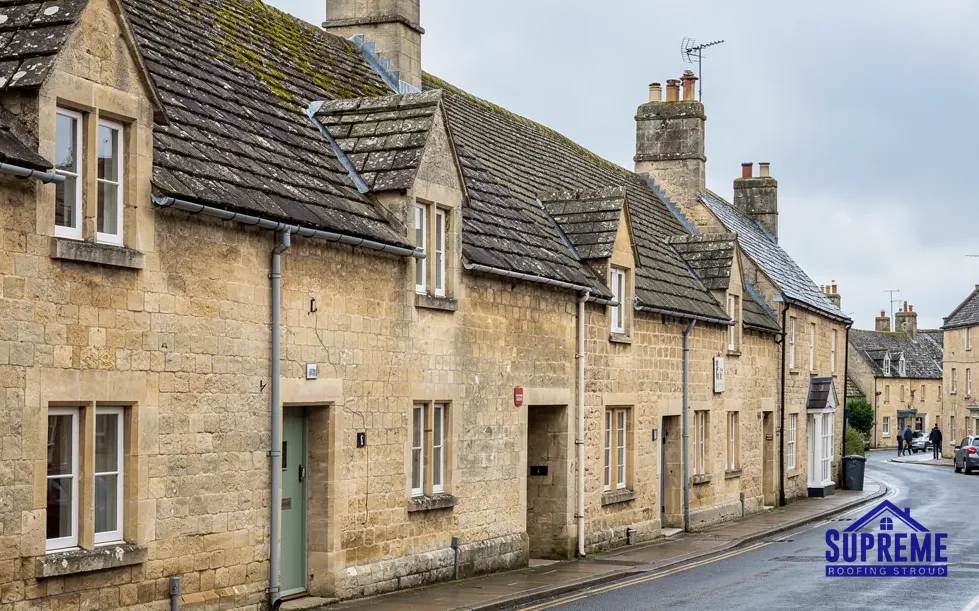
Terrace of stone cottages with dormer windows and stone tile roofs

Chapter 01
The River Boyd and the old village: reading a roof before quoting it
An old village centre mixes ages and materials, so we identify what is on the roof before anything is priced.
Chapter 01In this chapter
Houses along a river from the old village outward are rarely the same age. Neighbouring houses in a place like this can differ by a century or more, each with its own covering, fixing method and history of repairs. The survey exists to find out which you have.
In this chapter
We start outside, looking at the coverings from the ground and from the scaffold or ladder, then go into the loft. From below we can judge the underlay and the battens, and spot any chink of light that should not be there. A roof valley, which is the line where two slopes run into each other, gets particular attention, since leaves gather in it and its lining carries the heaviest flow of water. Chimney flashings, abutments and verges follow. We photograph each one and keep the pictures with the quote.
Ventilation is the other thing we read from the loft. Marley's summary of BS 5250 asks for a continuous 10 mm gap at the eaves on pitches above 15 degrees where a non-breathable underlay is used, with an extra 5 mm of high-level ventilation on pitches over 35 degrees. A roof that has been insulated since it was built, with the insulation pushed hard into the eaves, may have lost that airflow, and the evidence appears as damp timber and stained felt rather than as a leak you can see.
Ridge, hip and verge
The top edge of a roof, where tiles meet at the ridge or hip, and the sides, at the gable end where the tiles stop, are the parts most likely to have been bedded in mortar. BS 5534:2014 requires mechanical fixing for ridge, hip and verge, and BS 8612 covers dry-fix systems that do the job without mortar. Where an old ridge has cracked bedding or slipped tiles, switching to a dry-fix system is often the sensible repair. Our ridge, verge and dry-fix page explains the method and what the survey checks first.
The costs are published nationally, so you can weigh them before we visit. MyBuilder's 2026 guide has a dry ridge at £40 to £60 a metre. Checkatrade gives £50 to £70 a metre for the same work and £70 to £100 for a dry hip, both without VAT. Where the ridge stays on mortar, MyBuilder's range is £300 to £600 to re-bed or replace the tiles, and £200 to £400 to repoint a ridge or hip.
A ridge held by mortar alone has only its own bond to rely on.
- Dry ridge, MyBuilder£40 to £60 per metre
- Dry ridge, Checkatrade£50 to £70 per metre
- Dry hip, Checkatrade£70 to £100 per metre
Chapter 02
On the A420: reaching Wick from Stroud with scaffold and materials
Wick is 25.5 road miles from Stroud, and a good job plan starts with how the lorry gets there.
Chapter 02In this chapter
Wick lies on the A420 between Bristol and Chippenham, and is reached from Stroud by 25.5 road miles heading south-south-west. That distance is well inside our working area, and it shapes the job in practical ways rather than commercial ones. The first of them is deliveries. Scaffold, tiles, battens, lead and skips all arrive by lorry, and a lorry needs somewhere to stop without blocking a lane or the main road.
In this chapter
If your house fronts the A420 itself, parking and loading need thought. A house on a quieter lane off it raises different questions about width, turning space and neighbours' cars. We record the answer at the survey and carry it into the access plan. Where a scaffold or a skip needs to stand on the highway, permission has to be arranged first, so we allow time for it when we agree a start date.
Planning like this is part of keeping prices clear. A job whose access has been surveyed holds fewer surprises, and the scaffold appears on the paperwork before the day, not as an extra when the lorry turns up. MyBuilder's 2026 re-roof guide puts scaffold at about £1,125, and Checkatrade gives £700 to £1,300, which is why it deserves proper attention in any quote.
Waste is part of the same plan. Strip-out produces a surprising weight of old battens, felt and broken tile, and a skip has to stand somewhere legal and level. We agree its position when we agree the scaffold, so that neither blocks the other, and the skip leaves when the job does.
When a leak cannot wait
We prioritise leaks and storm damage. If water is coming through, the first move is a temporary cover to stop further damage, which is a different job from the permanent repair and is priced as one. A tarpaulin lashed over a slope buys time, but it is not a repair, and before we leave the site we explain what the permanent fix will involve.
Quotes you can compare
After we have been on your roof, you receive pictures of what we found and a written price for the job, from access equipment and stripping through to materials, labour and clearance. Our roof repairs page shows how smaller jobs are priced and when a repair stops making sense.
Chapter 03
Wick Court, St Bartholomew's and a limestone quarry that has closed
Two listed buildings and a closed quarry make stone, and matching it, a live question in Wick.
Chapter 03In this chapter
Wick Court is Grade I, the highest grade, and St Bartholomew's, dating from 1850, is Grade II*. On a listed building, works that would affect its character need authorisation before they start. In a roof, the covering, ridge, lead and chimneys all form part of the protected fabric, so any change should be agreed first rather than reported afterwards.
In this chapter
Where services are still held in a church, the ecclesiastical exemption applies, and for a Church of England building the diocese grants a faculty in place of listed building consent. We do not assume how any building is used, and we ask the person who looks after it. A building that is no longer in use for services is a different matter and normally needs listed building consent from the council.
The quarry adds a practical angle. Wick Quarry was a limestone quarry and is no longer operational. The wider point is about replacement stone anywhere: English Heritage policy, reproduced in Cotswold District Council's 2000 guidance, wants replacement slates to follow the originals closely: same rock, shade, surface, dimensions and thickness. Where a quarry has closed, the match has to be sourced from elsewhere, and that takes time and money.
St Bartholomew's dates from 1850, which makes it over 170 years old. Any roof of that age has lived through at least one round of repairs, and the sensible assumption is that the present covering, flashings and gutters are not all original. A survey that separates the sound original work from later patching is what lets a repair target the failed parts and leave the rest alone.
Costs for stone roofing
Checkatrade's 2026 guide shows stone slate at roughly £160 to £210 per m², and says the figure moves with the supply of the slate and your region. That is a national range, not a Wick price. If your roof is stone, our Cotswold stone roofing page explains how stone is matched and repaired.
Myth: A closed quarry nearby means replacement stone for a Wick roof is easy to find.
Fact: Heritage policy wants new stone to match the original in rock type, colour, grain, size and depth, so a match is sourced roof by roof, not assumed. The search can add weeks, and we build that into the programme at the survey.
Smaller old houses
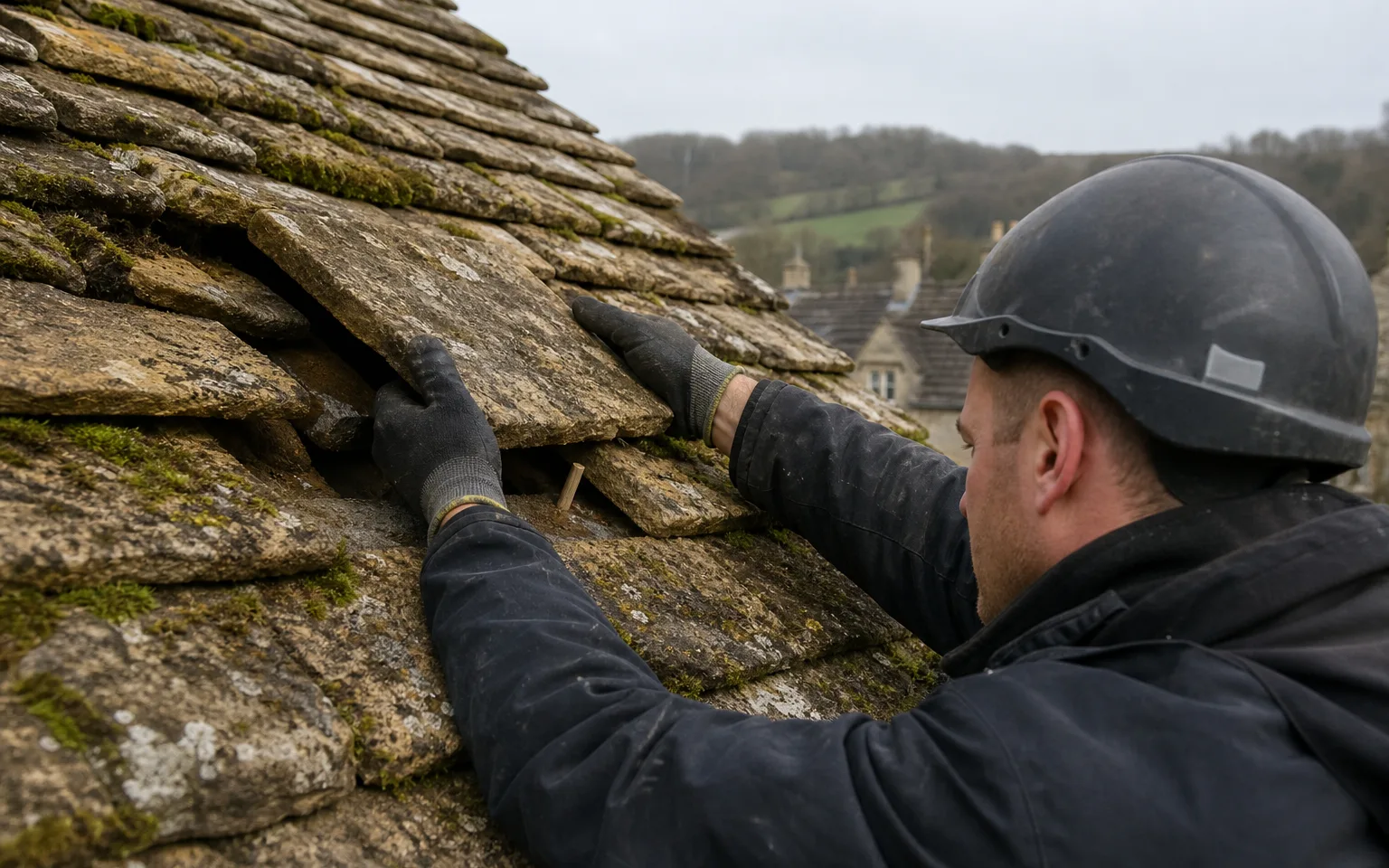
A house does not need a listing to deserve care. On older cottages we reuse sound material, keep the line of the ridge and verges, and avoid replacing stone with something lighter that changes the look.
Map showing Wick and the Stroud service radius, with nearby towns we also cover.
Near Wick
Roof work we do here
Wick Court, St Bartholomew's and the A420 pavement
My Wick house has a cracked mortar ridge. Is dry-fix a better repair than re-bedding?
Often yes, particularly where the old bedding has cracked or loosened. The 2014 edition of BS 5534 stopped treating a mortar bed on its own as enough to hold ridge and hip tiles, and dry-fix systems are tested under BS 8612. We inspect the tiles first, then price dry-fix and re-bedding as options side by side.
Does a house near Wick Court or St Bartholomew's need listed building consent?
Only if the house itself is listed, or the work touches a listed structure such as a shared wall or an outbuilding in the same curtilage. Being next door to a Grade I or Grade II* building does not make a house listed, so ask South Gloucestershire Council about that particular address before anyone alters the covering.
Can scaffold stand on the pavement beside the A420 at Wick?
Only with permission for the highway, which takes time to arrange. We decide where the scaffold must stand at the survey, apply once a start date is agreed, and show the cost under a heading of its own.
What does your guarantee cover on a Wick roof?
The work is backed by a written 10-year workmanship guarantee. That speaks to how the job was done, while the life of the materials depends on exposure and upkeep. Survey photographs sit beside it as a record of the roof before work began.