

Roofers in Warmley
Roof work in Warmley, the village on the A420 east of Bristol where an eighteenth-century brass works, the listed house William Champion lived in and a conservation area all sit within reach of the same streets.
Warmley at a glance
- Distance
- 27.8 road miles south-south-west of Stroud
- Council
- South Gloucestershire Council
- Conservation area
- Warmley Conservation Area
- Listed house
- Warmley House and stable block (Grade II*)
Warmley's roofs, from the brass works to the railway path
Warmley is a village in South Gloucestershire between Bristol and Bath, on the A420, and it is better known to historians than the quiet main road suggests. The former Midland Railway line through the village is now the Bristol and Bath Railway Path. Before the railway there was industry: in 1738 William Champion patented a new method of smelting zinc, and in 1746 he began building a large integrated brass works at Warmley, with his own house and landscaped garden beside it.
That history left buildings behind. A factory with a clocktower, where pins were made from brass wire from about 1760, survives, and parts of the works are now the Kingswood Heritage Museum. Warmley House, built around 1750 for Champion, is listed Grade II* together with its stable block, and the Church of St Barnabas is listed Grade II. Add the village's own conservation area, and a good many roofs here come under some form of heritage control.
What this means for a house owner is a matter of asking the right question at the start. Some Warmley buildings are protected individually, some by position, and many by neither. We do not treat them alike. A first look at your roof tells us what the covering is, and a short check with South Gloucestershire Council tells us whether the building or its street has extra rules. Only then do we put a number on the job, and the number is in writing.
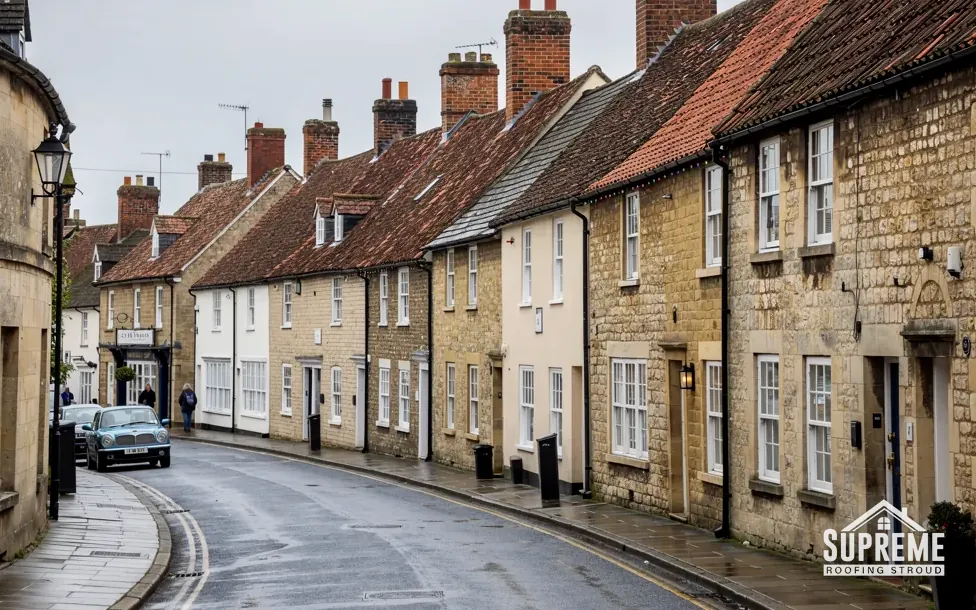
Curving street of stone and rendered terraced houses with tiled roofs 
Detached red brick Edwardian house with mock-Tudor gables and a tiled roof
Chapter 01
The brass works that William Champion built
Zinc patented in 1738, a works begun in 1746 and roofs that had to cover a lot of floor.
Chapter 01In this chapter
William Champion patented his zinc smelting method in 1738, and eight years later he began building his brass works at Warmley. The works was a big undertaking for its date, an integrated brass factory rather than a single workshop. The numbers on the page are a reminder of scale, and scale is what makes industrial roofs a distinct kind of job.
In this chapter
A building designed to hold machinery or stock needs width, and width means long spans. A long span usually means a roof with a shallow slope or a series of linked ranges, with gutters running between them. Water that falls on one range has to reach a downpipe a long way off, and the gutter that carries it is often built into the structure rather than hung on the outside. When one of these built-in gutters fails, the rain is released inside the walls. We follow the route water takes from the highest point of such a roof to the ground before judging any single repair.
The clocktower factory, where pins were made from brass wire from about 1760, is an example of a different kind of roof: a compact industrial building with a feature on top. Those features matter even when they are small. A clock face, a louvred opening or a bell housing breaks the roof surface and creates a place where wind-blown rain can find a way in. We look for cracked sealant, lifted flashing edges and mortar that has crumbled, and we photograph each one from close up so you can see for yourself what we saw. A tower or a cupola adds junctions, and every junction needs a flashing. A flashing is a strip of metal, often lead, dressed over the joint between roof and wall to stop water entering. On a tower the flashing is at a height where repair needs proper access, so the scaffold plan is part of the quote.
Roofs of a similar scale today
Not every large roof in Warmley is historic, but the same issues apply to modern units and workshops, which is where our commercial roofing work comes in. Commercial customers usually want to know how long a roof will be out of use and who to speak to on site, so the programme and the single point of contact are agreed at the start.
For a building in use, the work is phased so that the part being stripped is dried in each day. On a listed or heritage building, we also record the existing detail before anything comes off, because the evidence of what was there is part of what the council will want to see.
On a big roof, find the route the water takes before judging any single repair.
- 1738year William Champion patented a new method for smelting zinc
- 1746year he began building the Warmley brass works
- c.1760approximate year pin-making from brass wire began in the clocktower factory
Chapter 02
Warmley House, its stable block and St Barnabas
One Grade II* listing that covers a house and its stable block, and a Grade II church close to the same streets.
Chapter 02In this chapter
Warmley House and its stable block share a single Grade II* listing, first made in 1953, a grade that puts them among the more significant buildings in the country. The Church of St Barnabas is listed Grade II, the ordinary grade. For anyone with a roof near either, what matters is that listing covers the building as a whole and protects it inside and out, so the roof counts as part of what is listed, not an add-on.
In this chapter
A stable block has a particular roof pattern. It is typically a long, simple building with a ridge running its full length, which means one long run of ridge, two long eaves and several rainwater outlets. That simplicity can be a help, since a repair is easy to see and to scope. It can also hide problems: a long ridge bears on every rafter below it, and one soft patch of timber can leave a ridge sagging over a considerable distance. We sight along the ridge from the ground and from the roof, and mark any dip in the survey photographs.
If the building is listed, even a repair has to be carried out with materials that match. The council will want to know which tiles or slates are being used, how they are fixed and what happens to the old ones. Our approach is to record the existing covering, size by size, and match it. Sound old pieces of covering can go back on the slopes seen from the street, with new material kept for the faces that are out of view. Conservation officers often accept that compromise.
A church close by
St Barnabas is a church, and while it remains in use, roof work on it falls to a faculty from the diocese. The listed building consent that applies to a house or stable block does not apply to it. If you live next door, your own roof is a separate matter with its own rules. The two jobs are scoped separately, and neither is waiting on the other. A parish and a homeowner have different timetables, and we would rather plan around that than try to hurry either.
We also ask whether a shared wall or a shared valley links your property to a neighbour. The lead roofing page explains how sheet lead is used to dress such joints and why its thickness, called the lead code, matters.

Chapter 03
The A420 corridor, the railway path and Warmley Conservation Area
A road and a path run through the village, and a conservation area sits around them.
Chapter 03In this chapter
Warmley lies on the A420 towards Bath, and the old Midland Railway line through it now carries the Bristol and Bath Railway Path. That makes two routes for traffic and people, and both affect how we plan a roof job. The road decides where lorries can stop and when. The path decides where a scaffold can stand without blocking walkers and cyclists.
In this chapter
Warmley Conservation Area is the planning layer on top. Being inside it does not stop a roof being repaired. It means that the council takes an interest in changes that alter the appearance of a building. Replacing the covering with the same material does not normally alter it, and we carry that out as a routine job. A change of material, a new roof window facing the street or a dormer is a different proposal, and we take it to the planning team before it goes into a quote.
We find it helpful to explain to customers what a typical sequence looks like on a conservation-area house. First, the survey with photographs. Second, a conversation with the council if anything about the proposal changes how the roof looks. Third, the written quote, which names the scaffold, the strip, the materials, the labour and the clearing away of waste. Finally, a start date that allows for any consent period, and once the work is done, a 10-year workmanship guarantee in writing.
Distance and arrival
Warmley is 27.8 road miles south-south-west of Stroud. The drive is long enough that we plan deliveries and crew so that nobody has to go back for a forgotten item. If a repair is small enough for a single visit, we tell you that, along with what we would need from you to do it: a clear route to the ladder, access to the loft where there is one, and a note of where the leak shows inside.
For work that needs scaffolding, we agree with you where the boards and waste will sit, and whether the road outside allows a skip. Terraced houses on the main road may have no garden to work from, so we plan access at the survey and carry it into the quote. Where the whole roof is coming off, the roof replacement page shows how a full re-roof is staged, from scaffold to the final clear-up. Because the village has both a main road and a railway path, we also tell you which days are likely to be quieter for deliveries and for the larger lifts.
Map showing Warmley and the Stroud service radius, with nearby towns we also cover.
Near Warmley
Roof work we do here
Champion's brass works and Warmley House stables
Can a house near Warmley House have its roof repaired without consent?
It depends on whether your own building is listed. Your neighbour's listing leaves your own house unprotected, although a conservation area boundary may reach it. We check both with South Gloucestershire Council before we write a quote, so there are no surprises.
How do you deal with the long internal gutters on old industrial buildings?
Tracing the run from the highest point to the ground comes first, with each outlet and lined channel checked on the way, and the gutter work then quoted for. Blocked outlets are a common start to leaks on big roofs, so we photograph them first.
Is Warmley's conservation area a barrier to a new roof?
Not where the covering is replaced with the same thing, since that does not normally alter how the building looks. A different material, a street-facing roof window or a dormer is different, and the planning team should be asked first.
What happens if my roof is leaking while permissions are being sorted?
Leaks and storm damage come to the front of our list, and we make a leaking roof safe first. The lasting repair then follows once the material and any consent are agreed, so the temporary step never becomes the permanent one.