

Roofers in Emersons Green
Roof work in Emersons Green and Lyde Green, where housing built since the 1990s meets a science park beside the M4, with good and fair prices published first.
Emersons Green at a glance
- Distance
- 26.4 road miles south-south-west of Stroud
- Council
- South Gloucestershire Council
- Setting
- North-east fringe of Bristol, on former farmland
- Households
- 6,799 in 2021
Emersons Green's roofs, from farmland to the ring road
Emersons Green is among the newest settlements on our map. It was a hamlet in Mangotsfield parish until 1927, then part of Mangotsfield Rural from 1927 to 2015, and was renamed and enlarged in 2015. The modern settlement was developed in the 1990s and early 21st century on farmland, and coal was mined in the area in the 19th century. Lyde Green, to the east and originally farmland too, began its transformation into housing in the mid-2010s.
The numbers show how fast it grew. Households in the parish rose from 4,086 in 2001 to 4,921 in 2011 and 6,799 in 2021. A science and technology park, built with Bristol University and the University of the West of England, sits next to the M4 and the A4174 ring road. The place is on the north-east fringe of Bristol, and lies 26.4 road miles from Stroud, heading south-south-west.
For roofs, that history has a plain consequence. The settlement is modern development rather than a historic core, and the government's planning data lists no conservation area near the centre. Roofs of this generation sit in the middle of their working lives, so the useful questions are about maintenance, extensions and additions rather than restoration. South Gloucestershire Council is the authority for planning and for most consents.
That changes what a roofer does. The work is less about rescuing an old roof and more about keeping a newer one sound, and about making additions fit well.

Hillside terraces of stone houses with slate roofs and chimneys 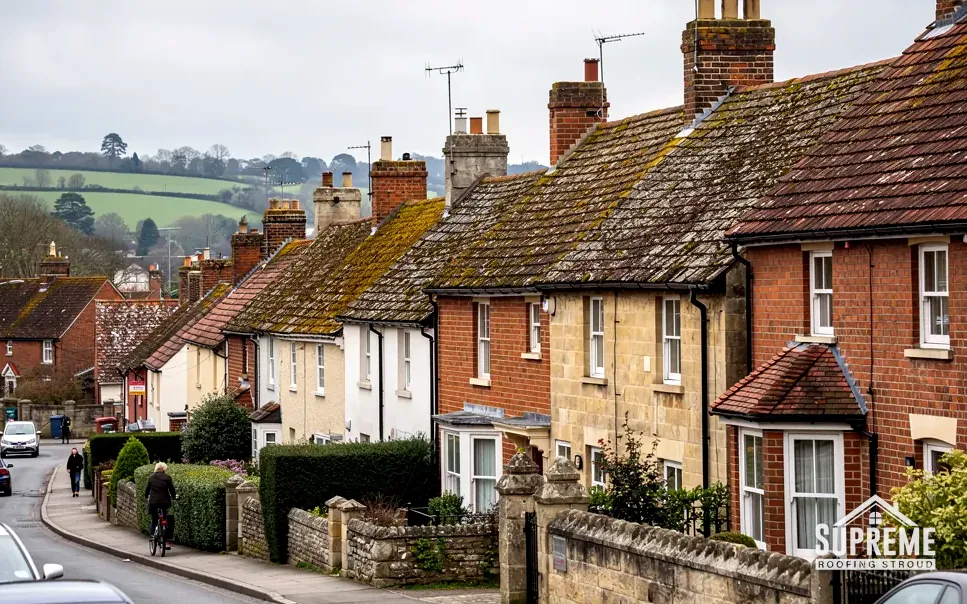
Sloping street of brick and stone terraced houses with mossy tiled roofs
Chapter 01
From 4,086 households to 6,799: roofs between ten and thirty-five years old
Two decades of rapid growth mean plenty of younger roofs, and a particular set of checks.
Chapter 01In this chapter
When the household count climbs from 4,086 to 6,799 in two decades, a good many of the roofs date from that stretch. A house finished in the 1990s is now in its thirties, one from the 2000s is in its twenties, and the Lyde Green homes that began in the mid-2010s are around ten years old. None of those is old for a roof. They are, however, old enough for the small things to start failing.
In this chapter
Lifespan figures for the common coverings disagree. If your roof is concrete tile, MyBuilder gives 30 to 50 years, and Marley cites around 60 while adding that no guarantee is implied. The spread is a reason to judge each roof on its condition rather than its age. What tends to go first on a roof of this generation is not the covering. It is the detail around it: sealant at flashings, lead at the stack, the joints in plastic gutters and the ridge and verge fixings.
Ridge and verge on 1990s and 2000s roofs
BS 5534 was revised in 2014, and Marley reads the revision as ending reliance on mortar alone for ridge and hip tiles. Roofs built before that may have ridges and verges held by bedding that has now aged for decades. It is worth a look from the ground or a ladder, and it is a modest repair when it is found early: MyBuilder's 2026 guide gives £40 to £60 per metre for a dry ridge.
Gutters and fascias
Plastic gutters on houses of this age have been through a long run of seasons, and brackets can loosen and seals open at the joints. MyBuilder puts guttering at £30 to £70 per metre in 2026. If the fascia behind has gone soft, replacing it with the gutter saves a second visit and a second scaffold.
On a newer roof a dated record of condition has a second use. If a flashing starts to weep in three years, photographs taken now show whether the fault is new, and the same pictures help if you sell and a buyer's surveyor asks about the roof. We hand them over with the quote whether or not you go ahead.
What we record at the survey
Our survey takes in the ridge, verges, flashings and gutters, then examines the covering from beneath, in the loft, with a photograph of each. You then receive a written quote, and a list that ranks urgent repairs ahead of jobs that can wait, so you can plan spending over a few years instead of facing a single large bill.
On a roof in its twenties, the covering is rarely the problem; the details around it are.
- 4,086households in the parish in 2001
- 4,921households in 2011
- 6,799households in 2021
Chapter 02
Lyde Green and the extension years: lofts, roof windows and flat additions
Newer houses are often adapted, and each adaptation brings its own roof rules.
Chapter 02In this chapter
Lyde Green's housing began in the mid-2010s, and newer houses get adapted as households change. Typical projects are a loft room, a rear extension or a replacement for an original conservatory. Each of those touches the roof.
A loft room almost always means roof windows. Approved Document L caps roof windows at 1.4 W/m²K, or WER Band B as an alternative, and rooflights at 2.2 W/m²K. Approved Document B then adds a means-of-escape test: the roof window helps only when it sits within 4.5 m of the ground, while a loft room over two storeys has to reach a protected stair. MyBuilder's 2026 guide puts fitting at £350 to £600 for a standard window, with scaffold at about £500. For the planning side, our roof window planning page covers what applies, and the skylights hub covers choice and fitting.
Scaffold is the cost that is easiest to share. MyBuilder puts it at about £500 for a roof window job, and if gutters or a ridge need attention at the same time, one erection covers all three. We look for that overlap when we write the quote, because it saves money without cutting any of the work.
Conservatories that have reached their second roof
The conservatory roofs of the early 2000s are now in their second decade. HomeBuilding gives about 10 years for a polycarbonate roof and The Eco Experts 10 to 15, so replacement is on the table for many of them. Choosing a solid roof turns the job into a material alteration, which needs a Building Regulations application, and whoever checks the old frame must be sure it will take the extra weight. Our conservatory roof replacement page explains the options.
Flat roofs on extensions
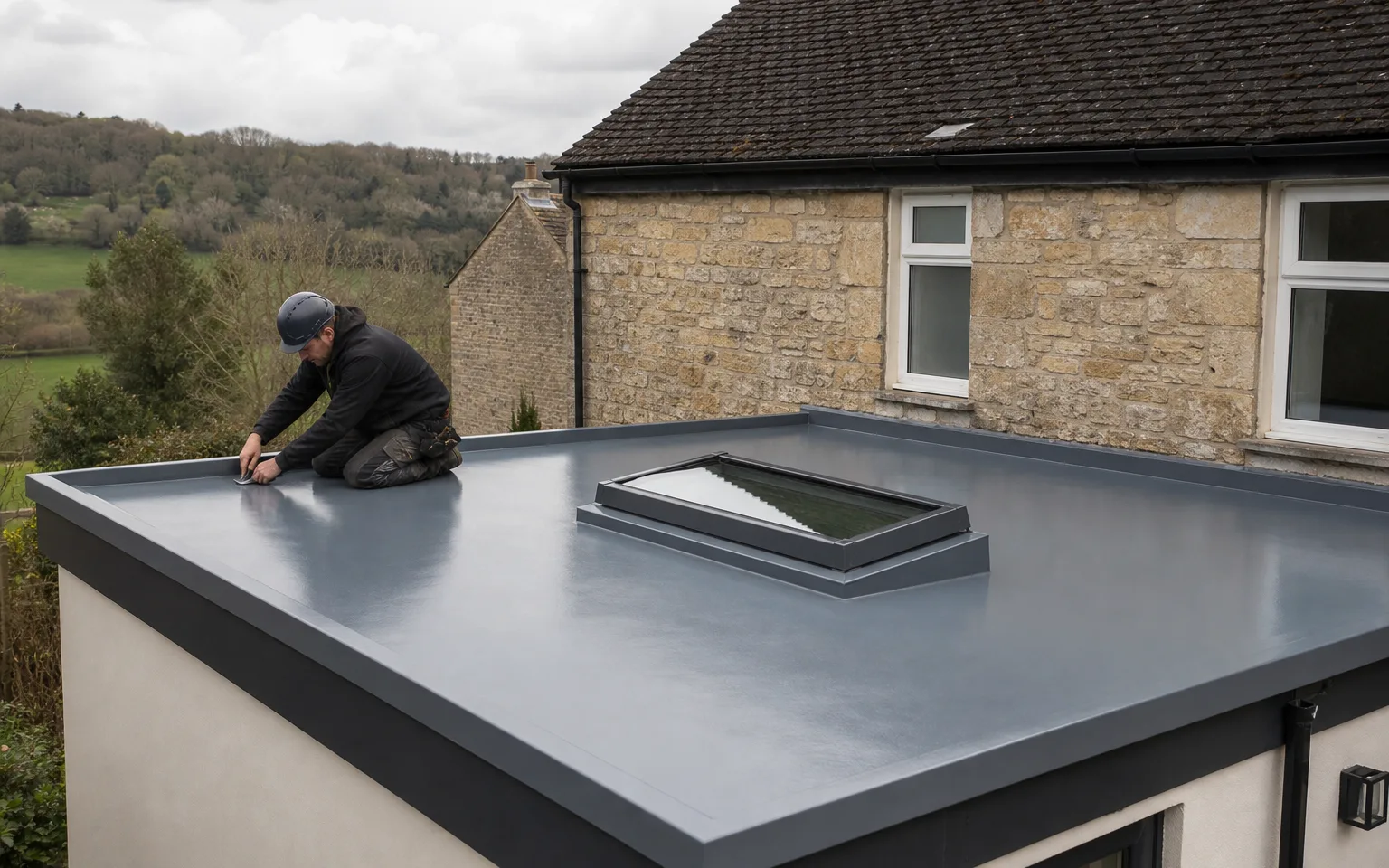
A single-storey extension or garage conversion often has a flat roof, and flat roofs have rules of their own. Following BS 6229, IKO and Rockwool describe designing to a fall of 1:40 so that the finished roof still drains at 1:80 after tolerances and deflection. Ponding is the commonest sign that this was missed. MyBuilder's 2026 flat roof guide gives £90 to £130 per m² for EPDM, which is one of several options we price side by side.
| Item | Figure | Source |
|---|---|---|
| Roof window | 1.4 W/m²K or WER Band B | Approved Document L, Table 4.2 |
| Rooflight | 2.2 W/m²K | Approved Document L, Table 4.2 |
| Escape window opening | 0.33 m² minimum, 450 mm minimum height and width | Approved Document B, para 2.10 |
| Roof window as escape | Within 4.5 m of the ground | Approved Document B, para 2.2 |
Chapter 03
The science park, the A4174 and commercial roofs in Emersons Green
A business park beside the M4 adds large, flat and low-pitched roofs to the mix.
Chapter 03In this chapter
A science and technology park built with Bristol University and the University of the West of England sits next to the M4 and the A4174 ring road. Each building there is surveyed on its own terms, but the questions on a commercial roof repeat from site to site, and we can explain what the work involves.
In this chapter
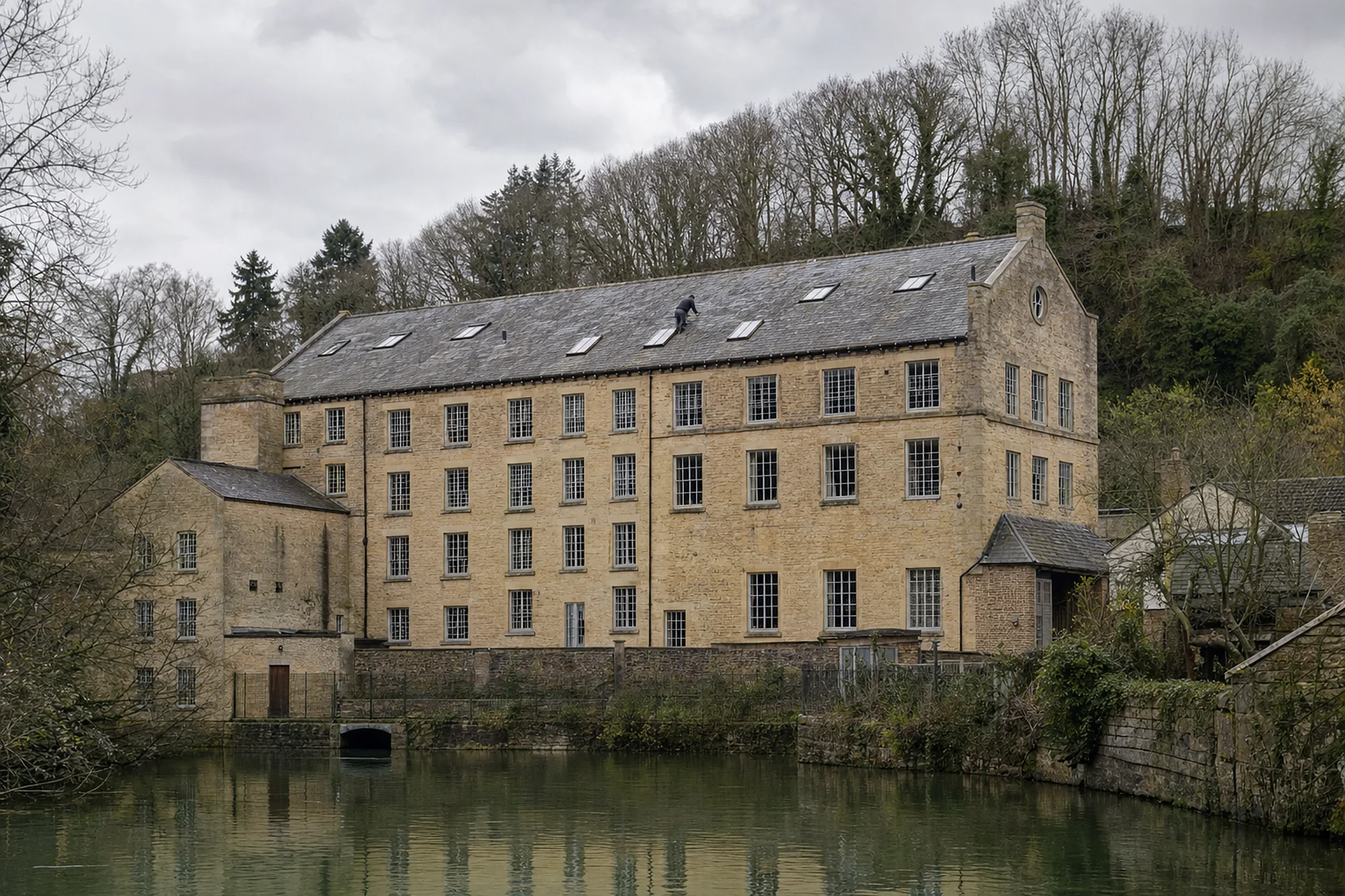
Large buildings of this type tend to be flat or low-pitched, with single-ply membranes, built-up systems or metal sheeting, rooflights, and drainage that runs through internal outlets and parapet gutters. Drainage is where we start, because a blocked outlet or an under-sized overflow turns a roof into a tank. Falls are the next check. Design falls of 1:40 give finished falls of 1:80 under BS 6229, and anything flatter ponds. Membrane life is quoted as 20 to 30 years or more for EPDM, and PVC single-ply at 20 to 30 years from GreenSpec, so a roof laid in the 1990s is nearing the end of its range.
Working on an occupied site
A commercial roof is worked around the people beneath it. Delivery times, fire routes, visitor parking and the position of air-handling plant decide where scaffold, a mobile tower or a hoist can stand. We agree those with the site manager first and write them into the access plan so work does not clash with the working day. Our flat roofing page sets out the coverings and what each involves.
Rooflights deserve a mention too. On older flat commercial roofs they are among the commonest places for water to enter, through failed seals, cracked glazing or a kerb that has settled. We inspect each one, record its condition and price repair or replacement beside the membrane work, so the whole roof is dealt with together.
Reaching the site
Emersons Green lies on the north-east fringe of Bristol, and the drive from Stroud is 26.4 road miles. Roads around the ring road and the motorway are shared with a great deal of traffic, so we plan loading and delivery windows with the client and keep the work area tidy so that it can be cleared and left safe at every stop. The 10-year workmanship guarantee that comes with our work is issued in writing at handover.
Map showing Emersons Green and the Stroud service radius, with nearby towns we also cover.
Near Emersons Green
Roof work we do here
Lyde Green houses beside the science park
My Emersons Green house was built in the 1990s. What should a roof check cover?
The ridge and verge fixings, the flashings, the gutter joints and brackets, and the underside of the covering from the loft. Roofs of that age are rarely failing outright, but the details around the covering tend to need attention first, and a survey separates urgent items from ones that can wait.
Can I put a roof window into the loft of a two-storey Lyde Green house?
Usually yes, but the loft room has to meet Building Regulations. Escape rules apply: a roof window is only counted as an escape route within 4.5 m of the ground, and a loft over two storeys has to reach a protected stair. We handle the window, the flashing and the fitting, and for planning you ask South Gloucestershire Council.
Is a flat extension roof in Emersons Green likely to pond?
It can. If the deck was laid without enough fall, water sits in shallow pools and shortens the life of the membrane. The BS 6229 approach is to design for 1:40 so the finished roof achieves 1:80. The fall is measured during our visit, ahead of any covering recommendation, and if correcting it would add cost, we tell you and include it in the quote.
Should I replace the conservatory roof I had fitted in the 2000s?
Not automatically. A polycarbonate roof is quoted at about 10 to 15 years, so one from the 2000s is past that range, and a leak or clouding settles the question. A solid roof is a bigger job and needs a Building Regulations application, so we check the frame first.