
Roofers in Frenchay
South-west of Stroud by twenty-eight road miles: roof work among Georgian houses on the common, a 1975 conservation area and tree cover running down to the Frome.
Frenchay at a glance
- Distance
- 28 road miles south-west of Stroud
- Council
- South Gloucestershire Council
- Conservation area
- Frenchay Conservation Area, designated 1975
- Listed
- Unitarian Chapel and Manor House, Grade II*
Frenchay's common, its Quaker houses and the Frome woods
Frenchay is named for its woods. The earliest record, from 1257, gives the name as Fromscawe, which means the wood on the Frome, and the village still lies beside the wooded river valley on the north-eastern fringe of Bristol. That tree cover matters to anyone who owns a roof here, because leaves, seed and overhanging branches all end up on slopes and in gutters.
The other defining feature is the common. Many of the eighteenth-century houses overlooking it were built by wealthy Quaker families, among them Bristol merchants. Houses put up for people of that standing were built with care, and their roofs were expected to outlast the family. Two buildings carry the higher Grade II* listing, the Unitarian Chapel and Frenchay Manor House, and three houses on Frenchay Common are Grade II.
Frenchay was designated a conservation area in 1975 for its architectural and historic character. A roof here is therefore seen as part of a street picture as well as a building, and the order of work reflects that. First comes the identification: the covering, the way it was laid and whether the house is listed. Only then do we write the written quote, so nothing is left to be discovered once the scaffold is up.
The village also has a larger institutional past, in Frenchay Hospital, and big roofs belong to a different conversation, which we cover below.

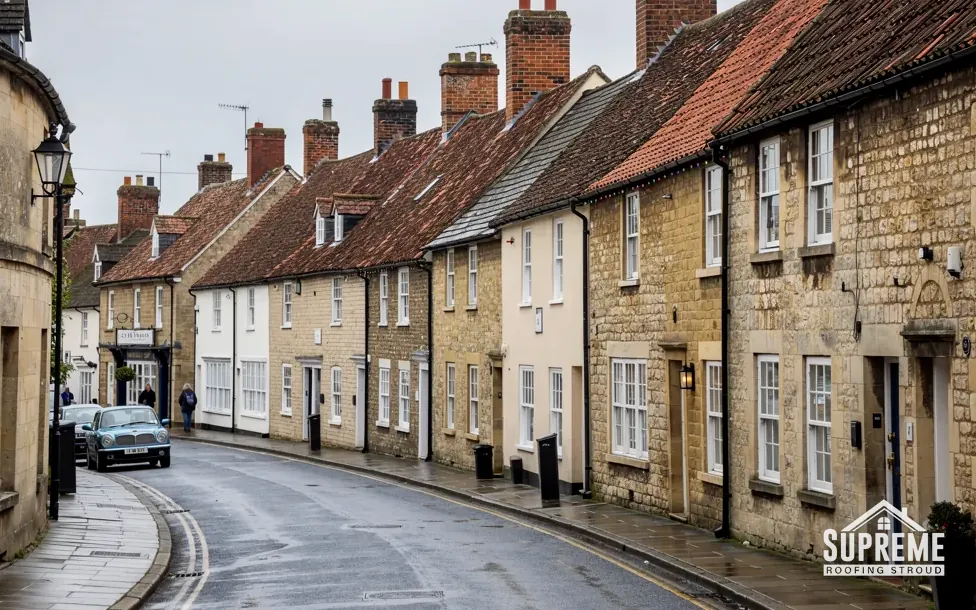
Victorian terraced houses with slate roofs and chimneys on a hillside 
Flint and brick cottage with a clay tile roof beside a road
Chapter 01
The houses around Frenchay Common and the Quaker merchants who built them
A roof put up for a merchant family is a roof to be mended in its own materials.
Chapter 01In this chapter
When wealthy Quaker families built along the common in the eighteenth century, they built houses meant to last, and the roofs have outlived several generations of repairs. A house like that usually has a pitched roof with chimneys on the party walls or the gables, a parapet or verge detail at the ends, and valleys where ranges meet. Each of those is a place where water finds a way in once the original materials have aged.
In this chapter
Three houses on Frenchay Common are listed Grade II. The principle is the same under South Gloucestershire Council as anywhere else: a listing protects the building in its entirety, front and back, inside and out. Replacing a roof covering on a listed house is not a cosmetic matter. The size, colour, texture and laying pattern of the old covering are part of what was listed, so the starting point is always to match them, and to ask the conservation officers before changing anything.
The conservation area adds a further layer for houses that are not listed. Re-covering like for like does not usually count as development, but a change of material may. It is a short call to the planning team, and we would rather you made it before accepting a quote than after the scaffold is up.
Reading the age of a roof
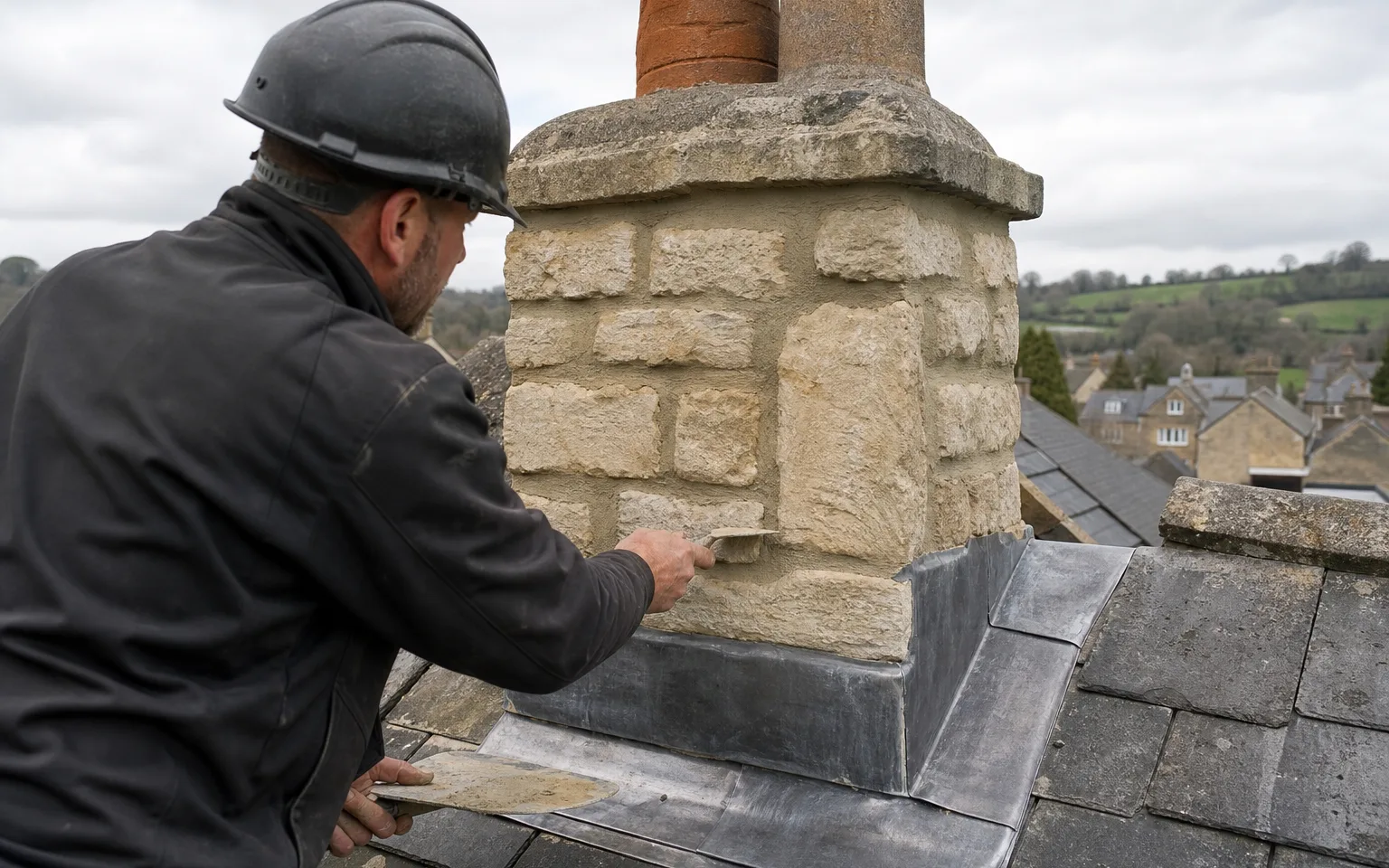
On an old house the roof has often been altered several times. A patch of newer tiles on one slope, a lead valley renewed in a different code from its neighbour, a chimney flashing in mortar rather than lead, all show where past repairs were made. Our survey photographs each of these and the quote covers them, so you can choose between a repair now and a full re-cover later. MyJobQuote puts the life of properly fitted lead flashing at more than eighty years, which is why renewing one is often a sound investment on a house of this age. Our lead roofing page explains codes and where each is used.
Neighbouring houses
Houses around a common are visible from one another, and a mismatch shows. If a neighbour has re-covered recently, we ask what they chose, who laid it and how it has weathered, and advise on whether the same approach suits your house. Where two roofs meet at a shared party wall, the junction is checked on both sides, because a failed flashing on one house will quickly show as damp on the other.
On a listed house the old covering is the specification.
- 1257first record of the village, as Fromscawe
- 1670year the Quaker Meeting House dates from
- 1809year the Meeting House was replaced with a new building

Chapter 02
Roofs under the Frome valley trees: leaf fall, shade and moss
A village named for its wood has roofs that spend much of the year in shade.
Chapter 02In this chapter
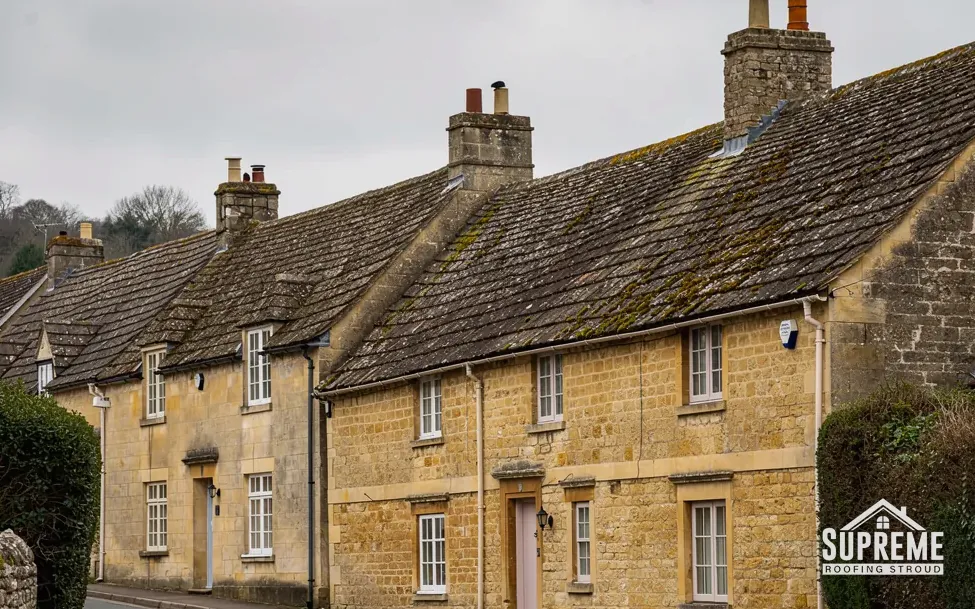
Trees are the first thing most people notice about the Frome valley here, and they shape how roofs age. A slope that sits under a canopy gets less direct sun, dries more slowly after rain and collects whatever falls from above: leaves, twigs, seed cases and the fine debris that settles into valleys and behind chimneys. Moss and algae take hold on those slopes first.
Moss is not simply untidy. It holds moisture against the covering, it lifts the edges of slates and tiles as it grows, and it can block a valley or a gutter outlet when a clump breaks away. Cleaning is the usual answer, and the method matters. MyBuilder's 2026 cost guide gives about £5 to £10 per m² for manual scraping, £15 to £20 for soft washing and £10 to £15 for pressure washing, and it cautions against pressure washing on delicate tiles. On an old house with soft clay or thin slates, we scrape by hand or soft wash rather than blasting the surface.
Cleaning is half the answer. A branch that rubs the covering in the wind will wear it faster than any moss, and a tree that overhangs a roof keeps it in shade whatever you do. Pruning is the owner's decision, and a tree surgeon's job rather than ours, but we point out limbs that are causing damage and note them in the survey photographs.

Gutters and valleys under trees
Leaf fall tests gutters every autumn. A valley that collects leaf will overflow in a downpour, and water running down a wall is the beginning of damp inside. We check outlets, gutter joints and valley linings and tell you what needs clearing before winter. A mesh guard over a gutter helps, but it needs its own inspection, since fine debris builds up on top. See our roof cleaning and moss removal page for the methods we use and what each costs.
When shade means more than moss
Persistent damp on a slope can be a sign that the roof is not draining as it should, or that the loft is not ventilated. We look inside as well as outside, because condensation in a roof space under a shaded slope can mimic a leak. Fixing the ventilation costs less than replacing a covering that was never faulty. Bats and nesting birds are protected, and tree-lined roofs are where they are most likely to be found, so we stop and check before disturbing any eaves or ridge.
Myth: Pressure washing is the quickest way to clear moss from an old roof.
Fact: It can damage delicate tiles, so on older coverings hand scraping or a soft wash is the safer choice.

Chapter 03
The Meeting House, the Unitarian Chapel and the larger roofs of Frenchay
Public and institutional buildings come with long spans, lead and a longer approval path.
Chapter 03In this chapter
Frenchay Unitarian Chapel is listed Grade II*, and the Quaker Meeting House, which dates from 1670, was replaced with a new building in 1809. Buildings of that kind have roofs unlike a house: wide spans over a single hall, parapet gutters, lead valleys and stone or slate coverings that carry real weight. A chapel roof may also have a bellcote, a ridge with decorative detail and a roof void that has hardly been opened in decades.
In this chapter
Approval for work depends on who uses the building. The exemption from listed building consent covers only the Church of England, the Catholic Church, the Methodists, the Baptists and the United Reformed Church, and only while a building is in use for worship. Unitarians and Quakers are not among them, so roof work on the Grade II* Unitarian Chapel that alters its character needs listed building consent from South Gloucestershire Council, like any listed house. We start by asking the trustees what is planned, and we would not begin a stripped roof until the consent is in writing.
The hospital was greatly expanded in the Second World War for the US Army, and its services merged with Southmead Hospital in 2014. It is worth mentioning because large institutional buildings, and the flat and low-pitched roofs that go with them, are a different category from a Georgian house, with different survey needs, different access and a different approach to phasing the work.
Commercial and community roofs
On a larger building, the survey looks at drainage first, because on a wide roof a choked outlet sends a surprising volume of water somewhere it should not go. Lead, single-ply and built-up coverings each need their own detail at parapets and upstands, and access may need a tower or a full scaffold. We plan the phasing so the building keeps running, and any opened section is sealed before we leave each evening. Our commercial roofing page describes how those jobs are surveyed and priced.
Planning a committee decision
For a committee or trustees, we write the survey findings and the written quote so they can be read without a roofer in the room. Photographs of the roof, a clear list of what is urgent and what can wait, and a note of any consents needed make it easier for a group to agree a plan. If funds are limited, the list can be phased over more than one year, with the weathertight work first and the cosmetic work last, and each phase is priced when the survey is written up rather than guessed at later.
Map showing Frenchay and the Stroud service radius, with nearby towns we also cover.
Near Frenchay
Roof work we do here
Georgian houses on the common and Frome woods
What should I check before re-covering a house on Frenchay Common?
Find out whether it is listed. Three houses on the common are Grade II, and a listed roof needs the same covering, laid the same way, with listed building consent for changes to its character. Even if it is not listed, the 1975 conservation area applies.
Why does moss return so quickly on roofs under the Frome valley trees?
Shade and falling debris keep a slope damp for longer, which is what moss needs. Cleaning removes it for a time, but pruning overhanging branches and keeping gutters clear slow its return.
Is lead worth renewing on an eighteenth-century house?
Often, yes. Lead flashings and valleys are among the first parts to give way on an older roof, and MyJobQuote says correctly installed flashing can last more than 80 years. We would choose the lead code to suit the position.
Who authorises roof work on a chapel or meeting house?
It depends on the denomination. The Church of England, Catholic, Methodist, Baptist and United Reformed churches use their own faculty process while a building is in worship. Unitarian and Quaker buildings are not exempt, so a listed chapel or meeting house in Frenchay needs listed building consent from South Gloucestershire Council for changes to its character.