
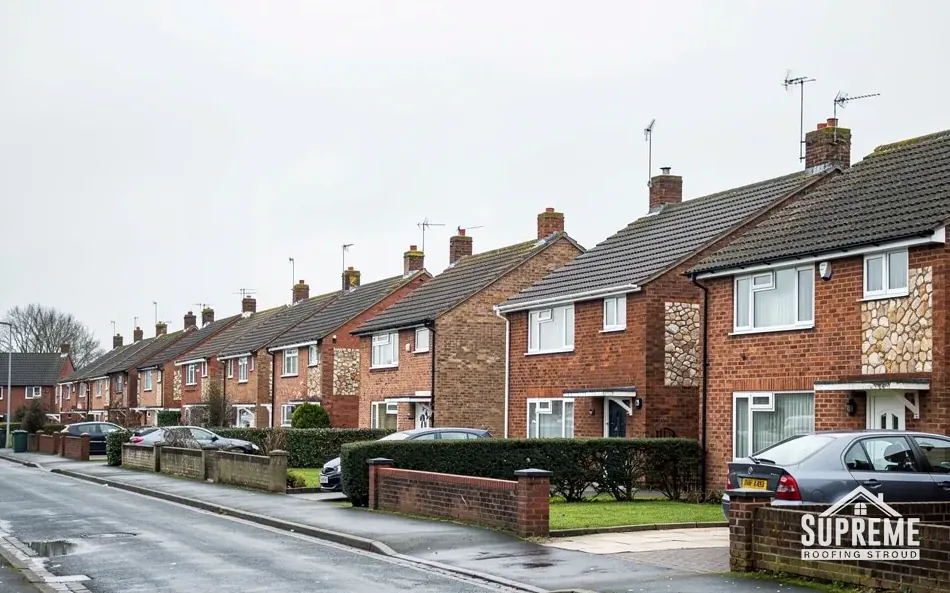
Roofers in Hambrook
Roof work in a Frome valley village at the foot of Winterbourne Hill, with a listed court, a conservation area and a brook that runs in beside the river, 27.5 road miles south-west of Stroud.
Hambrook at a glance
- Distance
- 27.5 road miles south-west of Stroud
- Council
- South Gloucestershire Council
- Conservation area
- Hambrook Conservation Area, designated 1975
- Setting
- River Frome valley, foot of Winterbourne Hill
Hambrook between the Frome and Winterbourne Hill
Hambrook sits at the south-western foot of Winterbourne Hill, on the north-eastern edge of Bristol, with Winterbourne on one side and Frenchay on the other. The River Frome runs along its eastern edge and the Bradley Brook joins the river inside the village. A small settlement here is recorded in the Domesday Book, so people have been keeping rain out of Hambrook buildings for a very long time.
A place shaped by a river and a hillside raises two practical questions before any roof is priced. Where does the water go once it leaves the slope, and how do ladders and scaffold reach the eaves? Both questions are answered at the survey, on the ground, rather than from a map.
The village has a conservation area, designated by the council on 30 July 1975, and Hambrook Court, an eighteenth-century house, is listed Grade II. Those two designations tell you which jobs need a second look. A repair on a house outside the boundary is a matter between you and your roofer. A repair on a listed house, or one inside the conservation area, may involve South Gloucestershire Council before the first slate or tile comes off.
We never assume what is under a Hambrook roof. The survey identifies the covering, the state of the battens and the condition of the timbers, and we photograph the roof so you can follow the findings on your own phone. Your written quote follows, with the scaffold, the strip-out, the new materials, the labour, the rubbish and the tidying up each carrying a figure.
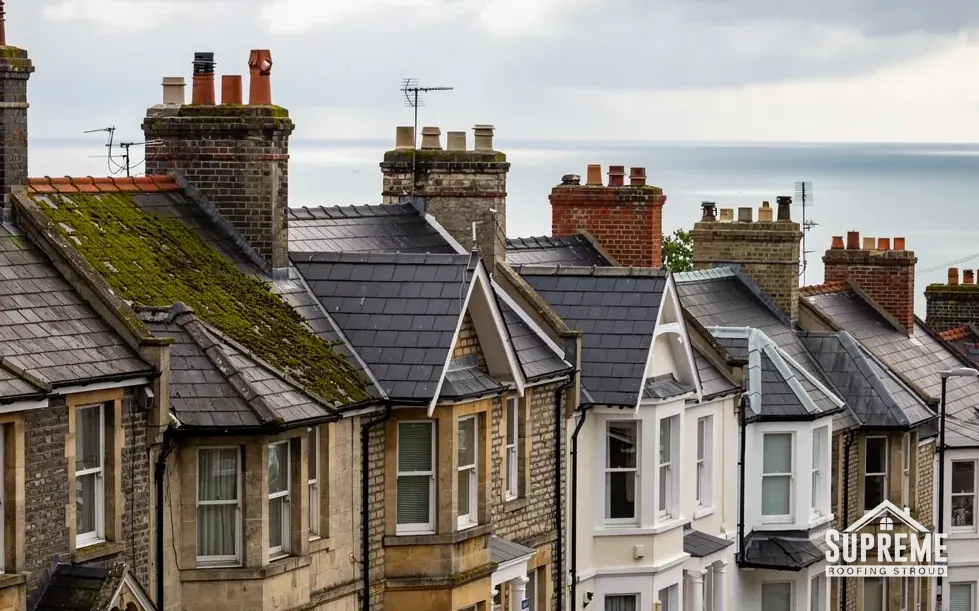
Row of Victorian terraced houses with slate roofs, bay windows and brick chimneys 
Street of stone terraced houses with slate and clay tile roofs

Chapter 01
Hambrook Court, the 1975 conservation area and what counts as a repair
A listed house and a designated area change the paperwork long before they change the roofing.
Chapter 01In this chapter
Hambrook Court dates from the eighteenth century and is listed Grade II. The conservation area and the listing each bring their own rules. A listing covers more than the front elevation, and the roof counts as part of it. Stroud District Council's own guidance says grade makes no difference to that protection, and the same logic holds for a listed house here, where the authority is South Gloucestershire Council. Anything that alters the special character of the building calls for listed building consent. Whether a given repair crosses that line is a question for the council's conservation officers.
In this chapter
The conservation area is a separate layer. Inside it, the council looks closely at changes to how a building looks from the street. Re-covering a roof in exactly what was there before is not usually treated as development at all, since the outward appearance is unchanged. A switch to another material, or a new feature on a slope people can see, is a different case, and a call to the planning team comes first. The conservation area boundary can run along one side of a lane, so two neighbouring houses may sit in different positions.
For us, the sensible response to both designations is the same. We identify the existing covering at the survey, note its size, colour and laying pattern, and propose the nearest honest match. Natural covering is replaced with natural covering. Salvaged material from the same roof is set aside and reused wherever it is sound, with new material to make up the shortfall.
Recording an older roof
On an older house in Hambrook, the survey notes the covering, the ridge, the verges, the flashings round chimneys and the lead in any valley. Each photograph is dated and kept with the quote. If listed building consent or a planning question comes up, you then have a clear record of the roof as it stood before work, which is exactly what a conservation officer will want to see. What the visit covers, and what lands in your inbox afterwards, is set out on our roof inspections and surveys page.
Smaller roofs, same care
Not every Hambrook house is a listed court. Most jobs here are repairs and replacements on ordinary homes, and the same method applies at a smaller scale: see the roof, photograph it, quote for the work, and leave the site clear.
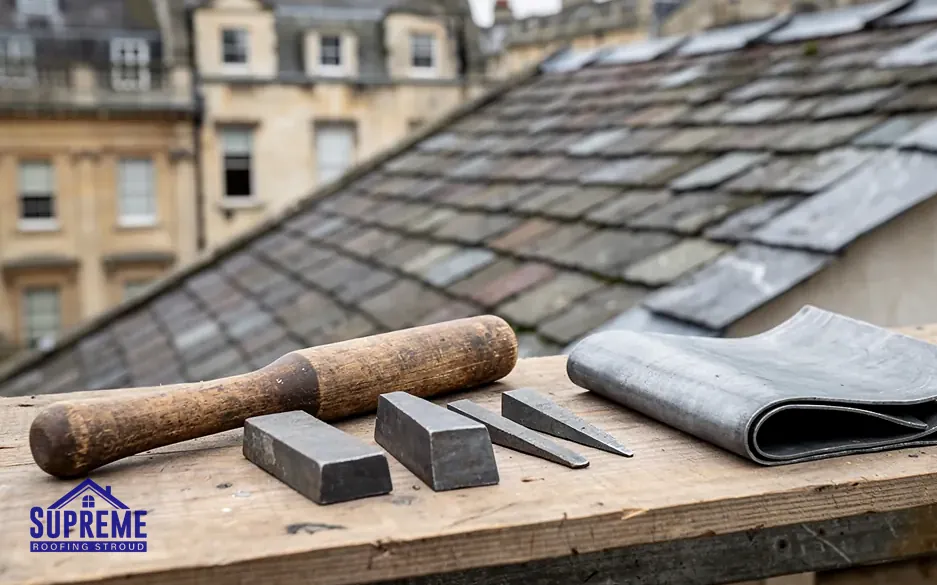
A listed roof is judged by what it looked like before we touched it.
| Your house | First step |
|---|---|
| Listed, such as Hambrook Court | Ask the council's conservation team about listed building consent |
| Inside the conservation area | Match the existing covering and ask the planning team about any change |
| Outside both | Like-for-like work usually needs no planning permission |
| Large replacement | Check whether Building Regulations approval applies |
Chapter 02
Where the Bradley Brook meets the Frome: water, gutters and damp
Rainwater has to leave the roof cleanly in a village with two watercourses.
Chapter 02In this chapter
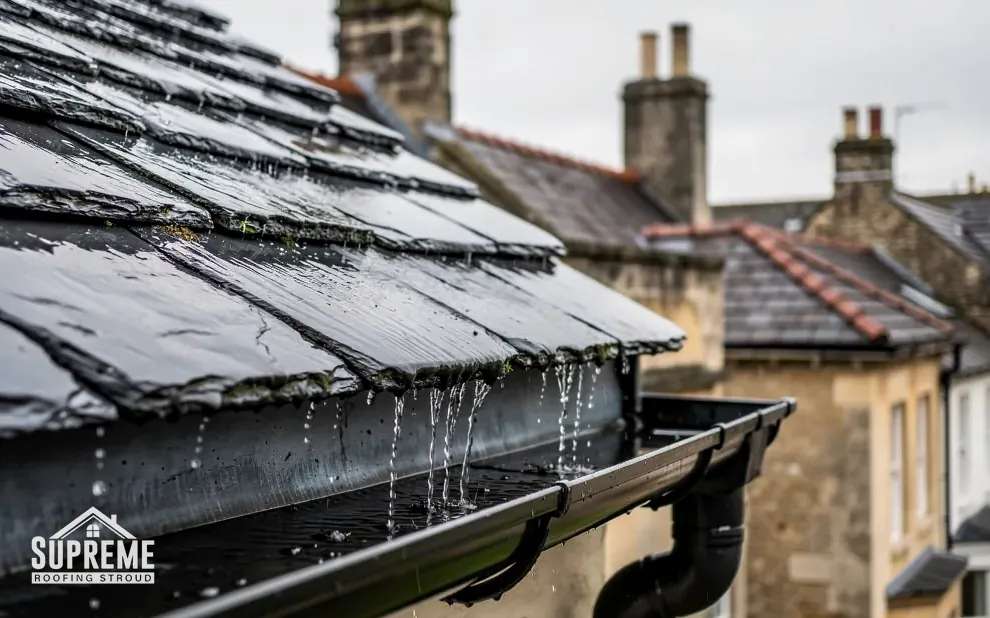
With the Frome along the eastern edge and the Bradley Brook joining it in the village, much of Hambrook sits close to running water. The point here is a simple one. A roof is only the first stage of a drainage system, and in a valley village the second stage, the gutters and downpipes, carries a lot of weight.
In this chapter
Gutters on older houses are often asked to cope with more than they were designed for. A run that has sagged ponds water along the fascia. A joint that has opened lets a thin stream down the wall, and over a few winters that stain becomes damp inside the room. Moss grows first where water lingers, and in a damp valley setting a shaded slope can hold it for a long time. We look for these signs from a ladder and, where it is safe, from the roof itself.
Gutter falls are gentle. Manufacturers typically recommend a fall to the outlet of between about 1:600 and 1:350, depending on the system, and brackets are spaced according to the product. A gutter that holds water along its length has usually moved from that fall, and re-hanging it is often cheaper than replacing it. Fascia and soffit boards behind it need checking at the same time, because rot there is the usual reason a gutter will not stay level.
Lead, flashings and chimneys
The other places water gets in are the junctions: where a roof meets a chimney, a wall or a dormer cheek. Lead flashings and soakers do that job, and a flashing that has lifted or split is a common cause of a ceiling stain. We include junction repairs in the quote, so the gutter work and the covering are both accounted for. Our guttering, soffits and fascias page sets out what we replace and what we refix.
Autumn leaf and winter moss
Valley villages with mature gardens fill gutters with leaf every autumn. Clearing them before the wet months costs a fraction of what a leak costs after one, and it is the least expensive roof maintenance there is. We note outlets and valleys that tend to clog and tell you which ones to watch.
Downpipes and where they discharge
A downpipe that empties against a wall footing, or into a drain that has silted up, undoes the work of a good gutter. At the survey we follow each pipe to its end, because a roof that sheds water neatly onto a saturated patch of ground still ends up with damp in the wall below. Cracked hoppers and loose pipe brackets are quick to put right while we have access.
Water that leaves the roof badly comes back in through the wall.
Chapter 03
A village under Winterbourne Hill: access, scaffold and the written quote
Hillside plots shape the scaffold plan, and the plan shapes the price.
Chapter 03In this chapter
From Stroud it is 27.5 road miles south-west to Hambrook, and the terms are the same as anywhere else we work. What changes with a hillside village is the plot, not the price list. Ground that falls away behind a house means a scaffold with two working heights. A drive that narrows or a gate that opens onto a lane means materials are delivered in smaller loads and carried further. A house that sits close to its neighbour means the scaffold may need agreeing with whoever is next door.
In this chapter
All of it goes into the quote. Scaffolding gets a figure to itself, which shows what share of the total it takes. Skip hire is another. If steep ground means a hoist or crane, that cost is agreed before work begins. Typical national figures are published on our service pages before anyone visits: For scale, the October 2026 Checkatrade update gives a range of £700 to £1,300 plus VAT for scaffolding a full re-roof, and MyBuilder's 2026 guide puts it nearer £1,125. Your own number comes from the survey.
Working near a river and a brook calls for care with debris. Old slates, tiles and mortar are bagged or lowered as they come off, never dropped into gutters or onto the ground. Once the last tile is on, we sweep the plot and load every bag of debris onto our own vehicle.
Re-roof or repair
Many Hambrook roofs will need a repair rather than a replacement, and we tell you plainly when a repair is enough. Re-bedding a ridge, replacing slipped tiles or renewing a flashing can add years to a roof for a modest cost. Stripping the whole slope makes sense once the battens are failing across it, or the covering is simply spent. If the job touches a large part of the roof, Building Regulations may come into play, and on a notifiable job we tell you which approval applies and submit the notice ourselves. The roof repairs page shows how a repair is told apart from a replacement.
Next step
Our workmanship carries a written 10-year guarantee. To start, ring 01453 933613, message us on WhatsApp or fill in the enquiry form, and add a photo of the gutter or slope you are worried about.

Map showing Hambrook and the Stroud service radius, with nearby towns we also cover.
Near Hambrook
Roof work we do here
Hambrook Court, the brook and Winterbourne Hill
Does a roof near Hambrook Court need different treatment from an ordinary house?
If the house is listed, yes. Listing covers the whole building, so changes to its character need listed building consent from the council. Like-for-like repairs are the safest route, and we record the existing covering with photographs before starting.
My house is inside the Hambrook conservation area. Can I change the roof covering?
Matching the existing covering is normally straightforward. Changing to a different material, or adding something new to a visible slope, is a question for South Gloucestershire Council's planning team, and it is best asked before any quote is accepted.
Why do gutters near the brook and river seem to need more attention?
A damp valley setting keeps moss and leaf in gutters for longer, and a blocked or sagging run sends water down the wall. We check falls, joints and outlets together, and clearing them before winter costs least.
Will scaffold on a hillside plot add to the quote?
It can, because the scaffold may need two working heights and materials may need carrying further. We work that out at the survey and allow for the scaffold, so the figure is known well before the day.