

Roofers in Sedgeberrow
Roof work in Sedgeberrow, where seventeenth-century half-timbered cottages, a Grade II* church and an old mill stand beside the River Isbourne, with timber, lead and drainage given the attention they need.
Sedgeberrow at a glance
- Distance
- 29.4 road miles north-north-east of Stroud
- Council
- Wychavon District Council
- Listed
- St Mary the Virgin, Grade II*
- Setting
- Beside the River Isbourne south of Evesham
Half-timbered cottages and a mill beside the Isbourne
Sedgeberrow lies beside the River Isbourne, a tributary of the Avon, south of Evesham. The river gives the village its setting and, on one July day, its most remembered event: on 20 July 2007 the Isbourne burst its banks and flooded the village. That date matters to a roofer more than it might seem, because it is the reason drainage, gutters and ground water get as much attention here as the covering above.
The oldest houses are the several seventeenth-century half-timbered cottages that survive in the village. A half-timbered building has an exposed oak frame, with the spaces between the timbers filled in. The roof sits on that frame, so the condition of the frame and its connection to the roof matter as much as the tiles or slates on top. Roofs on buildings like these are rarely straight or square, so a new covering is laid to suit the building, not to straighten it.
Around the cottages are three listed buildings that anchor the village: St Mary the Virgin church, consecrated in 1331 and Grade II* listed, Church House, also Grade II*, and Sedgeberrow Mill, Grade II. Where a house sits close to buildings of that standing, care with materials and detail is part of the job, and we say what we would use and why before work begins. Wychavon District Council is the planning authority.

Hillside of stone terraced houses with mossy stone tile roofs and chimneys 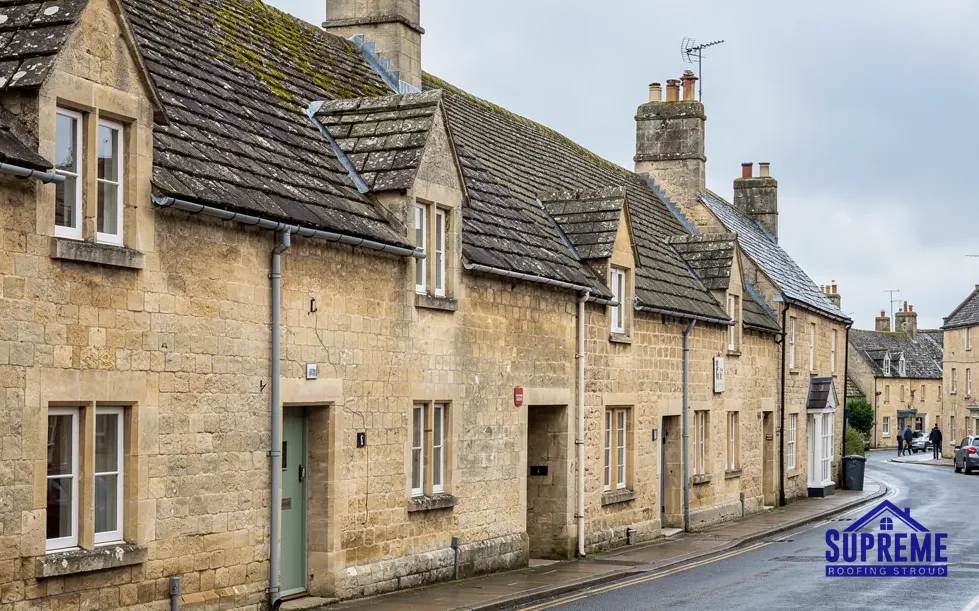
Terrace of stone cottages with dormer windows and stone tile roofs

Chapter 01
The Isbourne burst its banks in 2007: roofs, gutters and drains
Water that reaches a village from the river makes the roof's drainage work harder.
Chapter 01In this chapter
When the Isbourne flooded Sedgeberrow on 20 July 2007, the water that mattered most was at ground level. A roof sits above that. Yet roof work in a village that has seen a flood is still shaped by it, for two reasons: how the roof sheds water, and where that water can go once it leaves the gutter.
In this chapter
If the ground around a house is wet, or the drains are slow, rainwater from a roof has nowhere to soak away. Gutters then overflow in heavy rain, downpipes back up, and the lower courses of a wall take the water. We start a Sedgeberrow survey at the gutter line. Fall, joints, brackets and outlets are each checked along every run, and we look at whether the downpipes discharge to a drain or just onto a path. If a drain is not ours to repair, we tell you and point out what we saw, so you can ask a drainage firm to look at it.
Gutter makers suggest a slight slope to the outlet, anywhere from about 1:600 to 1:350 depending on the system, with evenly spaced brackets. A sagging gutter is a common cause of staining on an old wall, and it can be set right without touching the roof covering. Our guttering, soffits and fascias page explains the options, from repairing a run to replacing it.
After water has been in the village
A flooded neighbourhood leaves behind damp, and damp finds its way up into places that are not obviously linked to it. Loft spaces can feel the change if wall plates and timbers have taken up moisture. When we look at a roof in a village like this, we check the roof void for signs of damp, tide-marks on the timber, staining at the eaves and any mould that has built up where the air does not move. None of that proves a flood caused it, and we do not say so. It simply tells us where to look closer.
Planning for heavy rain
The sensible approach to a village beside a river is not to guess at the next flood but to make sure the roof and its drainage can cope with ordinary heavy rain. Clear gutters, intact joints and downpipes that discharge away from the walls do that. Everything is photographed at the survey, which shows you what needs doing and what can wait.
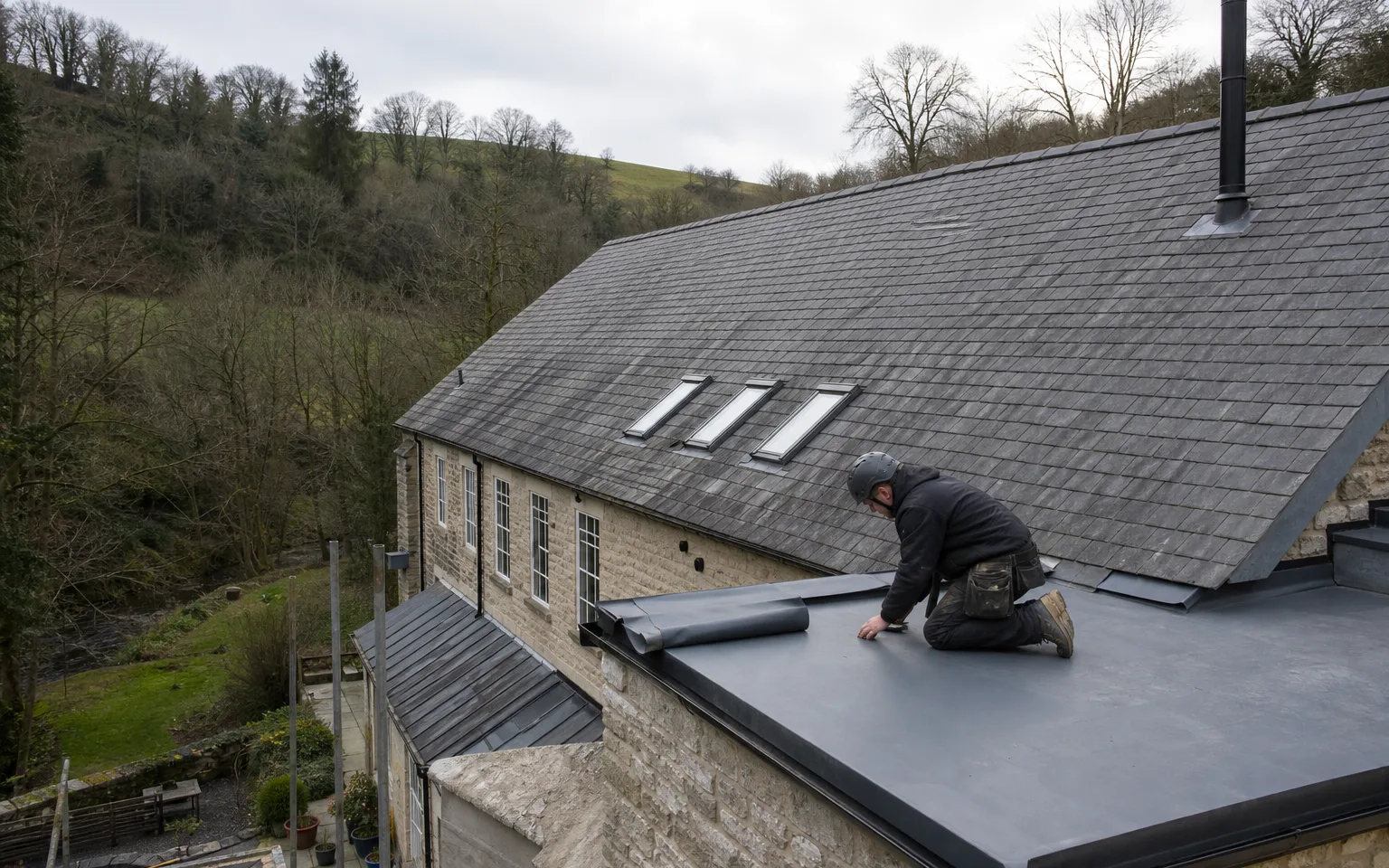
Where the water leaves the roof is part of the roof.
| Part | What we check | Why it matters here |
|---|---|---|
| Gutter run | Fall, joints, brackets | A sagging run overflows against the wall |
| Downpipe | Outlet, bends, discharge point | Blocked pipes back up in heavy rain |
| Ground drain | Whether it takes the discharge | Slow drains leave water against the footings |
| Roof void | Damp, staining, timber tide-marks | Shows where moisture has been getting in |

Chapter 02
Half-timbered cottages and the seventeenth-century roof frame
A roof on an oak frame is repaired by working with the timbers, not against them.
Chapter 02In this chapter
Several seventeenth-century half-timbered cottages survive in Sedgeberrow. An oak frame that has stood for hundreds of years has moved, settled and dried out, and the roof it carries has moved with it. The ridge may dip, the eaves may wave and the rafters may meet the wall plate at slightly different angles from one bay to the next.
In this chapter
Any repair has to allow for that. A modern tile or slate assumes a straight, even roof plane, and fitting it to an old frame takes patience. Battens may need packing, the gauge may have to vary slightly along a slope, and the courses at the eaves and the ridge need the most care. We try to fit the covering to the building, not to a drawing. From the lane we cannot tell what covers a given cottage, so we inspect it up close and photograph it.
Weight is the other concern. An old frame was built for the covering it was first given. Put a heavy covering where a light one sat and the structure carries more than it was built for. Building Regulations treat a covering that is 15% or more heavier as a change needing approval and a structural check, which is the reason like-for-like is the safest default on an old frame. If you want to change the covering, we mention it at the survey, and your building control body will advise on whether it is notifiable.
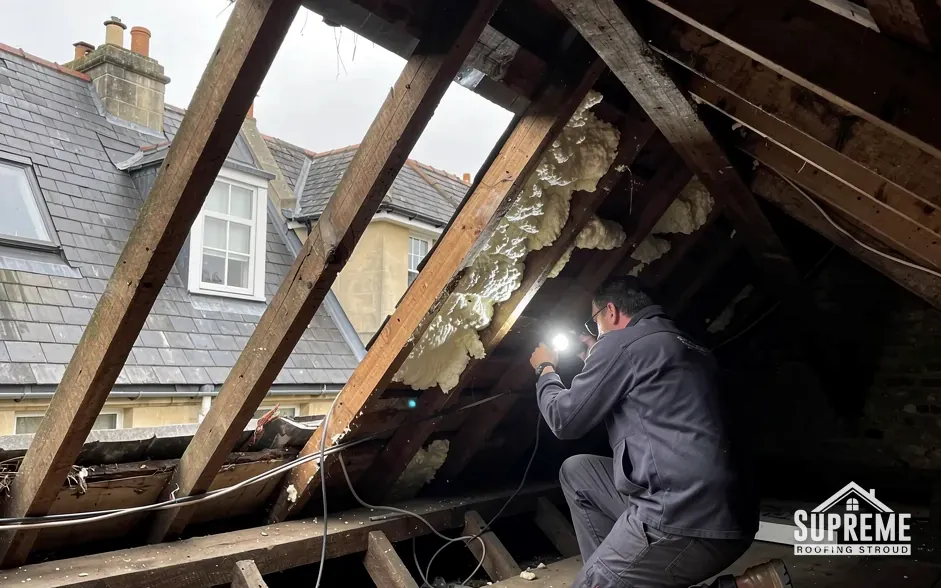
Timber that needs a closer look
At the eaves and around chimneys, old timbers meet moisture first. We look for soft wood, pests, and rot at the wall plate, which is the horizontal timber on top of the wall that the rafters sit on. If a timber needs repair, the fix is usually a splice or a replacement section, not a full replacement of the roof. The written quote covers any timber work, with photographs of the area, which shows what the work is for.
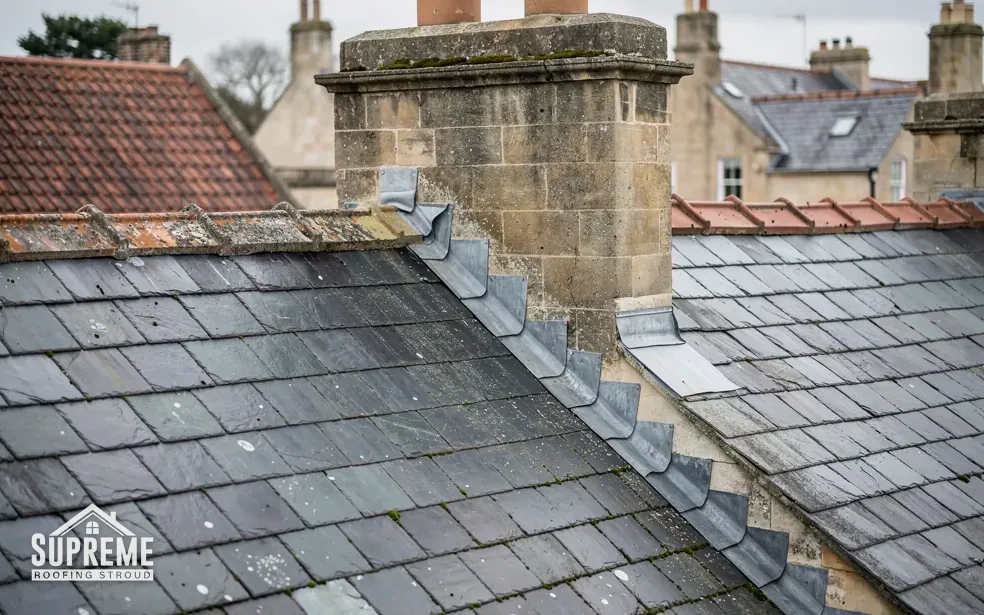
Chimneys and flashings
On a cottage roof like these, the stack is often the busiest junction, with a lead flashing around its base. Lead is a metal sheet dressed into place to keep water out at joints, and its thickness is sold by a code number. Our lead roofing page covers the codes and their uses. A cracked or lifted flashing is a routine repair on old cottages and is often the real source of a ceiling stain blamed on the tiles.
Chapter 03
St Mary's, Church House and the mill: listed buildings in the village
Three listed buildings set the standard for what care means on a roof here.
Chapter 03In this chapter
The church was consecrated in 1331, and despite restoration in 1868 it keeps its fourteenth-century form. It is Grade II* listed. Church House, close by, is also Grade II*, and Sedgeberrow Mill is Grade II. Listed status carries real consequences for roof work, and it helps to separate them.
In this chapter
If your home is listed, work that would alter what makes it special needs authorisation. Stroud District Council says the whole of a listed building, whatever the grade, has full legal protection, and the same principle applies in Wychavon. Re-roofing like for like may be straightforward, but a change of material, ridge, verge or chimney detail is something to raise with the council's conservation officer before the quote is accepted. We explain the consent process in the quote and can supply photographs and a specification to support an application.
A church in use follows another route: the ecclesiastical exemption means the diocese authorises roof work to St Mary's by faculty. A redundant church or converted chapel normally needs listed building consent from the council. Anyone caring for a church roof can ask us what a survey covers, though the permission route stays with the diocese.
Lead on old roofs
Old stone and tile roofs on important buildings often carry a good deal of lead: in valleys, gutters behind parapets and flashings around stacks. Correctly installed lead lasts a very long time, but it fails at the joins, and tears, splits or lifting edges let water in. Repair in kind is usually possible, and the old sheet should be assessed for reuse before it is replaced.
Next to a mill
Sedgeberrow Mill is a reminder that the village was once organised around the Isbourne. Roofs near a watercourse sit in damp air, and where trees grow beside the water, leaves and moss gather on slopes and in gutters. Our roof repairs page explains how we handle leaks, slipped coverings and storm damage, and what we prioritise first.
An estate with a long record
The records for this place go back a long way. In 777 King Offa of Mercia granted the estate to King Ealdred of the Hwicce, who passed it to the Bishop of Worcester. Few places can trace their ownership back that far. For a roofer, the point is that buildings here have been repaired and rebuilt for many centuries, and the sensible approach is to repair rather than renew whenever the fabric allows.

Map showing Sedgeberrow and the Stroud service radius, with nearby towns we also cover.
Near Sedgeberrow
Roof work we do here
Isbourne mill, half-timbering and the 2007 flood
Can the roof of a seventeenth-century half-timbered cottage in Sedgeberrow be re-covered safely?
Yes, with a covering chosen to suit the oak frame. We look at the timbers, check the wall plate for rot and keep the new covering no heavier than the old, because a covering 15% or more heavier needs approval. Any timber repair is agreed with you first.
Does the 2007 Isbourne flood affect how you survey a roof here?
It affects where we look. We check gutters, downpipes and discharge points first, because water that cannot drain away lands against the walls. We also look in the roof void for damp and staining, though we do not claim any particular mark came from the flood.
I live near the Grade II* church. Do I need consent to repair my roof?
That depends on whether your own house is listed. If it is, work affecting its character needs listed building consent from Wychavon District Council. The church itself is separate, while the church in use is dealt with by faculty from the diocese. We can help you work out which applies.
Why does lead matter on older Sedgeberrow roofs?
Lead keeps water out where a roof meets a chimney, wall or valley, and those joints are where old roofs leak. A lifted or split flashing is often the true source of a ceiling stain. Repair in lead of a suitable code is usually possible without re-covering the whole roof.