

Roofers in Lydbrook
Roof work in a Wye Valley village that ran from the riverside up a steep valley, with a furnace, a tinplate works, a viaduct and a cable works in its past.
Lydbrook at a glance
- Distance
- 26.4 road miles west-north-west of Stroud
- Council
- Forest of Dean District Council
- Setting
- Valley running down to the River Wye
- Listed
- Church of Holy Jesus, Grade II
Lydbrook's roofs, from Lower Lydbrook up the valley
Lydbrook is a Forest of Dean parish in the Wye Valley, 26.4 road miles out of Stroud on a west-north-west line, with Lower Lydbrook down by the river. The village follows a valley that runs down to the Wye, so its houses are strung along a slope, one above another, and a roof here is usually a roof on a gradient.
Its working past left an unusually well-recorded set of buildings and sites. The first commercially successful blast furnace was sited in Lydbrook and was working by 1608. Tinplate production began by 1798 and ceased in 1925. The Lydbrook Viaduct was first used on 26 August 1874, rose some 87 feet above the road below and was dismantled in 1966. The Lydbrook Cable Works at Stowfield were built in 1912 by Harold J Smith and bought by Edison Swan in 1925.
For roofing, that history points at two kinds of work: the houses on the valley sides, and the larger industrial-scale roofs that go with a place that made metal and cable. The Church of Holy Jesus, consecrated on 4 December 1851, is Grade II listed. Lower Lydbrook, down by the Wye, has had its own conservation area since 21 September 1995, but the village centre and the valley above lie outside it, so for most houses listing and the council's own advice are what to check first.
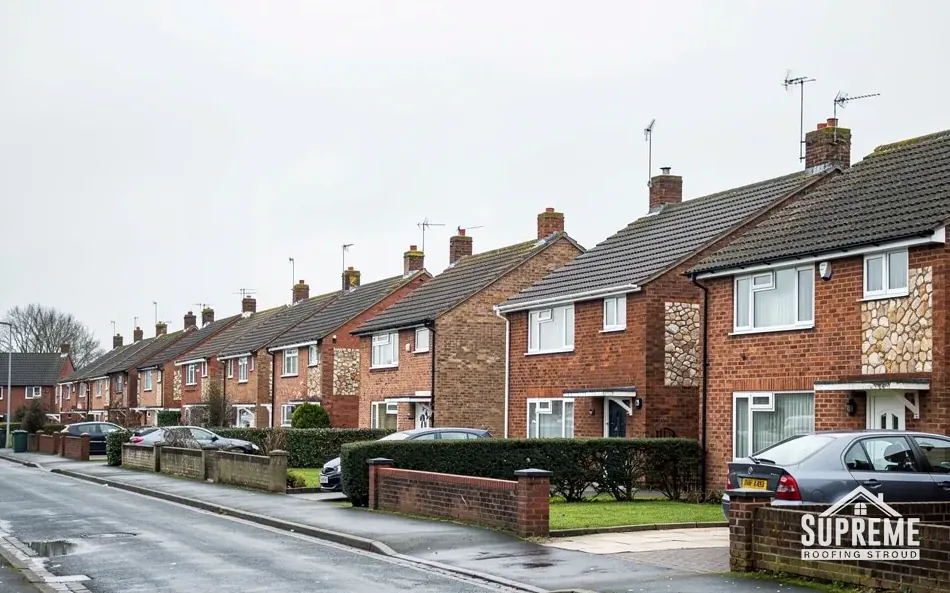
Street of red brick terraced and semi-detached houses with parked cars 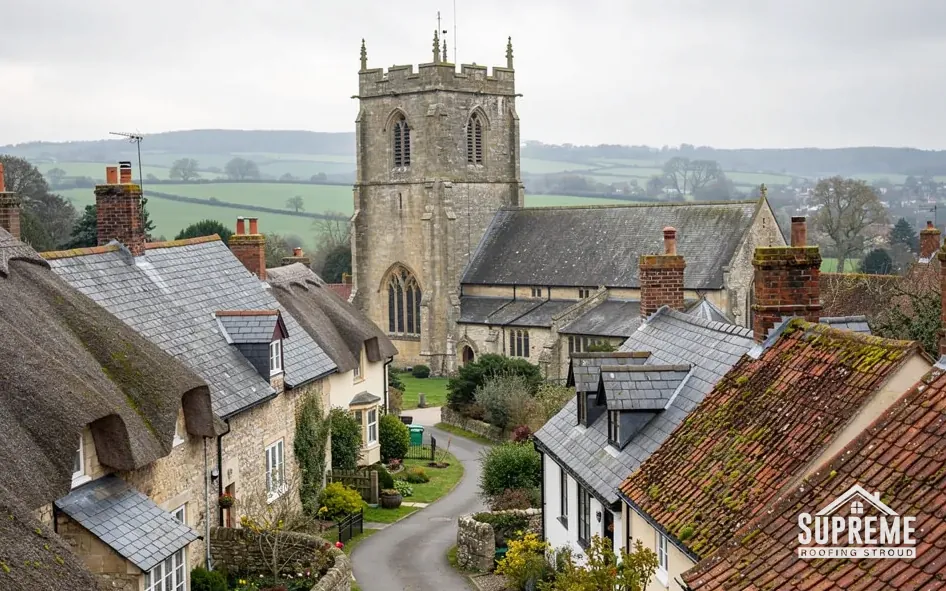
Village of thatched and tiled cottages around a stone church tower

Chapter 01
Houses strung along the valley down to the Wye
On a long slope, every house sits at its own level, with its own way up.
Chapter 01In this chapter
Lydbrook runs down a valley to the Wye, and its houses are arranged along the fall of the ground. A road on a slope puts the roof of one house level with the garden of another, and one side of a house may stand several feet higher than the other. At the survey we walk the whole plot before climbing anything, since the route to the roof settles how the job is organised, and then we look at the covering itself.
In this chapter
Wikipedia notes that the Lydbrook Viaduct stood some 87 feet above the road below. It is a handy reminder of the scale of the land here. On such ground roofs are seen from below as well as from above, and a defect on a ridge or chimney can be visible from the lane long before the owner notices a stain indoors.
Scaffold on a slope
A level scaffold on sloping ground does not exist. Ours is built in stepped lifts, with base plates under each standard and ties back into the building so it cannot move. Where a house is set back above a narrow lane, we look for the nearest point a vehicle can stop, then plan a carrying route for tiles, timber and waste. If the lane needs a temporary closure, or a licence for scaffold on the public highway, that goes in the timetable early. What you receive is a plan written into the quote. There is nothing left to be found out once the crew turns up.
Rainwater on a hillside
Gutters on a steep site do hard work. Water that comes off a long slope picks up speed, so a gutter with too little fall, or a downpipe too small for the roof, will overflow into the wall. We check the falls, the joints, the brackets and the outlets, and we ask where each downpipe discharges. Our roof repairs page describes how we deal with leaks while a lasting repair is arranged.

Chimneys, ridges and the lane below
A stack on a valley-side house is seen from the road below, which makes a leaning chimney or a cracked ridge easy to spot and awkward to ignore. We check the pointing, the flashing where the stack meets the roof, and the pot or cap on top. Lead flashing, correctly fitted, can last over 80 years according to MyJobQuote, so a sound flashing is repaired and kept. A loose ridge or hip is a different matter, because BS 5534 asks for mechanical fixing and does not rely on mortar alone.
What we photograph
Every Lydbrook survey ends with pictures of your own roof: the ridge, the valleys, the flashings, the eaves and the loft underside. They are what the written quote refers to, and they let you compare any other quote on equal terms.
On a valley side, the route up is part of the job.
Myth: A house on a valley side is scaffolded the same way as a house on the flat.
Fact: A sloping plot needs stepped lifts, firm bases and a carrying route, all of which we work out at the survey and allow for in the quote.
Chapter 02
Furnace, tinplate works and cable works
Industrial sites bring big roofs, flat sections and shared responsibility.
Chapter 02In this chapter
Lydbrook has been a place of metal for a long time. A blast furnace was working by 1608, tinplate production ran from 1798 to 1925, and the Cable Works at Stowfield was built in 1912 and bought by Edison Swan in 1925. If any buildings from those works now stand in new use, their roofs came with them, and a roofer is asked to look at them as they are today.
In this chapter
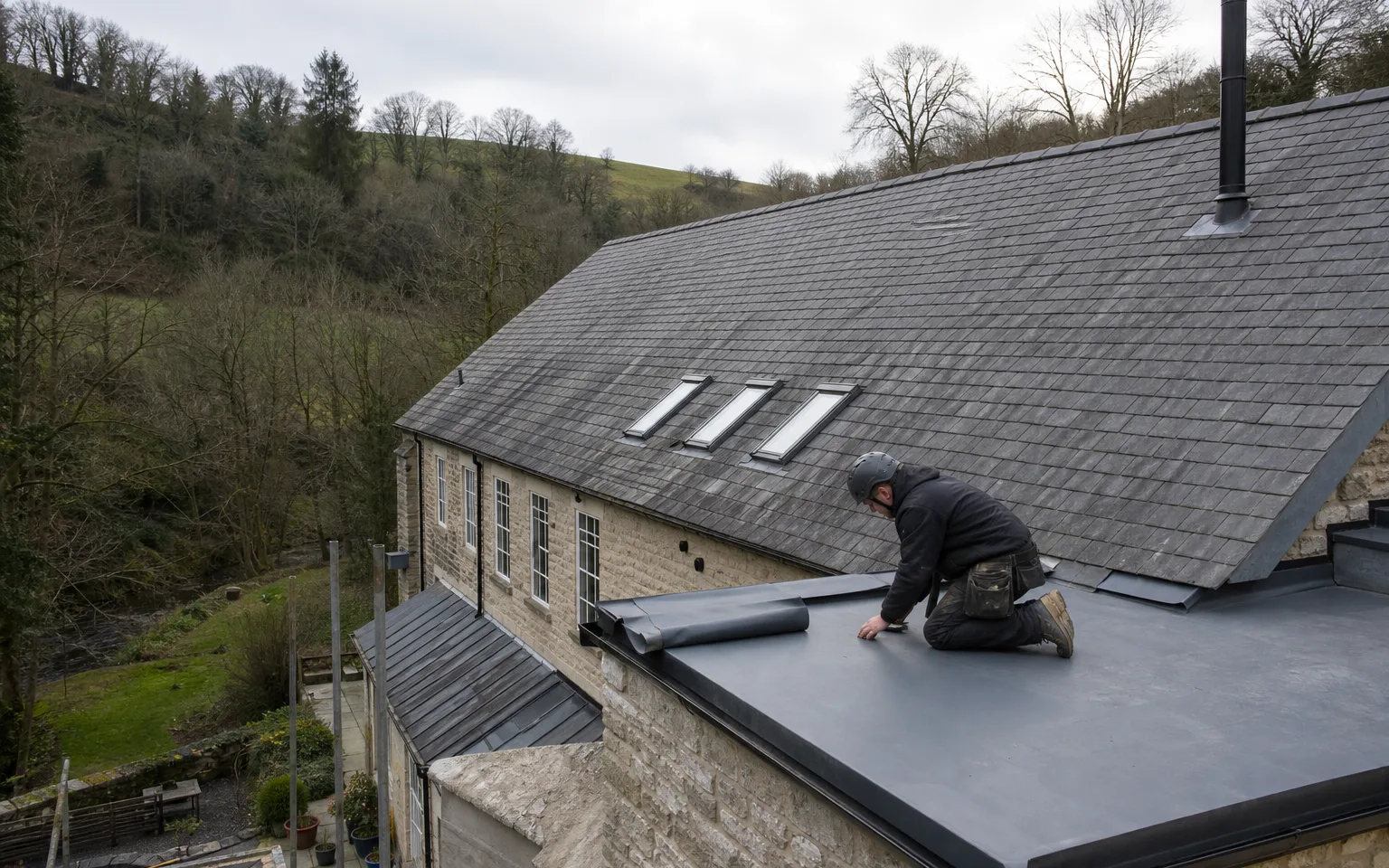
Large, low-pitched and flat roofs behave differently from a house roof. The finished fall on a flat roof should be at least 1 in 80, and BS 6229 asks the designer to aim for 1 in 40 so that tolerances and deflection do not leave water standing. Ponding, where water sits in a hollow, shortens the life of any membrane. MyBuilder puts a typical flat roof at between 15 and 30 years, a spread that reflects the covering chosen and the upkeep it gets. Our flat roofing page explains the main coverings, and our commercial roofing page describes how larger buildings are phased so a business can keep working.
Roofs with many owners
On a former works that has been divided into units, the roof is often shared while the leases are separate. The first job is to find out who is responsible for which part. We ask for the lease wording or the managing agent's details, survey the whole roof, and produce a report that can be circulated to everyone affected. The quote makes clear what belongs to each unit, so the cost can be shared fairly.
Sheeting, rooflights and fixings
Industrial roofs often carry profiled sheeting with rooflights set into it, and the fixings, laps and sealants are what fail first. Asbestos cement sheeting, where it turns up, calls for a separate plan. On HSE's reading, taking intact sheets off with care sits in the non-licensed category, but sheets that have shattered move the job into notifiable non-licensed territory. We assess the condition before pricing. Taking the sheets off, carting them away and laying the new covering are all covered by the quote.
A site of this age may also have drainage that does not match how the buildings are used now. We follow the water from the roof to the drain, and note anything that discharges where it should not.
| Date | Event | What to ask of a roof today |
|---|---|---|
| By 1608 | Blast furnace working | Who owns and maintains any surviving structure |
| 1798 to 1925 | Tinplate production | Falls, gutters and drainage on larger roofs |
| 1912 | Cable Works built at Stowfield | Sheeting, laps and rooflight fixings |
| 1925 | Works bought by Edison Swan | Shared responsibility between units |
Chapter 03
The Church of Holy Jesus and listed-building checks
A Grade II church, and what listing means for the roofs around it.
Chapter 03In this chapter
The Church of Holy Jesus was consecrated on 4 December 1851 and is Grade II listed. Grade II is a lower grade than II*, but the protection is the same in law: Stroud District Council's guidance says all listed buildings, whatever their grade, have full legal protection inside and out, back and front. That is Stroud's wording, though the principle is national. For a listed building in Lydbrook, the Forest of Dean District Council's conservation team is the one to speak to.
In this chapter
For a church still used for worship, the route is a faculty from the diocese. For a house or a hall that happens to be listed, it is listed building consent, and it must be in place before work that would alter the building's special character. Even a like-for-like repair may need checking, because many roof details count towards that character. We do not guess. If you tell us your building is listed, the survey includes a note of what we would propose, so you can take it to the council before you commit.
Curtilage buildings and outbuildings
A listed house often has outbuildings within its grounds that fall under the same protection. Stroud District Council's guidance suggests checking the status of such structures with its conservation department rather than assuming. The same caution suits Lydbrook: ask the council before you strip a barn roof, or recover a garage standing in the grounds of a listed property.
One conservation area, at Lower Lydbrook
Lower Lydbrook is one of the Forest of Dean District Council's 27 conservation areas, and a house by the river there faces closer scrutiny of any visible change to its roof. Higher up the valley that layer of control falls away, but listing does not. We therefore look at every older building with the question of status first, then the roof. Where the covering is stone or slate, the like-for-like principle applies: it is replaced with the same material, matched in size and colour. Our pitched roofing page describes how repairs and replacements differ.
Written down
Church councils and owners of older buildings often have to show a decision to someone else, whether a parish meeting, a diocesan adviser or a conservation officer. A clear specification, a set of photographs and a written price make that far easier.
Our workmanship carries a 10-year guarantee, in writing, and the quote covers scaffold, strip, materials, labour and waste, so a conservation officer or a church council can read exactly what is proposed.
Map showing Lydbrook and the Stroud service radius, with nearby towns we also cover.
Near Lydbrook
Roof work we do here
Steep valley sides and Lower Lydbrook's conservation area
How do you scaffold a house on Lydbrook's steep valley sides?
In stepped lifts, with base plates under every standard and ties back to the building. We choose a delivery point, plan the carrying route and apply for any road or footway licence at the start. All of it shows on the quote.
A unit in a former works has a leaking flat roof and shares it with others. Who deals with it?
That depends on the lease. We survey the whole roof, report on each unit's section and give the managing agent a document that can be circulated. The quote says which unit each piece of work belongs to, so the cost can be divided.
The Church of Holy Jesus is listed. Does that affect a house nearby?
Only if that house is listed itself or stands in the grounds of a listed property. We ask the council to confirm a building's status before proposing any change, and we advise you to do the same.
My house is outside the Lower Lydbrook conservation area. Can I change the roofing material freely?
Not necessarily. A building may be listed, and a change of material can need planning permission. A straight swap of like for like is the easy case; for anything beyond it we check with the Forest of Dean District Council's planning team first.