
Roofers in Coalpit Heath
Roof repairs and re-roofs in Coalpit Heath, the former coalfield village north-east of Bristol, where William Butterfield's church of 1844 sits among Grade II* neighbours.
Coalpit Heath at a glance
- Distance
- 24.2 road miles south-west of Stroud
- Council
- South Gloucestershire Council
- Notable listing
- Church of St Saviour, Grade II*
- Setting
- Former coalfield village north-east of Bristol
Coalpit Heath's roofs: a pit settlement, bell-pit ground and a Butterfield church
Coalpit Heath was founded as a coal mining settlement. There were pits at Frog Lane and between Mayshill and Nibley, and a railway line served them. The ground still carries the evidence: remains of many bell pits were found when the Kendleshire golf course was built. It is a village shaped by one industry and the housing grew up around the work rather than around a market or a green.
The building that stands out from that story is the parish church. St Saviour's was designed by William Butterfield in 1844 and was his first Anglican church. The Church of St Saviour, its Old Vicarage and the lychgate are each listed Grade II*, so a short stretch of ground holds three protected structures with three separate roofs. For anyone with a roof near them, that cluster sets the tone for the care the village expects, and for the questions we ask before we climb a ladder.
Coalpit Heath lies south of Yate, with Frampton Cotterell along its north-west border, and it is not among South Gloucestershire's 30 conservation areas, so for most houses the listing question matters more than any area designation. Whether you live in a terrace, a semi or a detached house, we start from what the survey shows on your roof.
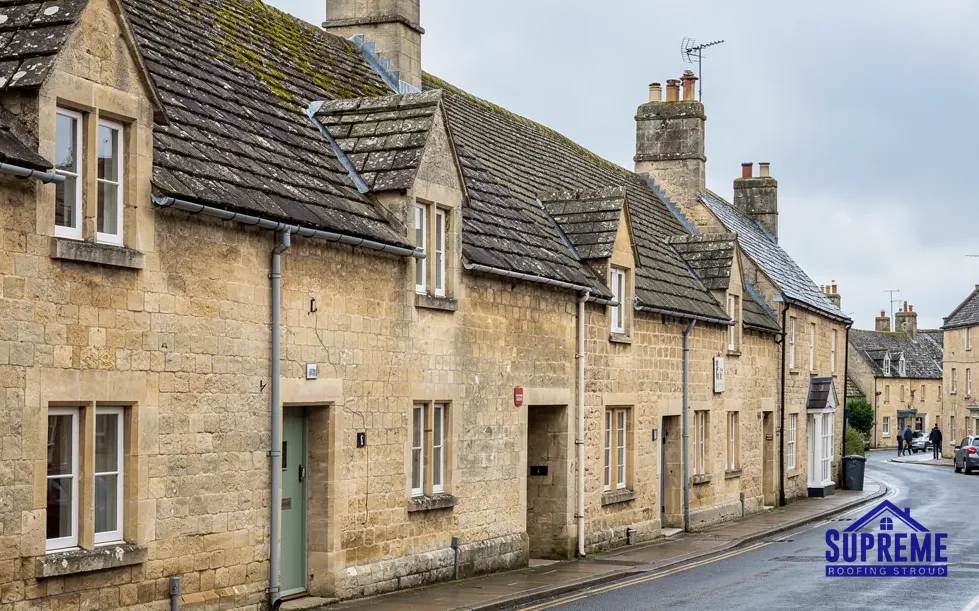
Terrace of stone cottages with dormer windows and stone tile roofs 
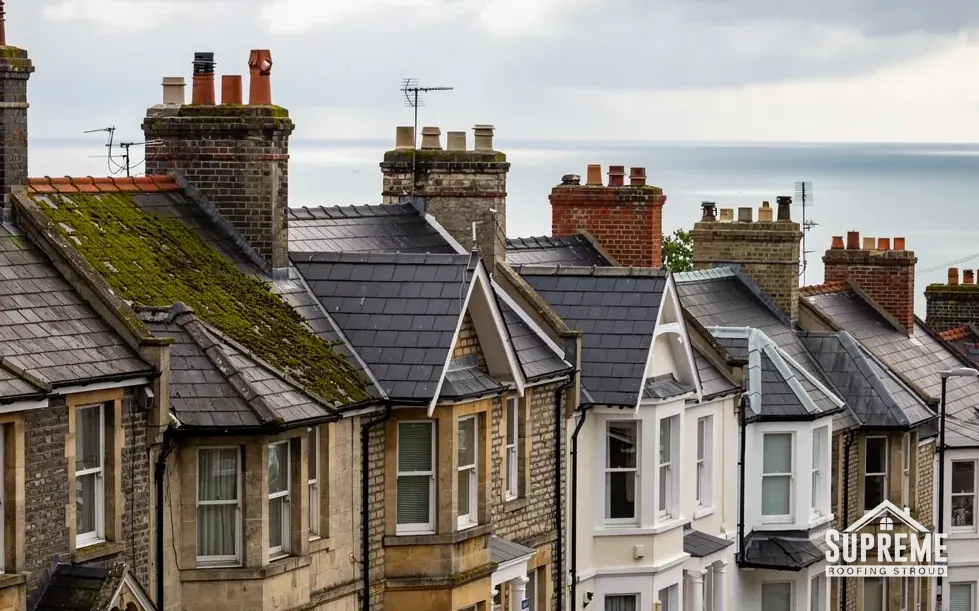
Hillside terraces of stone houses with slate roofs and chimneys

Chapter 01
Church, Old Vicarage and lychgate: three Grade II* roofs, three routes
Each listed structure answers to a different permission, even on the same plot of ground.
Chapter 01In this chapter
Three separately listed structures stand together at Coalpit Heath: the Church of St Saviour, its Old Vicarage and the lychgate. All three are Grade II*. A common mistake is to treat a cluster like this as one site with one set of rules. In law, each listing is a separate building, and each can have a separate route to approval, which makes the first conversation about permission, not tiles.
In this chapter
The church comes first. While St Saviour's remains a working church, the listed building system does not apply to it, and the diocese gives permission for its roof through a faculty. The Old Vicarage is another matter. A vicarage that is now a private house is an ordinary listed dwelling, and the council's listed building consent is needed for works touching its special interest. Making unauthorised changes to a listed building is an offence. The lychgate is the awkward one, since a small roofed gate on a churchyard boundary could fall under either regime, and we do not guess which. We ask the council and the diocese, in that order, and wait for a written answer before pricing. Our roof repairs hub gives typical prices for ordinary work in the meantime.
Scale does not make a small roof simple. A lychgate has very few slates or tiles, and every one is visible from the lane and the porch. Suppose a listed roof is in stone slate. English Heritage policy, set out in a Cotswold District Council guide of 2000, favours newly cut stone over second-hand stock, limits any reclaimed slates to the building that shed them, and rules out swapping sandstone for limestone or the reverse. Geology, tone, texture, size and thickness all have to line up. For a few dozen units, that is a demanding specification.
What the Old Vicarage owner should ask
For a vicarage-type house, ask three questions before booking any roofer. Is the listing description on the council's register? Does the roof or chimney appear in it? And who signs off a like-for-like repair, the conservation officer or the planning team? Our guide to listed roof repairs sets out what usually counts as a repair rather than a change, and our lead roofing hub covers the flashings that older buildings depend on.
A cluster of listed buildings means three separate conversations about permission.
| Structure | Listing | First call |
|---|---|---|
| Church of St Saviour | Grade II* | The diocese, for a faculty, while the church is in use |
| Old Vicarage | Grade II* | The council, for listed building consent |
| Lychgate | Grade II* | The council and the diocese, to confirm which applies |
Chapter 02
William Butterfield's first church and the lead behind its parapets
A mid-nineteenth-century church roof depends on metalwork that has to be sound for decades.
Chapter 02In this chapter
St Saviour's was designed by William Butterfield in 1844, and it was his first Anglican church. What follows is about how churches of that period are usually roofed and what a roofer checks. A church of the 1840s is typically a steep-pitched building with a high nave, lower aisles and a tower or bellcote, with the gutters behind parapets or tucked into valleys between the ranges. Those hidden gutters carry large volumes of water from big roofs and are the first things we examine. A blocked outlet there sends water into the wall head, where it may run for months behind the plaster before anyone sees a mark.
In this chapter
Lead does most of the work in those places. Sheet lead comes in numbered codes that stand for thickness and weight, and each code suits particular jobs, so the number matters. A bargain roll of the wrong code is false economy on a church roof. Code 4 is what most general flashing now uses, while codes 5 to 8 are used where the demands are heavier, as in valley gutters, parapets and box gutters (Leadworx; Royston Lead). Lead sheet is cut in lengths of about 1.5 metres because it expands and contracts with temperature; a long run fixed rigidly will crack at the fold. MyJobQuote notes that correctly installed flashing can last for over 80 years, and more than 100 for higher codes, which is why the right code and the right length matter more than the speed of the job.
The causes of failure are usually ordinary ones. A gutter outlet that blocks and lets a valley overflow. A flashing lifted by wind that was not fixed along its top edge. Mortar that has fallen out of a raggle, so lead no longer sits tight in the wall. A slipped slate above a flashing that drips on it. We find these from the roof edge and from inside the roof space, usually before they reach the ceiling. Where a leak has been running, we dry out the timbers before any new lead goes down, because lead laid over wet wood hides the problem and shortens its own life.
Typical lead repair costs
National guide prices for repair work are published for lead flashing (Checkatrade, updated October 2026, excluding VAT): lead flashing repairs run at £50 to £70 per metre, and stepped flashing at £80 to £120 per metre, in Code 5. A chimney flashing patch is typically £150 to £250 (MyJobQuote, last updated 22 September 2026), and our chimney repairs page shows when a patch is enough and when the stack needs more. Scaffold and access come on top. The quote that follows the survey covers access as well as the lead.
Hidden gutters carry the most water, so they are where a church roof is read first.
- Lead flashing repair, per metre£50 to £70
- Stepped flashing, per metre£80 to £120
- Chimney flashing patch£150 to £250
Chapter 03
Bell-pit ground, a railway line and how we plan a Coalpit Heath job
A former coalfield asks sensible questions about the ground under the scaffold.
Chapter 03In this chapter
Coalpit Heath is 24.2 road miles from Stroud, in a south-westerly direction, and the drive runs close to 44 minutes. When we plan a survey we think about the journey, but we also think about the ground. The village began as a mining settlement, with pits at Frog Lane and between Mayshill and Nibley, and remains of many bell pits turned up when the Kendleshire golf course was built. Other mines worked at Ram Hill and Henfield to the south, and the railway that served the pits closed decades ago and has left no visible trace on the ground. A bell pit is a shallow working with a shaft at the centre and a chamber widening beneath. None of this means your house is at risk. It does mean that scaffold feet and heavy deliveries are worth thinking about.
In this chapter
In practice that means sole boards under every scaffold standard, base plates sized to spread the load, and a check of the soil where a lorry or a hoist will stand. Soft, filled or recently dug ground is common anywhere, not only on old coalfields, and the same care applies. Should the plan include an extension, or a covering heavier than the present one, get the structure checked first and tell building control early. Building control approval applies where a new covering is 15 per cent or more heavier.
A village founded on one industry tends to grow in bursts as the work expands, so a single road may combine buildings of quite different age. We take each house as we find it, and we say plainly when a survey shows the roof is better than the owner feared. A terraced row will need party-wall junctions handled with the neighbours, and a detached house will need only its own scaffold.
What the survey includes
Every slope of your roof is photographed, and you keep the pictures. From outside we read the covering, the nail or peg fixings, the ridge ends, the flashings and the gutters; from the loft we read the rafters, the battens and the underlay. In the quote, access is allowed for alongside stripping, new materials, labour, waste and making good. Every job carries our written 10-year guarantee on workmanship, and we leave the plot tidy.
Map showing Coalpit Heath and the Stroud service radius, with nearby towns we also cover.
Near Coalpit Heath
Roof work we do here
Butterfield's St Saviour and bell-pit ground at Coalpit Heath
The Old Vicarage, church and lychgate at Coalpit Heath are all Grade II*. Do their roofs follow the same rules?
No. A church in use is dealt with through the diocese by faculty, a private house needs listed building consent from the council, and a lychgate may fall under either. We confirm the route in writing before pricing.
Why does lead matter so much on a Victorian-period church roof?
Hidden valley and parapet gutters carry large volumes of water, and lead is the metal usually used there. The right code and correctly sized lengths decide whether it lasts or splits, so we check both before suggesting a repair.
Do bell-pit remains under Coalpit Heath affect a roof job?
Not directly, since a bell pit is a shallow old working and not a fault in the roof above it. They are a reason to take extra care with ground under scaffold and delivery vehicles, and to include a structural check if a project adds weight.
My Coalpit Heath house might be in a conservation area. How do I find out?
Coalpit Heath is not on South Gloucestershire Council's list of 30 conservation areas. Listing is decided building by building, so where there is doubt over a particular house, put the question to the council's planning team and tell us what they say before work starts.