
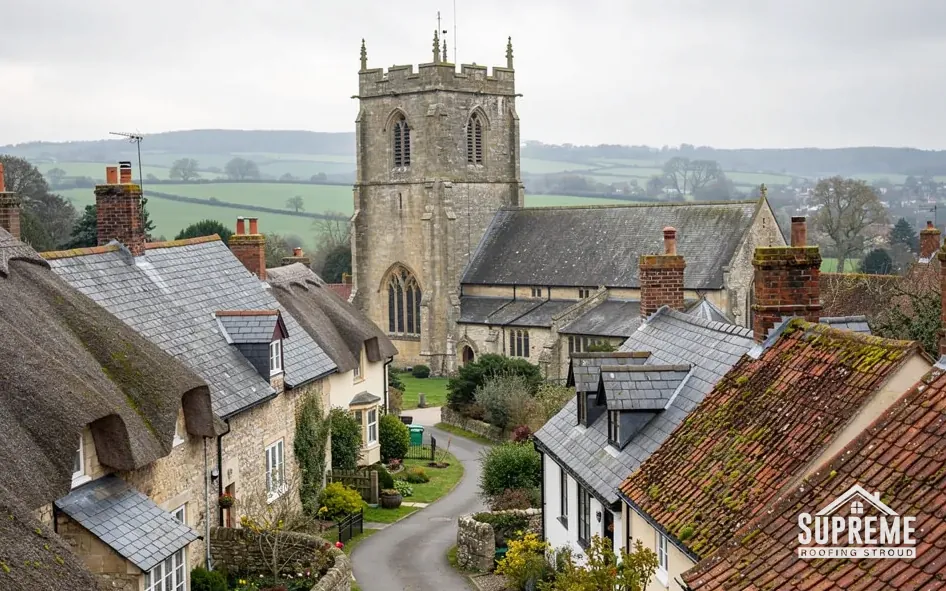
Roofers in Frampton Cotterell
Roof repairs and re-roofs in Frampton Cotterell, the River Frome village whose estates run from 1928 to 2011, with guide prices published ahead of any survey.
Frampton Cotterell at a glance
- Distance
- 24.1 road miles south-west of Stroud
- Council
- South Gloucestershire Council
- Population
- 7,188 in the 2021 parish count
- Setting
- River Frome valley north-east of Bristol
Frampton Cotterell's roofs: four estate eras, a hat factory and a church older than Domesday
Frampton Cotterell is a village on the River Frome about eight miles north-east of Bristol, and with 7,188 people at the 2021 count it is a large one. It is also an old one. A coal pit existed by 1301, presumably at Coalpit Heath, a name first recorded around 1680. Domesday in 1086 records a church that was not there before 1066, probably on the site of today's St Peter's. The hat factory on Park Lane is a notable Industrial Revolution landmark. Between the old landmarks and the newest closes lies a long span of building, and the roofs reflect it, from timber and masonry to felt, concrete and plastic components.
What stands out for a roofer is how clearly the later growth is dated. Beesmoor Road was built through farmland in 1928. Benson's Field became the Benson's Estate in the 1960s. Park Farm, about 200 homes, was built between 1996 and 2000, and Barratt Homes began an estate on Denny's Field in 2011. Each of those dates tells us something before we see a roof: the age of the covering if it has never been replaced, the building rules of the time, and which weak points to expect.
Frampton Cotterell is not among South Gloucestershire's 30 conservation areas. That makes the working rule simple. On an unlisted house, mending a roof or putting the same covering back proceeds without a planning step, and the Building Regulations apply where the work passes the usual thresholds. We start every Frampton Cotterell enquiry by asking when the house was built, because in a village this clearly layered, the date is the best single guide to what the roof needs.

Street of stone terraced houses with slate and clay tile roofs 
Row of stone cottages with mossy clay tile roofs along a quiet lane
Chapter 01
From Beesmoor Road to Denny's Field: reading a roof by its estate
Four dated developments give four different roof conversations.
Chapter 01In this chapter
The simplest way to understand a roof in Frampton Cotterell is to ask which part of the village it belongs to. The table below sets the dated developments against roughly how old an original covering would be today. These are approximate ages worked out from the dates, not measured lifespans, and any roof may have been replaced since.
In this chapter
Beesmoor Road was laid through farmland in 1928, so a house along it can be no older than that, and the earliest are the oldest of the group. If one still wears its first covering, that covering may be close to a hundred years old, and the usual conversation is about re-roofing, with the timber below checked as thoroughly as the surface. Fixings of that age have often rusted, and the view from inside the loft can tell us more than the slope outside. Benson's Estate homes from the 1960s are now around sixty. They sit in the zone where original coverings and underlays are often at or past the end of their typical lives, so the question is repair or replace. A tired covering with sound battens may only need patching and re-bedding. The same covering over soft battens and brittle felt is a re-roof in all but name, and patching it is money spent twice.
Houses at Park Farm, built from 1996 to 2000, are in mid-life. Their typical concern is the ridge and verge. Ridge tiles on a house built before 2014 may rely on mortar alone. The 2014 revision of BS 5534 ended that reliance, and ridge tiles are now fixed mechanically too. A re-bedded ridge or a dry-fix replacement today follows the newer rule; our ridge, verge and dry-fix page explains the difference. Typical dry ridge work costs £40 to £60 per metre (MyBuilder, updated 21 August 2026).
Barratt's Denny's Field estate, started in 2011, is the newest. Problems on a roof that young are rarely age-related, so if something fails it is worth checking whether the builder or a new-build warranty is still engaged before calling anyone to do paid work. We would rather you made that first call than paid us for work a warranty should cover.
Matching along a row
In every era the practical rule is the same, and it is borrowed from the street itself. Streets of similar houses read as one composition, so a re-roof is chosen to sit with its neighbours, and where a pair of semis shares a ridge, we agree the line of the junction with both owners before scaffold goes up.
In a village built in layers, the build date is the best single guide to the roof.
| Development | Built | Original covering, approx. age in 2026 |
|---|---|---|
| Beesmoor Road | Road laid 1928 | Up to about 98 years |
| Benson's Estate | 1960s | About 60 years |
| Park Farm, about 200 homes | 1996 to 2000 | 26 to 30 years |
| Denny's Field, Barratt Homes | From 2011 | About 15 years |
Chapter 02
The Park Lane hat factory and the roofs of working buildings
A mill-era landmark brings roof questions that a house never raises.
Chapter 02In this chapter
The hat factory on Park Lane is a notable Industrial Revolution landmark in Frampton Cotterell, and a coal pit existed in the area by 1301. Between them they show a village that worked long before it commuted. The roof of a working building, be it a workshop, an industrial unit or a converted factory, needs different thinking from a house roof. Spans are wider, falls are shallower, gutters are longer, and a leak can cost stock and production, not just a ceiling. Access also differs: working at height over a floor where people and machinery keep going means exclusion zones, edge protection and a clear plan for every ladder.
In this chapter
Commercial roofs come in a few main forms. A low-pitched sheeted roof depends on its laps, its fixings and its rooflight sealing. A flat roof depends on a single membrane, with its upstands, outlets and seams. A traditional pitched roof with slates or tiles, as is common on older converted buildings, depends on a sound timber structure and long valley gutters. Each fails in a different way, and a survey on a working building looks at access routes, edge protection, outlets and the drainage rate before it looks at a single slate.
Asbestos cement is a particular concern on older industrial and agricultural roofs and on 1960s garages. HSE sorts the removal of intact asbestos cement sheeting, done carefully, into non-licensed work; sheets that are well broken up fall into the notifiable class. The sheets' condition picks the route, so they are inspected before any method goes into the quote. Our commercial roofing page covers larger roofs, and our written quote comes after the survey visit.
Keeping a business running
A unit that cannot close needs its roof worked in sections, so one bay is open while the rest stays weathertight. We agree the order of bays, the hours for noisy work, and the point at which each section is covered again, and we put that programme in writing so the people running the unit can plan their own week around it. A leaking industrial roof is prioritised and covered first; the full repair waits until the structure has dried enough to open.
Chapter 03
Cul-de-sacs, shared drives and 24.1 miles from Stroud
On estate streets, parked cars and shared walls decide how scaffold goes up.
Chapter 03In this chapter
From our base in Stroud, the road to Frampton Cotterell runs 24.1 miles to the south-west and takes roughly 44 minutes. That is a long enough run that each visit is arranged with care, and we would rather spend the time on a thorough look than on a second trip. We usually ask for photographs and the build date first, then agree a survey time that suits you, and where several neighbours have asked at once, we offer to see them in a single trip.
In this chapter
The estates here were built as roads and closes, with pairs and rows of houses, shared drives and little room to spare. That shapes the job. Scaffold on a close is rarely free-standing: it has to stand on a drive or a pavement, away from parked cars, and often crosses a boundary where a neighbour's permission matters. Where two houses are joined, the wall and the ridge between them are common, so the work on that junction is done on both sides in the same visit. Where two neighbours need work, a shared scaffold is the sensible plan.
Deliveries are the next issue. A close with a single entrance and a turning head can take a flat-bed lorry only by prior arrangement, so we agree the day and the time, and ask neighbours to leave the bay clear. Tiles and slates come down in crates, never dropped, and the skip goes on the drive where possible. At the end of each day, loose debris is swept from the pavement so children walking home on a close are not stepping through offcuts. Our roof replacement page explains the order in which a re-roof is carried out, and why the stripped area is covered again before dusk each day.
Scaffold is a real part of the price. Typical UK guide figures run at about £1,125 (MyBuilder new roof cost guide, updated 21 August 2026) and £700 to £1,300 (Checkatrade, updated October 2026). On our written quote it appears alone, so you can see exactly how much of the total it represents.
St Peter's and the older village
Not everything in Frampton Cotterell is estate housing. The church recorded at Domesday probably stood on the site of today's St Peter's, so the older core of the village sits around buildings much older than any close. For those, the first question is always the listing, and we check it before we price a single slate. If a building proves to be listed, the council's listed building consent comes ahead of any quote for the covering.
Map showing Frampton Cotterell and the Stroud service radius, with nearby towns we also cover.
Near Frampton Cotterell
Roof work we do here
Benson's Estate, Park Farm and Denny's Field
My house is on the Benson's Estate and the roof is original. Is it due for replacement?
At around sixty years old, an original covering and its underlay are in the zone where replacement is often discussed. We look beneath the surface at the battens, fixings and felt before saying repair or replace, and we show you the photographs of what we found, and the written quote prices both routes.
Our Park Farm house has mortar-bedded ridge tiles. Do they need dry-fix?
Not by law, but a ridge re-done today follows BS 5534:2014, which does not rely on mortar alone. A dry-fix ridge meeting BS 8612 is one way to do that; a mechanically fixed bedded ridge is another. We price both.
My Denny's Field house is under fifteen years old and a roof tile has slipped. Who should I call?
Start with the builder or the warranty provider, since a roof that young may still sit within the original build terms. If they decline or the repair is outside the terms, we can inspect, photograph and quote the repair.
Can an old asbestos cement roof on a Frampton Cotterell garage be removed safely?
The HSE position is that whole sheets lifted carefully are non-licensed work, and badly broken ones are notifiable. We examine the sheets, then the quote sets out the method, where the waste goes and what replaces them.