

Roofers in Iron Acton
Roof repairs and re-roofs in Iron Acton, the conservation-area village beside the River Frome, where Acton Court and St James the Less set the standard for care.
Iron Acton at a glance
- Distance
- 23 road miles south-west of Stroud
- Council
- South Gloucestershire Council
- Conservation area
- Iron Acton, about 65.5 hectares
- Listed buildings
- 29, including two at Grade I
Iron Acton's roofs: Tudor Acton Court, a Grade I church and 65.5 hectares of designation
Iron Acton sits beside the River Frome, west of Yate. Its name records what the place once was: the "Iron" comes from iron mined near the village, and "Acton" is Old English for a farm or village with oak trees. There is still an oak wood beside the river, and the Frome gives the village its wooded setting.
The village is also a designated place. Iron Acton is one of South Gloucestershire's 30 conservation areas, and this one covers about 65.5 hectares and contains 29 listed buildings. Among them are Acton Court and the Church of St James the Less, both listed Grade I. Acton Court is the Tudor manor house on Latteridge Lane; Nicholas Poyntz gave it an east wing in the sixteenth century, and Henry VIII and Anne Boleyn visited in 1535. The parish church is Perpendicular Gothic and was restored in 1878 to 1879 under Sir T. G. Jackson, and a preaching cross put up by Sir Robert Poyntz still stands in the churchyard, protected as a scheduled monument.
For roof work, a designation like this changes the order of the questions. Before price or material, we want to know three things: the property's listing status, its position relative to the conservation boundary, and whether the work simply puts back what is already there. Repairs in kind are normally straightforward. A different covering or a new roof feature changes the view from the lane, and that goes to South Gloucestershire Council's planning team before we draw up a quote. It adds a step to the timetable, and we tell you at the first conversation.

Hillside terraces of stone houses with slate roofs and chimneys 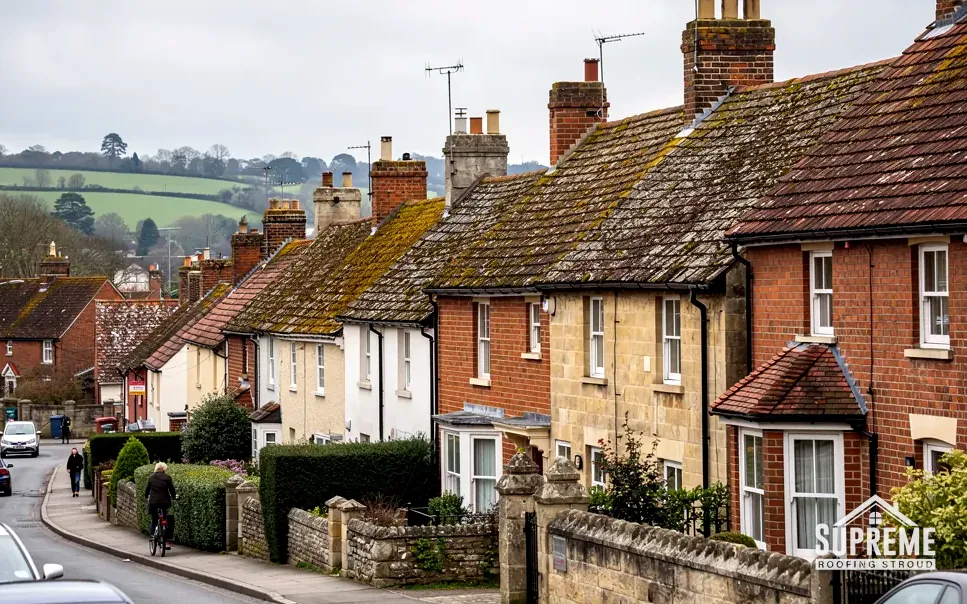
Sloping street of brick and stone terraced houses with mossy tiled roofs

Chapter 01
Acton Court and a village of Grade I neighbours
When the manor next door is a Tudor house, a roofer works to a higher standard of record.
Chapter 01In this chapter
Acton Court is the sort of building that makes a whole village careful. A Tudor manor house, extended in the sixteenth century by Nicholas Poyntz with an east wing, it is listed Grade I, and so is the parish church a short walk away. Grade I sits at the top of the listing system. Most of us will never be asked to put a ladder against a building of that rank, but the standard it sets spreads to every older house nearby, and the owners of those houses are right to ask how the work will be recorded.
In this chapter
The legal position for any listed building is the same. The 1990 Planning (Listed Buildings and Conservation Areas) Act requires authorisation for alterations that would affect a listed building's special interest, and making them without it is an offence under section 9. South Gloucestershire Council decides applications. On a Grade I building the sensible route runs through a conservation architect, who writes the specification; we price what that document asks for, and we do not substitute materials to save money. If the specification calls for a stone or clay covering to be re-laid, the quote allows for the labour for re-laying, apart from any new units needed to make up the shortfall.
An extension is where a Tudor house shows its age. The east wing Nicholas Poyntz added meets the older range at a junction, and junctions of that kind carry valleys, abutment flashings and often a change of pitch or of height. Those are the points we inspect first on any building with a later wing: lead that has split at a fold, a gutter that carries two roofs' worth of water in one run, and mortar that has parted from the stone. We photograph those details so that the repair can be drawn and approved, then built to match.
Smaller listed houses in the village
Most listed buildings in Iron Acton are not manor houses. Twenty-nine listed buildings inside the area means not every one is a manor house, and each listed building has the same legal protection inside and out, whatever its size. A repair that looks minor from the road can still be a change to the fabric, so we ask for the listing details at the start. Our page on listed roof repairs sets out what is usually acceptable, and the roof repairs hub gives typical prices before anyone visits.
Where the manor is Grade I, every neighbour's roof is read more carefully.
- 1535year Henry VIII and Anne Boleyn visited Acton Court
- 29listed buildings inside the Iron Acton Conservation Area
- 65.5hectares covered by the conservation area
Chapter 02
Inside the Iron Acton boundary: what a conservation area changes
Unlisted houses are covered by the designation too, and it shapes what may be done to a roof.
Chapter 02In this chapter
The Iron Acton Conservation Area is a good deal larger than the sum of its listed buildings. It takes in lanes, gardens, boundary walls and houses that carry no listing of their own, and the council's interest extends to all of it. The aim is to protect the character of the village as a whole, so roofs seen from the street count for as much as the facades beneath them.
In this chapter
For an unlisted house inside the boundary, a repair in the same material is normally fine and planning permission seldom comes into it. Putting back a slate, replacing a failed ridge or re-flashing a stack are ordinary jobs, and each can be priced from the survey photographs with little room for surprises. Trouble starts when the appearance changes. A different colour or texture of tile, a new type of ridge, a new roof light or a dormer all fall to the planning team. Dormers in particular are not permitted development in a conservation area, so a loft conversion that needs one will need a full application. For roof windows, the rules are different and are set out in our guide to roof window planning.
Some conservation areas also carry Article 4 directions, which withdraw certain permitted development rights. Whether one covers a given Iron Acton roof is not something we can tell from a desk. Rather than guess, we put the address to the council's planning team and pass on their reply before the quote is finalised.
Chimneys and rooflines
The skyline of an old village is made of its chimneys. A stack that leans, loses pointing or sheds a pot is a repair that has to be done in matching brick or stone and the right mortar, and our chimney repairs page explains how a stack is judged before it is taken down or repointed. Pulling a stack down altogether changes the roofline and is the kind of change the conservation team will want to see first.
The church in use
St James the Less is restored work, put in hand in 1878 to 1879 under Sir T. G. Jackson. If it is in use for worship, the church is outside the listed building system and goes through the diocese for a faculty. Roof work there is the diocese's decision, with the parish, not ours.
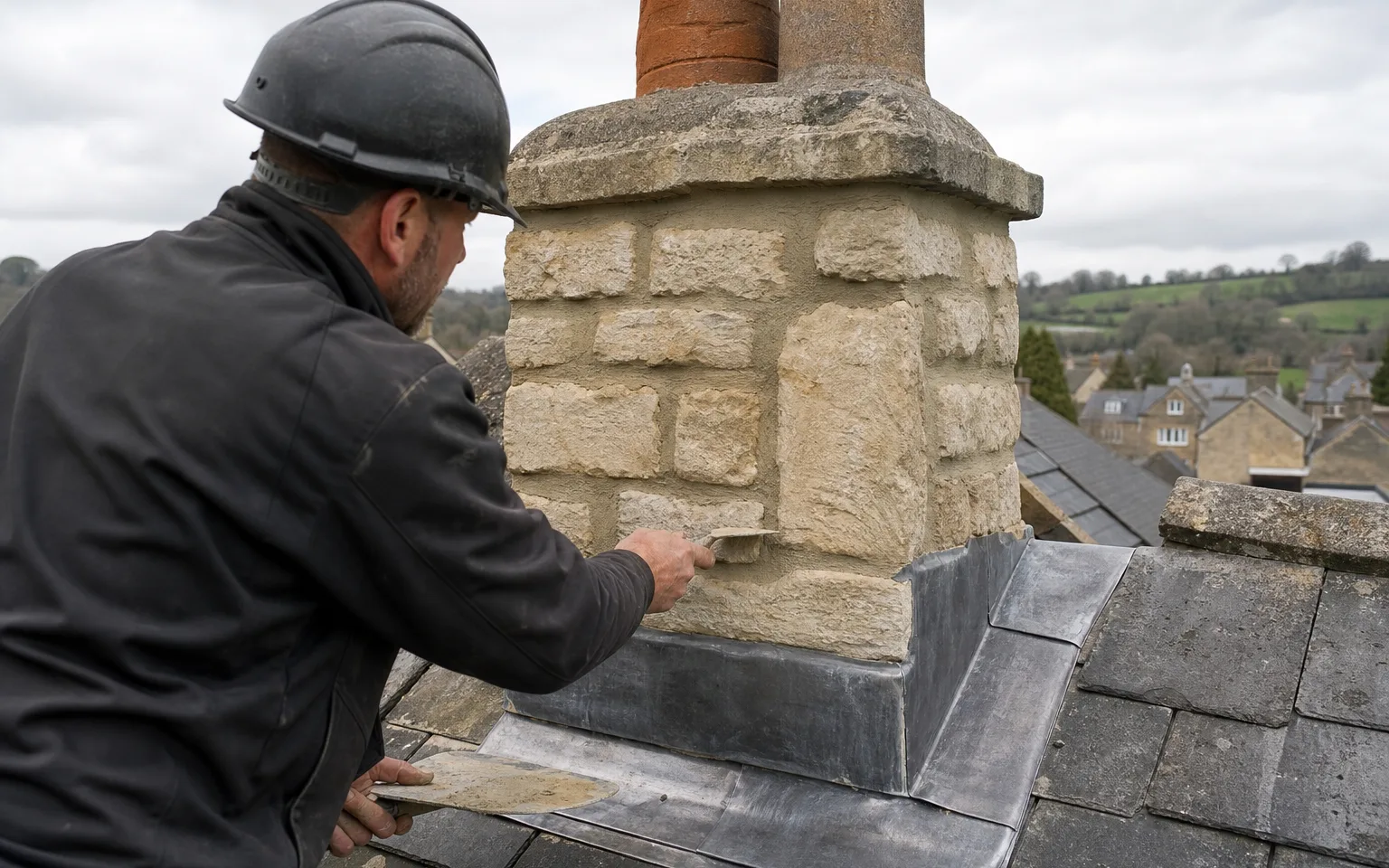
A conservation area is judged from the lane, so the roof you see from the road is the roof they look at.
| Your building | First call |
|---|---|
| Listed house or outbuilding | South Gloucestershire Council, for listed building consent |
| Unlisted house in the conservation area | The council's planning team, for any change of appearance |
| Church in use for worship | The diocese, for a faculty |
| Unlisted house outside the boundary | Building control, if the work passes the thresholds |
Chapter 03
Oak woods by the Frome: leaves, shade and old iron
A village named for oaks and iron keeps its roofs under trees and its nails under watch.
Chapter 03In this chapter
Iron Acton lies 23 road miles south-west of Stroud, roughly 37 minutes by car, and the first thing the name tells a roofer is that there are trees. Acton is Old English for a farm or village with oak trees, and the oak wood beside the River Frome is still there. Roofs under and beside mature trees live differently from those in open ground. Leaf fall settles in valleys and gutters, shade holds damp on the covering for longer, and moss follows. None of that is a defect in the house. It is a maintenance pattern, and the answer is regular clearing rather than a panic once water is coming through. Leaves that sit in a valley gutter rot into a paste that blocks the outlet, so the first heavy rain after a dry spell finds the weak point.
In this chapter
Overhanging branches are the other half. A limb that brushes a slope will scuff and loosen the covering in a gale, and a falling branch can crack tiles or slates in a single strike. We note any branch that touches a roof and suggest that the tree owner consults the council before work is carried out, because trees in a conservation area are controlled. Our guttering, soffits and fascias page covers clearing and replacing runs that fill every autumn.
The other half of the name is iron. The metal was mined near the village once, and ironmongery still matters on a roof. Ordinary steel nails rust, then swell and split the slate or timber they were meant to hold. On repairs we use fixings that will outlast the covering they hold, so that a new slate is not hung on a nail that will fail before the next decade is out. On an old roof, you often find nail sickness, where slates have slipped because the nail that held them has rotted through, well before the slate itself has worn out.
Planning the visit
Because lanes in a village like this are narrow, we agree where a lorry can unload and where scaffold can stand before the date is fixed. Access is worked out in advance rather than improvised. The written quote then covers scaffold, stripping, new materials, labour and clearing up, so a landlord with several properties here can compare like with like.
Map showing Iron Acton and the Stroud service radius, with nearby towns we also cover.
Near Iron Acton
Roof work we do here
Acton Court and 29 listed buildings in Iron Acton
My Iron Acton cottage is unlisted but inside the conservation area. What may I alter on the roof?
A repair in the same material is normally fine. A different covering, a new roof window or a dormer is a change of appearance and goes to South Gloucestershire Council's planning team, and dormers are not permitted development in a conservation area.
Does a Grade I building in Iron Acton need a different kind of roofer?
It needs a conservation architect to write the specification and a contractor who will price and follow it. Listed building consent covers the works, and we do not change materials or methods on our own.
Can overhanging oaks near my Iron Acton roof be trimmed before the work?
Trees in a conservation area are controlled, so the tree owner should ask the council before any cutting. We note the branches that touch the roof and flag them in the survey.
Why do you mention nails when quoting a repair on an old Iron Acton roof?
Rusted nails are a common reason slates slip on an old roof. A repair with a new slate on a failing nail would not last, so we check the fixings around the repair and price replacements where they are needed.