

Roofers in Aust
A small village on the Severn estuary shore, beside the Severn Bridge and 28.2 road miles out from Stroud, where the Grade II* church keeps its timber roofs and the riverbank fields flood at times.
Aust at a glance
- Distance
- 28.2 road miles west-south-west of Stroud
- Council
- South Gloucestershire Council
- Setting
- Severn estuary shore by the Severn Bridge
- Listed
- Parish church (St John), Grade II*
Aust: a medieval church, a lost ferry and a shore that floods
Aust lies on the eastern side of the Severn estuary, near the eastern end of the Severn Bridge. It is a small village, with 513 people at the 2021 count. The place is old: it is recorded as Austan in 793 or 794, when it was returned to the Church of Worcester, and for centuries a ferry ran from here across to Beachley.
The land beside the river shapes any building job. The riverbank farmland floods at times because the Severn has a high tidal range, which makes this a low, open shore rather than a hillside of steps and terraces. The problems are different from the ones we plan for in the Five Valleys: less about carrying slates up a flight of stairs, more about where a lorry can stand and how firm the ground is under a scaffold base.
The best-documented building is the parish church of St John, listed Grade II*. It is Perpendicular Gothic for the most part, has timber roofs and a stone font of the 15th century, and was restored in 1866 by Pope and Bindon. That tells us what kind of place this is: a settlement with buildings from several centuries, where we do not assume what a roof is made of or how old it is until we have climbed up and looked.
Aust sits in South Gloucestershire, so planning questions go to South Gloucestershire Council, not to Stroud District Council. We point you to the right team and if a roof is listed, or the work might change how it looks, that question is put on the table at the survey, ahead of any price.

Stone terraced houses with slate roofs and chimneys stepping up a hill 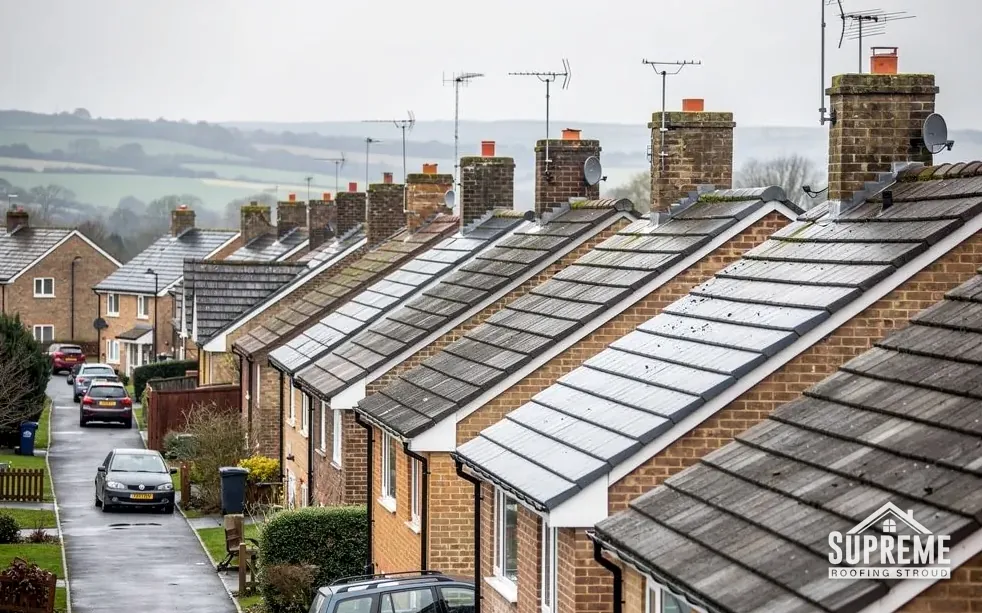
Terraced houses on a hillside street with tiled roofs and brick chimneys
Chapter 01
Estuary shore, tidal range and the ground under a scaffold
On low ground by the river, the work starts with where the lorry stops.
Chapter 01In this chapter
A roof on a hillside is a problem of height and steps. A roof on the Severn shore is more often a problem of what lies underfoot. Aust's riverbank farmland floods at times because of the river's high tidal range, and we treat that as a planning fact rather than a reason for alarm. A house or farm building on low ground may have soft approaches in a wet spell, and a delivery of tiles, battens or lead needs somewhere firm to be unloaded and stored.
In this chapter
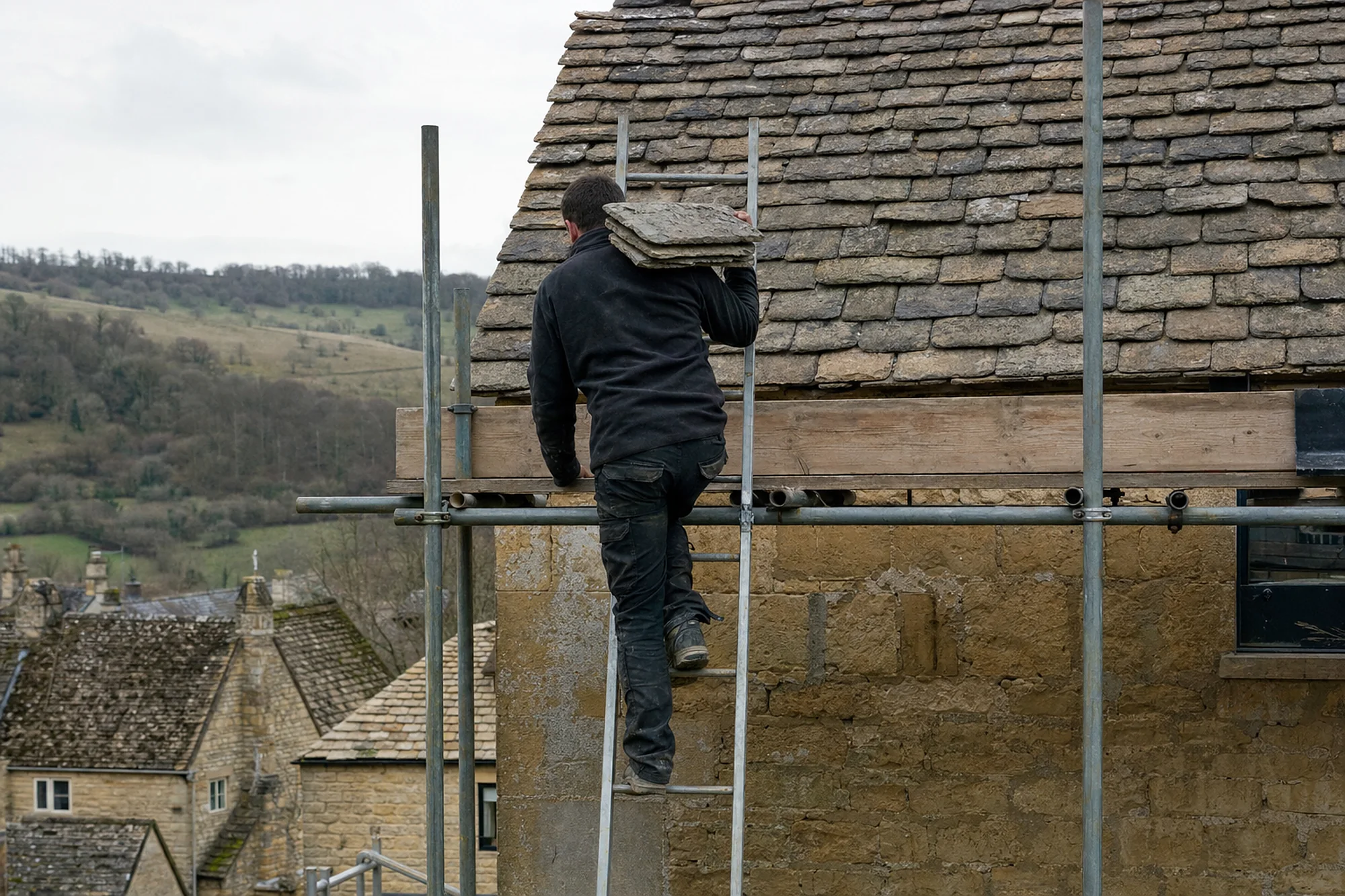
On the survey visit we follow the way in from the road, note the surface, look at where the scaffold will stand and where a skip or waste bags can sit, and write the plan down. Scaffold boards bear on ground through base plates, and on soft or sloping ground those plates may need timber sole boards under them. That is allowed for in the written quote, not a surprise when the scaffolders arrive.
Where the water goes
Low ground also changes the question of drainage. A roof sheds a great deal of water in a heavy shower, and the gutters and downpipes carry all of it to a few points. Where the soil beside a wall is already sodden, an overflowing gutter keeps the lower courses damp for longer. So we look at where each downpipe discharges, whether the outlet is clear, and whether the gutter run slopes towards its outlet, since manufacturers typically recommend a fall somewhere between about 1:600 and 1:350 depending on the system.
Where gutters, fascias and soffits are tired, they are often replaced together because the same scaffold serves all three. Our guttering, soffits and fascias page sets out typical national costs, sourced and dated, so you can see the range before we visit.
What the survey records
We photograph the ridge (the high point where the two slopes meet), the verge (the edge at a gable end), the valleys where two slopes meet and the flashings, the strips of lead or other metal that seal the joins against chimneys and walls. You receive those photographs with the written quote, each defect shown beside the work that deals with it. Nothing is left vague, and a fault that can be repaired is quoted as a repair, not as a reason to replace the whole covering.
If the roof is a farm building or an outbuilding rather than a house, the same method applies. Large sheet roofs, older tiled ranges and flat-roofed lean-tos each get their own set of notes, because they fail in different places. We say plainly which parts are sound and which are not.
By the river, the roof job begins with the ground.
Chapter 02
The Austan ferry, the Severn Bridge and the long road from Stroud
Aust is 28.2 road miles away, so a job here is planned as a single trip.
Chapter 02In this chapter
For a long time the way across the water here was the Aust ferry to Beachley. A ferry crossed from ancient times, the last service was revived in 1926, and it closed when the Severn Bridge opened in September 1966. The bridge changed the village from a landing place into a place people drive past, and it is still the landmark you see from the shore.
In this chapter
It also helps explain why we treat Aust differently from a job in Stroud itself. The village is 28.2 road miles from our base, west-south-west of Stroud, and the drive takes about 36 minutes. That is inside the 30 road miles we cover, but it is far enough that we plan each visit with care. A survey is arranged so that we see everything in one go, including the loft, the roof from the outside and the route in for materials, instead of returning later for something we overlooked.
Planning the work as one trip
The same thinking applies once the work is agreed. Materials are ordered to the survey measurements, delivery is arranged for a day the scaffold is up, and the sequence of work is set so no section of roof is left uncovered at night. On a job this far from base we want the weather window, the delivery and the crew to line up, because a wasted day costs everyone. If a repair is small, we say whether it can be combined with another nearby job, or whether it is better done when other work brings us to the area.
- 28.2road miles from Stroud to Aust
- 1966year the Severn Bridge opened and the Aust ferry to Beachley closed
- 793approximate year the village is first recorded, as Austan (793 or 794)
Pitched, flat and in between
Most domestic roofs fall into two families. A pitched roof (one with sloping sides) is covered in slates or tiles laid in overlapping courses over battens and underlay, the waterproof sheet beneath the covering. A flat roof is covered in a continuous membrane such as EPDM, a synthetic rubber sheet, or GRP, glass-reinforced plastic. Our pitched roofing page covers slate and tile roofs in depth, and the typical lifespans of each material are given there with their sources.
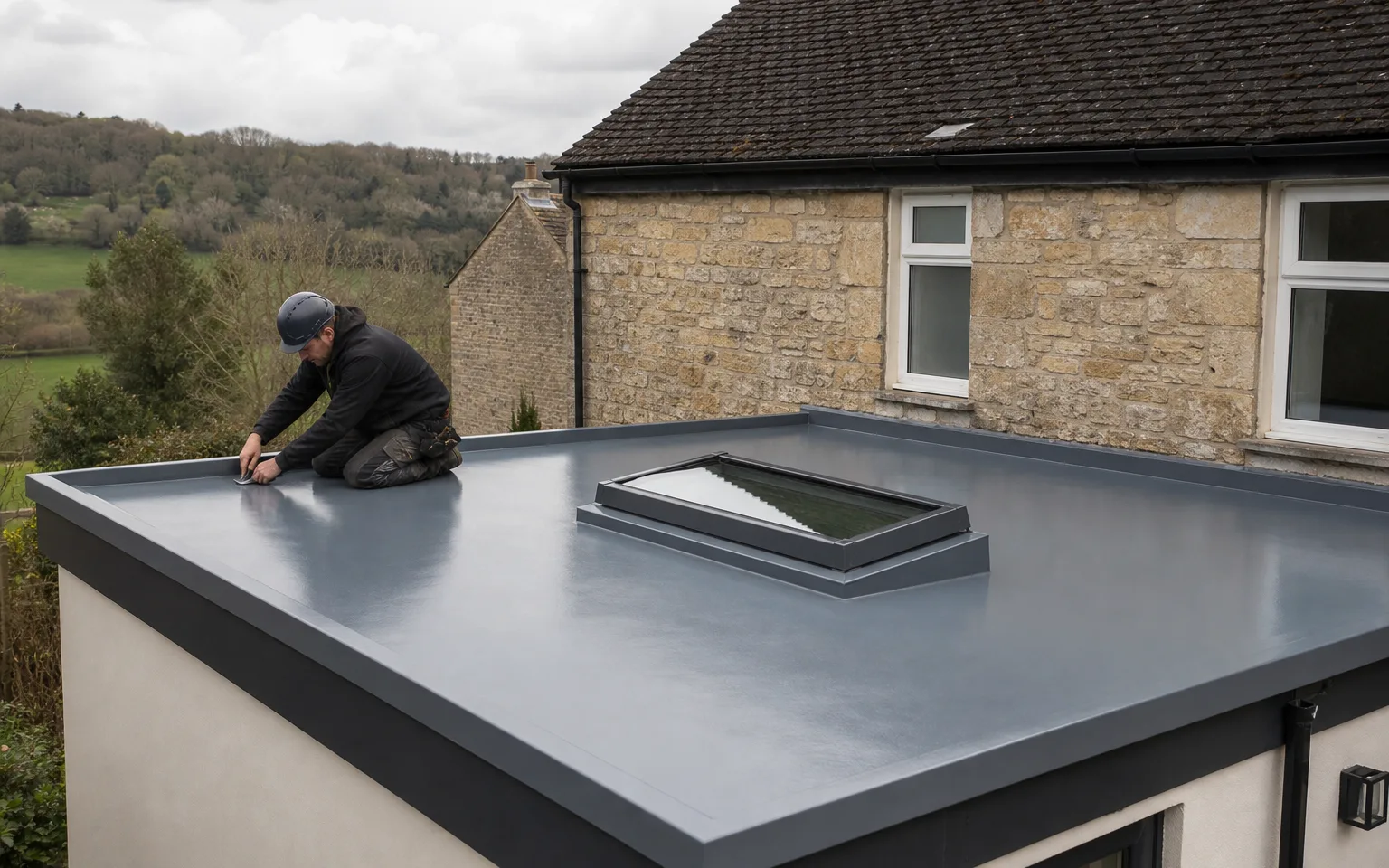
When a repair is not enough, roof replacement is the next step, and the quote covers scaffold, stripping, materials, labour, waste clearance and making good. Because Aust is not on the doorstep, you will see the travelling and delivery plan in the paperwork alongside those lines, so nothing about the distance is left to be argued about later.
For smaller jobs, a message with a few photographs often tells us enough to say what is likely to be involved before anyone makes the drive. WhatsApp or the enquiry form both work, and we reply with what the pictures show and what still needs checking on site.
Chapter 03
St John's timber roofs and the rules for old, listed buildings at Aust
A Grade II* church is a reminder that age brings protection, and rules about who may decide.
Chapter 03In this chapter
The church of St John is the village's listed landmark. It is Perpendicular Gothic for the most part, with timber roofs and a stone font of the 15th century, and it was restored in 1866 by Pope and Bindon. Historic England lists the parish church at Grade II*. It makes a useful marker for how old buildings are treated, and nothing here is advice about the church itself.
In this chapter
St John's is in use, so the authority for its roof work is a faculty from the diocese. The council does not decide it. A disused church or a converted chapel has no such exemption, and for those the council is the decision-maker. Anyone responsible for an old building of that kind should find out which route applies.
Listed houses and outbuildings
A house, barn or cottage in the village could also be listed, and we cannot tell from the roadside. Legal protection for a listed building covers all of it, front and back, outside and in. Alterations that touch its special character need consent from the council, which can reach as far as a different roof covering or a different way of finishing the edges. Replacing like with like is not the same as changing, yet it is the council that decides where the line falls. We would rather ask South Gloucestershire Council's planning team first and wait for the reply than guess.
Timber is the part we look at first
An old roof frame is only as good as its timbers. When we get into a loft, we check the rafters, the horizontal purlins that support them and the wall plates bedded on the masonry, looking for staining, soft wood and insect damage. Water can be rotting timber long before a ceiling shows any stain. If a frame is sound, a covering can be renewed without touching it. If it is not, the survey report says exactly where, with photographs, and the repair is quoted.
Protected species and the quote
Old stone and timber buildings can hold bats and nesting birds, which are protected, so we check before work begins. If a roof is in a conservation area or listed, we check that before the quote is written, so the price reflects the real conditions. Our work carries a 10-year workmanship guarantee, in writing.
If your roof is in Aust and you are unsure whether it is listed, send us the address or a photograph. We will check the register, tell you what we find and what it would mean for the work, and then put the survey in the diary.
Map showing Aust and the Stroud service radius, with nearby towns we also cover.
Near Aust
Roof work we do here
Timber church roofs and the estuary shore at Aust
Does a roof close to the Severn estuary need different materials from one in the hills?
Not as a rule. The covering is chosen for the building and the pitch, and a lead flashing or a tile is the same here as anywhere. What changes on the shore is the ground, the delivery and the drainage, and we plan those at the survey.
Does the work I need in Aust go through Stroud District Council?
No. Aust is in South Gloucestershire, so planning questions go to South Gloucestershire Council. We explain what to ask, and we wait for their answer on any roof that may be listed.
Can I get a view on my roof from photographs before anyone visits?
Yes. Photographs of the roof taken from the ground will do, and of the loft too if you can reach it safely. We say what we can see and what must be checked on site. The firm figure follows the survey.
If my cottage is listed, does a like-for-like repair still need consent?
Possibly. Listing covers the whole building, and a repair that changes the appearance of the roof can need consent. Check with South Gloucestershire Council before work starts.