
Roofers in Olveston
Roof repairs, flat roofs and re-roofs in Olveston, the Severn-edge village with a Grade II* church and manor, drained marsh at its back and a commuter past.
Olveston at a glance
- Distance
- 23.3 road miles south-west of Stroud
- Council
- South Gloucestershire Council
- Conservation area
- Olveston, designated 30 July 1975
- Listed
- Church of St Mary and Olveston Court, both Grade II*
Olveston's roofs: a struck church tower, drained marsh and a village that became a commuter parish
Olveston lies on the edge of the Severn levels. Salt marshes once covered almost half the parish, and they were drained and a sea wall built against flooding from the Severn estuary. The parish stayed mainly agricultural until the Second World War. Then the growth of the aircraft industry at Patchway and Filton turned it into a commuter area, and the housing followed.
Two buildings anchor the village's history. St Mary the Virgin was built around 1170 and rebuilt in 1370; lightning in 1605 destroyed the bells, the spire and much of the chancel, and the tower was rebuilt the following year. Olveston Court holds the remains of the medieval fortified manor of the Denys family. Both the church and the Court are listed Grade II*, so any alteration that affects their character needs consent: a diocesan faculty for the church while it is in worship use, and listed building consent for the Court. Quakerism arrived in Olveston in 1654, and the Quaker burial ground at Lower Hazel dates from 1656.
Olveston also has a conservation area, designated on 30 July 1975, and neighbouring Tockington has its own. Put those layers together and a roofer here meets three kinds of job. The first is protected buildings, where consent comes first. The second is ordinary older houses, where like for like is the rule. The third is later houses whose roofs are reaching the age of a first replacement. We work out which kind you have before talking about price, because the answer decides who must be asked, how long the lead time is and what the specification looks like.
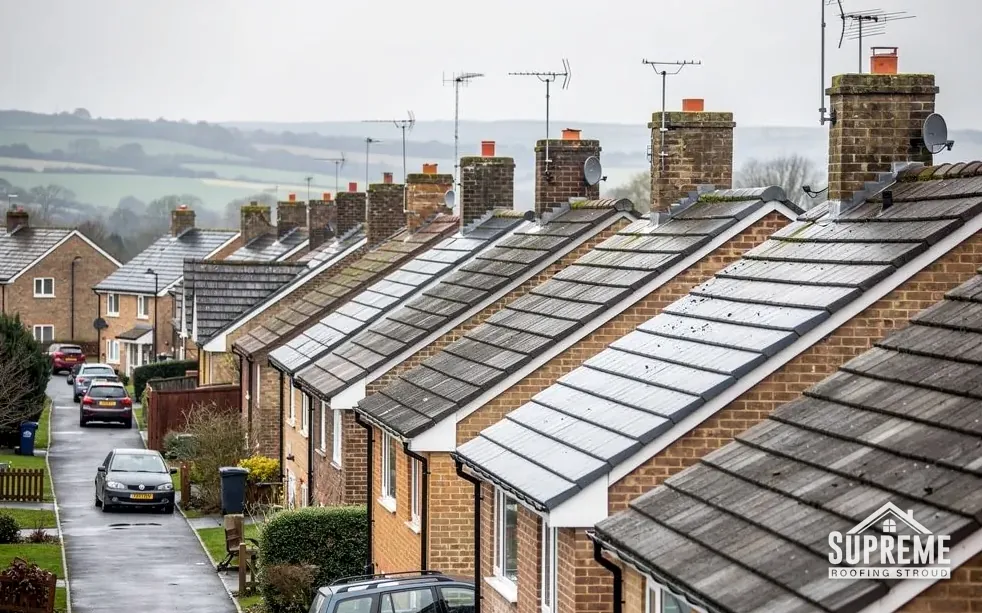
Terraced houses on a hillside street with tiled roofs and brick chimneys 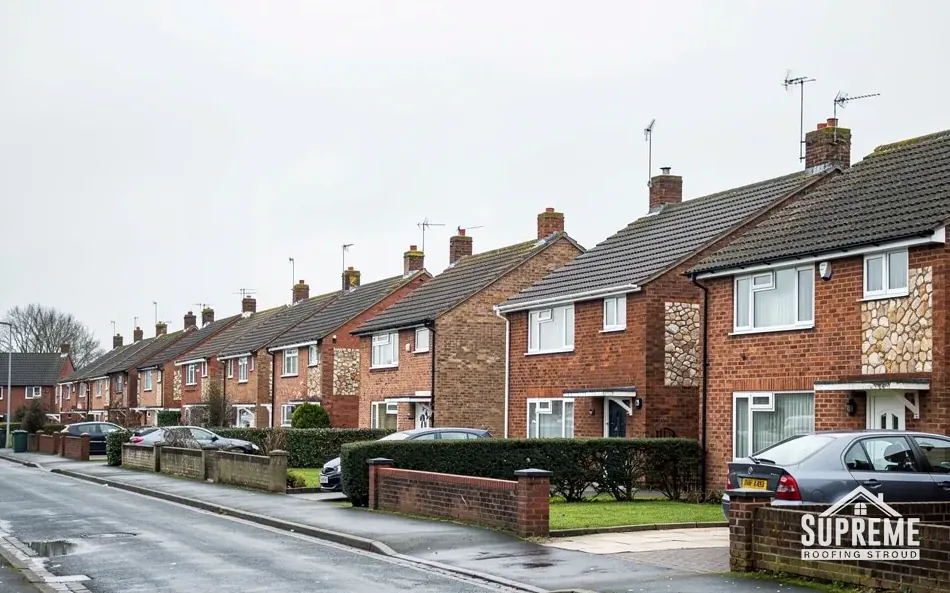
Street of red brick terraced and semi-detached houses with parked cars
Chapter 01
Lightning in 1605 and the roof of St Mary's tower
A church that lost its spire to a storm is a reminder of what the highest roof on the skyline takes.
Chapter 01In this chapter
Olveston's parish church, St Mary the Virgin, dates from around 1170 and was rebuilt in 1370. In 1605 lightning destroyed the bells, the spire and much of the chancel, and the tower was rebuilt the next year. A strike on that scale is rare, but the principle is ordinary: lightning looks for the highest point, and a tall tower or a prominent chimney is the likeliest path to earth. The damage a roofer sees after a smaller strike is more modest. Displaced slates and tiles, scorched or split lead, a cracked chimney pot, and sometimes cracked masonry underneath.
In this chapter
After a strike, or after any severe storm, the order of work matters. First the roof is made safe, which means tarpaulins, battens and a tied-down sheet over any opening. Then the damage is photographed section by section, because that evidence supports a claim on your own buildings policy. We write down what we found, where, and what the temporary measures were, so the insurer's adjuster reads the same account we do, and no part of the story rests on memory. Only then is the lasting repair planned. A strike can also affect parts you cannot see from below, such as rafter ends and the fixings that hold ridge tiles, so we check the whole slope, not just the visible gap.
The legal route for a protected building is set by its status. St Mary's and Olveston Court are both listed Grade II*. As long as St Mary's is a working church, a faculty from the diocese covers its roof. Olveston Court is different: listed building consent from South Gloucestershire Council is needed for alterations that would affect its character, and the same applies to any listed house in the village. Where lead has to be replaced, the codes matter. Leadworx calls Code 4 the standard for general flashing, while Royston lists Code 5 and above for valley gutters and similar hard-working details. Our lead roofing page sets out where each code belongs.
Rebuilt towers and old joints
The tower rebuilt in 1606 has now stood for centuries, and the lesson for any old building is that rebuilding leaves seams. A new roof meeting an old wall, or a later structure meeting an earlier one, makes a joint that moves in a different way from the surrounding masonry. Those are where we check for open flashings and failed pointing first, working from a ladder or a tower that does not lean on the old stonework.
After a strike or a storm, make the roof safe, record it, and only then plan the repair.
- 1170approximate year St Mary the Virgin was first built
- 1370year the church was rebuilt
- 1605year lightning destroyed the bells, spire and much of the chancel
Chapter 02
Drained marsh and a sea wall: where Olveston's rainwater goes
Land that needed draining teaches the same lesson as a flat roof: water must have somewhere to fall.
Chapter 02In this chapter
Olveston's marshland was drained and walled against the Severn, and the parish still sits at the edge of the levels. Almost half the parish was salt marsh once. That history is a useful way into one of the commonest roof questions we are asked: where does the water go? Every roof collects rain and every roof depends on a path off the building. When that path fails, water goes where it should not, down a wall, into a soffit or across a flat surface that cannot clear it.
In this chapter
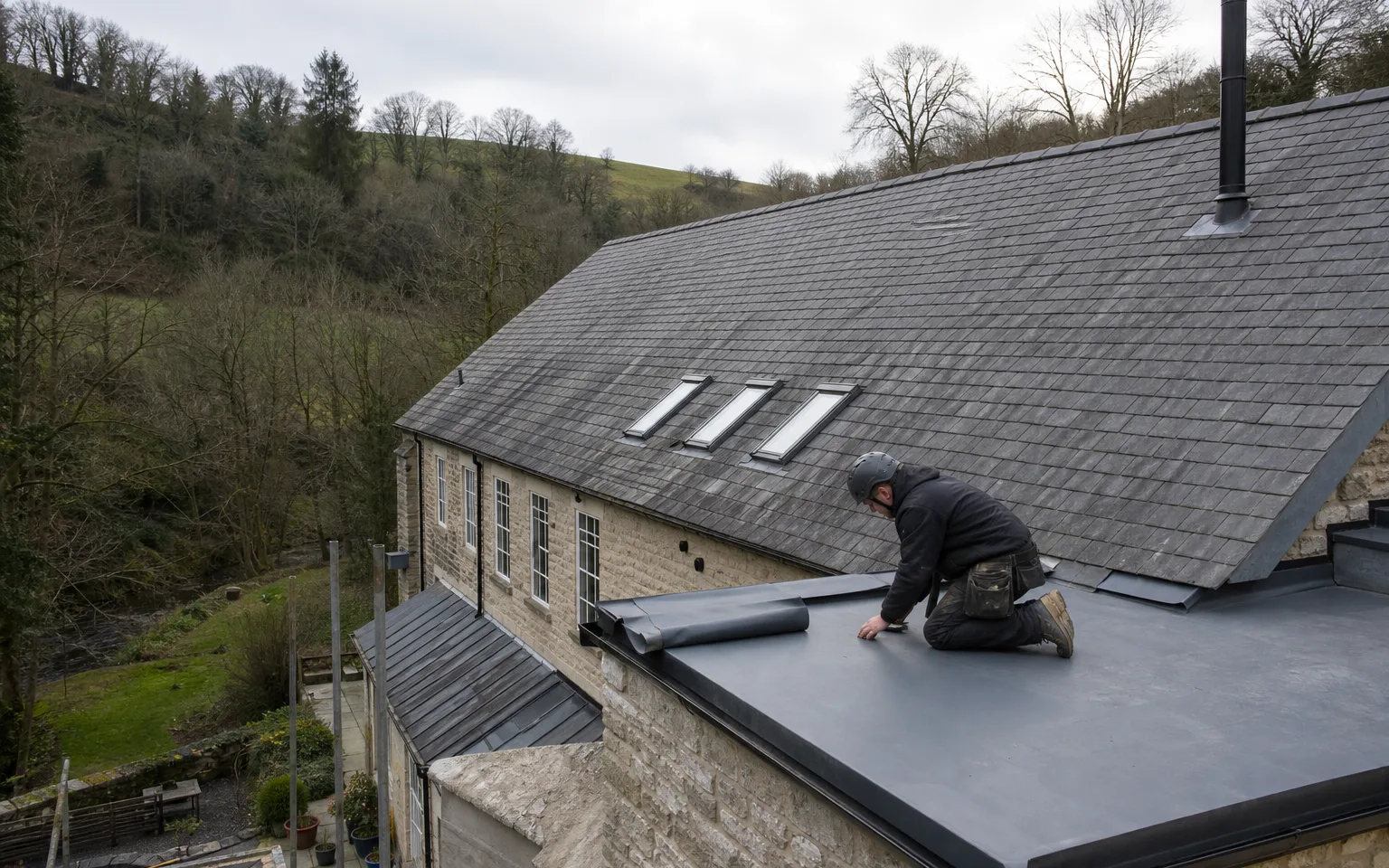
Flat roofs are where the lesson shows most. Extensions, porches and garage roofs are often flat, and a flat roof has to drain by design. Under BS 6229 the drawing shows 1:40 so that, after tolerances and deflection take their share, the finished fall is still no flatter than 1:80 (IKO and Rockwool). A deck built without enough slope, or one that has dipped between joists, holds a pond, and a pond is where felt blisters, seams open and EPDM sheets wrinkle under standing water. Typical prices run at £90 to £130 per m² for EPDM and £95 to £150 per m² for GRP (MyBuilder flat roof cost guide, updated 21 August 2026).
On pitched roofs the same logic applies at the eaves. A gutter laid to a slight fall carries water to the downpipe; one that has sagged between brackets holds it. A downpipe that ends at a blocked drain backs up and spills at the first joint. Where a garden is level, surface water has fewer places to run away. We check where each downpipe lands before we look at the gutter above it. Our flat roofing page lists the coverings and their typical lives.
The sea wall and storm damage
A wall against estuary flooding is a different thing from a roof, but the point carries over: defences are only as good as their upkeep. A roof's defence is its covering, flashings and gutters, and storm damage is nearly always a failure of something already worn. Leaks and storm damage get priority from us; the roof is made safe first and the lasting repair follows.
Myth: A flat roof is meant to be level.
Fact: A flat roof is designed with a fall so that standing water can clear; BS 6229 points to a design fall of 1:40 and a finished fall of at least 1:80.
Chapter 03
From farmland to commuter homes: the post-war roofs reaching their first replacement
Housing that followed the Patchway and Filton aircraft works is now old enough to need real decisions.
Chapter 03In this chapter
Olveston was mainly agricultural until the Second World War. After it, the growth of the aircraft industry at Patchway and Filton turned the parish into a commuter area, and the new houses that came with that change are the ones now facing the question every older roof reaches: repair, or replace? Any covering laid in the decades after the war is by now many decades old. Typical lives vary by material and source. MyBuilder gives concrete tiles 30 to 50 years, while Marley says around 60 years and adds that this is no guarantee. The truth for any single roof depends on exposure, workmanship and care.
In this chapter
The survey answers the question. We lift an edge to see the underlay, battens and nails as well as the surface, because a covering can look tired while the structure below is sound, or look fine while the felt beneath has perished. A repair makes sense when the failures are scattered and the timber behind them is sound; a few slipped units, a split ridge, a flashing that has lifted. A replacement makes sense when the underlay and battens have gone, because patching a covering over failed timber only buys a short delay. The written quote prices both routes, so you can compare them, and the photographs show you the underlay and battens we are describing rather than asking you to take our word.
Many commuter-era houses have also grown, with loft rooms and rear extensions. On a two-storey house, a loft room needs a protected stair for escape, and an escape route through a roof window works only within 4.5 metres of the ground. Part L sets energy limits for new roof windows, so choose the product before the date is fixed. Fitting and typical costs are on our skylights page. The village conservation area, designated 30 July 1975, means the planning team should hear about any visible change.
Replacing a heavier covering
Where a re-roof changes the covering, weight matters. A new covering that is 15 per cent or more heavier needs Building Regulations approval and a structural check, which is one more reason to match what is there.
Decide between repair and replacement on the evidence under the covering.
- Standard survey£150 to £250
- Drone survey£200 to £400
- Thermal survey£300 to £500
Map showing Olveston and the Stroud service radius, with nearby towns we also cover.
Near Olveston
Roof work we do here
Olveston Court, the struck tower and drained marsh
Both the church and Olveston Court are Grade II*. What does that mean for a listed house nearby?
A listed house in the village has the same protection under the 1990 Act: South Gloucestershire Council must grant listed building consent before changes touching its character. Like-for-like repairs are easier, but we check the status first and work to what the council approves.
My flat roof near the Olveston fields holds a pond after rain. Is that a failure?
It points to inadequate fall. A flat roof is designed with a fall of 1:40, finishing no flatter than 1:80, so water clears. Standing water shortens the life of felt, EPDM and GRP, and we test the deck for sag before recommending a patch or a new covering, since a patch laid over a sunken deck only moves the pond.
Does lightning damage to a roof show up straight away?
Not always. Displaced slates and split lead can be visible, while loosened ridge fixings and cracked masonry may only show later. After a strike we check the whole slope and photograph it, which also supports a buildings insurance claim.
My house was built when Olveston became a commuter area. Is the roof due for replacement?
It depends on the evidence under the covering. Our survey covers what lies under the covering, and the written quote prices a repair and a replacement side by side so you can choose.