
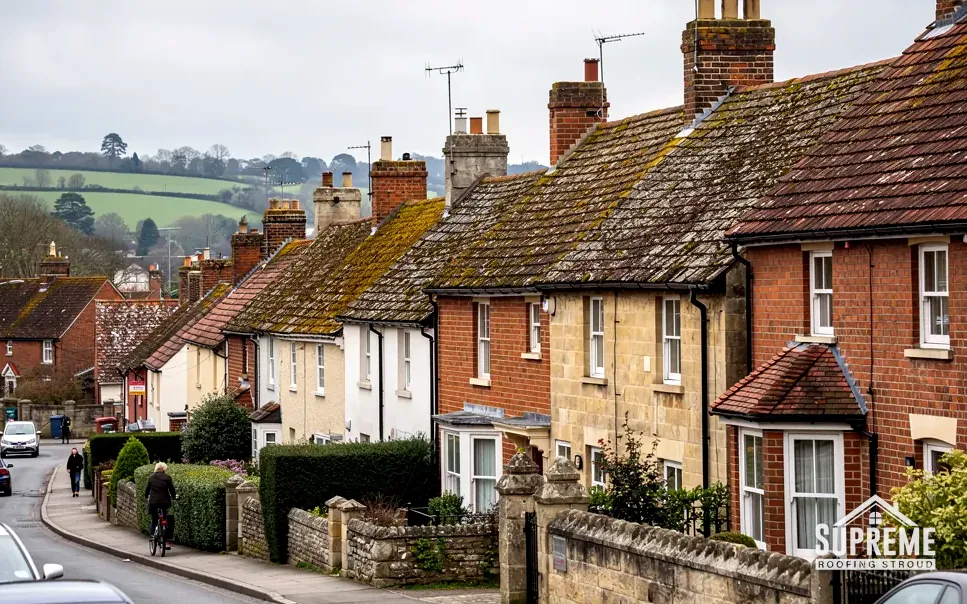
Roofers in Bradley Stoke
Roof repairs and replacements in Bradley Stoke, a town laid out on farmland from 1987, where the roofs are now into their fourth decade.
Bradley Stoke at a glance
- Distance
- 26 road miles south-west of Stroud
- Council
- South Gloucestershire Council
- Conservation area
- No record near the town centre
- Setting
- Former farmland on Bristol's north fringe
Bradley Stoke's roofs: a new town laid out on farmland from 1987
Bradley Stoke lies to the south-west of Stroud (26 road miles), on former farmland north of Stoke Gifford. Planning began in the late 1970s and building started in 1987, so almost every roof in the town dates from 1987 or later. Wikipedia describes it as Europe's largest new town built with private investment, led by private housebuilders. The town council took charge on 1 April 1992.
That history decides what a roofer finds here. Most of what a roofer meets here is estate housing from a single building programme. The housing has come in a single long run since the late 1980s, which means the earliest roofs are approaching forty years old, while the latest are young. About 40% of the town's housing is detached, according to the same source, so a large share of the roofs have four open elevations instead of a party wall on one or both sides.
The water is part of the picture. Stoke Brook runs through the town, and the Three Brooks nature reserve covers about 44 hectares, including a man-made lake. Green space and housing sit side by side, and gutters, soffits and the eaves detail feel that.
The national register of planning data lists no conservation area near the centre, so the questions here concern condition, fixings and Building Regulations. A younger roof asks for a different kind of attention from a very old one, and that is what the rest of this page covers.
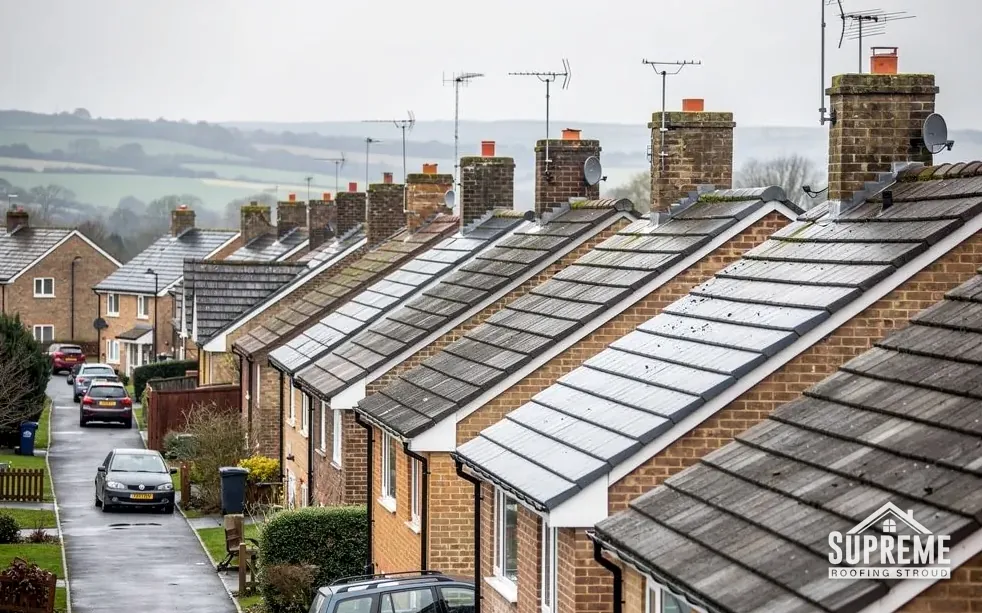
Terraced houses on a hillside street with tiled roofs and brick chimneys 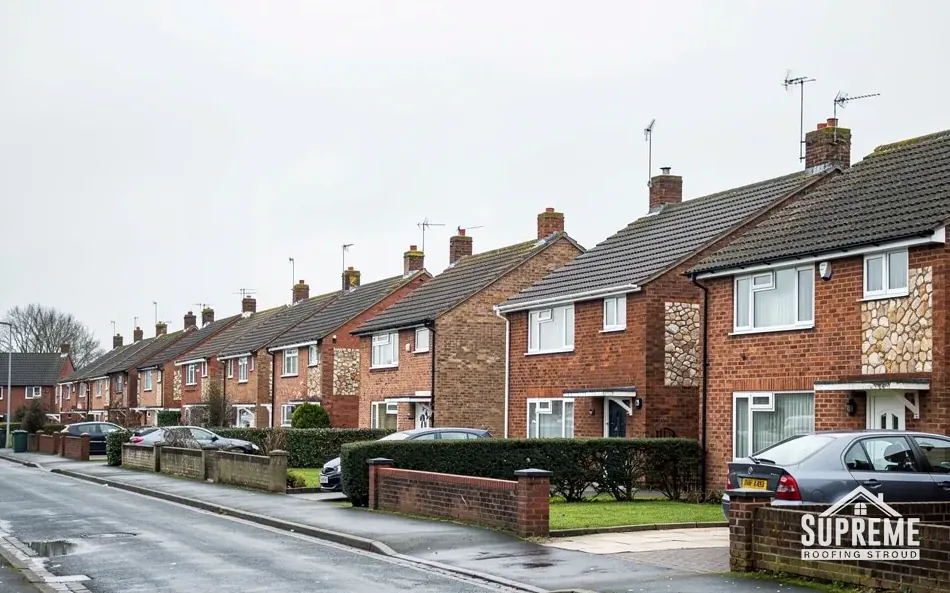
Street of red brick terraced and semi-detached houses with parked cars
Chapter 01
Late-1980s ridges and verges, now close to forty
On a new-town roof the covering often outlasts the mortar that holds its edges.
Chapter 01In this chapter
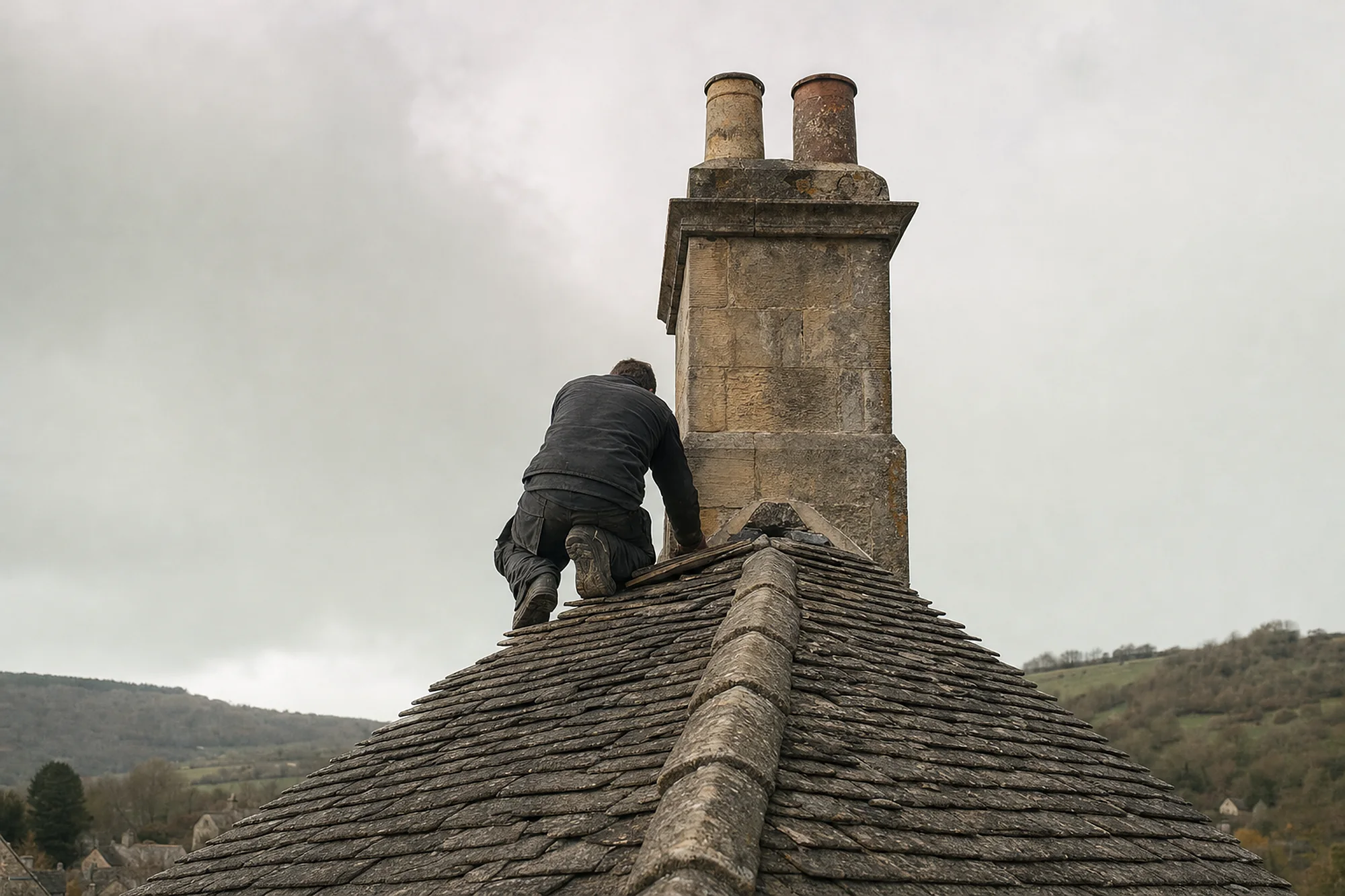
The first Bradley Stoke houses went up in 1987. A roof that old has had the same ridge, hips and verges for the best part of four decades, and these are the parts of a pitched roof that take the knocks. Three terms matter here. The ridge caps the top where two slopes join. A hip is the angled edge at the end of a hipped roof. A verge is the edge that runs up the side of a gable. All three are traditionally finished with tiles bedded in mortar, and mortar cracks over time as the building and the roof move.
Standards have shifted since those roofs were built. The 2014 revision of BS 5534 removed any doubt: bedded ridge and hip tiles need mechanical fixing, because mortar by itself cannot be counted on to hold them. We do not claim to know how any particular house in Bradley Stoke was finished; we check it. If the ridge shows cracks, gaps or tiles that rock under a gloved hand, we photograph them and show you.
Re-bed or go dry
There are two ways to put a ridge right. Re-bedding replaces the mortar and, in line with the current standard, adds mechanical fixings. A dry-fix system, which BS 8612 covers, replaces mortar with clips, screws and a vented ridge section. Costs vary with the roof's length and height. According to MyBuilder in 2026, repointing a ridge or hip typically costs £200 to £400, re-bedding or replacing ridge tiles £300 to £600, and a typical dry ridge job £500 to £1,000. Dry-fix is not automatically the better choice, and on a short ridge the cheaper repair may be the right one. Our ridge, verge and dry-fix page compares the options in more depth.
What lies beneath the tiles
A covering can look sound while the layers beneath it are tired. On a roof of this age we lift a few tiles in representative spots to look at the underlay, the battens and the loft side of the roof, and we photograph what we find. Underlay that has split or battens that have gone soft change the answer from a repair to a re-roof, so the picture matters more than the date on the house.
Verges at the gable ends
The verge takes its own share of strain. On a detached house with two gables, there are four verge runs to inspect, and a cracked mortar fillet there lets water behind the cladding or into the loft. We check each run from the scaffold or tower and not just from the ground, because a crack that is invisible from below is easy to see from arm's length.
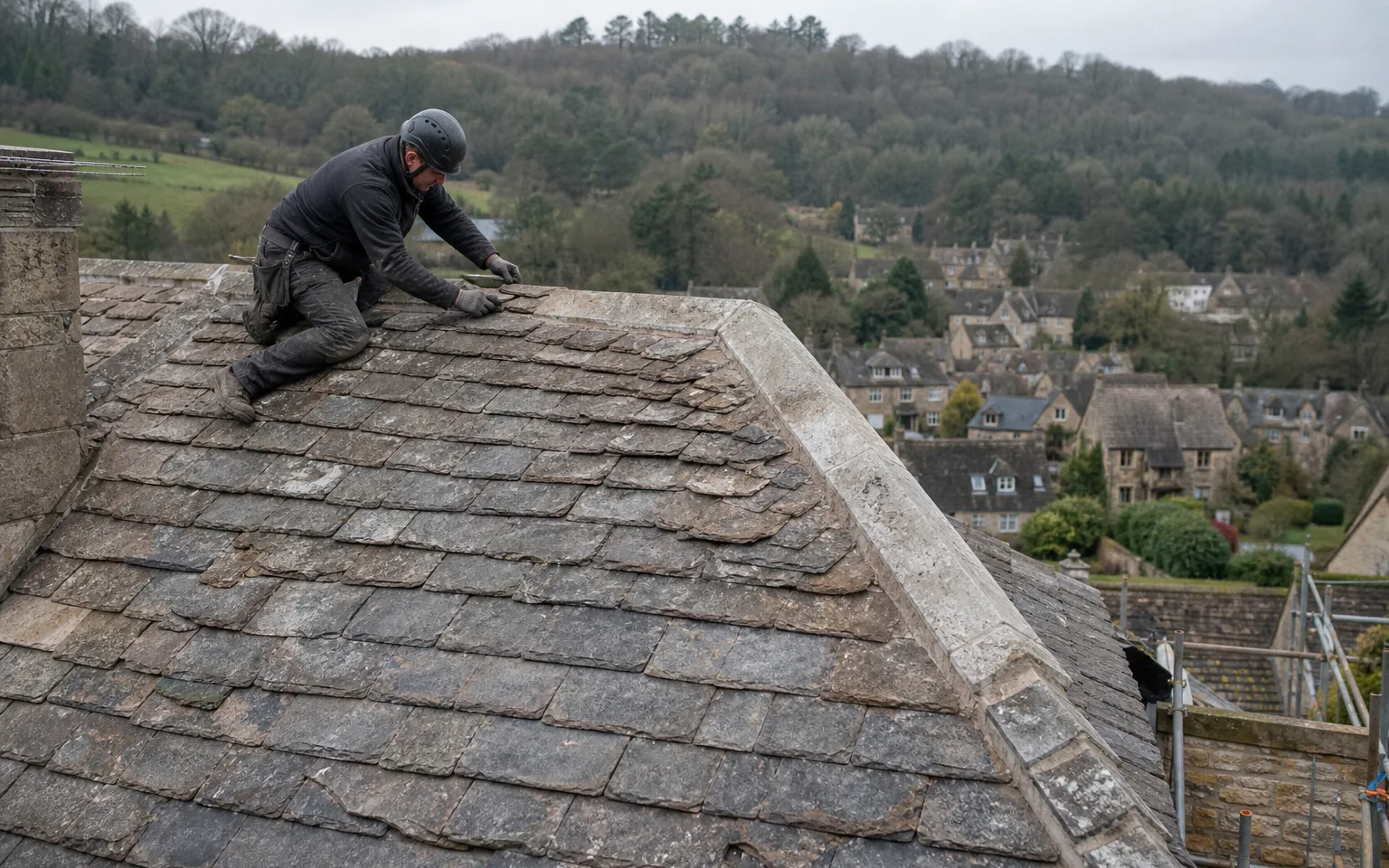
On a roof of this age, check the edges before you blame the covering.
- Repoint a ridge or hip£200 to £400
- Re-bed or replace ridge tiles£300 to £600
- Typical dry ridge job£500 to £1,000
Chapter 02
Detached houses: four elevations, one scaffold plan
With about 40% of Bradley Stoke's housing detached, access on all sides is the normal starting point.
Chapter 02In this chapter
A semi-detached house has a party wall on one side. A detached house has none, and the roof is exposed to inspection on every elevation: two long slopes, two gable ends or four hips, a chimney or two and often a garage roof tacked onto one side. That gives a surveyor plenty to look at and the homeowner plenty to price.
In this chapter
Scaffold for a detached house usually runs all the way round, because there is room to put it up and no reason not to. The cost is a real part of the job. MyBuilder's 2026 guide has scaffold on a full re-roof at around £1,125, and Checkatrade's October 2026 figures give £700 to £1,300. That is part of the written quote, so you can see what it is and ask whether any of it could be shared with other work, such as repairs to fascias or soffits that need the same access.
Whole-roof prices depend on shape. MyBuilder's 2026 guide gives £5,000 to £8,000 for a gable roof and £8,000 to £12,000 for a hipped roof, because a hip means more cuts, more ridge and more labour. Those are national typical ranges and never a quote. They help you see why two neighbouring houses of similar size on the same estate can price differently.
Repair or replace on a house this age
MyBuilder's 2026 guide gives roof repairs a wide span, with minor jobs at £100 to £300, moderate ones at £500 to £1,000 and major repairs at £2,500 and above. A cluster of moderate repairs adding up to a large sum is a sign worth stopping on. We set the cost of repeated repairs against the cost of a replacement covering, so you can compare the two without guessing.
Extensions and garages on the side
Detached houses often carry later additions: a garage with a pitched roof, a single-storey extension, a conservatory. Each adds a junction where old roof and new roof join, and junctions are where leaks tend to begin. We check these first. Where an addition has a flat roof, our survey looks at the falls, the edge trims and the upstand against the house wall as well, because a flat extension roof of this age can be on its second covering by now.
Myth: A newer house means a cheaper roof job.
Fact: The price follows the shape and the access, not the age: a hipped detached house costs more to re-roof than a gable-ended one, whatever its date.
Matching what is there
On a modern estate, a replacement covering needs to match the existing tile closely enough that the street still looks consistent. We photograph the roof, note the profile, and look at what the neighbours have. Our pitched roofing page explains how we choose coverings and what the pitch of the roof allows.
Chapter 03
Stoke Brook, the Three Brooks reserve and the eaves
Green space and a lake beside the houses mean gutters, soffits and fascias do real work.
Chapter 03In this chapter
Stoke Brook runs through Bradley Stoke, and the Three Brooks reserve takes in about 44 hectares and a man-made lake. For a roofer, the lesson from all that open space is modest but real: it means leaf fall, moss and nesting birds are part of the maintenance picture. A gutter that fills every autumn overflows down the wall, and a wall left wet for months can turn damp whatever the roof above is doing.
In this chapter
The parts that deal with water at the eaves are the gutters, the fascia board behind them and the soffit board beneath the overhang. MyBuilder (2026) suggests uPVC fascias and soffits last roughly 10 to 20 years before replacement, with a check about every five. Houses from the late 1980s and early 1990s are therefore at the age where those boards are due a hard look. We check for splits, sagging, discoloured joints and gaps at the soffit that let birds in, then quote for the replacement of fascia, soffit and guttering.
Birds, bats and the eaves
Both bats and nesting birds are legally protected. If either uses your eaves, say so before work begins and we will plan around them. Gaps at the soffit that let birds in are worth closing for the same reason, once the birds have gone.
Cost and scaffold
MyBuilder's figures for 2026 give guttering at £30 to £70 per metre, fascia at £80 to £150 per metre and soffit at £100 to £180 per metre, with scaffold at £20 to £40 per square metre. Because the work reaches eaves height, it often shares a scaffold with ridge or verge repairs, which is why we survey the whole roof edge once and quote it together. Our guttering, soffits and fascias page sets out what each part does and what usually goes wrong.
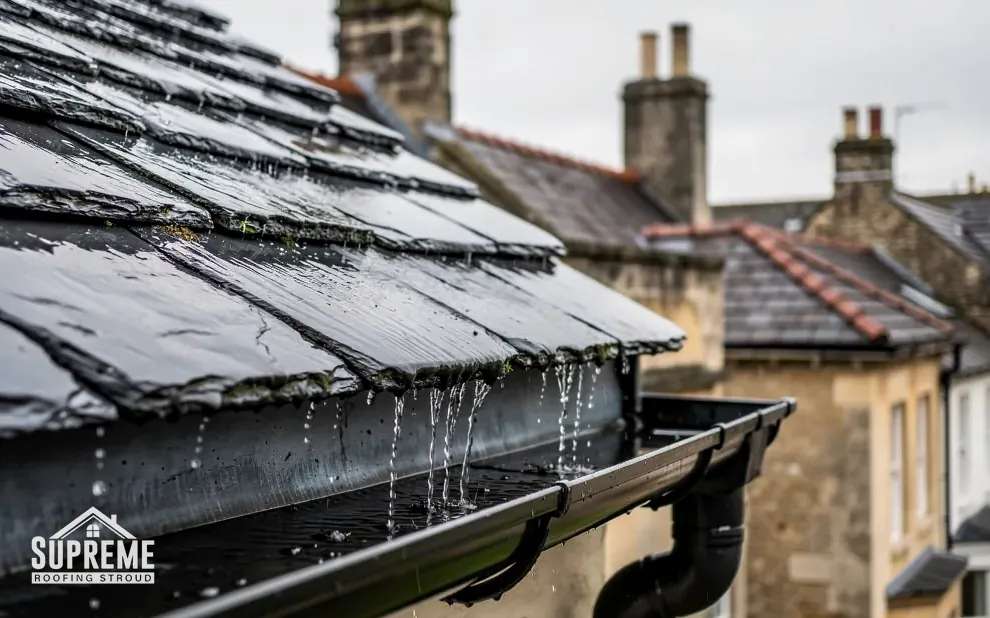
A written 10-year guarantee on our workmanship goes to you when the job is done, so the paperwork you keep matches the work you paid for.
Map showing Bradley Stoke and the Stroud service radius, with nearby towns we also cover.
Near Bradley Stoke
Roof work we do here
Late-1980s ridges and Three Brooks in Bradley Stoke
My Bradley Stoke house dates from the late 1980s. Is the ridge likely to need re-bedding?
It can, if it was finished with mortar alone. After this many years the mortar may have cracked, and BS 5534 now expects bedded ridge and hip tiles to have mechanical fixings too. We check the ridge from the roof, photograph any cracking and tell you whether a repair or a full re-bed makes sense.
Why does a detached house in Bradley Stoke need so much scaffold?
A detached roof has no party wall, so work on any elevation needs safe access. Scaffold typically runs all the way round the building. Because it sits in the quote, you can judge its effect and decide whether to bring other work forward while it stands.
Do the Three Brooks reserve and Stoke Brook make my gutters work harder?
Green space can mean more leaves and moss around the eaves, which fills gutters and keeps walls wet. We cannot say how your gutters will behave, but we can show you the state of them from the scaffold and fit what suits the run.
Is a Bradley Stoke house covered by conservation area rules?
No conservation area is recorded near the town centre. Building Regulations still bear on a re-roof, with limits of 25% of the building envelope and 50% of the roof. If you are unsure about your own address, ask South Gloucestershire Council.