
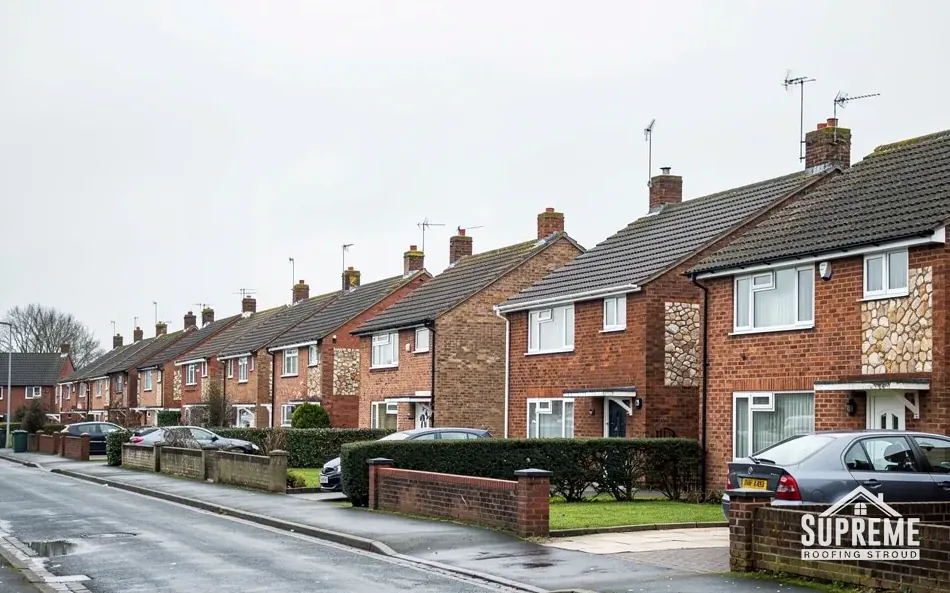
Roofers in Filton
Roof work in Filton, from the inter-war semis of Filton Park to the big flat and low-pitch roofs that grew up around the aircraft works.
Filton at a glance
- Distance
- 27 road miles south-west of Stroud
- Council
- South Gloucestershire Council
- Listed landmark
- St Peter's Church, Grade II
- Setting
- North fringe of Bristol
Filton's roofs, from the Concorde sheds to Filton Park
Filton is a town in South Gloucestershire on the north fringe of Bristol, 27 road miles south-west of Stroud. Two stories decide its roofs: the aircraft works and the housing built to serve them.
Aeroplane manufacture began in the Bristol Tramways sheds at Filton in 1910. Aero-engine production followed in 1920, and Concorde was built here in the late 1960s and 1970s. Buildings of that kind are large, and the roofs that cover them are large too. Anyone with a workshop, a unit or a large flat roof in Filton is dealing with a different scale of problem from a householder.
The housing grew alongside. Inter-war semi-detached houses were built first in Filton Park, west of the A38, and the area east of the A38 began developing in the 1930s. Those semis give a house type with its own habits: two houses under a linked roof, a shared party wall and, in many pairs, a chimney stack straddling the line between them. St Peter's Church was begun around 1340, is much altered since, and is Grade II listed.
Filton has no conservation area of its own, so for most houses listing is the only heritage check. The parish population was 11,295 at the 2021 census. For roof work that means plenty of ordinary houses and one older core, and our approach is to take each roof on its own merits and photograph what we find.
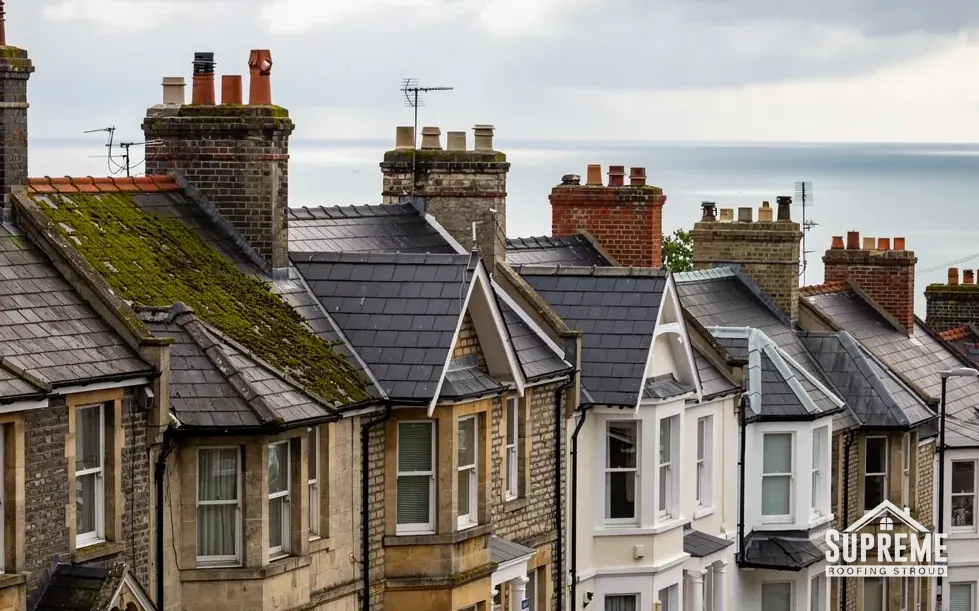
Row of Victorian terraced houses with slate roofs, bay windows and brick chimneys 
Street of stone terraced houses with slate and clay tile roofs
Chapter 01
Inter-war semis of Filton Park and the shared stack
Two houses, one roofline, one chimney: how a pair of semis changes repair and re‑roof decisions.
Chapter 01In this chapter
The semi-detached houses laid out in Filton Park west of the A38, and the 1930s housing that spread east of the road, were built as pairs. Each pair shares a party wall, and usually a ridge and a chimney stack that straddles the boundary. A shared stack is a roof feature with two owners. The part above the roof is exposed to the weather on all four sides, and its pointing, flaunching (the sloping mortar collar around the pots, which carries rain away) and flashings need to be sound for both houses.
A repair to one half of a pair is normally possible. A re-roof is different, because where your roof meets next door's along the party line, the junction needs a proper detail whether the neighbour's covering changes or not. If you replace more than half of the roof area or more than a quarter of the building envelope, the Building Regulations thresholds are passed, so ask us how we divide the work. We survey the stack from both sides where we can.
Chimneys, in figures
MyBuilder's 2026 guide puts chimney repointing at about £750 on average, with a spread of £500 to £2,000. By house type, it quotes £600 to £900 for a semi with the chimney on the side and £900 to £1,500 for a semi with a central stack. A flashing repair runs £250 to £1,200, and a full stack rebuild £2,000 to £10,000 or more. The range is wide because access, height and condition vary, which is why we give a figure only after a survey.
Lead on the stack and the bay
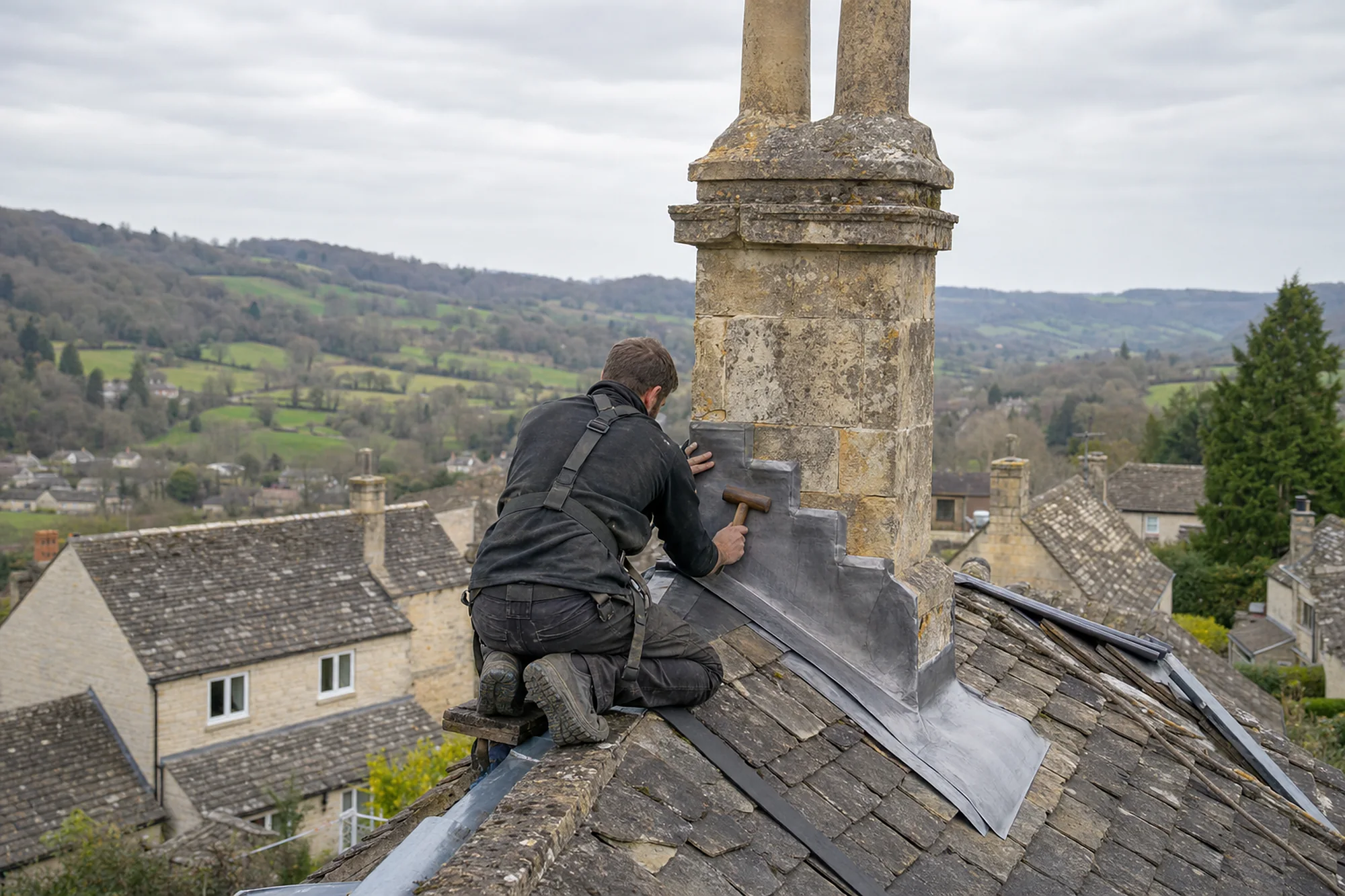
Where a stack rises through the roof, lead flashing seals the join, stepped up the slope of the roof in short pieces. Repairs to lead flashing run at £50 to £70 per metre in Checkatrade's 2026 repair guide, and stepped flashing at £80 to £120 per metre (Code 5, excluding VAT). Lead Code 4 is the code Leadworx names for everyday flashing, and a heavier code is chosen where the detail demands it. If a flashing has lifted at one end, a repair may be enough. If the lead has cracked along its length, a new run costs less than repeated patching, and we show you the cracks in a close-up photograph before saying so.
Bays, porches and hips
Inter-war semis often have a bay window with a small roof of its own, a porch roof and a hipped main roof. Each is a junction where leadwork or a valley gutter keeps water out. Our chimney repairs page sets out what we check on a stack from the roof, and how we price the rebuild.
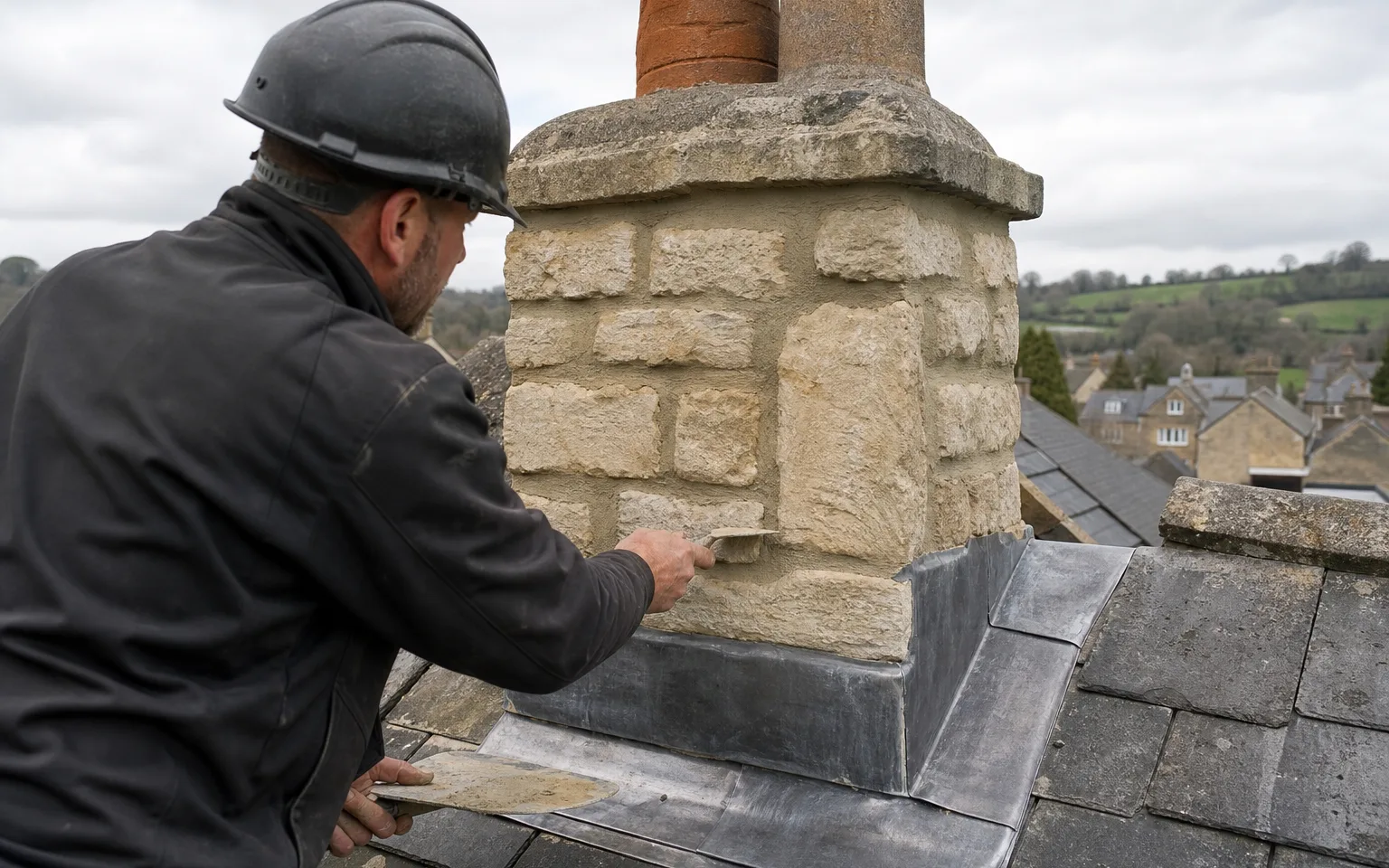
A shared stack is the one part of a semi that two owners have to agree on.
| House type | Typical repointing cost |
|---|---|
| Bungalow | £200 to £700 |
| Semi, side chimney | £600 to £900 |
| Semi, central chimney | £900 to £1,500 |
| Detached | £700 to £900 |
Chapter 02
Aircraft sheds and the roofs that followed them
From the Bristol Tramways sheds in 1910 to Concorde, aircraft work makes large roofs a normal part of the town.
Chapter 02In this chapter
Bristol Tramways sheds gave Filton its first aircraft in 1910. The engines came in 1920, and Concorde in the late 1960s and 1970s. What the history tells a roofer is that Filton has long been a place where large, low-pitched, wide-span roofs are normal, and where a commercial roof is not an oddity.
Large roofs follow different rules from house roofs. They need a drainage plan before anything else: outlets, internal gutters, falls that carry water to them and an overflow that works. BS 6229 asks for a design fall of 1:40 and a finished fall of around 1:80, according to IKO and Rockwool, and a roof that ponds shortens the life of any membrane. Prices for covering a flat roof differ by material. MyBuilder's 2026 guide puts bitumen felt at £70 to £100 per m², EPDM at £90 to £130, GRP at £95 to £150 and PVC single-ply at £95 to £140. Lead is dearer again.
Older sheeting and asbestos
Older industrial and garage roofs may be asbestos cement sheeting, so we test before we touch. HSE guidance treats intact asbestos cement, carefully removed, as non-licensed work; once sheets are substantially broken up, the job becomes notifiable non-licensed work. We explain which side of that line a roof sits on before we price it.
Rooflights on a large roof
Big roofs often carry rooflights to bring daylight into the space below, and each one is a hole in the waterproof layer. Under Part L, a new or replacement rooflight in an existing building is held to 2.2 W/m²K, based on its outer developed surface area. The kerb, the upstand round it and the way the membrane is dressed up to it all need to be right, and they are the first details we check for leaks. Our survey notes each rooflight, photographs its kerb and records the state of the glazing or sheeting.
- 1910year aeroplane manufacture began in the Bristol Tramways sheds at Filton
- 1920year aero-engine production followed
- 11,295parish population at the 2021 census
Planning a large roof
A big roof is tackled bay by bay, so every section we open is sheeted over before we leave for the night. Staff, stock and equipment under the roof are protected before the first sheet is lifted. Our commercial roofing page describes how that planning works and what we ask you to prepare.
Chapter 03
St Peter's, begun around 1340, and the leak that will not stop
A Grade II church and the houses around it share one problem: finding where the water comes in.
Chapter 03In this chapter
St Peter's Church was begun around 1340 and is much altered since. It is Grade II listed, which gives it legal protection. Where services still take place there, roof repairs go through the diocese's faculty system, and the ecclesiastical exemption takes listed building consent out of the picture. If you own a listed house near it, the position is different, and the council's listed building consent applies. Not every old-looking house is listed, so the Historic England list and South Gloucestershire Council can answer the question for your address.
In this chapter
Leaks are the other thing a church and a house roof have in common. Water seldom comes in where it shows. It runs down a rafter or along a batten and drips yards from the real fault, so a damp patch on a ceiling points to the area to investigate, not to the point of entry. We start from the roof side: missing or slipped tiles, cracked pointing at the ridge, a worn valley, a failed flashing round a chimney or soil pipe, or a blocked gutter sending water up under the first course.
Making the roof safe first
When water is coming in, the first job is to stop more arriving. Our priority is the water coming in. A temporary cover or a quick repair goes on first to make the roof safe, and the lasting fix is explained once the building is dry enough to assess properly. MyBuilder's 2026 guide puts minor repairs at £100 to £300 and storm-damage fixes at £500 to £1,500. After the survey, the lasting repair arrives as a written quote.
When repair stops being the answer
MyBuilder's 2026 guide puts the average roof repair between £150 and £1,500, with major repairs at £2,500 and above. If the faults keep recurring in different places, a re-cover can cost less than the repairs added together. We set the two options side by side on the written quote and let the numbers speak, so you are not pushed towards a bigger job than the roof needs. Whichever you choose, the work we carry out is backed by a 10-year guarantee on workmanship, issued in writing, and the waste leaves the site with us.
What the photographs show
We photograph your own roof from the survey, close up, and show you the fault before and after. Our roof repairs page covers the typical causes of leaks and the order in which we trace them.

Map showing Filton and the Stroud service radius, with nearby towns we also cover.
Near Filton
Roof work we do here
Concorde sheds, Filton Park semis and flat roofs
Can I repair my half of a Filton semi's roof without touching next door's?
Usually, yes, for a repair. The junction along the party wall needs a proper detail, and a shared chimney stack affects both sides. A full re-roof is a different decision, because the Building Regulations thresholds look at the whole roof. We survey from your side and, with permission, from next door's.
Does the chimney on my 1930s Filton house need repointing or rebuilding?
That depends on whether the brickwork is sound. Repointing suits a stack whose bricks are good and whose mortar has eroded. If bricks are loose or the stack leans, a rebuild is safer. MyBuilder's 2026 guide separates the two: about £750 on average to repoint and £2,000 or more to rebuild.
Can a large flat roof at a Filton business unit be re-covered in stages?
Often it can. We split the roof into sections, keep each uncovered section watertight overnight and plan the order so that stock and staff are protected. Drainage is surveyed first, since the falls and outlets decide what covering is suitable.
I live near St Peter's Church in Filton. Is my house listed too?
Not necessarily. St Peter's is Grade II listed, but nearby houses are only listed if they appear on the national list themselves. The Historic England list, or South Gloucestershire Council, can tell you for your address. If it is listed, the council's listed building consent applies.