

Roofers in Easter Compton
Roof work in Easter Compton, the small village at the foot of Blackhorse Hill, from the chapel and Village Hall to outbuildings, garages and family homes.
Easter Compton at a glance
- Distance
- 27.4 road miles south-west of Stroud
- Council
- South Gloucestershire Council
- Parish
- Almondsbury civil parish
- Setting
- Foot of Blackhorse Hill, near the M5
Easter Compton, below Blackhorse Hill and beside the old ferry road
Easter Compton lies south-west of Stroud by 27.4 road miles, at the foot of Blackhorse Hill in the civil parish of Almondsbury. The M5 runs close by. It is a small place, so each roof is looked at as we find it rather than assumed from its neighbours.
The village was previously known as East Compton, and it lay on the route leading to ferries across the River Severn. The village is far older than the motorway beside it. Its parish church stands at Compton Greenfield, just across a field, and has a fine Norman doorway dating from 1180.
In the middle of the village, the Methodist chapel opened in 1869, and the former school is now the Village Hall. Those two buildings are the community's shared roofs. Around them stand the houses, garages and outbuildings of a village that has never been large.
South Gloucestershire Council is the local authority, and Easter Compton does not appear on the council's list of conservation areas. Without a designation, a straightforward repair to a house raises no conservation question. Re-roofing still falls under Building Regulations, and whether any individual building is listed is for the council to confirm. In a village of this size, the jobs we expect are moss, gutters, small repairs and the occasional garage or hall roof, and each gets a photographed survey of your own roof and a written price before any work is agreed.
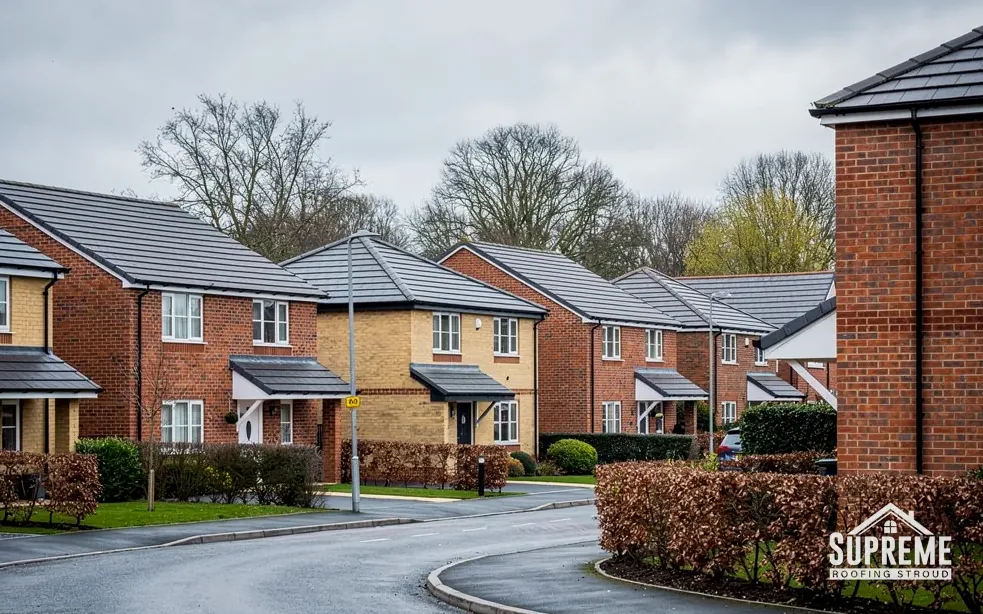
Modern brick housing estate with grey tiled roofs along a curving road 
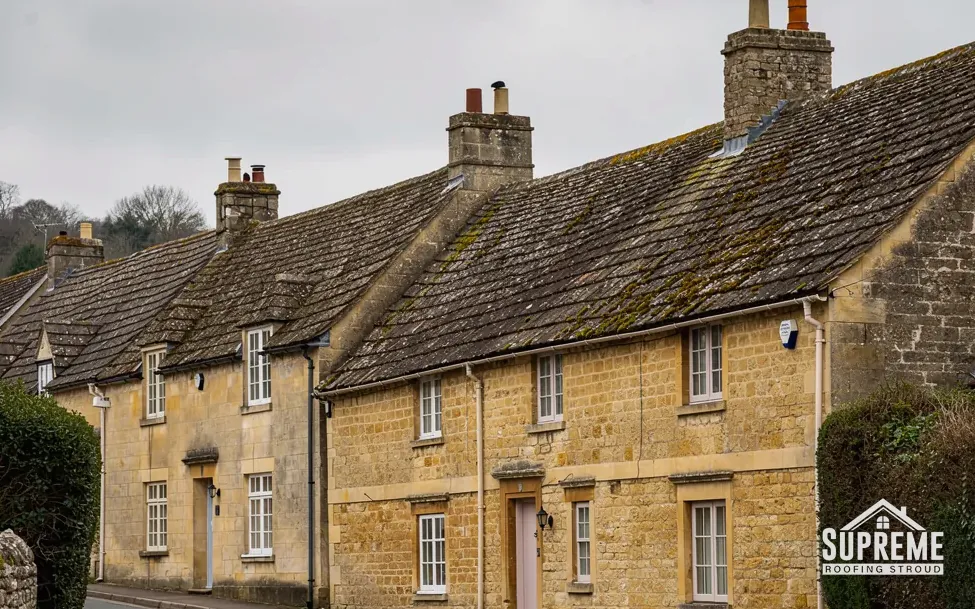
Hillside of stone terraced houses with mossy stone tile roofs and chimneys

Chapter 01
The 1869 chapel, the old school and the Village Hall roof
Community buildings are repaired by committees, and a clear survey is what helps them decide.
Chapter 01In this chapter
The Methodist chapel in the middle of Easter Compton opened in 1869. The former school is now the Village Hall. A building run by trustees or a hall committee behaves differently from a private house. Decisions are taken at meetings, money is raised or granted, and several people need to read the same account of what is wrong before they agree to spend it.
For roofs like these we write the survey for that readership. Photographs go first, each captioned with where on the roof it was taken. Then comes a plain list of faults in order of urgency, and a priced list of repairs. The quote covers everything from the scaffold through to making good, so a treasurer can hold it against the budget. Larger or more complex non-domestic roofs are described on our commercial roofing page.
Chapels, churches and consent
The rules differ depending on how a building is used. A church building within the Church of England's faculty jurisdiction, and qualifying buildings of the Methodist Church, Baptist Union and United Reformed Church, keep the ecclesiastical exemption under the 2010 Order while they are used for worship. Once worship ends there, or the building is converted, the exemption falls away, and a listed one then needs listed building consent from the council. Easter Compton's chapel does not appear on the national list. All Saints at Compton Greenfield does, at Grade II*, and while it is used for worship its roof work runs through the diocese.
Paying for it in stages
Community buildings seldom have the whole sum to hand. If a hall committee raises money in stages, the repair can sometimes be phased: first the urgent items that keep water out, then the next layer of work in a later season. We will say honestly which items are safe to defer and which are not, and the written quote reflects that. A scaffold is the exception, since putting it up twice costs more than once, so we check whether one visit can cover the work that cannot wait.

The church across the field
The parish church of All Saints at Compton Greenfield, listed Grade II* and entered through a Norman doorway of 1180, is a reminder that the oldest buildings need the most careful hand. Where a historic building is involved, the lowest-risk approach is to repair, not replace, to match what is there in material and detail, and to get the permissions in place before any scaffold goes up. We explain the sequence and let the owners or churchwardens decide.
A shared roof needs a survey that every trustee can read.
Chapter 02
At the foot of Blackhorse Hill: moss, gutters and runoff
Cleaning a roof is cheap compared with replacing one, if the method suits the covering.
Chapter 02In this chapter
Easter Compton sits at the foot of Blackhorse Hill, and a roof near a hill can have ground water to think about as well as rain. Gutters, downpipes and the ground beneath them need to carry water away from the walls, and a quick look at where the downpipes discharge often says more about damp than the roof itself.
Moss is the other common sight on a village roof. It holds water against the covering, lifts edges as it grows and blocks valleys and gutters when it falls. Removing it is routine, but the method matters. MyBuilder's 2026 guide gives manual scraping at £5 to £10 per m², soft washing at £15 to £20 and pressure washing at £10 to £15, and adds a caution about high-pressure jets on fragile tiles. Whole-roof cleaning prices run from about £300 for a flat roof, £450 to £850 for a pitched one, £500 to £1,000 for slate and £400 to £750 for tile. Those are national ranges, not prices for your roof.
When scraping is not enough
Moss can point to something else going on: a worn covering, poor drainage, or shade from nearby trees. If cleaning only buys a season before it returns, the survey will say so. We also look at what lies under the moss, because a roof scraped clean can reveal cracked tiles or slipped slates that the growth had been hiding.
Guttering costs and brackets
MyBuilder's 2026 guide puts guttering at £30 to £70 per metre. A village house with a long run along the front and a shorter one at the back is a modest total, and replacing sagging sections is cheaper than repeated unblocking. Brackets spaced too widely let plastic gutters sag, so we count them as well as the length. Fascia boards that have gone soft behind the gutter need replacing before the new gutter is fixed to them.
Gutters before winter
A gutter that is full cannot do its job, and water running over the lip soaks the wall and the fascia. We clear, flush and check the fall, then look for joints that leak and brackets that have pulled out. Our roof cleaning and moss removal page explains the methods and what each suits.
- Flat roof clean£300 to £600
- Tile roof clean£400 to £750
- Pitched roof clean£450 to £850
- Slate roof clean£500 to £1,000
Chapter 03
The old ferry road, garages and outbuildings
On a road once travelled to the Severn ferries, the small roofs at the back of a plot often need as much attention as the house.
East Compton lay on the route leading to ferries on the River Severn, and a village on a through route collects the buildings that go with it: garages, workshops, stores and sheds behind the houses. Their roofs are small, and they are easy to forget until one leaks onto something that matters.
In this chapter
MyBuilder's 2026 guide gives garage roof replacement costs for a single flat garage of £700 to £1,000, for a double flat garage of £900 to £1,400 and for a pitched garage of £2,500 to £4,500. The jump to the pitched figure reflects the extra material and labour of a framed roof with tiles or slates. We quote these jobs in the same way as a house, covering materials, labour, tipping and finishing, and we say when a repair would do instead.
Corrugated sheeting and asbestos
Older garage and outbuilding roofs may be asbestos cement sheeting, which is why we check before touching one. According to the HSE, removing asbestos cement that is carefully handled and not broken up is non-licensed work, and an AC roof that has been substantially damaged or broken becomes notifiable non-licensed work. MyBuilder's 2026 guide puts removing a single garage roof at £350 to £1,295 and a double at £650 to £1,800. We take a view on the sheets at the survey and explain how they would be removed and disposed of.
Choosing a covering for a replacement garage roof
MyBuilder puts flat roofs generally at 15 to 30 years. Within that, felt is quoted at 10 to 20 years, EPDM at 20 to 30 years or more, and GRP at 25 to 40. A pitched garage roof, in tiles or slates, is a bigger outlay and a longer-lived one. The right choice depends on the garage, the budget and how you use the space, and we lay out the options on the survey with the cost of each beside it.
Reaching the back of a plot
Getting materials to a rear garage is the part of the job that varies most. A side passage, a shared drive or a narrow lane each changes how we deliver and carry. We note the route when we survey, and if no vehicle can get close, the carry is planned by hand or hoist. When the roof is finished, the site is cleared, the waste leaves with us and our workmanship carries a written guarantee of ten years.
| Garage roof | Typical cost |
|---|---|
| Single flat roof | £700 to £1,000 |
| Double flat roof | £900 to £1,400 |
| Pitched roof | £2,500 to £4,500 |
| Asbestos cement removal, single garage | £350 to £1,295 |
Map showing Easter Compton and the Stroud service radius, with nearby towns we also cover.
Near Easter Compton
Roof work we do here
Blackhorse Hill, the chapel and the Village Hall
Does a former school building, like Easter Compton's Village Hall, need a different roofing approach?
The roof is treated like any non-domestic roof, but the process around it differs. A hall committee needs a clear survey, a written price and a record of the work for its minutes. We write ours for that readership and are happy to explain it.
Easter Compton is close to the M5. Does that change how you plan a job?
It changes the route and the timing more than the roof. We plan deliveries along the lanes, agree where the lorry and skip will stand, and check the carrying distance from the road to the work. Those details are written into the quote, and we confirm the working arrangements with you or the hall committee before the scaffold is ordered.
Can moss be taken off a roof without damaging the tiles?
Yes, if the method matches the covering. MyBuilder cautions that high-pressure jets can harm delicate tiles, so scraping or soft washing suits some roofs better. We check the covering first and then choose the method.
My Easter Compton garage has old corrugated sheets. Could they be asbestos cement?
They might be, which is why we do not break or drill them before checking. Under HSE guidance, carefully removed intact asbestos cement counts as non-licensed work. Our survey looks at the sheets first; the method, the disposal and the new covering are then explained and covered in the quote.