

Roofers in Almondsbury
Roofing across Almondsbury, from the steep hill that splits the village to the houses strung along the A38, with typical prices published before we visit.
Almondsbury at a glance
- Distance
- 24.7 road miles south-west of Stroud
- Council
- South Gloucestershire Council
- Conservation area
- Almondsbury, designated 1975
- Setting
- Escarpment above the Severn floodplain
Almondsbury's hill, its Grade I church and the A38 frontage
Almondsbury sits 24.7 road miles south-west of Stroud, on an escarpment that rises above the Severn floodplain. A steep hill splits the village in two, and that one feature shapes most of what a roofer has to think about here: which houses sit above the road, which sit below it, and how a ladder, a scaffold tower or a delivery lorry gets close enough to the eaves.
The name goes a long way back. Domesday Book records it in 1086 as Almodesberie, and the parish church of St Mary the Virgin dates to 1140. The church is Grade I listed, and a lead-covered spire was added to its tower sometime before 1619. Lead is the covering people reach for when a shape is awkward, and that holds as much for a modern chimney as for a medieval spire.
Later building follows the road. Houses are strung out along the A38 as ribbon development, beside the Almondsbury Interchange where the M4 and M5 cross. A house on a busy frontage has different access problems from one tucked up the hill, and a roofer needs to plan for both.
The village has a conservation area, first designated on 30 July 1975. Inside the boundary, putting back what is already there is simple on paper, while changing the covering raises questions for the planning team. We point out the difference at the survey, so it never surprises you later, and our own workmanship carries a written 10-year guarantee whichever way that decision goes.

Hillside terraces of stone houses with slate roofs and chimneys 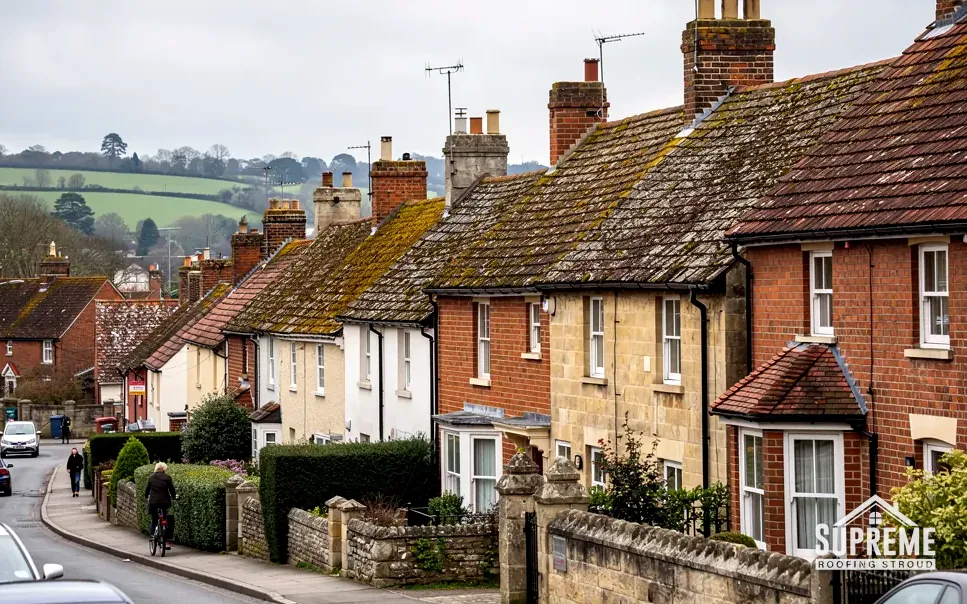
Sloping street of brick and stone terraced houses with mossy tiled roofs
Chapter 01
The lead spire of St Mary's and lead on village roofs
A Grade I church shows what lead can do; the same metal seals chimneys, valleys and abutments on ordinary houses.
Chapter 01In this chapter
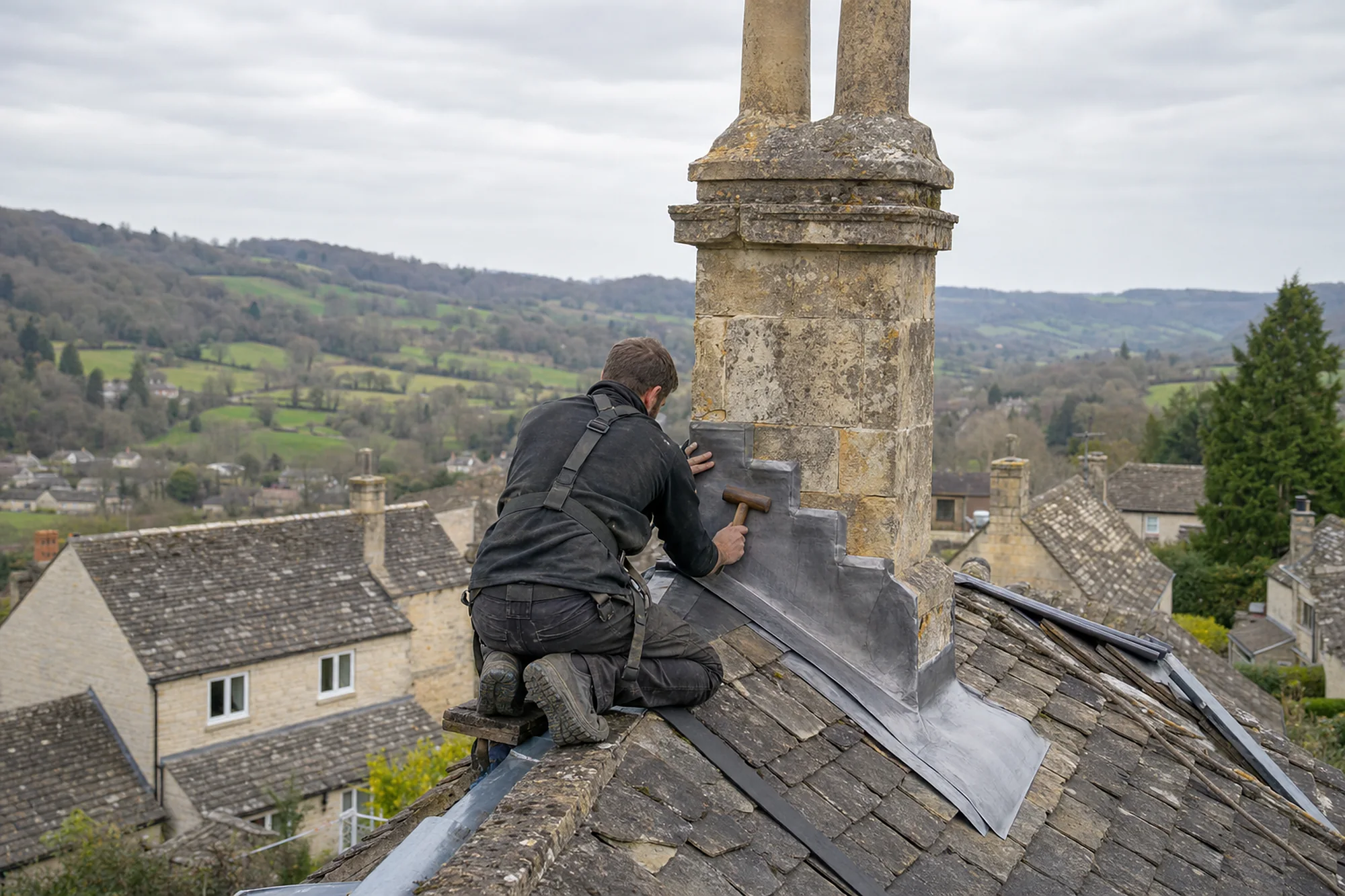
St Mary the Virgin is the building the village is known for. The parish church dates to 1140, it is Grade I listed, and its tower carries a lead-covered spire added sometime before 1619. Few roofs ask more of a covering than a spire does, because there is no flat to stand on, no gutter to catch a drip and no easy way up. Lead copes because it can be dressed tightly around a shape and worked again when it moves.
That is worth knowing even if your own roof is a semi-detached house. Lead turns up on ordinary village roofs wherever two surfaces meet: round a chimney, down a valley between two slopes, along the abutment where an extension climbs a wall. A flashing is the strip of metal that seals one of those joins, and a soaker is the small piece of lead woven under each tile or slate course at a junction. Both are cut from sheet lead, which is sold by code, a number from 3 to 8 that rises with thickness. Code 4 (1.80 mm) is the code Leadworx names for everyday flashing, and Code 5 (2.24 mm) goes into heavier details.
How long lead lasts, and why it still fails
MyJobQuote's 2026 guide says correctly installed flashing can last over 80 years, and over 100 years in the higher codes. When lead fails sooner, the metal is rarely the culprit. A flashing pulled out of a wall joint by an earlier repair, a mortar fillet that has cracked and let water in behind, or a sheet dressed too tight that split as it warmed and cooled: those are the faults we look for first. We photograph the failure, show you the picture and quote for the repair. A chimney flashing patch is typically £150 to £250, and a full replacement averages £570, according to MyJobQuote in 2026.
When the roof belongs to a church
A working church has an approval route of its own. Under the ecclesiastical exemption, roof work on a church used for worship is authorised through a faculty issued by the diocese, and listed building consent does not come into it; the parish carries that process. A listed house in the village is another case again: the council's listed building consent is required before anything alters its special character. Our lead roofing page goes further into the metal itself.
Lead rarely fails first; the joint around it usually does.

Chapter 02
Working a roof on the hill that splits Almondsbury
On an escarpment, the plot decides the scaffold, the carrying distance and the order of the day.
Chapter 02In this chapter
Almondsbury's hill is steep enough that two neighbours can have roofs at very different heights above the same road. A house cut into the slope can stand a storey taller behind than it looks from the road. A house below the road may have a ridge you can almost touch from the pavement. The first job on any survey here is to stand where the scaffold will stand and see what the ground allows.
In this chapter
Sloping plots usually mean a stepped scaffold, built to one height on the downhill side and another on the uphill side, with base plates set on boards where the ground is soft or sloping. That costs more labour than a flat-ground erection, and it belongs in the quote, not folded into a vague total. Some houses can be reached only up steps or along a narrow path. There, slates and tiles are carried by hand or lifted with a hoist, and the old covering comes back down the same way. On a full strip that handling is a genuine share of the hours, so we price it openly.
Where the water goes
A roof on a hillside sheds water onto ground that is already falling away. Downpipes that discharge near a retaining wall, a neighbour's boundary or a path can cause damp problems that look like roof leaks. When we check the gutters we also follow the water from the outlet to wherever it ends up, and say so if the real fault is the drainage and not the covering. Our roof repairs page covers the sequence we follow: stop the water, then deal with the cause.
- 1086year Domesday Book records the village as Almodesberie
- 1140date of the parish church of St Mary the Virgin
- 1975year the conservation area was first designated
Ridge and verge on a hill skyline
Roofs on a hill skyline are easy to see from a distance, and the first things anyone notices are the ridge and the verges, the sloping edges at the gable ends. Under BS 5534:2014 every ridge or hip tile needs a mechanical fix as well, because mortar on its own is not counted on. When an older ridge has been bedded in mortar only, we show you the cracks and the gaps, and give a price for re-bedding with a mechanical fixing, usually a dry-fix system, rather than patching the pointing a third time.

Skips and sacks leave with us when we do, and the quote allows for the tipping. Ask us to look at the roof from the lane below as well as from the top step, because a roof seen from only one side can hide its faults.
Chapter 03
Houses along the A38 and the Almondsbury Interchange
A roof on a busy frontage is planned from the road first and from the ridge second.
Chapter 03In this chapter
The A38 runs through Almondsbury lined with houses, and the Almondsbury Interchange sits just beside the village where the M4 and M5 cross. For a roofing job, living on a frontage like this changes the plan in several practical ways. There may be no drive. The front wall may sit hard against the footway. Deliveries of tile, slate or timber have to arrive when a lorry can stop without blocking the road, and the skip has to go somewhere that is legal to put it.
If a scaffold has to stand on the public footway, the highway authority has to grant a licence before it goes up, so we raise that the moment you agree a start date. Where the front of the house is impossible, a side passage or the back garden may carry the scaffold instead, and we check that at the survey with photographs of the access. None of this is a reason to put a repair off; it is a reason to see it in the written quote rather than on the day.
Inside the conservation area
Almondsbury Conservation Area was first designated on 30 July 1975 as Lower Almondsbury, then extended and renamed in April 2024, and planning questions in the village go to South Gloucestershire Council. Re-roofing in the same covering, which leaves the building's outward appearance as it was, is generally not treated as development. Switching material is another matter, and so is anything that changes what the street sees. Raise it with the planners before you sign, and we will say what we think the question is. A listed building tightens the rules further.
Re-roofing and Building Regulations
Two limits matter on any house along the A38: 25% of the building envelope and 50% of the roof. Stay under both and Building Regulations approval is not normally needed. Pass either and approval comes in, with a possible thermal upgrade to the roof. Where the work is notifiable, the notification is ours to deal with and the consent is something we talk through. If you want to know what condition the roof is in before choosing, a survey with photographs of your own roof is the sensible first step, and our roof inspections and surveys page lists each point we check.
Map showing Almondsbury and the Stroud service radius, with nearby towns we also cover.
Near Almondsbury
Roof work we do here
The Grade I church and A38 frontage at Almondsbury
My Almondsbury house is built into the hillside. How do you reach the roof safely?
The ground comes first. A stepped scaffold with base plates on boards suits a sloping plot, and where a lorry cannot get close, materials are carried or hoisted. We note the route to the roof at the survey, and the scaffold is allowed for in the quote, so you can see what the slope adds.
Does the Almondsbury Conservation Area stop me re-roofing?
No, but it adds questions. Putting back the same covering, without changing how the building looks, is generally not development. A different material, or a new feature on the roof, deserves a conversation with the planners at South Gloucestershire Council first, and we tell you where we think the line sits.
Who approves roof repairs on St Mary's, the Grade I church?
Because of the ecclesiastical exemption, a church used for worship gets a faculty from the diocese in place of listed building consent, and the parish makes that application. A listed house nearby is different: the council must grant listed building consent before work alters its character.
Can a leaking lead flashing on my chimney be patched, or does it need replacing?
A patch often works when the lead itself is sound and the fault is a lifted edge or a cracked joint. MyJobQuote's 2026 guide gives £150 to £250 for a flashing patch and about £570 for a full replacement. We photograph the flashing and the wall joint, then show you which of the two the picture supports.