
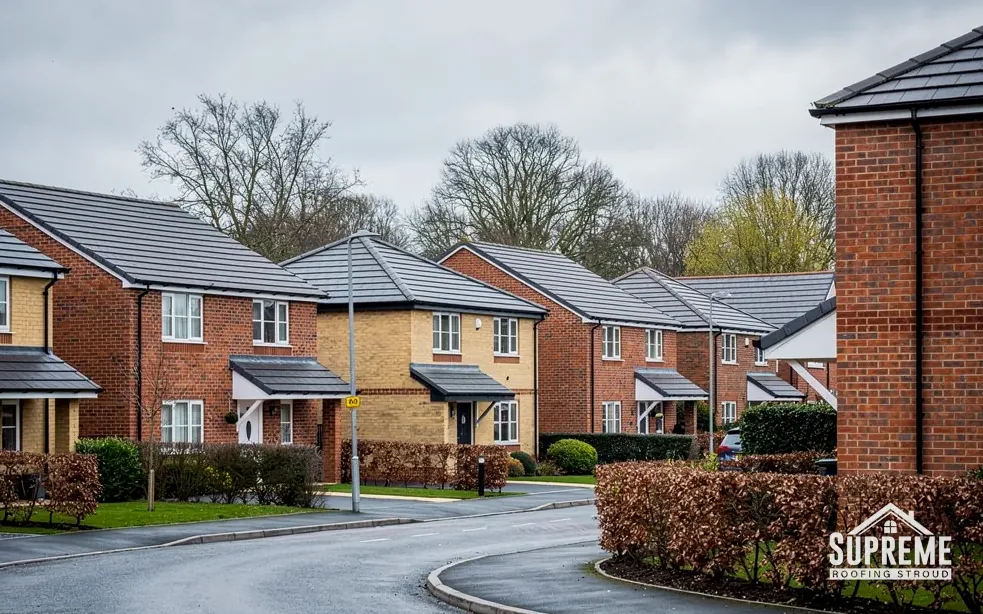
Roofers in Alveston
Roof repairs, re-roofs and surveys in Alveston, the former royal manor one mile south of Thornbury, with typical prices published before anyone visits.
Alveston at a glance
- Distance
- 21.1 road miles south-west of Stroud
- Council
- South Gloucestershire Council
- Parish
- Includes Rudgeway and Earthcott
- Conservation area
- None found near the village centre
Alveston's roofs: a royal manor, a drifting village centre and a parish in three parts
Alveston is a village and former royal manor, one mile south of Thornbury and about ten miles north of Bristol. The parish takes in Rudgeway and Earthcott as well, so a job here can mean three different settlements rather than a single street.
The history is long. The Domesday Book of 1086 records the manor in the hands of Harold Godwinson, with ten hides and about 35 households, and it remained a royal hunting park until 1149. Alveston was made a separate parish only in 1846; until then the manor sat inside Olveston parish. The centre of the village has moved as well. In the nineteenth century it lay around Church Farm, and today some see the Ship Inn, a coaching inn dating to 1589, as its heart, while most would point to the small shopping parade.
For a roof, that history matters in a simple way. A village whose centre has drifted across four centuries has buildings of many periods standing side by side, and no single covering describes them. We do not guess a material from the postcode, and we would rather say we need to look than quote from a distance. We look at the roof in front of us, photograph it during the survey and price it like for like. National planning data shows no conservation area within about 500 metres of the village centre, but an older or listed property can still carry its own controls, so we check the status of an old building before we propose any change to its covering.

Row of stone cottages with mossy clay tile roofs along a quiet lane 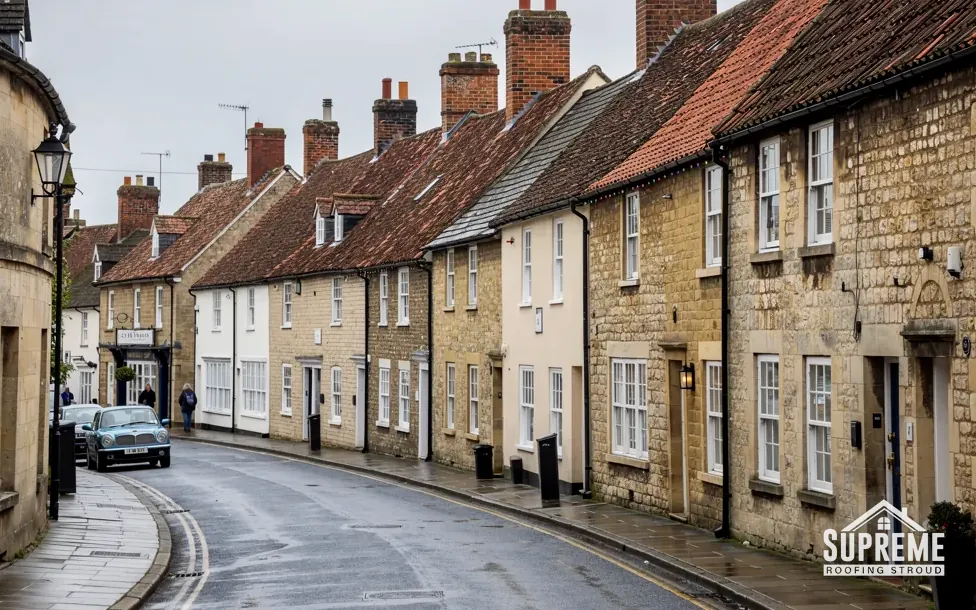
Curving street of stone and rendered terraced houses with tiled roofs
Chapter 01
Four centuries of building around the Ship Inn
A village centre that moved leaves old and newer roofs on the same lanes.
Chapter 01In this chapter
When a village centre shifts from a farm to an inn, the buildings do not all move with it. Alveston has the Ship Inn, which dates to 1589, and in the nineteenth century the focus was around Church Farm. Houses, outbuildings and cottages built for either centre are still standing, and each has been re-roofed at least once since. Some will have been covered in whatever was to hand at the time, which is why we look closely at the battens and the nail fixings before saying whether a covering can be saved. A single lane can therefore show three or four generations of roof work, patched and extended by different hands.
In this chapter
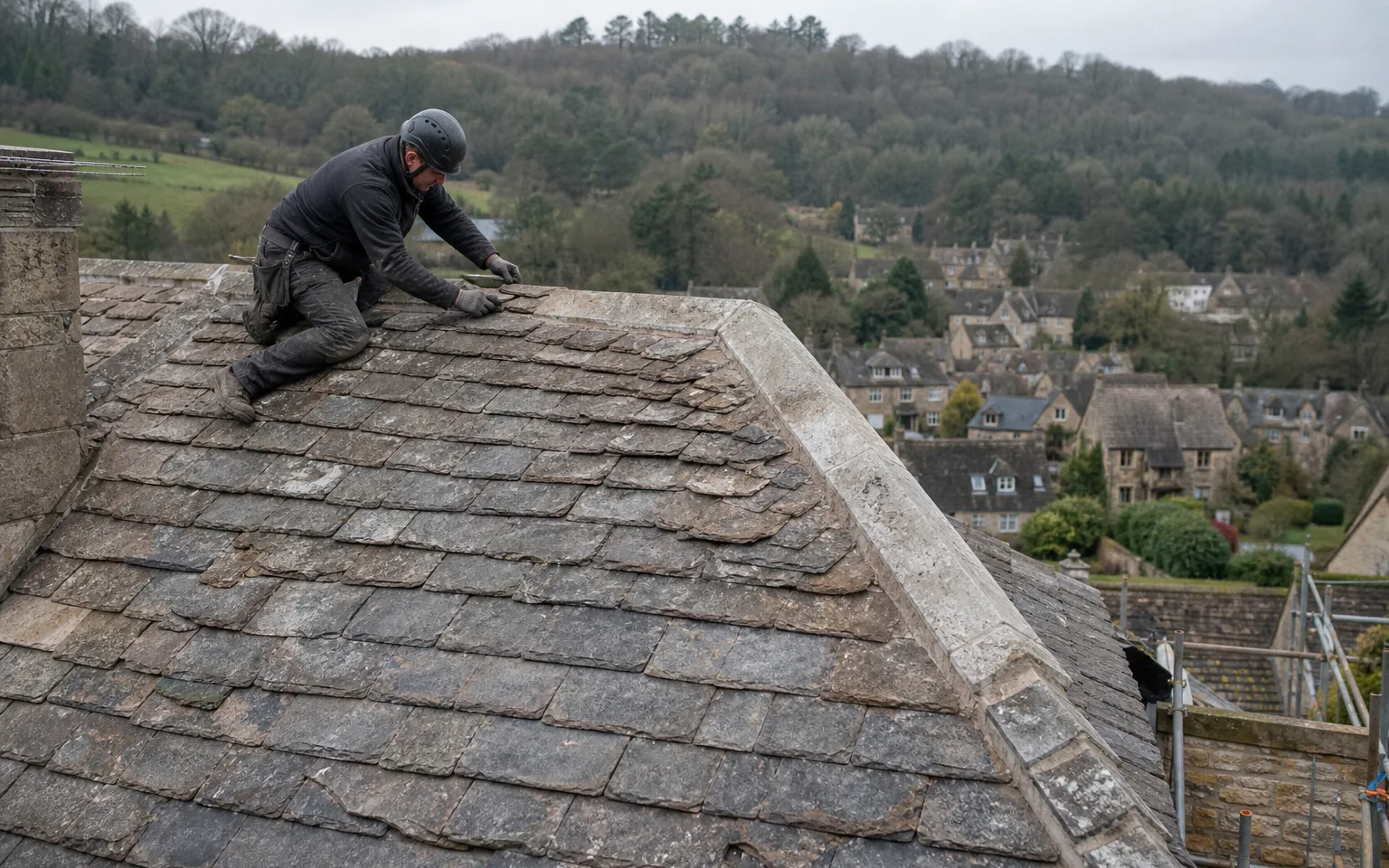
That matters when we climb up. An older roof structure was cut and fitted by eye rather than built to a drawing. Rafters may vary in size and spacing, a purlin may have deflected under the weight of a later covering, a ridge may dip between two walls, and the line of an eaves course can wander. None of that is a fault in itself. It does mean a new covering cannot simply be laid on a flat plane without first reading what the timbers are doing, and battens sometimes have to be packed or doubled to bring the surface true. We note those details at the survey and put them on the quote as labour, not as a surprise.
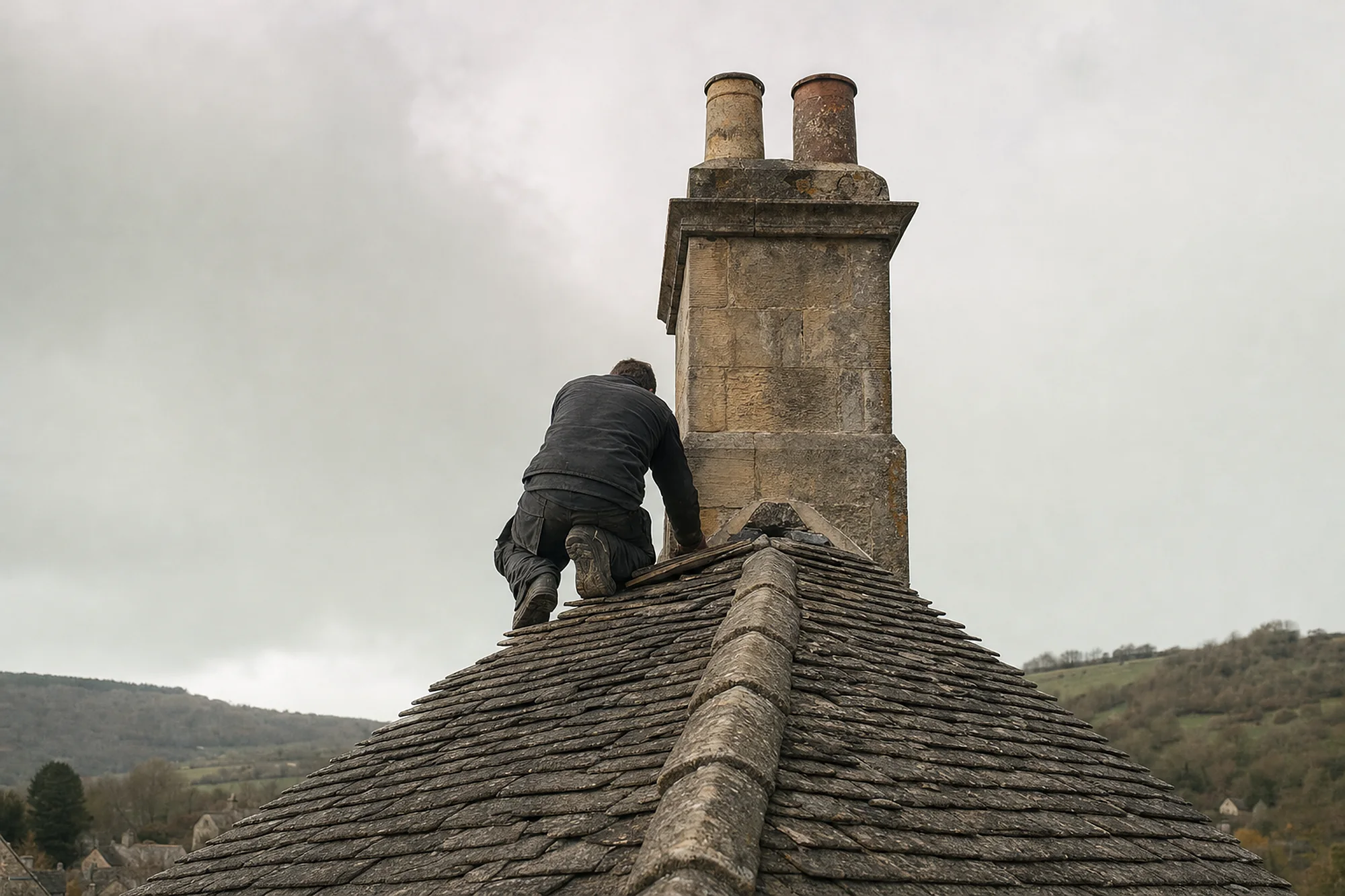
Two terms help here. The ridge is the high line where the slopes join, and the verge is the sloping edge that finishes the end wall. On older buildings both are common entry points for water, because the mortar that sealed them has weathered and the tiles or slates beside them have crept. Ridge tiles are now fixed mechanically as well as bedded, a rule that dates from BS 5534:2014, and a repair done today should follow it.
Reading the age of a roof
Before any quote we want three answers. How old is the building? Has the covering been replaced, and with what? Is the property listed? If the house is listed, the council has to authorise changes that touch its character, and South Gloucestershire Council's conservation team is who to ask. An unlisted house is simpler, since replacing a covering in kind seldom counts as development under planning law, though we confirm each case.
Inns, shops and working buildings
A roof over a trading building runs to a different programme from a roof over a spare bedroom. Work above an inn or a shop has to be sequenced around deliveries, opening hours and the public pavement. Our pitched roofing page explains how a strip and re-cover is staged, and our roof repairs page covers the smaller jobs where one slope needs attention.
A lane that has seen four centuries of building will show every one of them on its roofs.
- 1086year Domesday records the manor, held by Harold Godwinson
- 1149year the royal hunting park ended
- 1589date of the Ship Inn
Chapter 02
Rudgeway's ruined tower and what an open roof does
A church reduced to a tower and one wall shows why the covering matters.
Chapter 02In this chapter
Rudgeway, in the same parish, has the old St Helen's church. It survives only as its tower and the south wall of the nave, a ruin that has been restored and is owned by Rolls-Royce. Nobody is asking us to roof a ruin, but a building reduced to a tower and a single wall is a useful reminder of what a roof actually does. It is the part that keeps water out of the masonry below. Take the covering away and the walls take every shower directly, at the joints, at the tops of the walls and around the openings.
In this chapter
The same logic applies to an ordinary house or barn. Most of the damage we are called to put right starts small: a slipped slate or tile, a split in a lead flashing, a gutter that has stopped carrying water away from the wall. Water finds the weakest point and works inward, sometimes for a long while before a stain shows on a ceiling, and an old roof with deep eaves can hide the first signs entirely. By then the rafter feet, wall plate or ceiling joists may be damp, and the repair costs more than the first fix would have.
We read a roof from the outside in. First the covering: missing, cracked or lifted units, moss build-up, mortar loss at the ridge and verges. Then the details: flashings round chimneys, valleys between slopes, and the junctions where an extension meets the older roof. Then the drainage: gutter falls, joints, downpipes, and whether rainwater lands where it should. A downpipe that discharges against a wall can do as much harm as a missing tile, so we follow the water all the way to the ground. Typical UK repair costs sit between £150 and £1,500 on average (MyBuilder roof repair cost guide, updated 21 August 2026), and the written quote after the survey covers the job in full.
Dispersed parish, dispersed roofs
Alveston's parish takes in Rudgeway and Earthcott, so a farm outbuilding, a cottage and a modern house may sit a mile or two apart. Outbuildings and barns are often forgotten until the roof is open to the sky. If you have one, we can survey it with the house and quote both. Where a building is empty we still check the structure before recommending a new covering. Our roof inspections and surveys page sets out what the photographs and the report include.
Chapter 03
Twenty-one miles from Stroud to Alveston: planning the survey
A south-west run of about half an hour deserves a proper visit, not a quick look.
Chapter 03In this chapter
Alveston is 21.1 road miles south-west of our base in Stroud, and the drive takes about 31 minutes. That is a fair run for a survey, so we plan it properly instead of turning up to look at one ridge and going home. When two or three jobs fall in the same parish, we try to book them together, which keeps the visits useful for everyone. We ask for a few photographs and the address first, together with anything you know about the age of the roof and whether the building is listed. The typical guide prices on our service pages come before any of that, so you have a sense of the range before we agree a time.
On the visit, pictures of your own roof are taken and kept for you. We measure the slopes, note what the covering is, and look at the fixings, the ridge and verges, the flashings and the gutters. We also work out where the scaffold will stand. On a village lane that means asking where a delivery lorry can stop, whether parked cars narrow the road, and where a skip can go without blocking a neighbour. At a house up a track or behind a field gate, it means working out how materials will be carried in and waste carried out.
The written quote follows, and it covers access, stripping, materials, labour, skips and making good. Each has a typical range, so another firm's quote can be set beside it. If the roof is stone, slate or clay tile, we price stone, slate or clay tile again, not a cheaper cover that changes the look of the house. Roofing work is normally charged at standard-rate VAT, and your quote shows it.
Work carries a 10-year workmanship guarantee in writing. When the job finishes, the site is swept and the old covering leaves with us. Where the work is notifiable under the Building Regulations, we tell you what consent applies and send the notification to building control ourselves. A leak jumps the queue: we make it watertight first, then plan the lasting repair once the roof has dried out and can be opened up properly.
The quote should list what the job needs, and nothing it does not.
Myth: A roofer who travels 20 miles will add the journey to the bill.
Fact: Distance is not an extra on our quote. The lines are the ones the job needs: access, the old covering coming off, the new one going on, and clearing up.
Map showing Alveston and the Stroud service radius, with nearby towns we also cover.
Near Alveston
Roof work we do here
Rudgeway, Earthcott and the old Alveston manor parish
My Alveston house is old but I cannot see a conservation area nearby. Can I change the roof covering freely?
National planning data shows no conservation area within about 500 metres of the village centre. That does not settle your house, because a listed building has its own protection wherever it stands. Replacing a covering in kind seldom needs planning permission, but swapping one material for another can change how the house looks, so ask South Gloucestershire Council's planning team before you commit.
Do you cover Rudgeway and Earthcott as well as Alveston village?
Yes. The parish takes in both, and we survey them in the same way. Tell us which settlement you are in when you get in touch, and we plan the visit and the access around the property.
I have an old outbuilding near Alveston with a failing roof. Is it worth re-covering?
Often it is, provided the walls and timbers are sound. We check the rafters, the wall plate and the bearing points first. If the structure will carry a new covering we price it as its own job, and if it needs repair first, we tell you.
Will scaffold on a village lane near Alveston be allowed for in the quote?
Yes. Lanes with parked cars or a narrow carriageway take more planning, and scaffold is allowed for in the quote, and if the scaffold needs to cross the public footway we arrange the permit before the start date.