
Roofers in Stanton St Quintin
Upper and Lower Stanton, a Grade II* church, a trio of thatched cottages and two post-war estates: a varied set of roofs in a nearly flat Wiltshire parish, with typical costs shown before anyone visits.
Stanton St Quintin at a glance
- Distance
- 21.2 road miles south-south-east of Stroud
- Council
- Wiltshire Council
- Conservation area
- Stanton St Quintin, with the airbase area adjoining
- Listed
- Church of St Giles, Grade II*
Upper Stanton, Lower Stanton and the roofs between them
Stanton St Quintin is a parish of two villages. Upper Stanton holds the church, the manor house and the rectory house, and Lower Stanton, a little way off, grew around the tenant farmsteads. Between them, as the county history describes it, the land is nearly flat, resting on roughly equal parts of Cornbrash, Forest Marble clay and Kellaways Clay, with open ground along the northern edge that was once an airfield. Level ground usually helps with access, though we still settle where the scaffold and the deliveries go before the quote is written.
The county history gives the building story in a few strokes. Glebe Farm, apparently 17th-century, is the oldest house in the village, and a stone farmhouse of about 1830 stands at Lower Stanton. Three thatched cottages went up at Upper Stanton in 1925. The 1950s added Valetta Gardens, 43 houses built in 1950 and 1951 for RAF Hullavington, and Newbourne Gardens, 20 council houses of 1954. By 1989 most of the houses in Lower Stanton were twentieth-century.
The village has its own conservation area, and the Hullavington Airbase conservation area adjoins it. The Church of St Giles, built of limestone rubble and ashlar, is Grade II* listed. Near either, a quick word with Wiltshire Council before a covering or detail changes will head off an argument later.

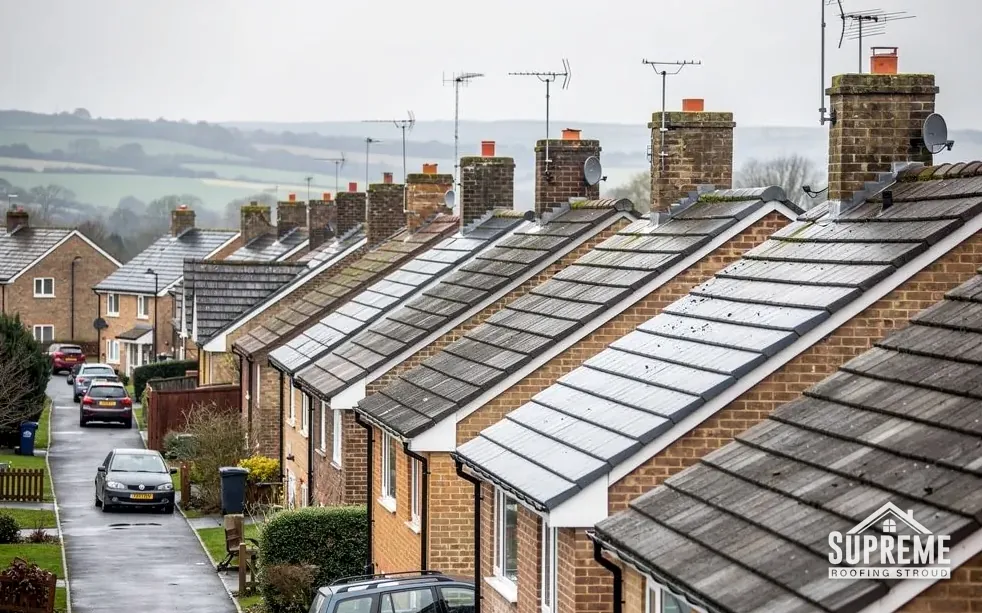
Stone village houses with slate and tile roofs above green fields 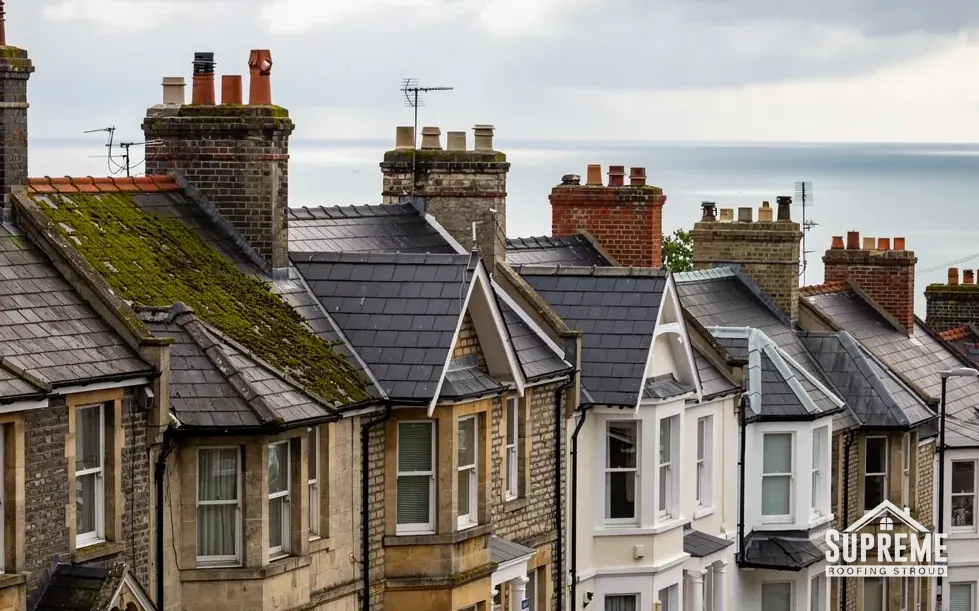
Row of Victorian terraced houses with slate roofs, bay windows and brick chimneys

Chapter 01
St Giles and the centre of Upper Stanton
A Grade II* church sets the standard for every roof within sight of it.
Chapter 01In this chapter
Upper Stanton is the older of the two villages, and St Giles anchors it. The church is limestone rubble and ashlar, and Grade II* places it among the more important listed buildings. A listing covers the whole of a building, inside and out, whatever its grade. On a listed house, listed building consent is required for roof alterations of the kind that alter its character, and matching materials make that application far easier to support. It also helps to know in advance which parts of a roof the council regards as original fabric.
In this chapter
A church takes another path. As long as services are held in it, the building is under the ecclesiastical exemption and the parish seeks a faculty through the diocese. We do not make that decision. What we can supply is evidence. Church roofs tend to combine broad slopes, lead flashings, valley gutters and long runs of rainwater goods, and every one of those is a point where a small defect turns into a stain on a wall or a wet patch inside. A survey that photographs each defect gives a parochial church council something concrete to lay before the diocese.
Lead on old roofs
Lead is the metal most often found at the junctions of an old roof, and it is sold in numbered codes by thickness. Leadworx describes Code 4 as the everyday standard for flashings, with thicker codes reserved for valleys and large roofs. MyJobQuote reports that correctly fitted lead flashing can outlast 80 years, and 100 on the higher codes. On a building of this age that makes patch-and-restore the normal approach to lead, with wholesale renewal kept for sheets that have actually failed. Our lead roofing page lists the codes and the typical costs.
The conservation area around it
The village has its own conservation area, which adds a second layer of control to the listing. An in-kind repair seldom needs planning permission, since the 1990 planning legislation does not count works as development when they leave a building's outward appearance materially unchanged. Changing the material is a different matter, as is any house under an Article 4 direction. Both points can be settled with Wiltshire Council's planners, ideally before any material is ordered.
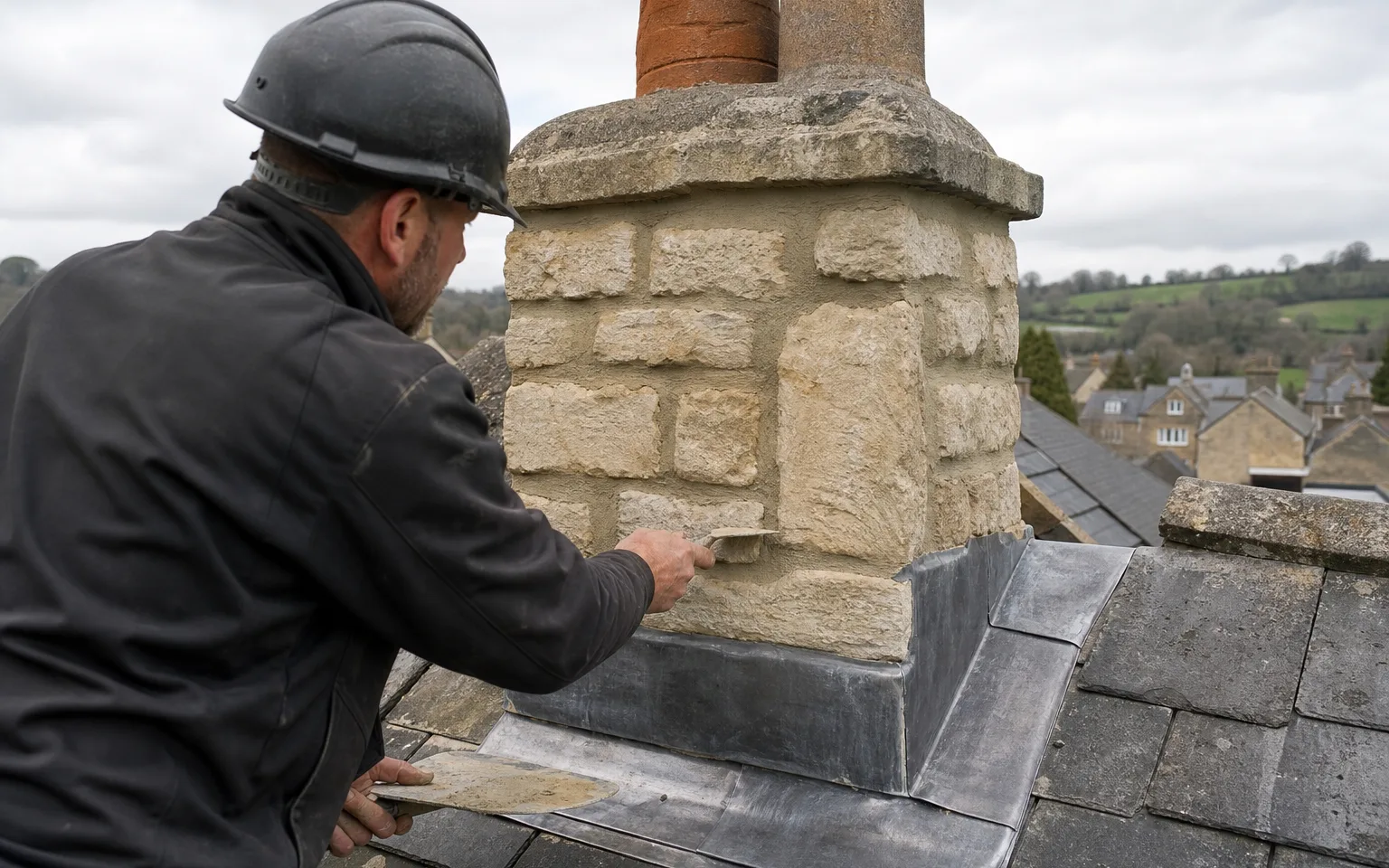
On an old roof the lead usually shows where the water has been.
Chapter 02
Thatched cottages of 1925 and a 17th-century Glebe Farm
Around every thatched roof there is slate, tile, lead and brick that still needs a roofer.
Chapter 02In this chapter
The three thatched cottages at Upper Stanton date from 1925, and they stand among much older buildings. Glebe Farm is apparently seventeenth-century, which makes it the oldest house in the village. Together they show the range a roofer meets in this one parish: a house of several centuries, a cottage row that is a century old, and plain 1950s semis, with every one of them reachable on foot from the next.
Thatching is a craft of its own, and our work begins where the straw stops. That means the stack rising through the ridge, the flashing where a slate or tiled extension meets a thatched wall, the porch, the outbuilding, the gutter on the next roof along, and the bargeboards and brickwork around them. Next to thatch those details count for more, because water shed from a hard roof onto straw, or a flashing that has let go beside it, soaks the thatch in the wrong place.
Chimney stacks beside thatch
A stack is a flue and a weather joint at once. Crumbling pointing, a leaning pot, a broken flaunching (the mortar crown that fixes the pots and throws water clear), and a split lead tray all show only from close range, and from the road a stack can look true when it is not. We climb to it, photograph every face and list what we find. MyBuilder's 2026 guide gives about £750 on average for chimney repointing, within a range of £500 to £2,000, and £2,000 to £10,000 or more for a rebuild. The chimney repairs page explains what moves a job up or down that range.
Old frames and the farmhouse of about 1830
The stone farmhouse of about 1830 at Lower Stanton, and a house as old as Glebe Farm, are both likely to carry roof timbers that have shifted and been mended over the years. The method is the same on each. Establish what the covering really is before choosing the repair, keep to like for like, and never lay a heavier covering on an old frame without a check. The Planning Portal puts the threshold at a covering 15 per cent or more heavier than the one it replaces, which needs approval, and recommends getting a structural engineer or a surveyor to look first.
The roofer's job around thatch is everything that sheds water onto it.
Myth: If a chimney stack looks straight from the lane, it must be sound.
Fact: Cracked pointing, a failing flashing and a loose crown only show up close, which is why the survey climbs to the stack and photographs every face.
Chapter 03
Valetta Gardens and Newbourne Gardens
Two post-war estates, seventy-odd years old, are reaching the point where whole roofs are in question.
Chapter 03In this chapter
Valetta Gardens was built in 1950 and 1951 for RAF Hullavington, and gave Stanton St Quintin 43 houses at a stroke. Newbourne Gardens followed in 1954 with 20 council houses. Homes put up together share a roof design, an age and a set of weak spots, so when the covering on one is tired, the rest of the road is probably not far behind.
In this chapter
At seventy years old the question for these houses is often repair or replacement. A spot repair suits a roof with a handful of slipped tiles or one failed flashing, and MyBuilder's 2026 figures put minor repairs at £100 to £300 and moderate ones at £500 to £1,000. When battens have softened, the underlay has perished and the covering is giving way in many places, repairs become a string of small bills with no end, and a full new covering becomes the saner figure. MyBuilder's 2026 guide puts a typical UK re-roof at £5,000 to £12,000, gable roofs towards the lower end and hipped ones higher. The figure that matters is the one on your own written quote, written once we have been up and looked.
Where the regulations draw the line
The Planning Portal sets the limits for re-roofing: under 25 per cent of the building envelope and under 50 per cent of the roof, and approval is not normally needed. Go past them and approval is needed, and extra loft insulation may be part of the bargain. We tell you early which side of that line your job lies on, and we handle the notification if one is due. The roof replacement page follows a full strip and re-lay stage by stage.
Insulation while the roof is open
A re-roof is the best moment to improve the loft insulation, because the roof is already open. VAT Notice 708/6 zero-rates the installation of insulation in a home up to 31 March 2027, and a 5 per cent rate is due after that. General roofing work is standard-rated, so your quote will show VAT, and the insulation is treated correctly for VAT.
- 43houses built in Valetta Gardens in 1950 and 1951 for RAF Hullavington
- 20council houses built in Newbourne Gardens in 1954
- 1925year the three thatched cottages were built at Upper Stanton
Keeping the road in step
With houses built as a group, neighbours often want to re-roof as a group. A shared scaffold is one cost that can be split between households, and matching tiles keep the estate looking as it was laid out, which neighbours on a row often appreciate. Afterwards we clear the site and take away the waste. A 10-year guarantee on our workmanship is given in writing.
Map showing Stanton St Quintin and the Stroud service radius, with nearby towns we also cover.
Near Stanton St Quintin
Roof work we do here
Valetta Gardens, a thatched trio and St Giles
A neighbour's cottage is thatched and my slate extension sits beside it. Can you work without disturbing the thatch?
Yes, with planning. We shield the thatch side from debris and run-off, and check the flashing where the two roofs meet, since that join is the usual cause of trouble. The scaffold layout is agreed at the survey, with the neighbour told in good time, and the day itself is then free of nasty surprises. If a party wall or a shared gutter is involved, it is written on the quote instead of discovered on site.
Who gives the go-ahead for repairs to the roof of St Giles in Upper Stanton?
For a church in use, the diocese grants a faculty, rather than Wiltshire Council granting listed building consent. Our survey of the roof can be priced section by section, giving the parish a set of figures and photographs to attach.
My Valetta Gardens house was built for the RAF in 1950. Can I re-roof in a different tile?
You can, but two checks come first. A covering that adds weight can trigger a structural check and Building Regulations approval. Separately, Wiltshire Council's planners can say whether a visible change on your street needs permission.
Does living in the Stanton St Quintin conservation area mean the roof is off limits?
No. A repair in matching material is normally ordinary maintenance. Wanting a different material, or living under an Article 4 direction, is the cue to ask the planning team first. A short call beats a letter from the council later.