
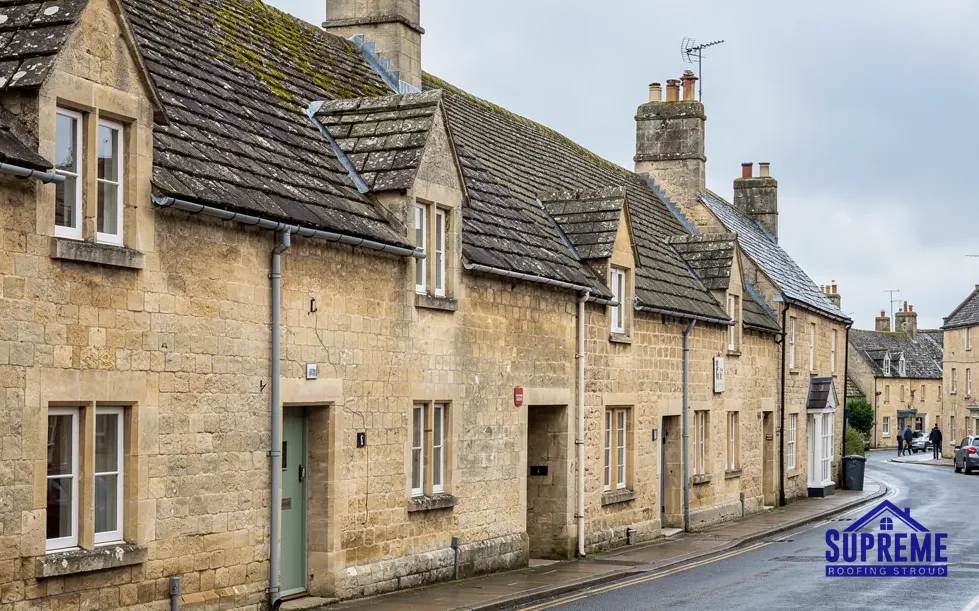
Roofers in Old Sodbury
Roof work at the foot of the Cotswold escarpment, in a village older than Chipping Sodbury, with a Grade II* church and farmhouse and a hillfort on the ridge above.
Old Sodbury at a glance
- Distance
- 18.5 road miles south-south-west of Stroud
- Council
- South Gloucestershire Council
- Listed landmark
- Church of St John the Baptist and Home Farmhouse, both Grade II*
- Setting
- Foot of the Cotswold escarpment, in the River Frome valley
Roofs under the escarpment between the Frome and the Cotswold Edge
Old Sodbury lies in the valley of the River Frome, just below and west of the Cotswold escarpment, between Chipping Sodbury and the Cotswold Edge, and on the Cotswold Way. From Stroud it is 18.5 road miles, heading south-south-west. This is the Frome that runs towards Bristol, not the Stroud one our own town sits on, so anyone searching the map should check which river they have found.
The village is older than its neighbour. Its name comes from the Anglo-Saxon Soppanbyrig, meaning Soppa's fort, and Domesday Book of 1086 records it as Sopeberie. On the escarpment edge north-east of the village an Iron Age hillfort encloses 11 acres. Those dates are far older than any roof you can touch, but they set the scale: a place with this long a history carries buildings of many ages, patched and re-covered along the way.
Two buildings in the village are listed Grade II*: the parish church of St John the Baptist, which is late Norman or Transitional, and Home Farmhouse. South Gloucestershire Council handles listing and planning enquiries, and Old Sodbury is not one of the district's conservation areas, so listing is the question that matters for an older house. For everyday jobs, the point to hold on to is that old roofs rarely have a standard answer. Each one is read on the day, with its timbers, its fixings and its neighbours in view.

Detached red brick Edwardian house with mock-Tudor gables and a tiled roof 
Stone terraced houses with slate roofs and chimneys stepping up a hill
Chapter 01
Home Farmhouse, its outbuildings and what listing covers
A listed farmhouse sits among barns, stables and sheds, and each may have its own status.
Chapter 01In this chapter
Home Farmhouse is listed Grade II*, and a listing protects the whole building, not only the front. The law that governs listed buildings makes it an offence to carry out work that would affect a building's special character without authorisation. For a roof, that includes the covering, the structure beneath it, the chimney stacks and the lead. Like-for-like repair is the easiest case to argue, but it still has to be described properly, and a lazy description is what slows a decision down.
In this chapter
The more difficult question is the outbuildings. A farmhouse seldom stands alone: there may be a barn, a stable, a cart shed or a dairy, and whether they share the house's protection depends on their history and their relation to it. The sensible course is to ask the conservation team whether a barn or shed counts as part of the listing, rather than assume. South Gloucestershire Council is the body to ask here. We would rather find out before the scaffold goes up than discover a problem halfway through a re-roof.
Farm roofs of a different kind
Agricultural roofs have their own problems. Large spans, long runs of gutter and a mix of old and new sections are typical, and sheeting added in the last century may contain asbestos cement. Under HSE guidance, lifting intact asbestos cement sheet carefully, without breaking it, is non-licensed work, while sheeting that is heavily damaged becomes notifiable. First we test which category the material falls into, then we explain the removal and the disposal route. We claim no licence. MyBuilder puts a single garage roof removal at £350 to £1,295 and a double at £650 to £1,800 (2026), and an asbestos survey at £50 or more.
When the old sheets come off, something has to go on. Replacing a garage roof typically costs £2,500 to £4,500 for a pitched one (MyBuilder, 2026), and a flat one £700 to £1,000 for a single garage. The choice depends on pitch, use and whether the building is attached to anything protected.
A farm is also a working place, so deliveries and scaffold are planned around animals, machinery and gateways. The pattern we follow is the same for house and outbuilding: survey with pictures, a written description of what is there, a proposal that says what changes and what does not, and then a written quote. Our pitched roofing page covers coverings, battens and underlay for a full re-cover, and the written guarantee for our work is 10 years.
A listed farmhouse and the shed beside it may not share the same rules.
Chapter 02
Soppa's fort, a Domesday name and the age of the timbers
In a village recorded in 1086, the roof frame is often the oldest thing the covering has to protect.
Chapter 02In this chapter
The name Old Sodbury began as Soppanbyrig, Soppa's fort, and Domesday Book of 1086 has it as Sopeberie. It is older than neighbouring Chipping Sodbury, and so are many of the structures people live in. The practical point for a roofer is not the date but what the date implies: a house that has been altered across several centuries often has a roof frame assembled from different periods, with old oak, later softwood and modern repairs side by side.
In this chapter
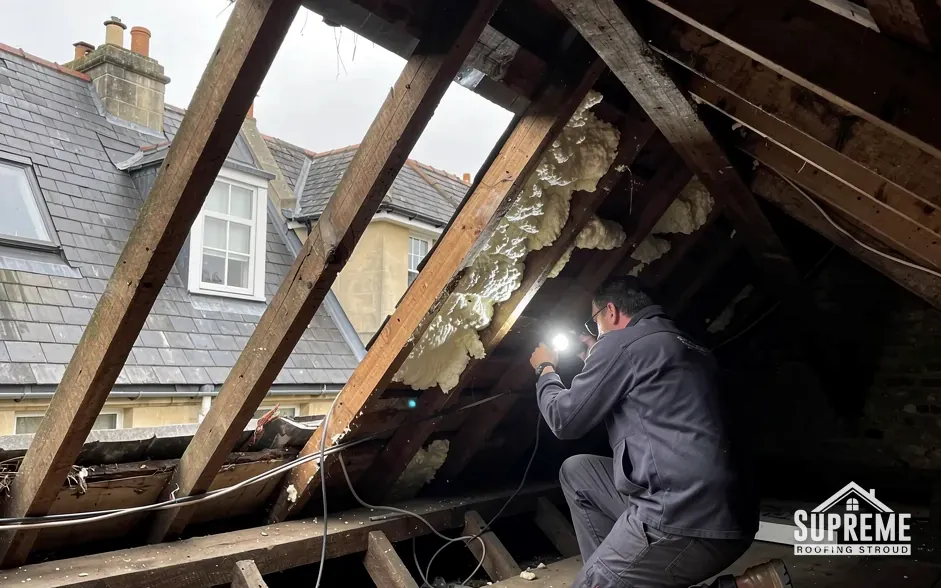
That mix needs reading before anything is laid on top of it. We go into the roof void, look at wall plates, rafter feet and purlins, and note where timber is damp, split or insect-damaged. A covering is only as secure as the battens and rafters under it. If the frame needs repair, that is priced before the covering, because laying new slate or tile on a failing structure is a waste. Where the covering is heavier than what it replaces, a structural check follows under Approved Document A.
Ventilation, insulation and spray foam
Old roof voids need to breathe. BS 5250 guidance, as Marley sets it out, calls for continuous eaves ventilation behind a non-breathable underlay, and much less behind a breathable one with a sealed ceiling. Old ceilings are rarely sealed, so the choice is made from what we see overhead.
- 1086Domesday Book records the village as Sopeberie
- 11 acresarea enclosed by the Iron Age hillfort on the escarpment edge
- Grade II*listing of both St John the Baptist church and Home Farmhouse
In some older roofs, foam has been sprayed onto the underside of the slates or tiles. RICS issued guidance for consumers in March 2023, warning that poor installation can cause dampness and that on a listed building it is unlikely to gain consent. Today's Conveyancer, reporting a BBC investigation in November 2024, said some lenders were declining mortgages on homes with spray foam, while others looked at each case individually. Check with your own lender and insurer. MyBuilder puts removal at £20 to £50 per m², averaging about £1,500 (2026). Our spray foam insulation removal page explains the assessment.
Thermal rules apply when a roof is renovated: stripping to the rafters and rebuilding can bring in Part L. The survey notes how much of the roof is being renovated, so the Part L position is clear before the job begins.

Chapter 03
Flat roofs and extensions in the Frome valley
Add-ons to old houses and farm buildings often carry flat roofs, and flat roofs reward attention to falls.
Chapter 03In this chapter
Old houses grow. A kitchen added at the back, a utility room, a garage beside the gate: in a village like Old Sodbury these additions often have flat or low-pitched roofs, and they tend to be the part of a property that leaks first. The reason is simple. A pitched roof sheds water by gravity alone, while a flat roof relies on a membrane, its falls and its upstands all being right.
In this chapter
Falls are the first thing we measure. BS 6229 guidance, quoted by IKO and Rockwool, is a design fall of 1:40, which still leaves a finished fall of 1:80 or better once tolerances are absorbed. Below that, water lingers, silt settles and the membrane ages faster. Ponding that lasts more than a day or two after rain is a sign of a roof that has settled or was laid too flat. Outlets matter as much as falls: a clogged outlet or one set above the lowest point of the deck leaves a permanent pool, and upstands at the walls need enough height to stay clear of standing water.
Lifespans depend on the material and how it was laid. Sources disagree, and we treat their figures as ranges. EPDM is cited at 20 to 30 years or more, GRP at 25 to 40, and a felt roof at 10 to 20, depending on workmanship. MyBuilder's flat roof guide puts replacement at £70 to £100 per m² for bitumen felt, £90 to £130 for EPDM and £95 to £150 for GRP (2026). Our guttering, soffits and fascias page covers the rainwater side that goes with them.
Where the extension meets the old wall
The junction between a flat roof and an old stone or brick wall is the weak point. A lead flashing or upstand has to be tucked into the masonry, and old lime mortar crumbles where a hard cement-based repair has been used. We check the joint by hand and note whether it can be raked and re-pointed or needs cutting in properly. On a listed property, any change to this junction needs the same care as the roof itself.
Where an extension adjoins a farmhouse, the choice of covering also affects how it looks from the lane and the footpath. Some owners prefer a green or sedum finish, others a plain membrane, and we explain the alternatives and quote for whichever you choose.
A flat roof survey takes less time than one for a pitched roof, but it is worth doing before the first leak rather than after. The written report shows the falls, the condition of the upstands and outlets, and how long we think the covering has left, as a typical range and never as a promise.
Map showing Old Sodbury and the Stroud service radius, with nearby towns we also cover.
Near Old Sodbury
Roof work we do here
Home Farmhouse, St John's and the ridge hillfort
Home Farmhouse is Grade II*. Do the barns and sheds next to a listed house need consent for roof work?
It depends on whether they count as part of the listed building. Ask South Gloucestershire Council's conservation team to confirm each building's status before work. We describe the roof in writing so the question is precise.
My Old Sodbury garage has an old sheet roof. How is asbestos cement removed?
Intact sheets can be taken off carefully as non-licensed work under HSE guidance. Heavily broken sheeting is notifiable. We assess the sheets first. The quote then covers how they come down, where they are taken and what replaces them.
Will spray foam in the loft of an older house affect a sale or a mortgage?
It can. RICS published a consumer guide in March 2023, and a November 2024 report on a BBC investigation said some lenders were declining it, with others judging each case. Speak to your lender and insurer before deciding, and keep their answers in writing. The survey can record the foam and its extent so the conversation has facts behind it.
Do you survey the roof frame, or only the covering?
Both. We go into the roof void to read rafters, wall plates and purlins, because new slate or tile on failing timbers is wasted money. Any structural repair is priced before the covering.