

Roofers in Nettleton
Roofers in Nettleton, where two brooks meet at the head of the Bybrook valley and the parish spreads across Burton, West Kington and a string of small hamlets.
Nettleton at a glance
- Distance
- 20.1 road miles south of Stroud
- Council
- Wiltshire Council
- Setting
- Head of the Bybrook valley
- Parish
- Includes Burton and West Kington
Nettleton's roofs: two brooks, six settlements and one chapel from 1823
Nettleton is a Wiltshire village on the Cotswolds' southern side, and its shape is set by water. The Burton Brook and the Broadmead Brook meet on the eastern boundary of the parish and join to form the Bybrook River. A roof here is never far from a stream, a ditch or a wet lane, and that colours how we think about gutters, ground levels and anything that touches the foot of a wall.
The second thing to know is that Nettleton is not one compact village. The parish takes in the villages of Burton and West Kington, plus the hamlets of Horsedown, Nettleton Shrub and West Kington Wick. Burton and Nettleton were separate parishes until 1934. So a customer who says they live in Nettleton may be on a lane in any of those places, and the roof, the access and the neighbours can differ a good deal from one to the next.
The Domesday Book recorded 24 households at Nettleton in 1086, so people have lived here a very long time, though no roof from that date has come down to us. What we meet on site are the later layers: farmhouses, cottages, outbuildings, a church and a chapel, each with its own history of repairs.
The covering of any particular roof is something we establish on site. Two public buildings stand out in the record: the parish church, St Mary's at Burton, which is Grade I listed, and a Baptist chapel that has operated in Nettleton since 1823. Between them they show a place with older public buildings as well as houses, and we treat any roof we are asked to look at as a fresh survey rather than a repeat of the last.

Stone terraced houses with slate roofs and chimneys stepping up a hill 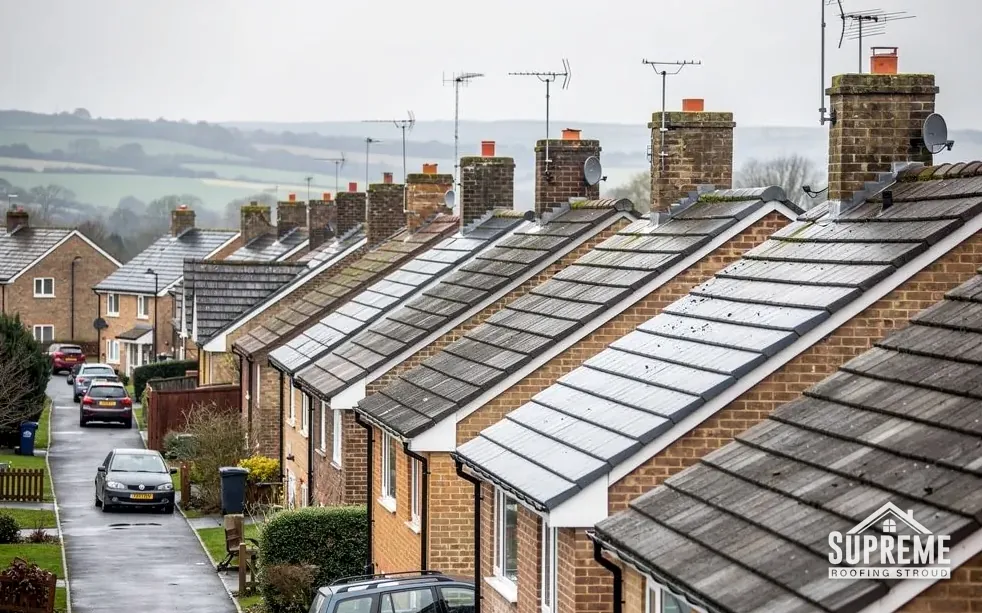
Terraced houses on a hillside street with tiled roofs and brick chimneys
Chapter 01
Burton Brook, Broadmead Brook and the water that reaches Nettleton's gutters
Where two streams meet, rainwater has to leave the roof and keep going.
Chapter 01In this chapter
From Stroud it is about 20.1 road miles south to Nettleton, and the parish boundary is where Burton Brook and Broadmead Brook come together to form the Bybrook River. The map makes a plain point. Water arrives from higher ground, passes through, and leaves along the brooks. A house in that sort of setting needs its roof water carried clear, because ground that is already wet will not take more.
That is why a Nettleton survey spends as long on the drainage side of the roof as on the covering. We start at the eaves. Is the gutter running to a fall, so water drains to the outlet rather than standing? Manufacturers typically recommend a gentle fall, between about 1:600 and 1:350 depending on the system. Are the brackets spaced evenly, and is any bracket loose or missing? Are the joints sealed, and does the downpipe discharge somewhere sensible? When a downpipe empties straight onto the footing, the lower courses of the wall take on moisture all winter.
Leaves and moss are the ordinary enemies. A gutter that is blocked by autumn debris overflows behind the fascia, wets the rafter ends and the soffit, and lets rot start where nobody can see it. Our guttering, soffits and fascias page gives the typical national price ranges for replacing these parts, and a survey tells you which of them actually need it.
If you suspect a roof problem but cannot reach the roof safely, a roof inspection and survey is the sensible first step. We climb up, take pictures of the covering and its edges and junctions, and write up what we see. The report separates urgent faults, such as a slipped tile over a bedroom, from things that can wait until spring. If a leak is active, we prioritise making it safe first and quote the permanent repair afterwards.
Moss is another thing to look for on shaded roofs near trees and water. A light covering can be scraped by hand, and MyBuilder puts manual scraping at £5 to £10 per m². Left alone, thick moss holds water against the tiles through the winter and can push them out of line. We note it on the survey, but we only suggest cleaning where the covering will tolerate it.
A roof by a brook has to shed its water well clear of the walls.
Chapter 02
Horsedown, Nettleton Shrub and West Kington Wick: roofs spread across a parish
A scattered parish means the access plan is part of the quote.
Chapter 02In this chapter
Few villages are described as a cluster of settlements, but Nettleton is. Besides the villages of Burton and West Kington, the parish includes the hamlets of Horsedown, Nettleton Shrub and West Kington Wick. Roofers get used to lanes that end in a farm gate or a gravel drive, and a parish like this has plenty of them. Our first questions on the phone are practical ones. Which settlement are you in? How wide is the lane? Is there a place to stand a lorry, or will every load have to be carried in by hand?
Access shapes the work more than people expect. A scaffold needs firm, level ground along the wall it serves, and on a lane edged by a ditch or a brook bank that can mean boards, extra legs or a lower working height at one corner. Delivery of tiles, battens and underlay on a pallet depends on whether the lorry can turn. Where it cannot, the materials are unloaded at the nearest wide spot and moved in by hand or by small barrow. All of this adds hours, and the hours are priced up front under access, and never added later as a surprise.
The same goes for the waste. An old covering weighs a lot once it is stripped, and carrying it down a long drive takes longer than dropping it in a skip at the door. We tell you where the skip will go and how the stripped material leaves the site, and at the end the yard or drive is left tidy, with the old covering gone from site.
Households in different hamlets often hire the same roofer in the same fortnight to save on scaffold and travel time. We are happy to look at neighbouring roofs on one visit where the owners agree, and we price each house separately so nobody pays for work on someone else's roof.
Burton and Nettleton stayed separate parishes until 1934, a reminder that old boundaries still shape how people say where they live. For our purposes the question is simpler: what is on top of the building, and how do we reach it? Send a few photos that show the roof from lane level and from the garden, say which hamlet you are in, and we can usually tell you what we will need to bring before we visit.

Chapter 03
St Mary's at Burton and a Baptist chapel older than the railways
Church and chapel roofs come with their own permissions and their own quirks.
Chapter 03In this chapter
The parish has two community buildings of note: the church of St Mary at Burton, listed Grade I, and a Baptist chapel that has operated in Nettleton since 1823. What we can say is how roof work on buildings like these is organised, because it differs from a house.
Churches still used for worship fall under the ecclesiastical exemption. For a Church of England church in use, that means roof work is authorised by a faculty granted through the diocese. That is the route for St Mary's at Burton, the Grade I parish church, where the diocese's advisory committee normally looks at the proposed method before a faculty is granted. The council's listed building route does not apply to a church in use. A chapel is another matter, because the exemption turns on the denomination and on current use. Once a chapel is converted or no longer in use for worship, it stands outside the exemption and, if listed, the council's consent applies. So the first call is to the person who looks after the building, whether that is a churchwarden, a trustee or the new owner.
Technically, the roofs raise their own questions. A chapel from the early 19th century will often have a wide span, a simple pitched roof and a gutter running along a long wall. A wide span puts weight on the roof timbers, and a long gutter run means water leaves in volume, so we check the outlets and the junction between the main roof and any porch or vestry. Lead flashings around a bellcote or a chimney are common failure points, since lead lasts a long time but can crack where it is poorly dressed. For lead flashings, Leadworx calls Code 4 the standard general choice, with thicker Code 5 used where more strength is wanted.
Most of this work is in the territory of commercial roofing, even where the building is small. Committees want clear figures, so the quote covers every stage, starting at the scaffold and ending with making good. Photographs from the survey go to the whole committee, so everyone sees the same evidence, and we give the guide prices before a visit so the discussion starts from known ranges.
Both buildings remind us that village roofs are shared assets. A leak over a hall or a vestry affects the whole congregation, and a quick make-safe followed by a properly planned repair is better than a rushed patch. Our workmanship is guaranteed for ten years, and the guarantee is written down, which is useful to a committee that has to account for its spending.
Map showing Nettleton and the Stroud service radius, with nearby towns we also cover.
Near Nettleton
Roof work we do here
Bybrook valley hamlets and the 1823 chapel
My house is down a lane in Nettleton Shrub. Can a scaffold and delivery lorry reach it?
Usually, but we check at the survey. Narrow lanes, ditches and soft verges decide where the scaffold stands and where the lorry unloads. If materials have to be carried in, that handling time is allowed for in the quote.
Does Nettleton have a conservation area that affects my roof?
Nettleton village itself has no conservation area, but West Kington, within the parish, has its own. Individual buildings can also be listed, so confirm your own address with Wiltshire Council's planning team before major changes.
Will you quote for a chapel roof in the parish as well as for houses?
Yes. We survey the building, photograph the roof for the committee and write the quote for the work. Whether the route is a faculty, listed building consent or neither depends on the denomination, any listing and whether the chapel is still in use, so that is the first check.
Why does a roof near a brook need its gutters checked first?
Wet ground cannot absorb much extra water. If a gutter leaks or a downpipe discharges at the wall base, the masonry stays damp. We check falls, brackets, joints and outlets before suggesting any work on the covering.