

Roofers in Marshfield
Roof work in Marshfield, where a market village of local stone has a conservation area, a Grade I church and 1612 almshouses to respect.
Marshfield at a glance
- Distance
- 22.8 road miles south-south-west of Stroud
- Council
- South Gloucestershire Council
- Conservation area
- Marshfield, designated 17 September 1973
- Listed
- Parish Church of St Mary, Grade I
Marshfield's roofs, from the 1234 market to the stone frontages
Marshfield sits at the southern end of the Cotswold Hills, on the borders of Wiltshire and Somerset, and it was a market place long before it was a quiet village. It gained market status in 1234, and fairs were first held in 1266. Wikipedia describes buildings that are eighteenth-century, with several from the seventeenth, their facades unified by the consistent use of local stone. Part of the old prosperity came from malting, as well as the wool trade.
For a roofer, a place with that history raises one question ahead of the others: how much of what you can see is original, and who has a say over it? The Marshfield Conservation Area was designated on 17 September 1973. Marshfield's St Mary's carries a Grade I listing, and the Crispe Almshouses and their chapel (1612) are Grade II*. A house in the old centre may therefore sit under two layers of control, one covering the area and one covering the building itself.
That is why a Marshfield roof is rarely a quick quote. We begin with a survey that records what is up there, identifies what it is made of, and checks the status with South Gloucestershire Council before any covering or ridge detail is proposed. Every figure we then give is in writing, so nothing is left vague.

Stone terraced houses with slate roofs and chimneys stepping up a hill 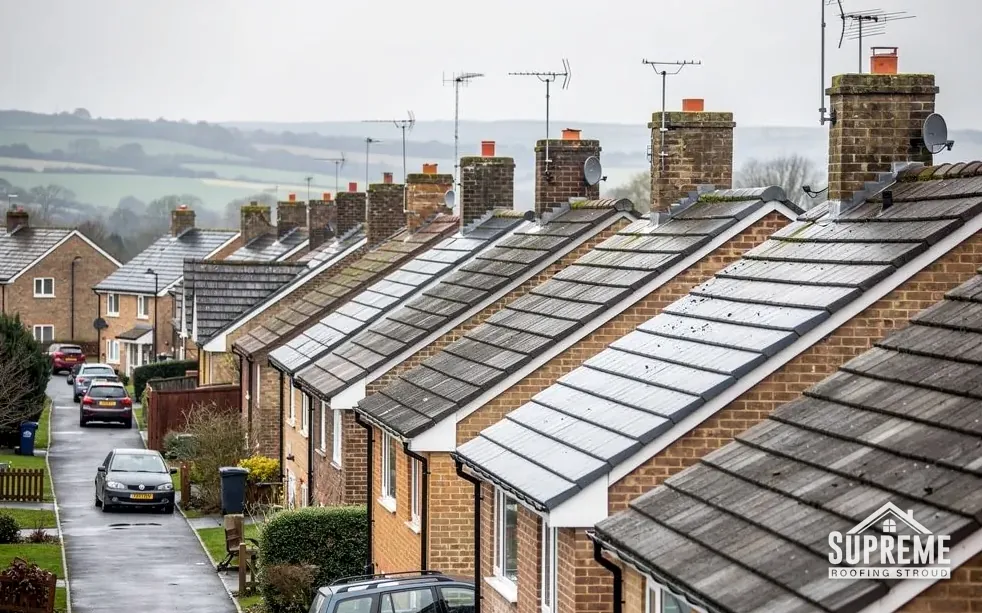
Terraced houses on a hillside street with tiled roofs and brick chimneys

Chapter 01
A market charter, a fair and the stone frontages
A village that traded from 1234 left a street scene that its roofs help to hold together.
Chapter 01In this chapter
When a village looks like one piece, it is usually because its roofs and walls agree with each other. The consistent use of local stone is what makes Marshfield's facades read as a set, and the roofs above them carry a share of that effect. A replacement that changes the colour, texture or line of the roof is seen from the street at once, which is the first reason we match the material already there rather than swapping it.
In this chapter
If your roof is stone slate, a few traditions are worth knowing before a quote lands. Cotswold District Council's 2000 guidance describes diminishing courses, with the biggest slates at the eaves (cussoms, normally around 600 mm long) and the shortest slates up near the ridge. It gives the traditional straight pitch as 47 to 55 degrees, and it records wooden pegs, usually cleft oak, as the fixing. That guidance belongs to a neighbouring district, so we treat it as an account of the craft rather than a rule for Marshfield. Our Cotswold stone roofing page goes through the method in detail.
Weight matters as much as looks. Stone slate is heavy, roughly 1000 kg per 10 sq m by the same guidance, so changing to or from it alters what the rafters must carry. The Planning Portal flags approval where a new covering raises the load by 15 per cent or more, and a lighter replacement is a different question from a heavier one. We ask about the structure before proposing a change of material in either direction.
New slates or old
English Heritage policy, reproduced in that 2000 guidance, prefers new stone slates over second-hand ones, and holds that any reclaimed slates should go back only onto the roof they came off. It also rules out swapping sandstone for limestone slates or the reverse, and calls fibre resin and reconstituted copies unsuitable for historic buildings. We follow that reasoning when a stone roof in the village needs patching. Salvaged slates from the same roof are sorted and re-used where sound, and matching new ones are sourced for the gaps.
What a repair looks like
Slipped and perished slates are the common fault, along with failed pegs. Fixing a roof like this by hand, slate by slate, costs more per metre than a modern covering, yet it keeps a roof going far longer than replacing it wholesale. Our roof repairs page explains how we separate a repair that will hold from one that only delays the reckoning.
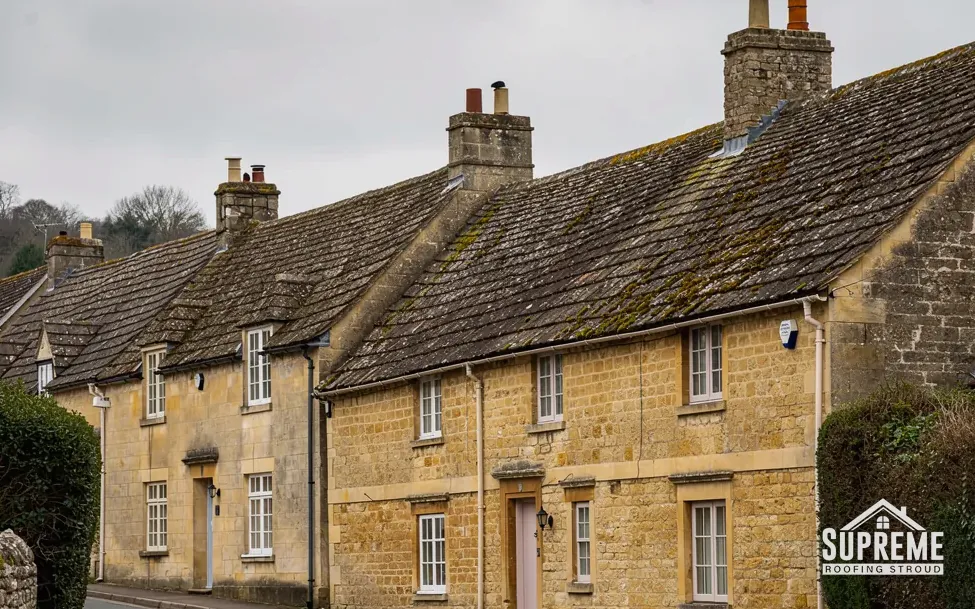
In a village built in one stone, a roof that does not match shows from the far end of the street.
Myth: A stone-walled village can be re-covered in any tile that looks close enough from the road.
Fact: Heritage policy quoted by Cotswold District Council in 2000 calls artificial substitutes inappropriate on historic buildings, and a conservation area makes the colour and texture of a covering a planning question.
Chapter 02
Crispe Almshouses, a Grade I church and the 1973 boundary
Three kinds of protection overlap here, and each changes who must agree before work starts.
Chapter 02In this chapter
Marshfield's recorded heritage is unusually well defined. St Mary's church is Grade I. The Crispe Almshouses and chapel, dated 1612, are Grade II*. Historic England list entries 1129438 and 1302631 cover them, and the conservation area around them was designated on 17 September 1973. Each designation does a different job, so it helps to separate them.
In this chapter
Where consent is needed, the officers reading an application want to see what exists and what is proposed. Our survey photographs of your own roof, slope by slope, and a scope that names the material give them something concrete to read. Applications that arrive with vague descriptions such as repair roof invite questions and delay, and a roof with a leak does not wait politely for the answer.
Listing protects a building. Stroud District Council's guidance makes the point that every grade of listing covers the entire building, interior and exterior alike, and the same national law applies in South Gloucestershire. A conservation area protects a place, and works that change the character of the area are looked at more closely. A church still used for worship is treated differently again, and its roof work is authorised by faculty from the diocese rather than by the council. A chapel is a separate question. Whether it is in worship use is what decides which route applies, and we do not guess; we ask the owner and the council. Where the building is a home, we also ask who holds the freehold, because an almshouse or any shared building may need agreement from more than one party before scaffold goes up.
For an ordinary house in the conservation area, a straight re-cover in the same material normally stays outside planning, because work that leaves the outward appearance of a building as it was does not count as development. Councils can however withdraw permitted development rights in an area through an Article 4 direction, so whether one covers your address is something to ask South Gloucestershire Council. The answer comes from the council, and it should come before you accept a quote, not after the scaffold goes up. Whatever the outcome, our workmanship on the job carries a 10-year guarantee, given in writing.
Lead on old buildings
Almshouses, chapels and churches tend to have lead at the junctions, valleys and parapets that keep water out. Leadworx lists Code 4 as the usual general flashing choice, and Checkatrade's repair guide prices a metre of lead flashing repair at £50 to £70, and stepped flashing in Code 5 at £80 to £120, both excluding VAT. Our lead roofing page explains codes, lengths and why lead wears out at its joints.
Chapter 03
Malting and wool: when the building began as a workplace
Wool and malt paid for the village, and a property that began as a working building has a working building's roof.
Chapter 03In this chapter
The village's former prosperity came partly from malting, as well as the wool trade. Weir Farm in Weir Lane, with its gables, was once a malting house, and The Maltings at 78 High Street keeps the trade in its name. What follows is what a roof with a working past tends to ask of its owner, if yours began as a store, a barn or an outbuilding and is now a home.
In this chapter
Such buildings usually have simple, large roofs: a long ridge, deep eaves and timbers that were never meant to be seen. Turning one into a home brings in rules the original builders never had to meet. If a roof element is stripped to its structure and rebuilt, or more than half of its surface is renovated, Approved Document L expects the whole element to reach a U-value of 0.16 W/(m²·K), with a lesser standard allowed where it would cost head room. A new element has to meet 0.15.
Ventilation matters just as much. BS 5250 guidance as read by Marley asks for continuous eaves ventilation of 10 mm on pitches above 15 degrees with a non-breathable underlay, and a high-level 5 mm gap on pitches over 35 degrees. A stone-walled building with a steep roof often meets that second test, and we design the ventilation path before the insulation goes in. Putting insulation into a home's roof space carries no VAT until 31 March 2027, while the rest of the job is standard-rated; the quote states which is which.
What it costs to cover a roof in slate or stone
Typical UK ranges, from national cost guides, are published here so you can set them against our written quote. Checkatrade puts stone slate at about £160 to £210 per m², and says the spread depends on the slate's origin, new or reclaimed supply, and your region. MyBuilder gives £100 to £180 per m² for slate generally. These are national figures, not Supreme prices. Once we have surveyed, the quote covers access, stripping, new material, labour, rubbish removal and repairs to the fabric.
- Spanish slate£100 to £130 per m²
- Welsh slate£140 to £180 per m²
- Slate overall£100 to £180 per m²
- Stone slate£160 to £210 per m²
Map showing Marshfield and the Stroud service radius, with nearby towns we also cover.
Near Marshfield
Roof work we do here
The 1234 market, 1612 almshouses and stone frontages
My Marshfield cottage has stone walls. Is the roof stone slate, and does that change the quote?
Local stone on the walls does not tell us what is on the roof, so we confirm it at the survey. If it is stone slate, the quote reflects the extra handling and matching, and the survey photographs show which slates are sound enough to re-use.
Does re-roofing in the same material need consent in the Marshfield conservation area?
A straight re-cover that leaves the building looking as it did is not usually development. Listing, or an Article 4 direction withdrawing permitted development rights, can change that, so confirm your property's position with South Gloucestershire Council first.
What changes if I insulate the roof of a former malting or farm building in Marshfield?
Insulating can trigger thermal standards under Approved Document L if the roof element is renovated at scale, and it needs a ventilation plan under BS 5250. We cover both in the survey, and insulation fitted in a home's loft is free of VAT until 31 March 2027.
Can you work on the lead and stone of a chapel or almshouse roof?
Yes. Our first question is about status: listed or not, and in worship use or not, since the answers decide whether the council or the diocese gives consent. Then the survey records each lead run and stone course, and the quote covers them.